
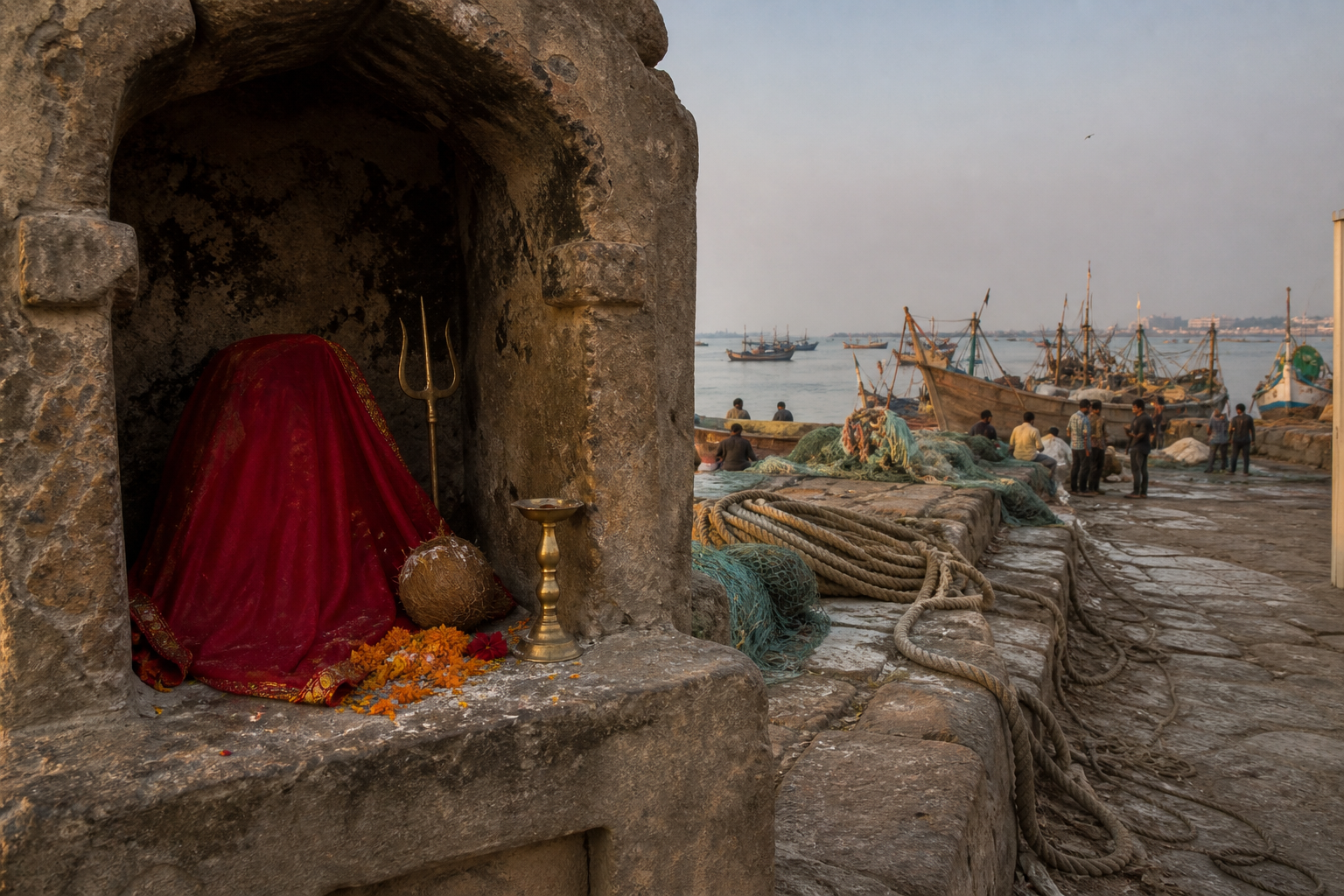
If you encounter Sikotar Maa’s name at a coastal shrine, in a family prayer room, or beside a Gujarat harbor, you may wonder whether she is simply a local sea goddess. That reading is too narrow. Her worship reveals how Shakti devotion entered the working life of sailors, fishing families, traders, and ports exposed to the sea’s uncertainty.
You can understand this tradition without reducing it either to folklore or to a promise of supernatural immunity. Look at what the devotion asks people to do before departure, what it teaches them to remember after returning, and how it joins spiritual trust to practical responsibility.
Begin where solid ground gives way to uncertainty
Sikotar Maa, also venerated as Vahanvati Mata, belongs to the protective and compassionate current of Shakti associated with Devi and Durga. Her particular domain is the coastal threshold: the place where familiar land ends and a vessel enters forces that no individual can command. That setting makes courage necessary, but it also makes humility unavoidable.
This is why the goddess’s protection should not be understood as the cancellation of danger. The sea remains sovereign in the practical sense. Weather, seasonal knowledge, the condition of a boat, the judgment of its crew, and cooperation aboard it still matter. Devotion gives that unavoidable responsibility a sacred frame: faith, skill, and knowledge of the sea belong together.
The iconography makes the relationship visible. A boat places the goddess within the world of actual voyages. An unfurled banner suggests direction, confidence, and a presence carried over the water. A blessing gesture conveys protection and maternal care. When you see these motifs, read them as a single visual statement: undertake the journey bravely, but do not undertake it carelessly.
It is also important not to erase the local form by looking only for an exact match with a better-known pan-Indian image. Sikotar Maa’s alignment with Durga and Devi locates her within the larger theology of Shakti. Her maritime vocation, however, gives that theology a distinctly Gujarati coastal expression. The wider tradition explains the divine power; the local name, symbols, and practices show how a community has learned to approach that power.
The ritual sequence matters more than any single offering
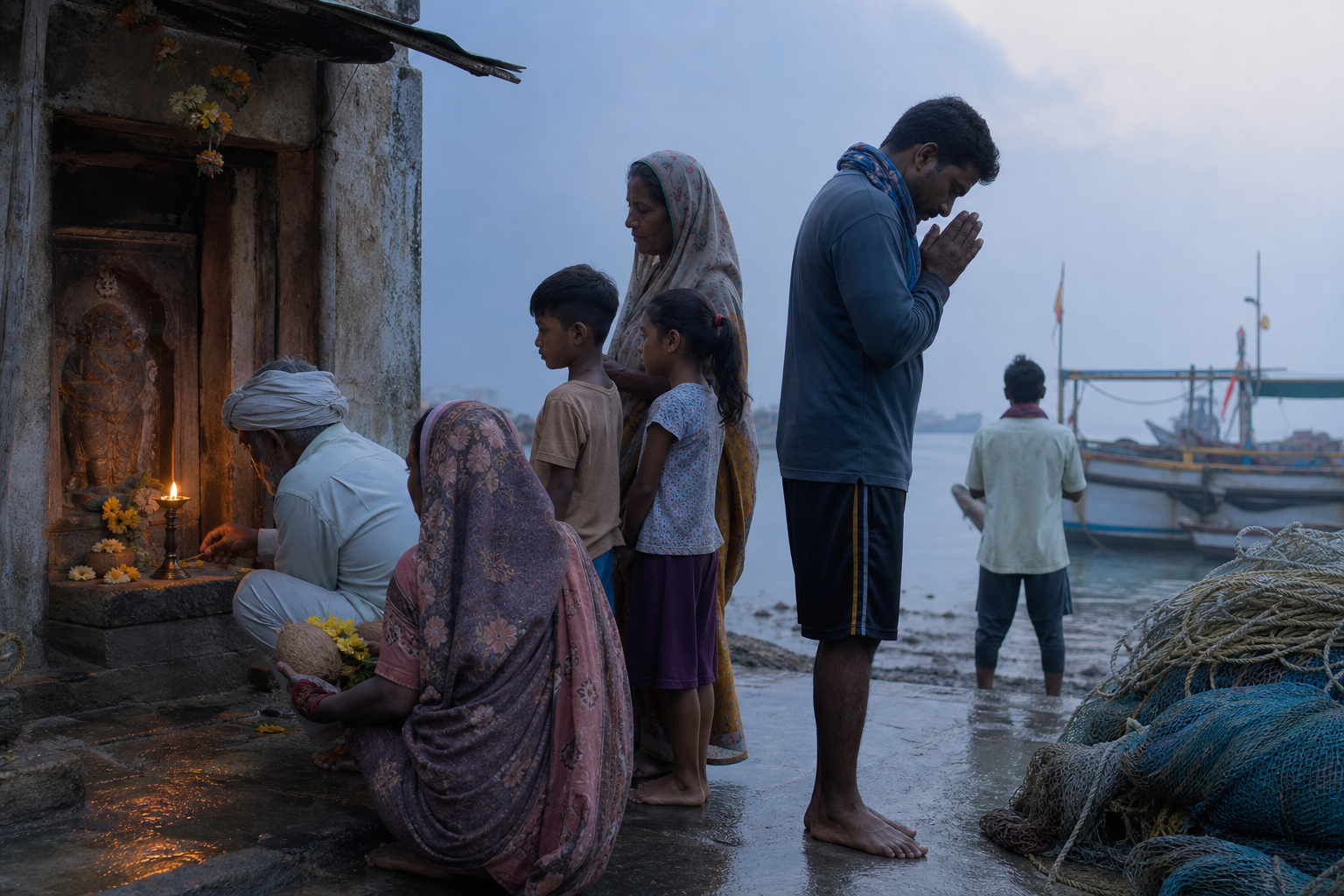
People sometimes notice a coconut, red cloth, incense, or protective thread and treat the object itself as the whole tradition. The deeper meaning appears only when you follow the sequence from departure to homecoming.
- Before departure: Families may present coconuts, incense, and red cloth. The pause acknowledges that a voyage should begin with attention rather than arrogance.
- At the vessel: Protective threads may be tied, while the boat and its mast are treated as bearers of collective trust. A voyage depends on more than the confidence of one person.
- After a safe return: Devotees fulfill vows and offer thanks. Gratitude completes the act that began before departure; it prevents survival from being treated as personal mastery alone.
- During communal observance: Navratri gatherings and Garba near coastal shrines carry maritime devotion beyond individual households. Private concern for a loved one at sea becomes shared memory and mutual support.
Seen in this order, the practice forms an ethic of prudence, dependence, accountability, and gratitude. Prayer prepares the mind to recognize vulnerability. The homecoming vow reminds the devotee not to forget that vulnerability once the immediate danger has passed.
If your family maintains such a practice, preserve the sequence when explaining it to younger generations. Do not hand them only an object and a rule. Tell them what happens before leaving, why responsibility continues aboard the vessel, and why thanks must follow return. That explanation keeps a living discipline from shrinking into an unexplained custom.
Shrines map Gujarat’s working coast, not an imaginary seascape

Sikotar Maa’s maritime identity grew within communities whose livelihoods were tied to fishing, sailing, and trade. Kharwa and Koli groups are especially associated with this devotion across Saurashtra and Kutch. Gujarat’s ports connected local coastal life to extensive Indian Ocean trade, so the risks of departure and the hopes attached to return belonged to both family life and the wider economy.
The placement of shrines makes this history tangible. Sanctuaries and small roadside places of worship appear near jetties and harbor routes in coastal centers including Veraval, Porbandar, Mandvi, and Okha. People can pause during the ordinary movement of boats, crews, nets, and goods. Worship is therefore not removed from work; it is inserted into the route by which work is done.
When you study or visit one of these shrines, four questions will reveal more than a quick photograph:
- Which fishing, sailing, or trading community uses the nearby harbor?
- Do local devotees primarily say Sikotar Maa, Vahanvati Mata, or another locally established form of address?
- Which observances occur before departure, and which belong specifically to a safe return?
- Where are memories of storms, rescues, vows, and homecomings actually told: in homes, at the harbor, in seasonal camps, or at the shrine?
These questions prevent two common mistakes. The first is turning every coastal shrine into an interchangeable example of a generic sea cult. The second is treating oral memory as if it were either worthless fantasy or a complete dated chronicle. Stories preserved by families, fishing camps, and harbor communities carry lived memory and moral meaning. Record them carefully, but distinguish personal testimony from claims that require independent historical documentation.
How to approach the tradition respectfully
A coastal shrine may be a place of worship, a landmark in a working harbor, and a repository of family memory at the same time. Respecting all three functions requires more than following a generic temple checklist.
- Learn the local name first. Ask how devotees at that particular shrine address the goddess. Do not correct a community’s usage to make it fit a simplified account learned elsewhere.
- Let local practice determine the offering. Coconuts, incense, red cloth, and threads are common elements, but their presence does not make every ritual identical. Ask a caretaker or devotee before placing anything in the shrine.
- Keep working routes clear. A jetty is not merely a scenic background. Crews may be moving nets, equipment, goods, or boats. Do not obstruct them for photography or observation.
- Request permission before recording people. A family vow, departure prayer, or homecoming observance is not automatically a public performance. The same rule applies when collecting an elder’s account of a storm or rescue.
- Preserve context with every memory. With permission, note the community, place, family connection, and circumstances in which a story was told. Label it as oral testimony rather than silently converting it into a verified historical event.
- Leave no devotional waste behind. Follow the shrine’s accepted method for offerings and carry away your own refuse. Reverence for a guardian of the sea is contradicted when worship adds avoidable litter to the coast.
This approach lets you participate without turning living devotion into spectacle. It also makes your understanding more accurate. You begin to see the shrine through the relationships that sustain it: goddess and devotee, vessel and crew, household and harbor, memory and place.
Maritime Shakti now demands responsibility for the sea

Harbor life can create solidarity without erasing religious difference. Hindu households may worship Sikotar Maa or Vahanvati Mata, while Jain and Sikh families express gratitude through their own prayers. The shared concern is safety, compassion, and responsibility in an environment where one household’s loss or rescue can affect an entire community.
That cooperation should not be misrepresented as theological sameness. Hindu, Buddhist, Jain, and Sikh traditions retain their own teachings, disciplines, and forms of worship. Their broader Dharmic regard for nature and moral responsibility nevertheless provides common ground for treating the ocean as more than an inert resource.
This point has immediate consequences. A protective maritime tradition loses coherence if devotion is separated from the long-term health of shorelines, fish stocks, and marine biodiversity. Coastal resilience and ecological stewardship are contemporary expressions of the same humility that informs prayer before a voyage: human livelihood depends on conditions that human beings do not fully control.
If you help organize a temple or community observance, connect it with a practical act suited to the place, such as cleaning the approach to a jetty, reducing disposable offering materials, or preserving local accounts of changing coastal conditions. If your family goes to sea, keep devotional preparation alongside experienced seamanship and applicable safety guidance, never in place of them. If you live far from Gujarat, support the preservation of coastal oral histories and responsible marine stewardship rather than reducing Sikotar Maa to decorative imagery.
Key takeaways
- Sikotar Maa, also revered as Vahanvati Mata, is a Gujarati maritime expression of protective Shakti.
- Her worship sanctifies preparedness, cooperation, humility, and gratitude; it does not make seamanship optional.
- The movement from pre-departure prayer to a fulfilled homecoming vow is more important than any isolated ritual object.
- Coastal shrines preserve the working geography and community memory of Gujarat’s fishing, sailing, and trading life.
- Shared concern at the harbor can unite Dharmic communities without requiring them to collapse their distinct traditions.
- Care for the goddess’s maritime domain should now be visible in cleaner shores, responsible offerings, and respect for marine life.
The next time you encounter Sikotar Maa, begin with three acts: learn the name used locally, notice how worship accompanies both departure and return, and leave the coast in better condition than you found it. That is how admiration becomes participation in Gujarat’s living maritime Shakti tradition.
References
