
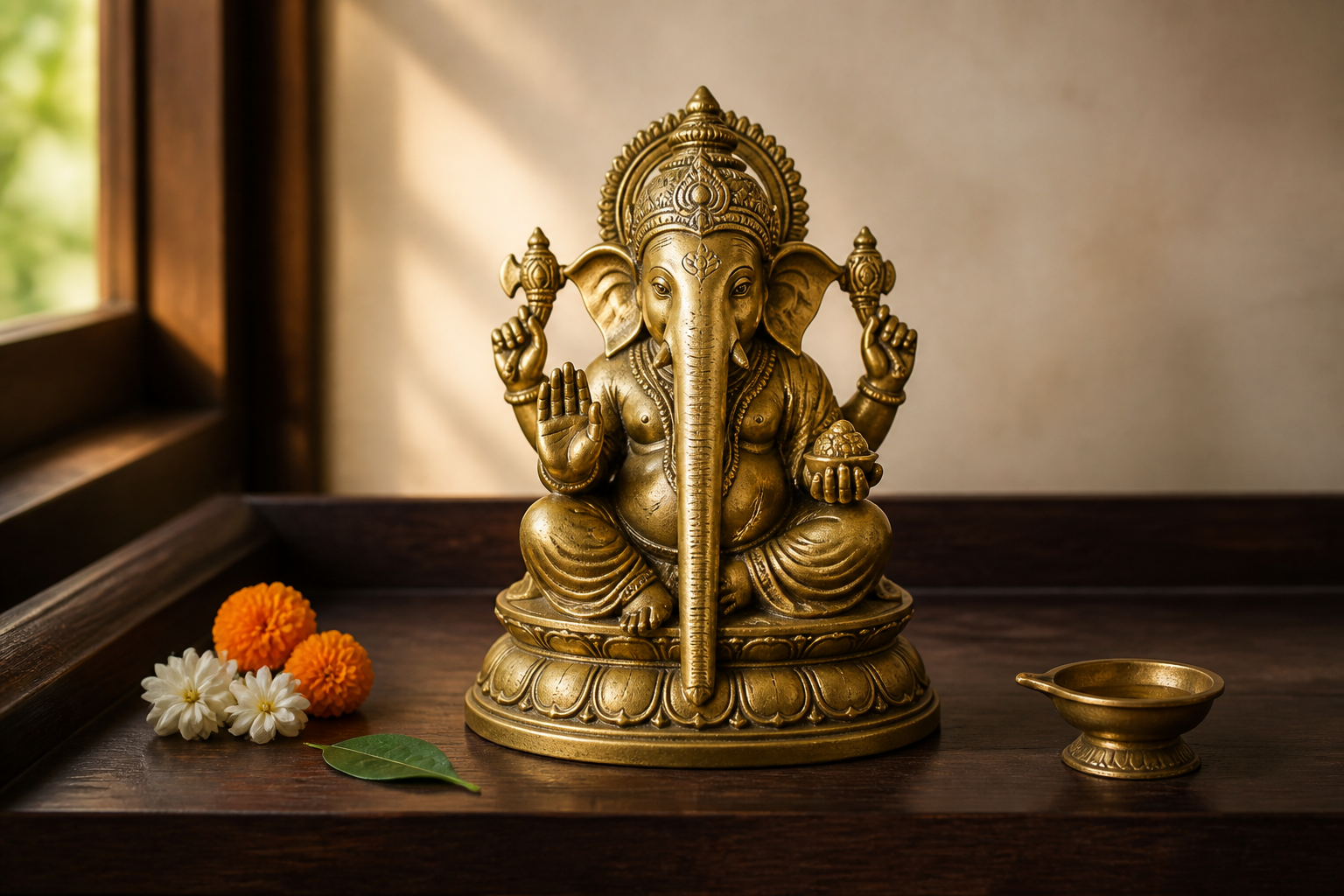
You may be considering a straight-trunk Ganesha murti for your home, meditation space, study, or workplace and wondering whether its unusual form carries special rules. The most useful answer is not that it is more powerful than other forms. Its distinguishing value is the spiritual discipline it places before you: balance your attention, examine your motives, and act without inner agitation.
Choose this form when you want Shri Ganesha to remind you that obstacles are not always circumstances to be conquered. Some are confusion, rigidity, distraction, or hesitation within the mind. A straight-trunk murti becomes meaningful when your worship helps you recognize those obstacles and respond with discernment.
What the straight trunk asks you to notice
Within a widely used yogic interpretation, the straight trunk evokes sushumna, equilibrium between ida and pingala, and the steady awareness cultivated through dhyana. Sushumna is understood as the central channel in yogic anatomy. Ida and pingala represent complementary currents. The centered trunk therefore becomes a visual language for attention that is no longer being pulled helplessly between opposing tendencies.
This is contemplative symbolism, not a claim that the physical shape of a murti automatically changes your inner condition. The image gives you something precise to practice: notice when desire and resistance, haste and fear, or action and reflection are fighting for control. Then recover enough steadiness to choose rather than merely react.
| Trunk form | Common symbolic emphasis | What it can remind you to practice |
|---|---|---|
| Left-turning | Ida, calmness, and domestic auspiciousness | Gentleness and steadiness in household life |
| Right-turning | Pingala and disciplined spiritual rigor | Deliberate observance, restraint, and focused effort |
| Straight | Sushumna, equilibrium, and unitive awareness | Centered discernment before thought becomes action |
These associations are interpretive guides, not a hierarchy of Ganesha forms. A straight trunk does not make a murti spiritually superior, and a left- or right-turning trunk does not make devotion incomplete. Regional customs differ, and your family tradition, sampradaya, or trusted teacher may emphasize another understanding. Ishta remains personal: the fitting form is the one that elevates your mind and refines your conduct.
The straight-trunk ideal also has a recognizable resonance across the Dharmic family. Attentive awareness in Buddhism, self-discipline and right conduct in Jainism, and ethical living joined with remembrance of Oneness in Sikhism all help a person move beyond compulsive, ego-centered action. These paths are not interchangeable, but their shared respect for disciplined awareness helps explain why an image of inner balance can speak beyond one narrow setting.
Let Vighnaharta reveal the obstacle within the obstacle
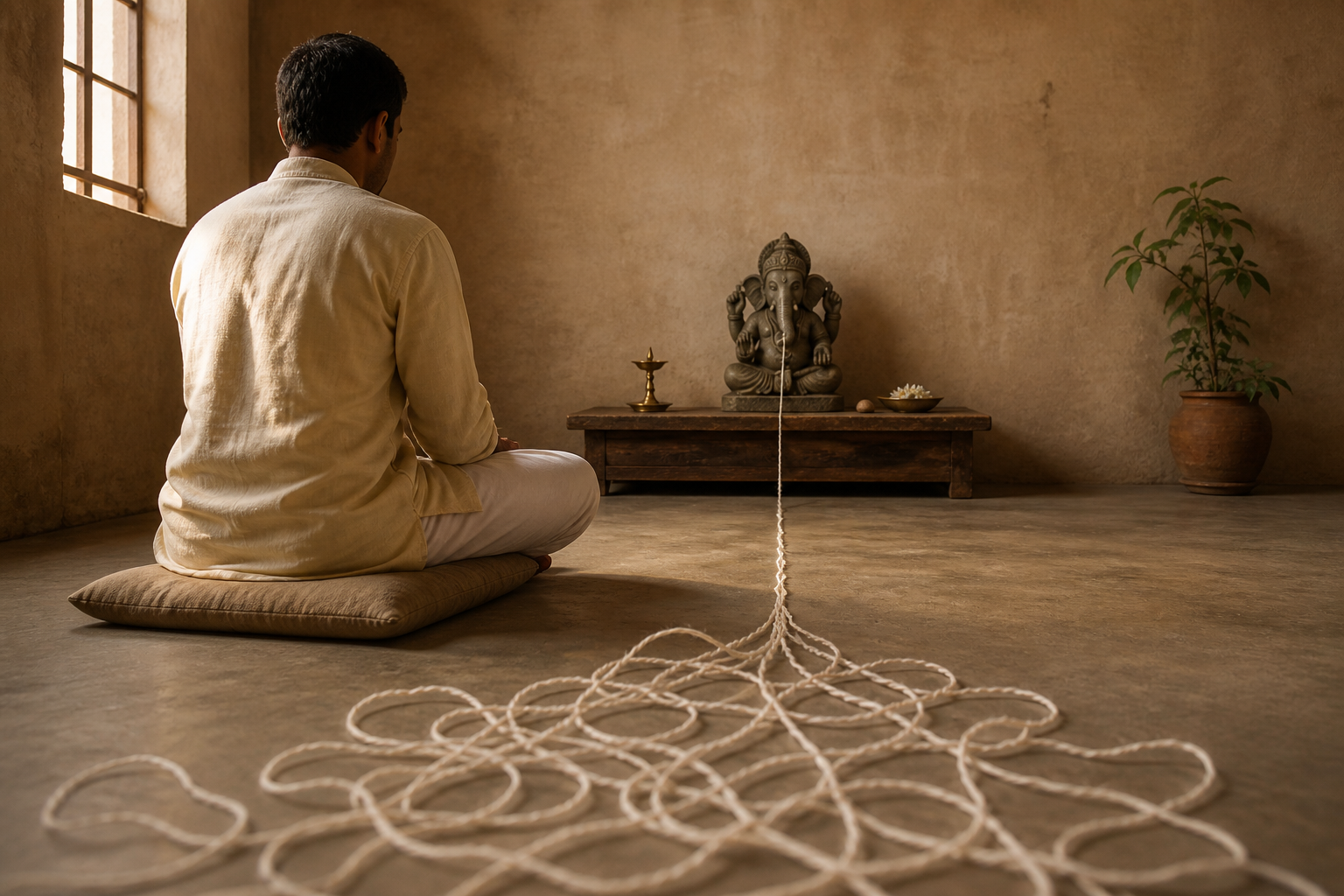
Ganesha as Vighnaharta is usually approached as the remover of obstacles. The straight trunk sharpens that devotion by asking where the obstruction actually lies. A delayed undertaking may face a real external barrier, but it may also be suffering from scattered attention, unexamined fear, careless speech, or refusal to make an ethical choice.
Before an examination, important meeting, family conversation, new project, or period of sadhana, sit before the murti and separate the situation into four questions:
- What exactly is obstructed: knowledge, permission, resources, attention, courage, or agreement?
- Which part of the difficulty is outside my control, and which part is being prolonged by my own habits?
- What would the truthful and compassionate response be, even if it is less convenient?
- What is the next responsible action I can take without haste or hostility?
The distinction matters. If information is missing, devotion should lead you to seek it. If duties conflict, it should lead you to weigh them with viveka, or discernment. If hesitation is the obstacle, the next step may be a modest but definite action. If your own rigidity is harming a relationship, obstacle removal may begin with listening rather than winning.
Ganesha is also honored as Siddhivinayaka, the bestower of success in noble undertakings and guardian of right beginnings. The word noble is important. Worship is not a mechanism for forcing every desired outcome. Its immediate work is to improve the quality of your beginning: a clearer intention, an ethically sound method, measured speech, and willingness to correct yourself. Those qualities cannot guarantee an external result, but they keep success from being separated from dharma.
Place the murti where its reminder can shape your conduct
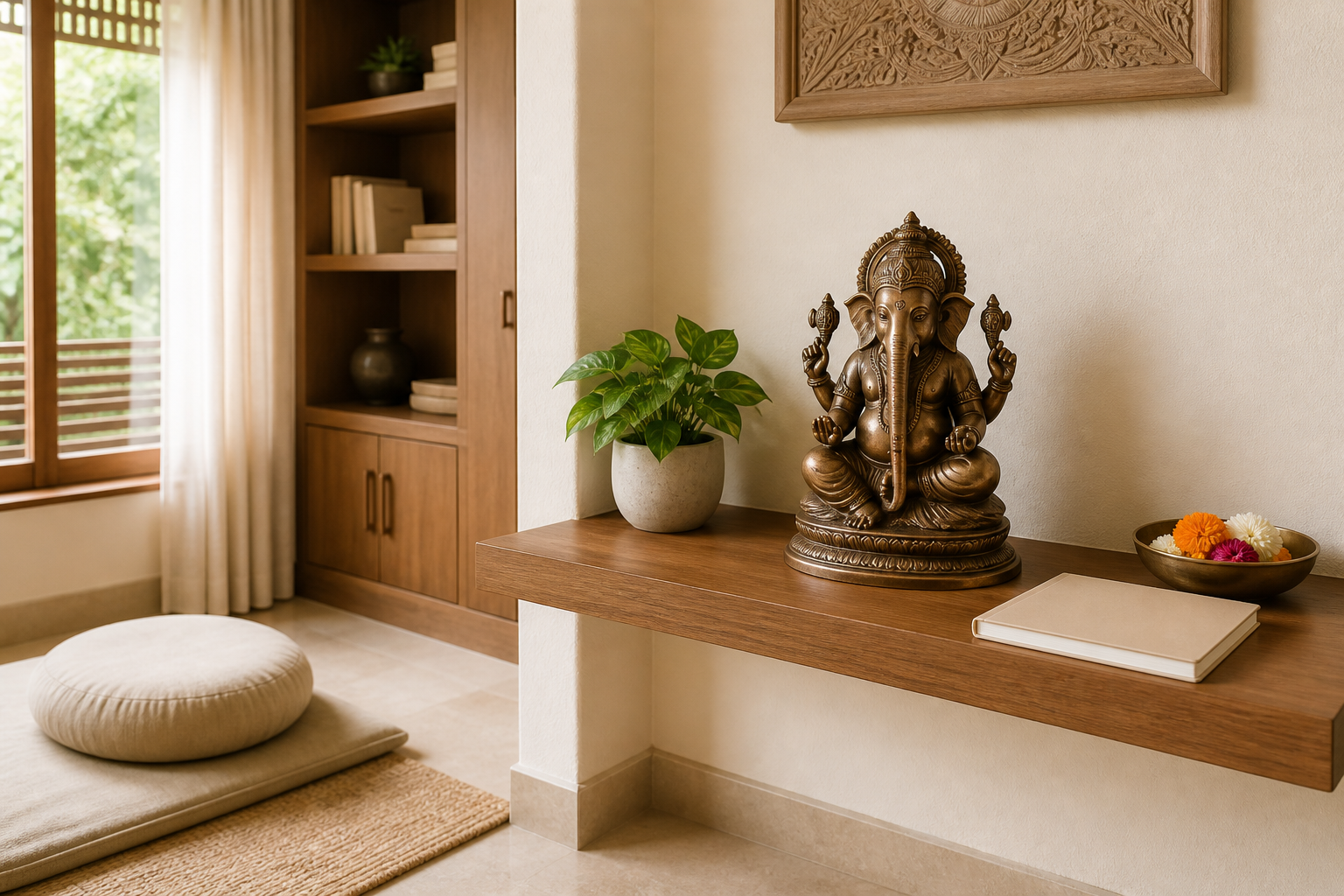
A straight-trunk Ganesha is especially suited to a place used for worship, study, meditation, planning, or careful decision-making. East or north-east placement within a sacred space is common. Treat that direction as a devotional custom rather than a mechanical promise of good fortune. A clean, quiet, well-lit place that you can maintain consistently is more useful than a nominally preferred direction in a neglected corner.
- On a home altar: Give the murti an orderly place where worship will not be crowded by unrelated objects.
- In a study area: Position it where you naturally pause before beginning work, not where it disappears behind books and equipment.
- In a meditation space: Keep the immediate field of view simple so the centered trunk supports one-pointed attention.
- In a workplace: Use the image as a reminder of ethical focus only where it can be treated respectfully by everyone sharing the space.
Modaka, durva grass, and fresh flowers are customary offerings. They need not turn worship into a display. Offer what you can maintain with cleanliness and sincerity. If a particular family or regional tradition gives you more specific directions, follow that living practice rather than assembling disconnected rules from symbolism alone.
Do not choose the straight-trunk form merely because it is less common or appears esoterically advanced. Rarity is not spiritual attainment. Choose it if centeredness, contemplative order, and balanced resolve are the qualities you genuinely want your sacred space to call forth each day.
Build a brief daily practice around the symbol
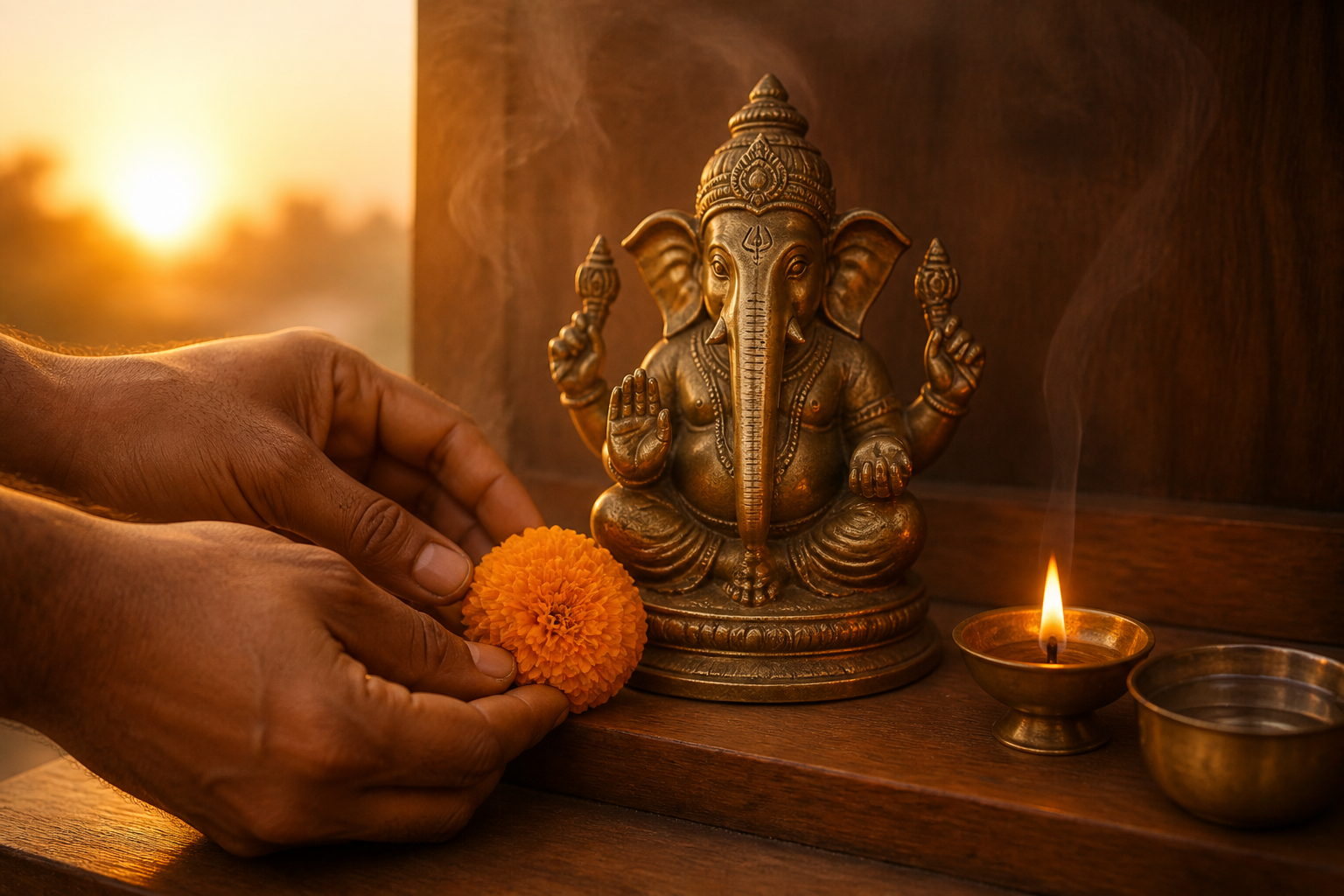
The straight trunk points toward balance, but abhyasa – consistent practice – is what brings that value into your day. A simple routine is enough. Its strength comes from repetition and ethical follow-through, not complexity.
- Prepare the space. Clear away dust and distraction, then sit with an upright but unforced posture.
- Make a simple offering. Light a lamp where an open flame is safe and permitted. Offer a flower, durva grass, or modaka when available.
- Settle the breath for three to five minutes. Observe gentle breathing without forcing it or attempting advanced pranayama. When attention wanders, return it quietly.
- Recite a Ganesha invocation. “Om Gam Ganapataye Namah” is appropriate and concise. The Ganesha Atharvashirsha may be used when it already belongs to your practice.
- Carry one intention into action. Identify the inner obstacle most likely to govern your day, then name the conduct that will counter it: patience before speech, clarity before commitment, or steady effort before seeking results.
The familiar “Vakratunda Mahakaya” invocation also remains appropriate. Its celebration of Ganesha through curved-trunk imagery does not make it unusable before a straight-trunk murti. A sacred name or prayer can illuminate a divine quality without restricting devotion to one visual design.
Do not use the murti to diagnose supposedly blocked nadis or to imagine that possessing it proves an advanced yogic state. The yogic reading functions as a contemplative map. Your most reliable evidence of progress is conduct: less reactive speech, greater patience under pressure, better follow-through, and more courage to correct an unhelpful habit.
This is where viveka and abhyasa meet. Viveka helps you recognize the right action. Abhyasa helps you repeat it after the initial devotional mood has passed. The straight trunk holds those two movements together: see clearly, then proceed steadily.
Key takeaways
- The straight trunk is commonly understood as a symbol of sushumna, balance between ida and pingala, and attention moving beyond opposing pulls.
- It is not inherently superior to left- or right-turning Ganesha forms; the right choice depends on your devotional orientation and tradition.
- Its most useful placement is a clean, respected space where you study, meditate, plan, worship, or make careful decisions.
- A lamp, three to five minutes of gentle breath awareness, a short mantra, and one ethical intention form a complete daily practice.
- Judge the practice by changes in attention, speech, patience, and action rather than by promises of automatic material results.
If you are choosing a murti now, look at the straight-trunk form and ask a direct question: is centered discernment the reminder you want to live with? If the answer is yes, prepare a place you can maintain and begin with a small daily observance. Let the first obstacle it removes be the distance between what you revere and how you act.
References
