

If you are trying to decide whether Arvind Kejriwal was merely the target of political prosecution or the symbol of a failed anti-corruption movement, refuse that forced choice. A weak criminal case can coexist with serious failures of policy, administration and political integrity.
Political accountability is not conviction by public suspicion. It is the duty to answer for decisions, expenditure, institutions and results. A Dharmic standard demands truth in both directions: an allegation must not be promoted into a verdict, and a favourable court order must not be promoted into a certificate of good governance.
Key takeaways
- Separate criminal guilt, audit findings, policy judgment and fidelity to political promises. They require different evidence and can produce different conclusions.
- Respect the court’s decision to discharge Kejriwal and Manish Sisodia in the CBI excise case. The alleged kickback must not be described as proven.
- Do not let that judicial outcome erase legitimate questions about the excise policy, the CAG’s estimated revenue loss or the government’s priorities.
- Judge claims of transformative governance against measurable outcomes in transport, water and healthcare, not against advertisements or slogans.
- Use exactly the same evidentiary standard for a leader you support and a leader you oppose. Without that symmetry, accountability becomes factional warfare.
Political accountability has four different levels

Much of the confusion around Kejriwal comes from collapsing four questions into one. Keep them separate and the record becomes easier to judge.
- Criminal liability asks whether an offence was established through admissible evidence in a particular proceeding. Courts decide this question. Public anger, an agency allegation and an audit loss estimate cannot substitute for the required proof.
- Financial and administrative accountability asks whether public money was planned, authorised, spent, recorded and monitored properly. CAG findings matter here even when they do not establish a politician’s personal criminal liability.
- Policy accountability asks whether a government chose sensible priorities, anticipated foreseeable consequences and corrected failure. Voters do not need proof of a crime before concluding that a policy was badly designed or poorly executed.
- Political integrity asks whether conduct remained consistent with the mandate used to obtain power. For a party elected on simplicity and clean politics, unexplained extravagance or institutional opacity carries greater political weight than it would for a party that made no such promise.
A leader can pass one test and fail another. Discharge in a criminal case answers the case before that court; it does not make buses arrive, repair leaking pipes or explain an audit variance. Conversely, an underperforming public service does not prove that the chief minister stole money. If you keep those boundaries intact, neither propaganda nor partisan outrage can do your thinking for you.
Measure governance where Delhi residents meet the state
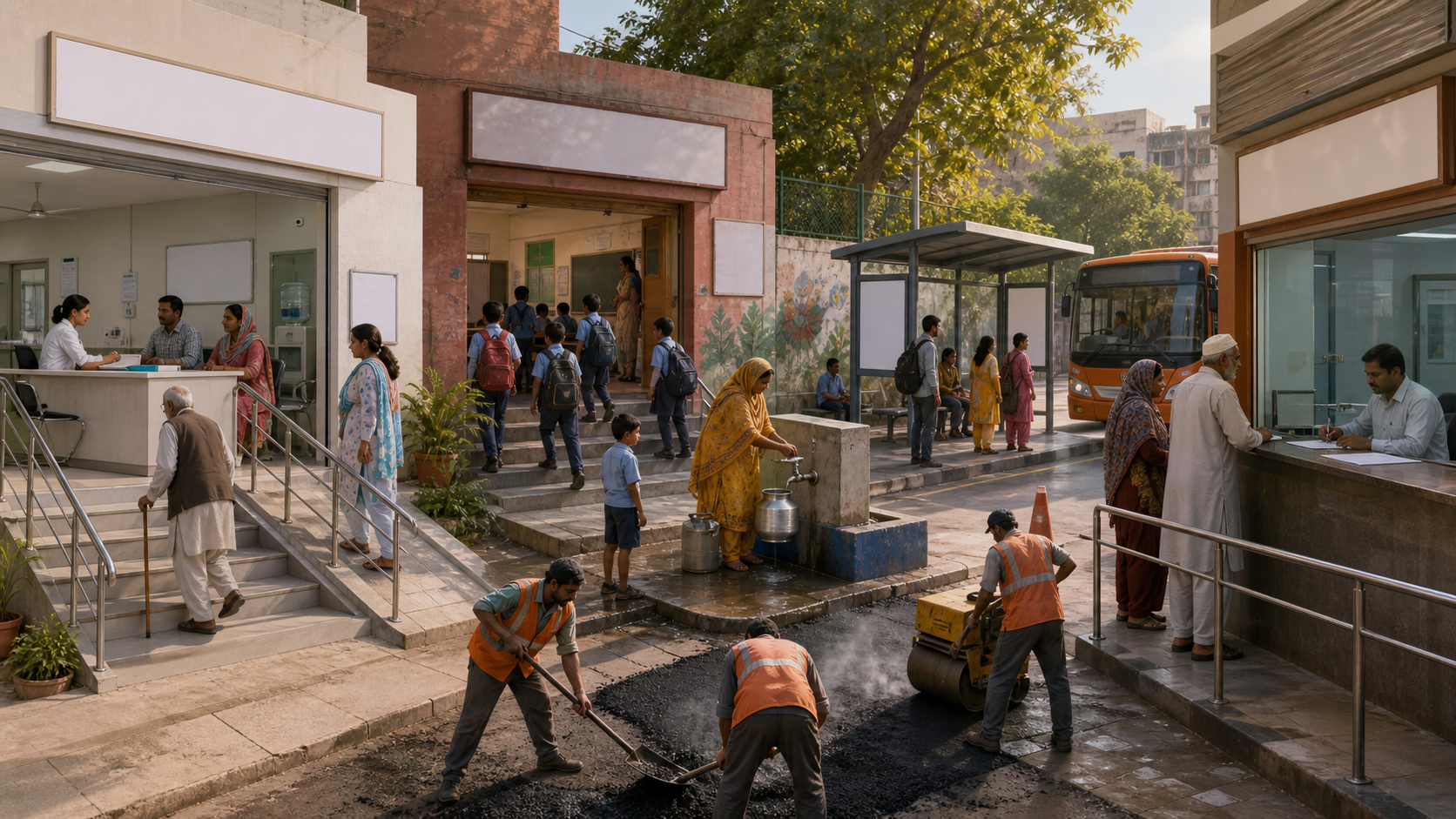
The cleanest test of a government begins where its promises meet ordinary life. For Delhi, that means the bus stop, the household tap and the neighbourhood clinic. These services are not side issues. They reveal whether budgets, institutions and administrative attention were converted into dependable public capacity.
| Area | Documented signal | What you can fairly conclude |
|---|---|---|
| Public transport | Between 2015-16 and 2022-23, the DTC fleet declined from 4,344 buses to 3,937, while only 300 electric buses were procured. Accumulated losses reached ₹60,741 crore and net worth fell to minus ₹58,757 crore. | The numbers do not prove personal corruption. They do require an explanation of fleet planning, financial sustainability and the gap between publicity and usable capacity. |
| Water | Peak summer need was placed at approximately 1,200-1,260 MGD against capacity of around 1,000 MGD. An estimated 40-53 per cent of treated water was reportedly lost through leakage, theft and illegal connections. Delhi Jal Board debt exceeded ₹73,000 crore. | A supply shortage may have several causes, but such high reported losses make distribution, maintenance and financial control central accountability questions. |
| Neighbourhood healthcare | Mohalla clinics reportedly faced shortages of doctors, medicines and equipment. An Anti-Corruption Branch inquiry flagged about 65,000 diagnostic tests as potentially fake or manipulated; a CBI inquiry was ordered and final findings were still awaited. | The flagged tests remain an allegation under investigation, not a final finding of fraud. Staff, medicine and equipment shortages can still be judged as service-delivery failures in their own right. |
| Excise policy | Investigative agencies alleged kickbacks, while the CAG estimated a ₹2,026 crore revenue loss. Kejriwal and Sisodia were later discharged in the CBI case after serious weaknesses were found in the evidence. | The alleged kickback is not a proven fact. The audit estimate and the wisdom of the policy remain separate subjects for political scrutiny. |
CAG found that DTC lacked a proper long-term business plan. It also identified failures in Delhi Jal Board planning, distribution, sewage management, project execution and financial administration. Those findings shift the political burden: a government claiming a revolution in public services should show what target it set, what result it achieved, why the variance occurred and what it changed afterward.
Free bus travel, subsidised water and a clinic near one’s home can all serve legitimate social purposes. But the benefit exists only when the bus arrives, the tap supplies usable water and the clinic has a doctor and medicine. When evaluating a welfare promise, ask about both access and capacity. A subsidy attached to a deteriorating system may help some residents while concealing the system’s decline.
The excise controversy requires due process and political judgment
The excise controversy is the best test of whether you can be critical without becoming careless. During Delhi’s recovery from Covid, liquor outlets offered buy-one-get-one-free deals and discounts of 40-50 per cent. The schemes were stopped after overcrowding raised law-and-order and public-health concerns, although smaller discounts were later permitted.
You can reasonably question why a government elected on schools, clinics and clean politics invested so much political energy in redesigning the liquor trade. You can question whether aggressive discounting was compatible with responsible regulation. Neither question proves a kickback.
The Enforcement Directorate and CBI alleged that a group of business and political interests influenced the policy and paid ₹90-100 crore in kickbacks. The CAG separately estimated a revenue loss of ₹2,026 crore. Kejriwal and Sisodia were arrested, but a court later discharged them in the CBI case after finding serious weaknesses in the evidence. These are three different propositions: an agency allegation, an audit estimate and a judicial assessment of the CBI evidence. They cannot honestly be merged into one claim.
Do not call the alleged ₹90-100 crore payment an established fact. The judicial finding forbids that shortcut. But do not call the policy vindicated merely because the CBI case failed at that stage. A criminal proceeding asks whether prosecutors established a legally sustainable case against particular people. Political judgment asks why the policy was chosen, what safeguards governed it, what revenue outcome followed and whether the government gave a convincing account of the result.
That distinction protects both justice and democracy. Due process protects a citizen from punishment based on accusation. Political accountability protects citizens from a system in which every policy failure is excused unless a prosecutor proves a crime.
Use this seven-question test before defending or condemning Kejriwal

Kejriwal’s muffler, small car and broom were not incidental stage props. They communicated a political covenant: power would be exercised simply, corruption would be confronted and the new rulers would not adopt the privileges of the old establishment. That makes consistency part of the record.
The chief ministerial residence renovation reportedly included costly curtains, marble, carpets, a television console, gym equipment and a minibar, while expenditure rose well beyond the original estimate. That does not by itself establish theft or an unlawful contract. It does create legitimate questions about necessity, approval, procurement, disclosure and consistency with the simplicity on which Kejriwal built his public identity.
- What exactly is the claim? Write it in one sentence. Is it an allegation of crime, an audit finding, a policy criticism, a service failure or a charge of hypocrisy? If you cannot classify it, you are not ready to repeat it.
- What is its present evidentiary status? Mark it as alleged, under investigation, audited, admitted, judicially rejected or judicially established. Do not remove those qualifiers when sharing the claim.
- What did the government promise? Use the promise actually made: clean politics, reliable services, fiscal stewardship or personal simplicity. Political accountability needs a declared standard, not a standard invented after the event.
- What measurable result followed? For transport, compare fleet size and procurement. For water, compare demand, capacity, distribution losses and debt. For healthcare, distinguish the number of signboards from the availability of staff, medicine, equipment and genuine patient services.
- Did the leader answer the strongest version of the question? A reply about political conspiracy does not explain a fleet decline. A speech about welfare does not answer an audit variance. A court victory does not answer a policy-design question.
- What correction followed? Look for a changed procedure, a funded maintenance plan, a procurement schedule, an independent inquiry, recovery of loss or publication of records. An explanation without correction may manage the news cycle while leaving the failure intact.
- Would you accept the same answer from the opposing party? If not, your conclusion is partisan loyalty rather than a standard of rajadharma.
Personal austerity is not a substitute for competent government, but a politician who campaigns on austerity makes it a legitimate subject of scrutiny. Ask for estimates, approvals, scope changes, invoices and the identity of the responsible authority. If those records are not available, criticise the lack of transparency. Do not invent a criminal conclusion to fill the gap.
Before you vote, defend Kejriwal in conversation or forward the next accusation, choose one disputed issue and complete these seven questions. If the strongest case depends on an allegation that a court found too weak, do not repeat it as fact. If the answer to audited failure is merely that no crime was proved, reject that category error too. Truthful scrutiny, applied without favourites, is how political accountability becomes a civic practice rather than a slogan.
References
