
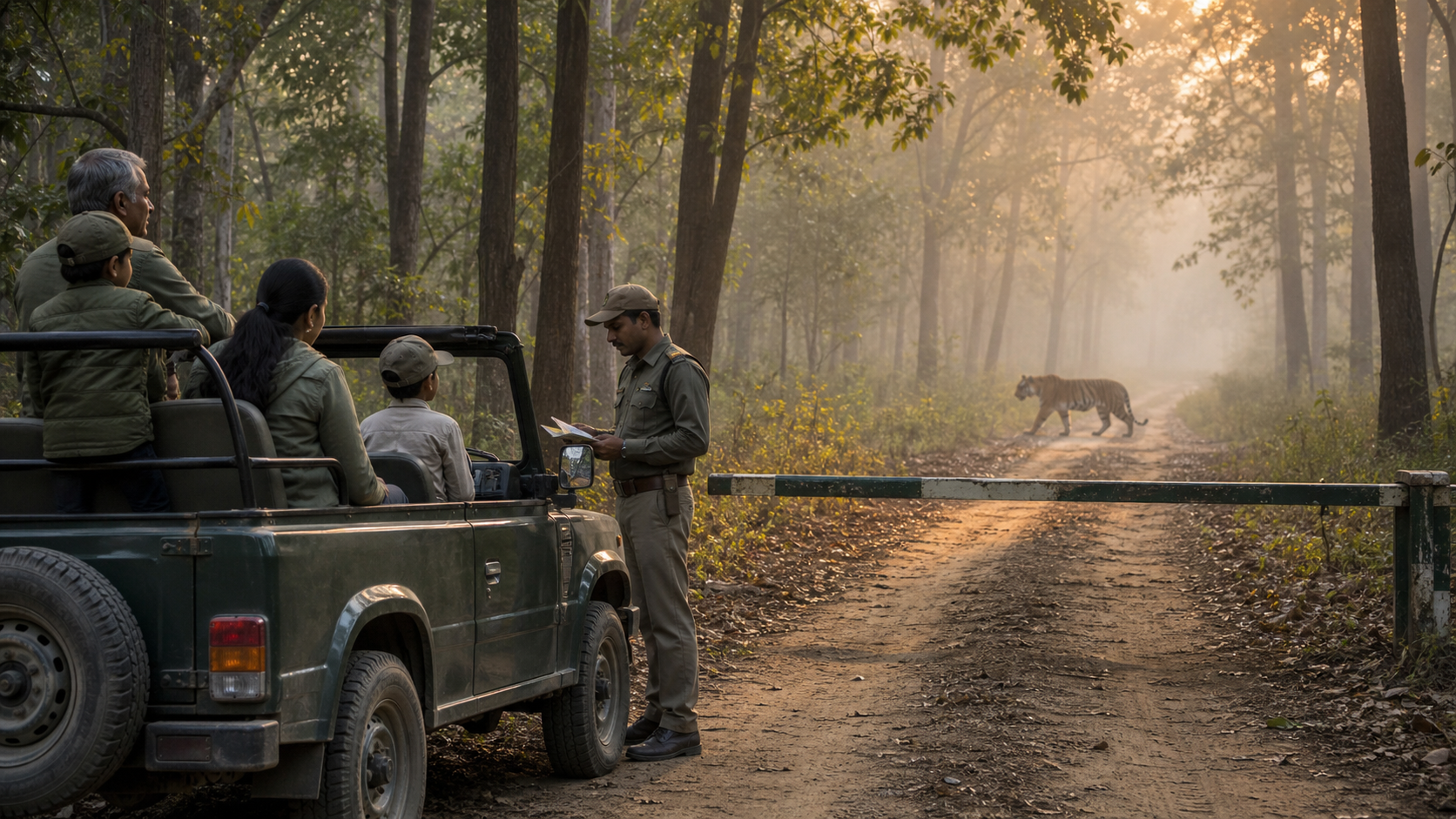
You have chosen a tiger reserve, found dates that work for your family, and started comparing hotels and transport. Yet the part most likely to undo the trip is the one many travellers leave until last: securing legitimate access to the forest at a price they can understand.
Treat the permit, safari, or scarce forest accommodation as the first booking, not an accessory to the holiday. At Dhikala in Jim Corbett National Park, ten rooms can attract roughly 3,000 people when booking opens a little after midnight on a busy night. When demand is that concentrated, the order in which you plan matters almost as much as the destination you choose.
The bottleneck sits between the visitor and the forest
Bharat does not lack wildlife worth travelling for. Its conservation record includes tiger recovery, a tripling of lion numbers, and the swamp deer’s retreat from extinction. The weakness is the man-made layer between a protected landscape and a visitor who wants to experience it lawfully.
Scarcity itself is not evidence of failure. A tiger reserve should limit vehicles, rooms, routes, and visitor pressure when conservation requires it. The failure begins when scarce public inventory is distributed through a process that ordinary people cannot navigate on equal terms.
Dhikala shows the difference. It is one of the few places where a visitor may stay inside a tiger reserve and wake up within the forest. That exceptional experience has only ten rooms. Yet agents using software can complete forms faster than an individual traveller and then resell the access at a rising markup. The ecological limit remains unchanged; only the person collecting the scarcity value changes.
In the Dhikala market described, a safari costing about Rs 8,000 one month ahead could be offered for Rs 20,000 a fortnight before the date and Rs 50,000 two days before it. The government received its fixed fee while the intermediary retained the amount above it. That price curve is a warning, not a universal tariff for every reserve: delay can expose you to a secondary market whose price has little connection to the underlying public charge.
Key takeaways
- Secure the scarce forest access before committing to non-refundable transport and accommodation.
- Ask for the official charge and the intermediary’s service fee as separate figures.
- Verify the reservation through the official channel and confirm that the correct traveller, date, room, or safari is recorded.
- Set a walk-away price before scarcity and family expectations begin driving the decision.
- Judge the trip by the forest experience, not by whether a tiger appears on demand.
- Support reforms that make access transparent without weakening ecological limits.
Book the scarce component before building the holiday around it
A hotel room near a reserve is not the same thing as entry into the reserve. A train ticket to the gateway is not a safari confirmation. Even a package bearing a tiger photograph proves nothing about the specific access included. Before paying, identify exactly which limited component the trip depends on.
- Define the experience you actually need. Distinguish between entry into a reserve, a vehicle safari, a particular tourism area, and an overnight stay such as Dhikala. Do not treat these as interchangeable products.
- Find the official booking channel for that reserve or property. Record the opening time, traveller information required, payment procedure, and the rules for cancellation, rescheduling, or changing a guest. These conditions can matter more than a small difference in price.
- Check inventory before buying the surrounding holiday. If transport must be booked earlier, use a refundable or changeable option where the additional cost is reasonable.
- Write down the official amount displayed for the date and experience you want. A screenshot or saved confirmation gives you a reference point when an agent later presents a package price.
- After booking, confirm the traveller’s name, date, type of access, room or safari details, payment status, and booking number. A vague message saying that access is “managed” is not a reservation.
- Keep the receipt, payment record, terms, correspondence, and official confirmation together. If something is disputed, an orderly record is more useful than a chain of verbal assurances.
Build a Plan B at the same time. That may mean changing the date, choosing another officially available experience, or making the trip about the wider landscape rather than one scarce room. A Plan B is not an admission that the trip has failed. It is what keeps a sold-out night from turning into a financially irrational purchase.
The Dhikala price pattern makes the timing risk unusually clear. In that example, waiting from one month ahead to a fortnight ahead was associated with a jump from about Rs 8,000 to Rs 20,000; two days before the date, the quoted amount reached Rs 50,000. You should not assume that every seller or reserve follows the same curve. You should assume that a scarce date becomes harder to evaluate when you are emotionally committed to the rest of the holiday.
Set two numbers before you start calling agents: the maximum total cost you can accept and the maximum service charge you are willing to pay above verifiable components. If the quote crosses either number, change the plan. Do not negotiate against yourself merely because transport, leave, or family expectations are already fixed.
Read the safari quote line by line

An agent can perform legitimate work: monitoring availability, coordinating a vehicle and guide, arranging accommodation, explaining procedures, and handling a complicated itinerary. Charging for that work is not the problem. The problem is a bundled amount that hides whether you are paying for service or buying access captured from a public allocation.
Ask the seller to separate the quote into these components:
- The permit, room tariff, or other amount paid to the government or reserve authority.
- The vehicle, driver, and guide charges, with a clear description of what is included.
- Accommodation, meals, transfers, and any other travel services.
- The agent’s booking or coordination fee.
- Taxes and payment charges.
- The cancellation deadline, refundable amount, and party responsible for issuing the refund.
If the seller refuses to itemise the amount, treat that as a reason to pause. A high price is not automatically fraudulent, and an agent’s fee is not automatically improper. Opacity is the warning sign. You cannot make a sound decision when the official charge, commercial service, and scarcity markup have been collapsed into one number.
Verify independently that the promised inventory exists and is recorded correctly. Use the reserve’s official channel where it provides a verification function, or contact the designated authority through details published on that channel. Do not rely solely on a cropped screenshot supplied by the person asking for payment.
Use a traceable payment method and obtain an invoice identifying the business or person being paid. Share identity documents only through a channel you have verified and only when they are required for the booking. A desperate search across numerous unknown sellers can expose both your money and your personal information.
Also ask what happens if the promised access is not confirmed. “We will try” and “your booking is confirmed” are different statements. The first may justify a modest, clearly refundable service arrangement; it does not justify paying as though a scarce room or safari has already been secured.
A tiger safari is not an entitlement to a tiger
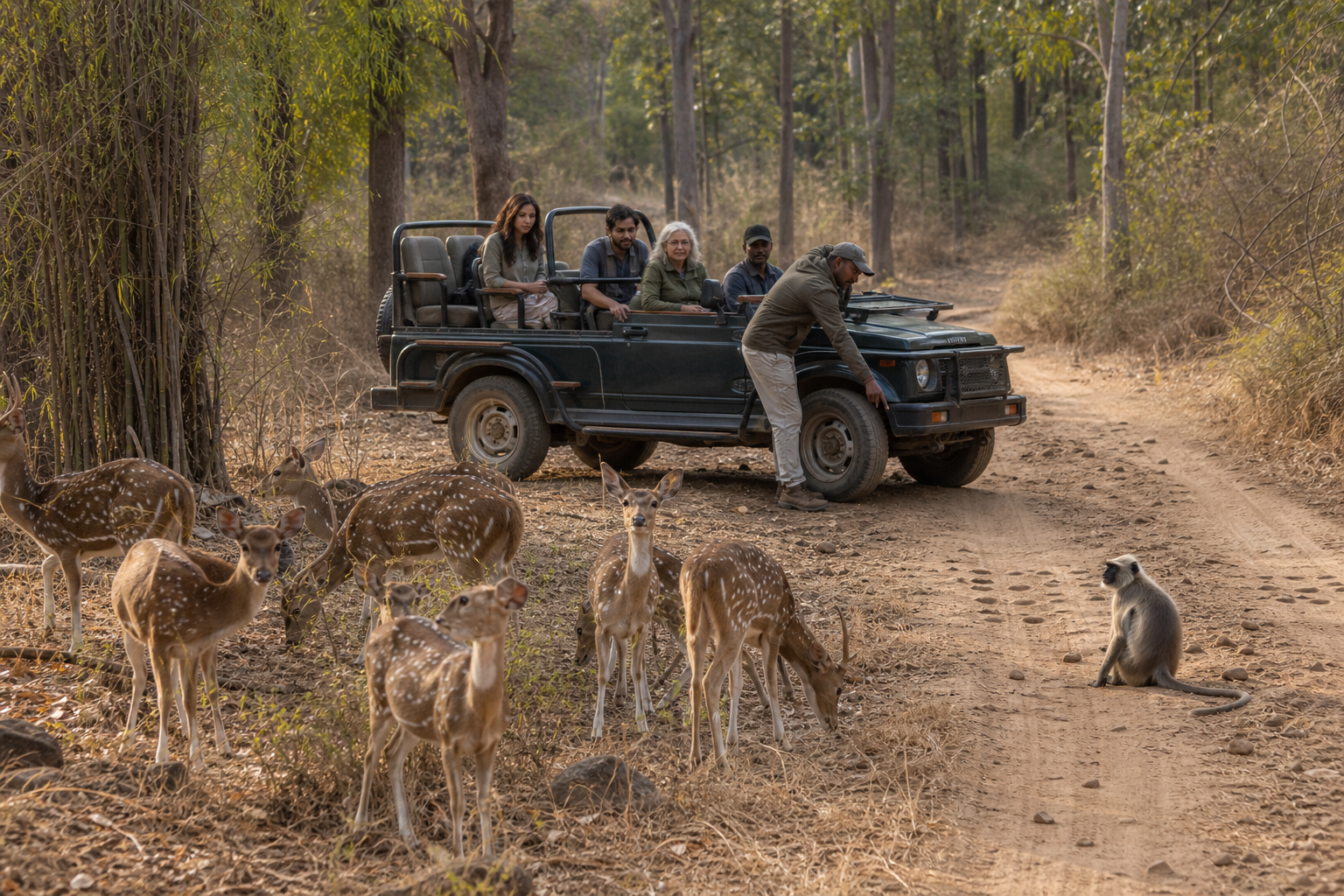
Once access is confirmed, the quality of your conduct matters. A wild tiger is not a scheduled attraction, and no responsible booking can guarantee that one will appear. If the only acceptable outcome is a tiger photograph, you have handed chance too much power over the value of the trip.
Enter the forest prepared to notice habitat, alarm calls, tracks, birds, ungulates, changing light, and the work of the people responsible for managing the visit. This does not diminish the hope of seeing a tiger. It prevents that hope from becoming pressure on a driver or guide to break rules, crowd an animal, create noise, or treat the reserve as a stage.
For a Dharmic traveller, ahimsa becomes practical here. It means accepting distance, restraint, uncertainty, and the authority of ecological limits. Darshan is received; it is not commanded. The right response to an animal choosing cover is not to demand a more intrusive encounter.
- Follow the reserve’s instructions on routes, timing, movement, noise, photography, food, and waste.
- Do not pressure staff to leave a permitted route or approach wildlife more closely.
- Do not feed, bait, call, chase, or otherwise manipulate an animal for a sighting or photograph.
- Keep disappointment inside the vehicle. It must not become a reason to disturb the forest.
- Ask operators who provides the vehicle, guiding, lodging, and other services. Prefer arrangements whose roles and charges can be explained plainly.
- Report a serious booking or conduct problem through the authority’s designated channel, using your saved confirmation and payment records.
This ethic also clarifies the tourism debate. More reliable access does not require more vehicles inside every sensitive area. A visitor-friendly system can retain strict ecological limits while making the limited places easier to understand, purchase, and verify.
Bharat needs transparent access, not mass entertainment
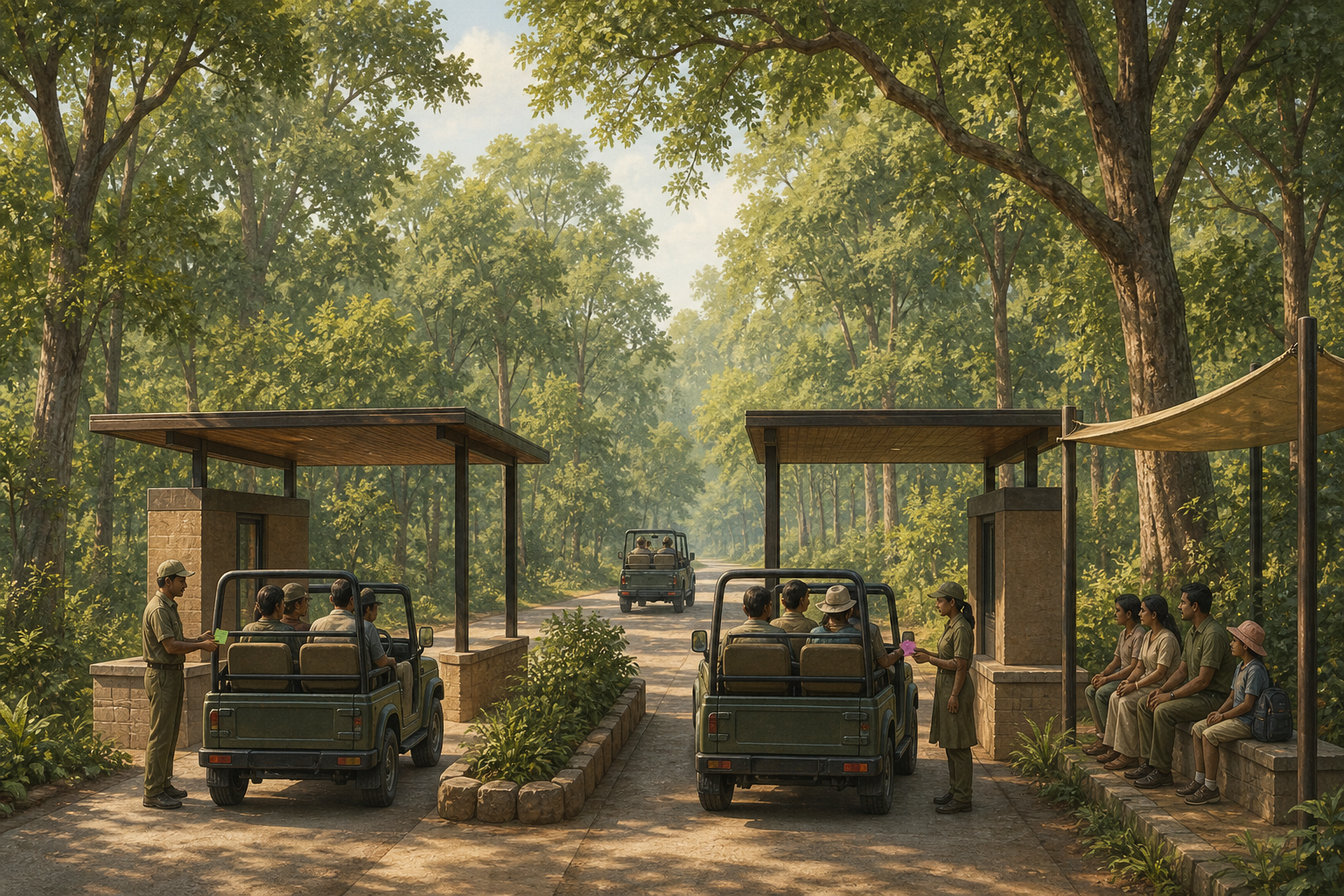
The contrast with the Maasai Mara is useful because it exposes a false choice. Bharat does not need to turn its forests into mass entertainment to attract and serve visitors better. Even though the Maasai Mara is smaller than Bharat’s tiger parks yet draws far more tourists, the lesson is not simply to admit more people. The immediate lesson is to make lawful access legible and trustworthy.
For extremely scarce inventory such as Dhikala’s ten rooms, a fair system should not reward whichever agent has the fastest form-filling software. Several reforms can improve allocation without adding a single room or vehicle:
- Publish one authoritative view of available inventory, opening times, charges, eligibility, and booking status.
- Use identity-linked bookings and bot-resistant controls proportionate to the demand, while protecting the personal data collected.
- When demand greatly exceeds supply at one opening time, use a transparent allocation or lottery process rather than a typing race.
- Create a visible waitlist so cancelled inventory returns to genuine applicants instead of disappearing into an informal market.
- Apply clear payment deadlines and release unpaid reservations automatically.
- Give each completed transaction a verifiable reference that the traveller can check without depending on the seller.
Agents should be integrated transparently rather than allowed to dominate through hidden technical advantages. An authorised reseller system could display the underlying public charge and the agent’s fee separately, require the traveller’s identity to be attached to the booking, and prevent unverifiable transfers. A traveller would then be able to pay for convenience without wondering whether access had been cornered first and marked up later.
Pricing also needs a public purpose. Keeping every place at one low fixed charge can invite automated capture when demand is enormous. Pricing every place at the highest amount affluent travellers will tolerate can exclude ordinary families from their natural heritage. A better design can preserve an affordable allocation while offering clearly priced premium or flexible options, with every charge collected through the official system rather than through a tout’s private ladder.
Any additional official revenue should be reported clearly. Visitors should be able to see how much tourism collects and how those funds are allocated among visitor management, habitat protection, staff, infrastructure, and surrounding communities. Transparency will not settle every policy disagreement, but it will show whether wildlife tourism is strengthening conservation or merely producing more expensive access.
Success should therefore be measured by more than the number of tourists. Reserve managers and governments can track how much inventory reaches travellers directly, how quickly cancellations are recycled, how large authorised service charges are, how many complaints are resolved, and whether ecological limits are being respected. A full booking ledger paired with a stressed forest would be failure; an empty forest economy surrounded by frustrated demand would also waste an opportunity.
If you are planning a trip now, begin with the official inventory, write down the base charge, and make every seller explain the difference between that amount and the final quote. Confirm access before locking in the rest of the holiday. Then enter the reserve ready to receive what the forest offers, not to demand what your payment cannot guarantee. That combination – a careful buyer and a restrained visitor – is the most immediate contribution you can make to better wildlife tourism in Bharat.
References
