
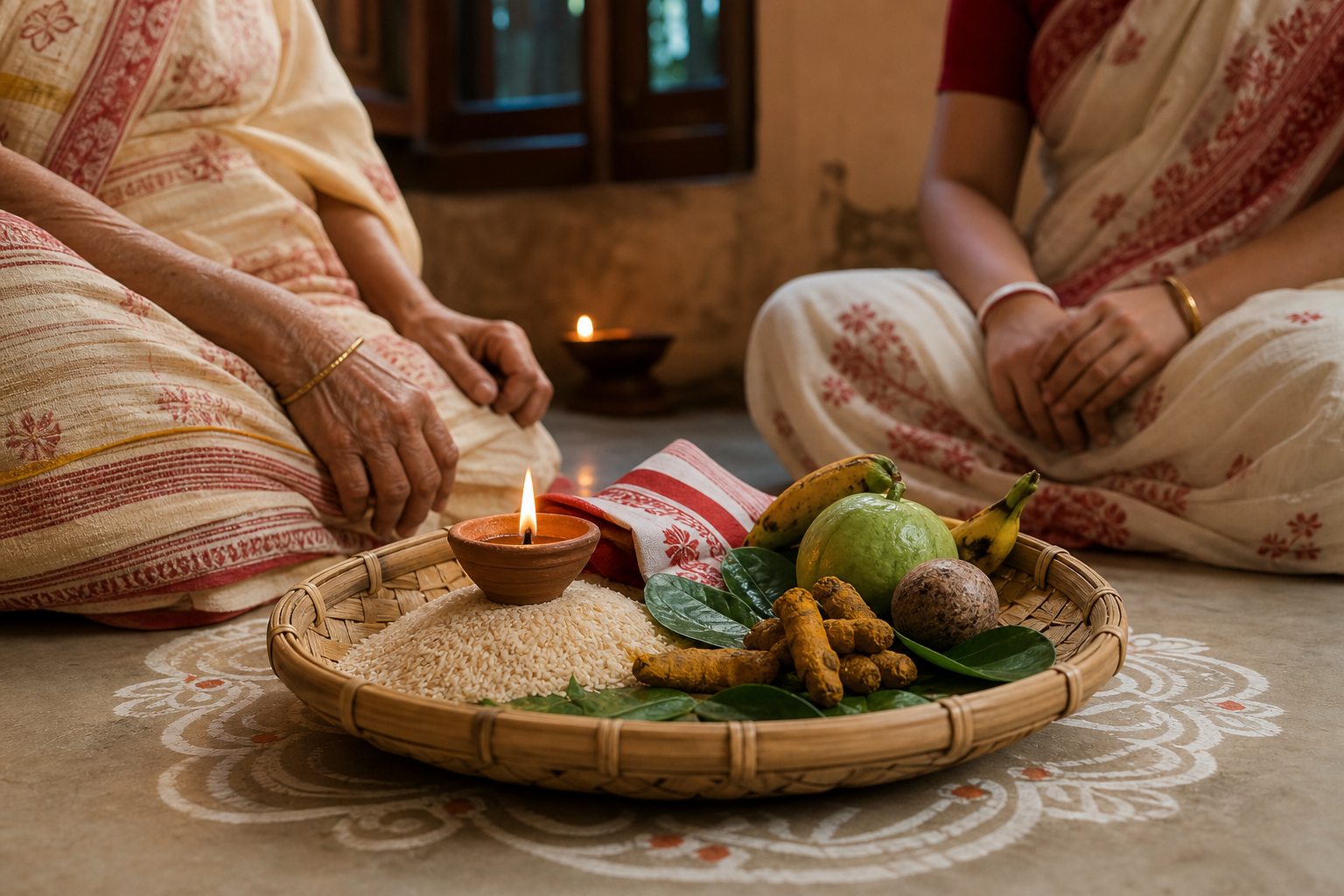
If you remember an elder placing rice, turmeric, and a lamp in a small bamboo basket but cannot recover every gesture, resist the urge to fill the gaps with a generic Lakshmi Puja found elsewhere. Ari Lakshmi is carried through household memory. The choice of grain, the arrangement of the basket, and the quiet participation of family members may matter more than an elaborate ceremony.
You can still prepare a respectful observance when that memory is incomplete. The sound approach is to preserve what your family knows, distinguish the central pattern from optional additions, and keep the ritual simple enough that its meaning remains visible.
Begin with family memory, not a universal checklist
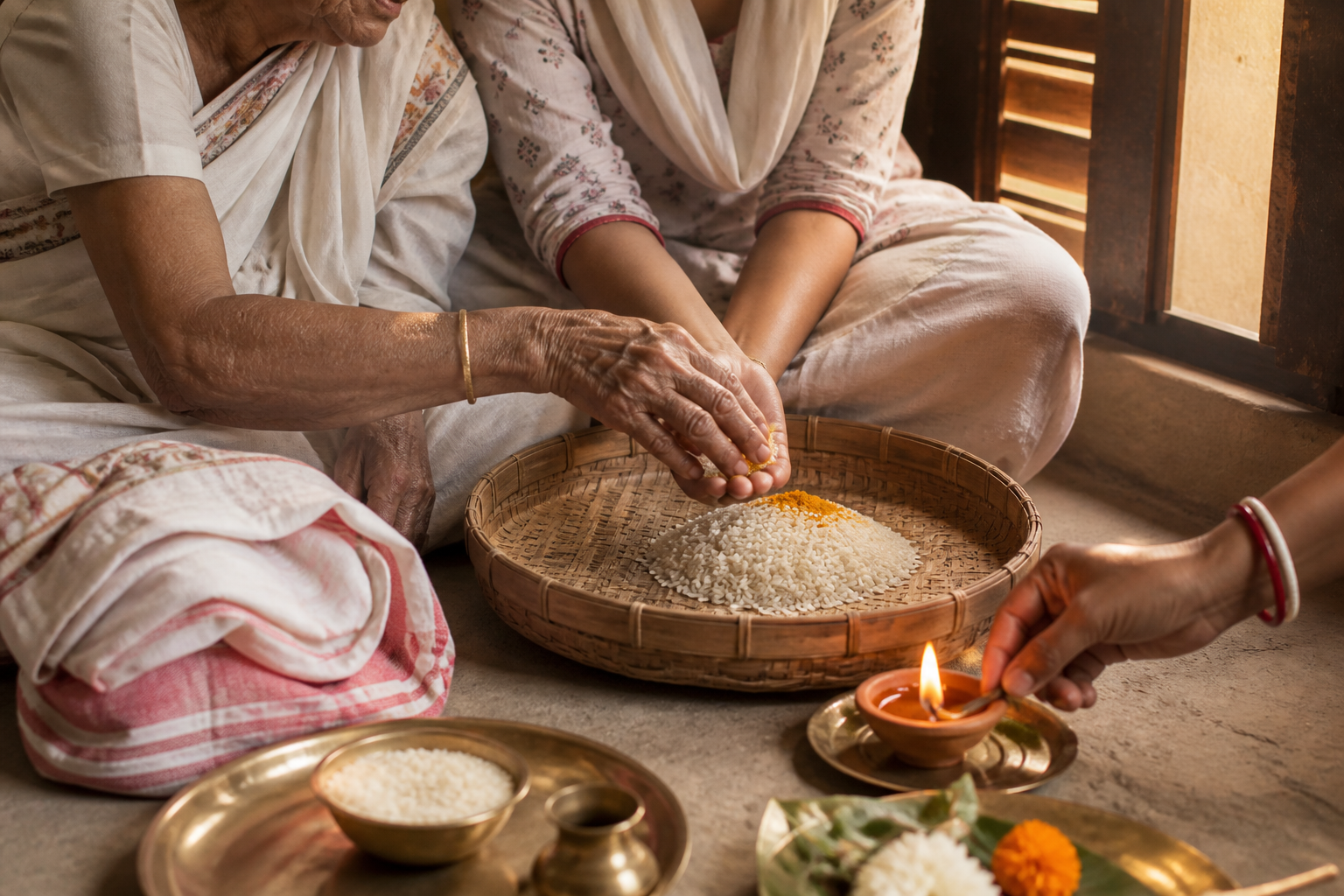
Ari Lakshmi invokes Goddess Lakshmi through an arrangement of grain and auspicious household materials in a small bamboo basket, often resembling the Bengali kulo. A sculpted murti is not required for this form. Lakshmi’s presence is indicated through the sustaining materials themselves, the light of the diya, and visual signs such as rice-paste alpona or small footprints.
The practice is especially preserved in family traditions connected with Dhaka and Comilla. That regional association should not be mistaken for a single standardized manual. A household may remember unhusked paddy where another uses rice, leaves where another uses cloth, or a particular combination of cowries, coins, durva grass, and betel leaves.
Before reconstructing the ritual, ask the oldest available relatives focused questions. “How was Ari Lakshmi done?” is often too broad to unlock a precise memory. Ask instead:
- Was the vessel a kulo, another shallow bamboo basket, or a basket reserved only for puja?
- Did the family spread rice, unhusked paddy, or both?
- Was the basket lined with cloth or leaves?
- Which objects were always present, and which appeared only when available?
- Were footprints or an alpona drawn, and where were they placed?
- Did an elder recite a known stotra, repeat names of Lakshmi, or maintain silence?
- What happened to the grain, offerings, flowers, and reusable objects afterward?
Record each answer as certain, uncertain, or household-specific. If two relatives remember different versions, preserve both memories instead of forcing one into the category of error. If no family account survives, use the simple form below, but describe it honestly to younger relatives as a careful reconstruction rather than an exact recovery of ancestral procedure.
Arrange the basket with a clear distinction between core and optional items
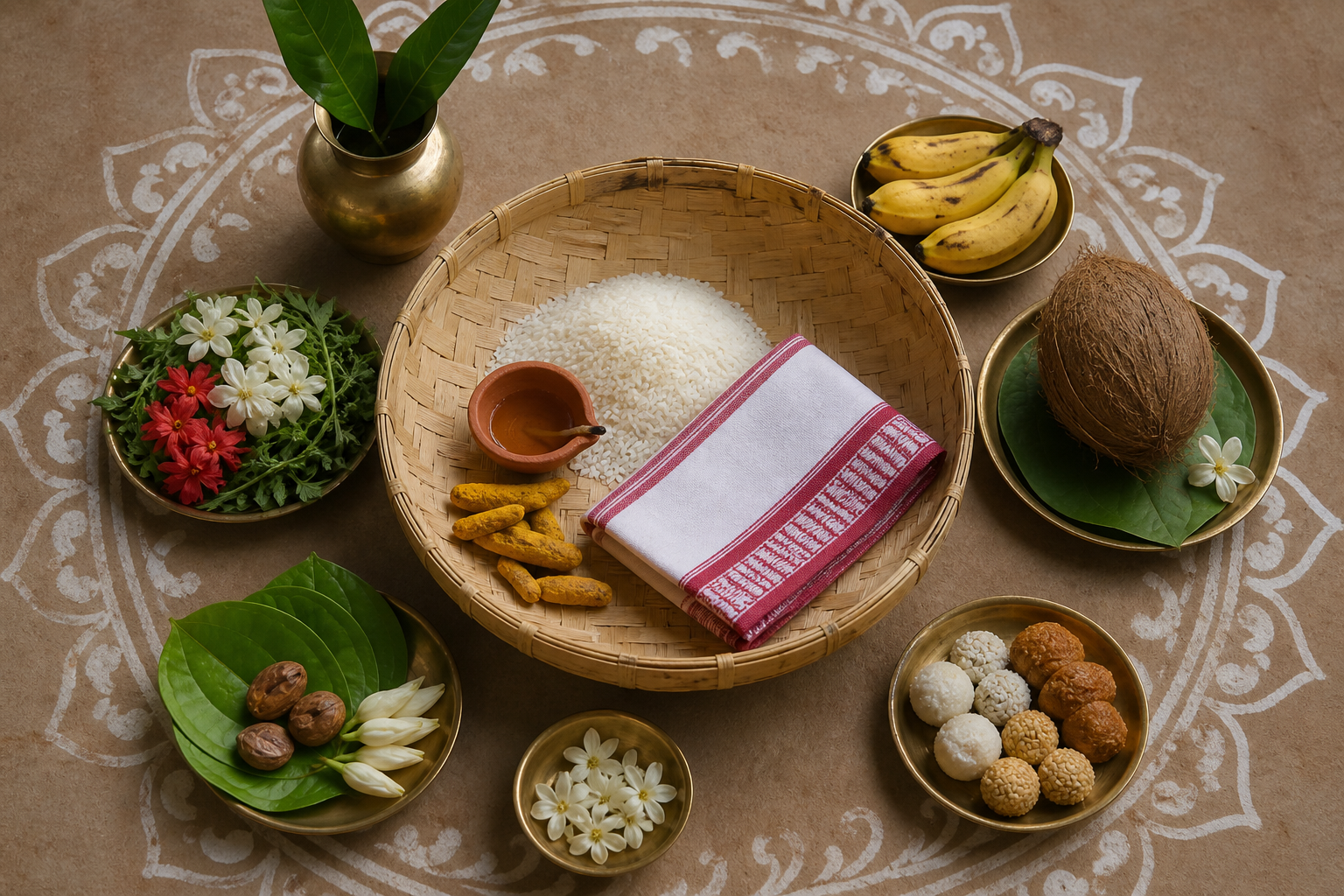
The heart of the arrangement is modest: a clean bamboo vessel, rice or paddy, an intentional sign of Lakshmi’s welcome, and a reverent offering. Other materials deepen the symbolism, but their absence does not justify abandoning the observance. This distinction matters when you live away from Bengal or cannot obtain every traditional item.
| Element | Place in the ritual | Practical choice |
|---|---|---|
| Small bamboo basket or kulo-like vessel | Holds the household shrine | Use a clean, sound basket that can rest securely on a flat surface. |
| Clean cloth or leaves | Creates a prepared lining | Use the material remembered by your family; either can serve when no inherited rule is known. |
| Rice grains or unhusked paddy | Forms the sustaining foundation | Spread a simple layer rather than treating abundance as a demand for excess. |
| Alpona or small footprints | Marks the invitation to Lakshmi | Use rice paste and keep the design as simple as your skill allows. |
| Diya | Represents illumination and clarity | Place it in a stable, nonflammable holder, safely separated from dry bamboo, grain, leaves, and cloth. |
| Turmeric, vermilion, durva grass, a paddy sheaf, betel leaves, cowries, coins, or a conch | Adds household-specific auspicious signs | Include what your family uses or what is respectfully available; do not assume every item is mandatory. |
| Flowers, sweets, or seasonal produce | Expresses offering and gratitude | Choose a modest quantity that the household can later share or use without waste. |
A workable sequence is:
- Clean the place of worship and choose a level surface where the basket will not be disturbed.
- Clean the bamboo basket and allow it to dry fully before adding grain, cloth, or leaves.
- Line the interior with the clean material used in your household, or with cloth or leaves if you are reconstructing the practice.
- Spread rice or paddy as the base. Handle it as food and sustenance, not as disposable decoration.
- Arrange any remembered auspicious items deliberately. A small number of meaningful objects is preferable to an overcrowded display whose purpose no one can explain.
- Draw a simple rice-paste alpona or small footprints to make the invitation to Lakshmi visible.
- Set the diya securely. If an inherited arrangement places it within the basket, protect the flame with a suitable nonflammable holder and maintain constant supervision. Placing the lamp immediately before the basket is the safer choice when dry combustible materials would otherwise surround it.
- Offer flowers, sweets, or seasonal produce. Recite a familiar Lakshmi stotra or names of the Goddess if your family knows them; otherwise, a period of attentive silence and gratitude is consistent with the quiet character of the observance.
Do not improvise complicated Sanskrit merely to make the puja appear complete. If pronunciation or a family recitation has been lost, preserve the intention plainly: offer gratitude for food, livelihood, household wellbeing, and the people whose work makes sustenance possible.
Follow inherited custom for handling the materials afterward whenever that custom is known. Without such guidance, avoid treating sacred food and reusable objects as rubbish. Edible offerings can be consumed or shared, cowries, coins, and the conch can be retained, and clean plant material can be handled in a respectful, low-waste manner. Make clear that this is practical stewardship, not a newly invented ancestral rule.
Let each symbol shape the household, not merely decorate it
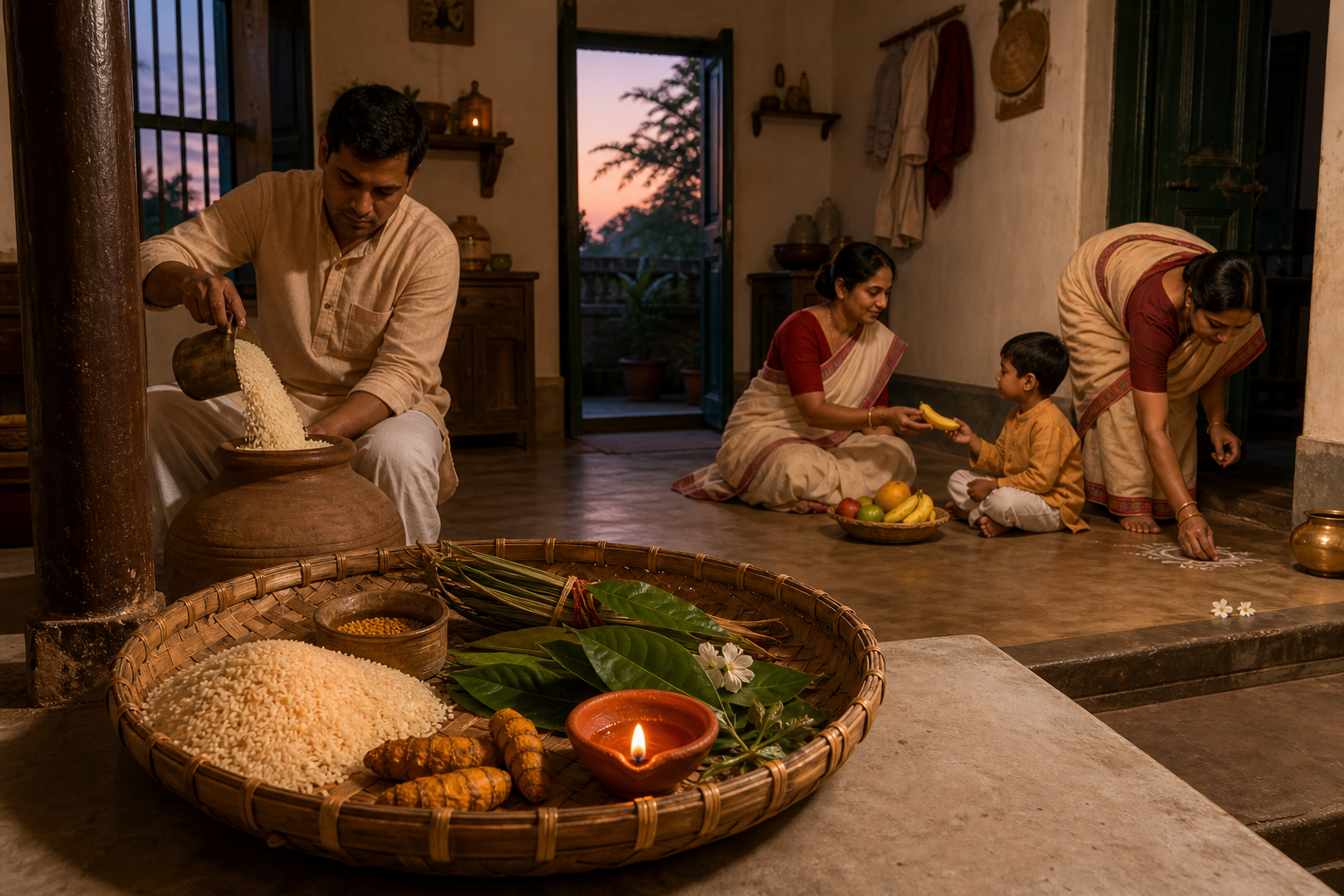
The basket’s materials offer a disciplined way to think about prosperity. Bamboo suggests sustainability and interdependence: each narrow strip gains strength through weaving. Rice and paddy represent annam, the sustenance on which family life depends, as well as continuity between harvest, storage, cooking, and the next season. Turmeric and vermilion carry auspicious associations and the presence of shakti. Cowries or coins point toward wealth, while the lamp turns attention toward the clarity required to use wealth responsibly.
This is why Ari Lakshmi becomes thin when it is treated only as a request for more money. The ritual joins material sufficiency to conduct. Ethical earning, careful consumption, gratitude for food, family cohesion, and daan belong in the same conversation as prosperity. The basket contains ordinary household materials because abundance must eventually be expressed in ordinary household choices.
You can make that connection concrete by asking one question for each major symbol:
- Rice or paddy: Are we buying, cooking, serving, and storing food without careless waste?
- Basket: Whose work is woven into this household’s stability, and have we acknowledged it?
- Coins or cowries: Is our livelihood being pursued and used responsibly?
- Lamp: Which financial or family decision needs clearer judgement rather than impulse?
- Footprints or alpona: What would make this home genuinely more welcoming, orderly, and harmonious?
- Offering: What food, attention, or material help can the household share through an appropriate act of daan?
These questions should lead to a small action, not a ceremonial speech. Plan meals more carefully, acknowledge someone whose labour is overlooked, repair a neglected household responsibility, or choose an act of sharing suited to your means. The ritual becomes credible when its ethics remain active after the lamp is extinguished.
Ari Lakshmi also gives children a direct way to inherit meaning. Give a child one manageable responsibility: drying the basket, spreading the rice, placing a flower, or drawing a simple motif. Then explain one connection in plain language, such as why grain is handled respectfully or why prosperity includes sharing. A child who understands one symbol is learning more than a child asked to watch an unexplained sequence from a distance.
The values of humility, non-violence, gratitude for sustenance, and service resonate across Hindu, Buddhist, Jain, and Sikh life, but that resonance should not erase distinctions. Ari Lakshmi remains a Bengali Hindu household form. Its broader dharmic significance lies in the ethical view it embodies, not in a claim that different religious rites are interchangeable.
Adapt the practice without turning it into generic festival decor
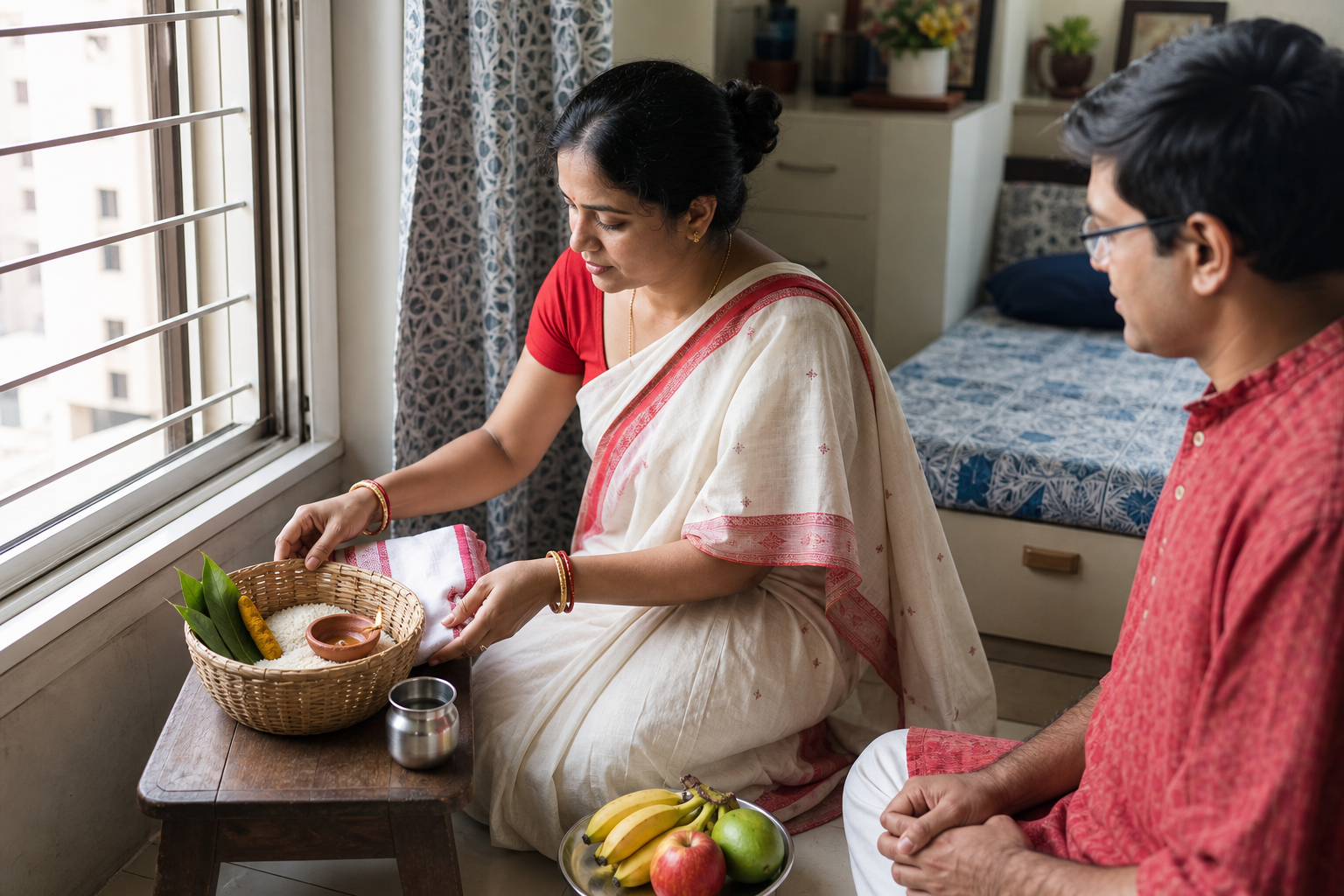
For an apartment or a home outside Bengal
You do not need a large shrine room. A small, clean surface can hold the basket, offering, and safely positioned lamp. If unhusked paddy is unavailable, rice already belongs to the remembered pattern. If fresh leaves are impractical, use a clean cloth. If you cannot draw an elaborate alpona, make the invitation simple rather than replacing it with a mass-produced display.
Keep bamboo at the centre when it is reasonably available. Its biodegradable, everyday character is part of the ritual’s agrarian language. Avoid buying a large plastic imitation merely because it looks more ornate. The purpose is not to reproduce a rural setting theatrically; it is to retain the relationship among basket, sustenance, auspiciousness, illumination, and gratitude.
A murti may already have a place in your household worship, but Ari Lakshmi does not become incomplete without adding one to the basket. Do not let a more familiar form of Lakshmi Puja displace the distinctive grain-filled arrangement you are trying to preserve.
Common ways the ritual loses its integrity
- Turning every possible item into a requirement: Turmeric, vermilion, durva, a paddy sheaf, betel leaves, cowries, coins, a diya, and a conch all belong to the range of remembered materials, but household use varies.
- Equating expense with devotion: The form draws its strength from accessible agricultural and household materials. Costly additions can obscure that simplicity.
- Copying an unrelated puja sequence: Use family memory and the basket-centred pattern first. Additions should not make the Ari arrangement incidental.
- Treating grain as confetti: Rice represents sustenance. Use a measured amount and decide beforehand how it will be handled respectfully.
- Prioritizing photographs over participation: Let family members understand and help arrange the objects before treating the shrine as a display.
- Leaving the diya unattended: Bamboo, dry grain, leaves, and cloth can burn. Keep the flame stable, separated from combustible material, supervised, and beyond the reach of children.
- Hiding uncertainty: If part of the family procedure has been lost, say so. Honest reconstruction preserves more than invented certainty.
After the observance, write down what the household actually did, which details came from elders, and which choices were practical adaptations. Add the names of relatives who remember other versions. That record gives the next generation something more useful than an unexplained photograph: a transparent account they can preserve, question, and refine.
Key takeaways
- Ari Lakshmi centres a small bamboo basket, rice or paddy, auspicious household materials, a sign of welcome, and a lamp or offering.
- Family memory takes priority over a universal checklist, especially for traditions rooted in Dhaka and Comilla households.
- Cloth or leaves, rice or paddy, and the selection of cowries, coins, durva, betel leaves, turmeric, vermilion, a paddy sheaf, or a conch can vary by household.
- The absence of a sculpted murti does not make this form incomplete; Lakshmi is invoked through the arrangement and its symbols.
- Keep the diya safely separated from bamboo, cloth, leaves, and grain, and never leave it unattended.
- Carry the ritual into household conduct through gratitude for food, responsible prosperity, mindful consumption, family care, and daan.
Before your next observance, make two short lists: what your family certainly remembers and what you must responsibly reconstruct. Prepare only what you can explain, invite one younger family member to help, and preserve the completed sequence in writing. That is how a quiet basket ritual remains a living inheritance rather than a fading image.
References
