
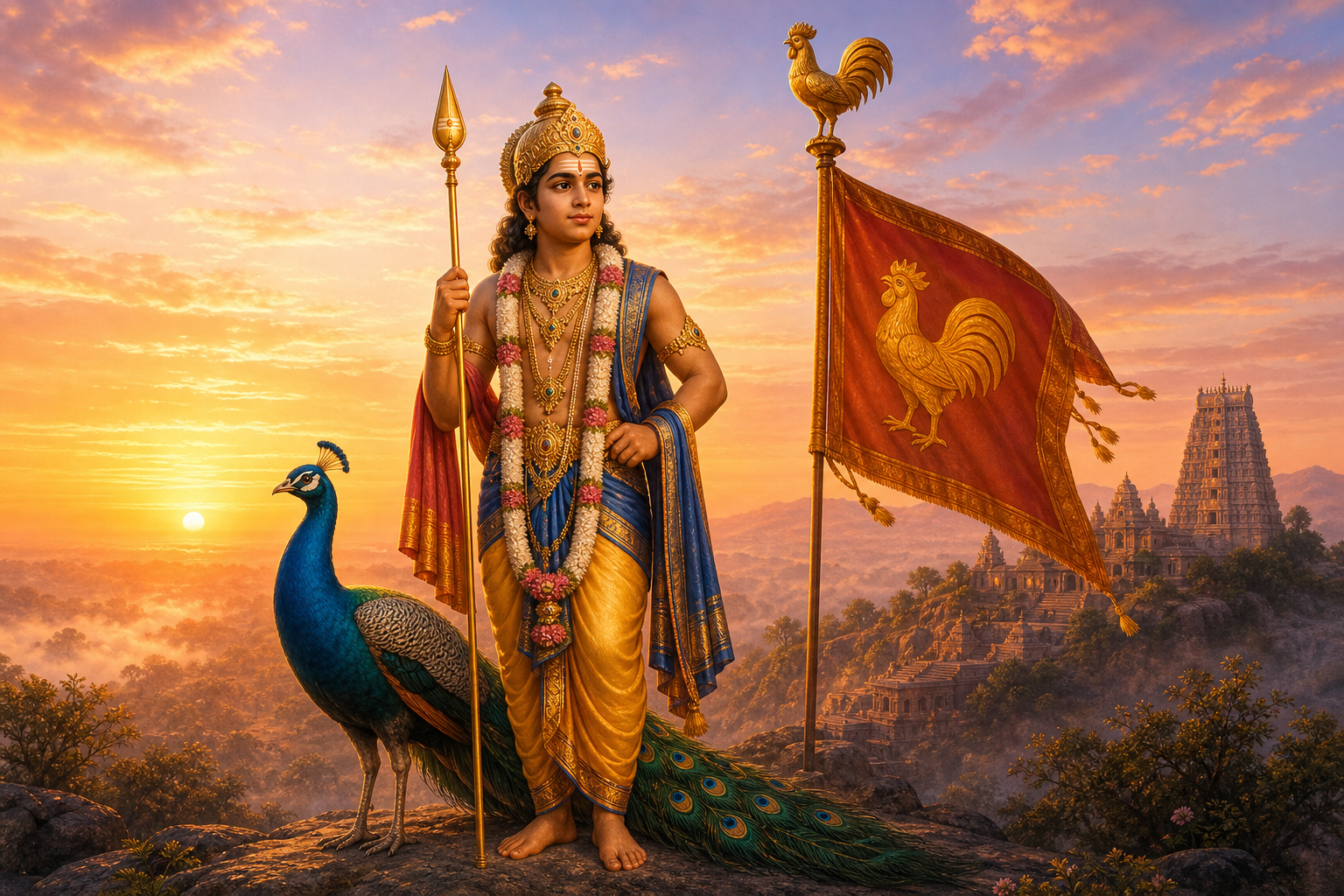
If you have seen the rooster flying above Murugan in temple art or a procession, you may have wondered why it is there. Murugan already has the vel and the peacock. The rooster is not a second vehicle or a decorative flourish. It is the sign that darkness has been broken, confusion has been recognized, and awakened consciousness must now become visible in conduct.
That distinction turns Seval Kodi from an unfamiliar emblem into a practical spiritual instruction. Read the vel, peacock, and rooster together, and you get a compact map of the inner struggle: perceive clearly, govern your energies, and live in a way that declares the victory of dharma.
Read the rooster together with the vel and peacock
The meaning of Seval Kodi becomes clearest in the narrative of Murugan’s victory over Surapadman. After the asura is subdued, the defeated powers appear in transformed form as the peacock and rooster. Energy that stood against the divine is not left directionless. It is placed in the service of the divine.
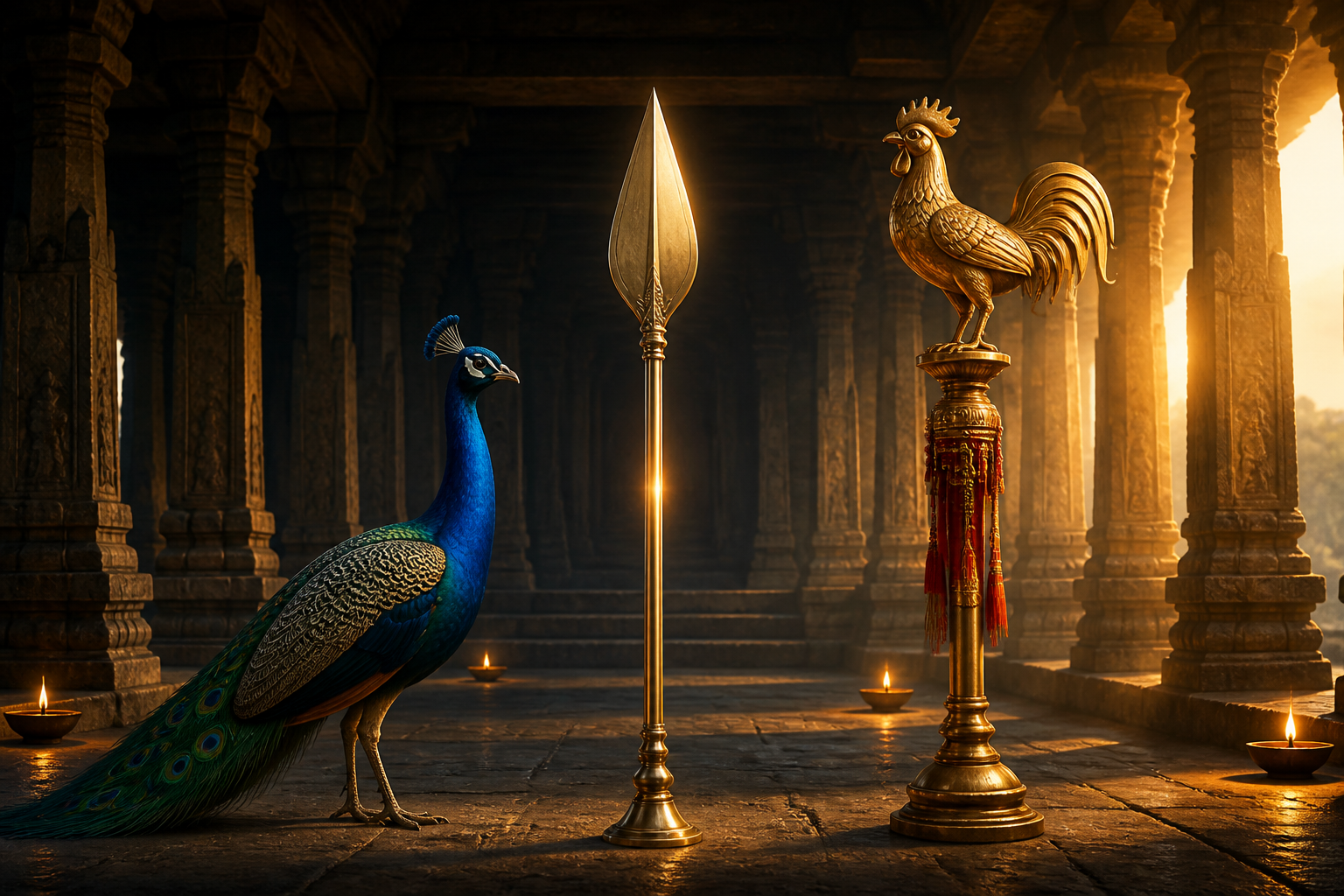
Each of Murugan’s principal emblems then performs a different symbolic function. The vel pierces. It represents the insight that penetrates confusion and exposes what is false. The peacock carries. As Murugan’s vahana, it represents power brought under graceful command. The rooster proclaims. Raised on the kodi, or banner, it makes the victory visible and keeps its meaning before the community.
You can read the three as a sequence. First, discernment cuts through illusion. Next, unruly energy is mastered rather than allowed to master you. Finally, the result appears in speech, choice, and action. If you treat the rooster as a mere trophy, you miss this last movement. Insight that never changes conduct has not yet become a raised banner.
This also prevents a common iconographic confusion. The peacock is Murugan’s mount; the rooster belongs on his standard. One bears the deity, while the other announces what his victory means. When you encounter the image, look at where each creature appears. Position is part of the teaching.
The dawn cry turns vigilance into a daily discipline

A rooster calls as night gives way to morning. In Seval Kodi, that familiar rhythm becomes an image of awakening from avidya, or ignorance. The call comes at the threshold, when darkness has not fully disappeared but daylight is already asserting itself. That is precisely when vigilance matters: before a habitual reaction, fear, appetite, or assumption has decided the direction of your day.
Vigilance here should not be confused with anxiety. Anxiety circles around possible danger without necessarily seeing clearly. Dharmic vigilance pauses long enough to distinguish fact from projection and duty from impulse. It asks: What do I actually know? What story am I adding? Which response keeps thought, speech, and action aligned?
The rooster’s cry also corrects a shallow idea of fearlessness. Fearless clarity is not loudness, aggression, or the need to win every exchange. It is the willingness to see an uncomfortable truth without disguising it. Sometimes that produces a firm word. Sometimes it requires restraint, an apology, or the refusal to act while anger is still determining the terms.
Because the rooster is displayed on a public banner, its symbolism does not end with a private moment of understanding. Your conduct has to carry the message. If you recognize that resentment is distorting a decision but continue speaking from resentment, you have seen the dawn without rising. Seval Kodi asks you to make awakening observable.
Murugan’s victory transforms power instead of wasting it
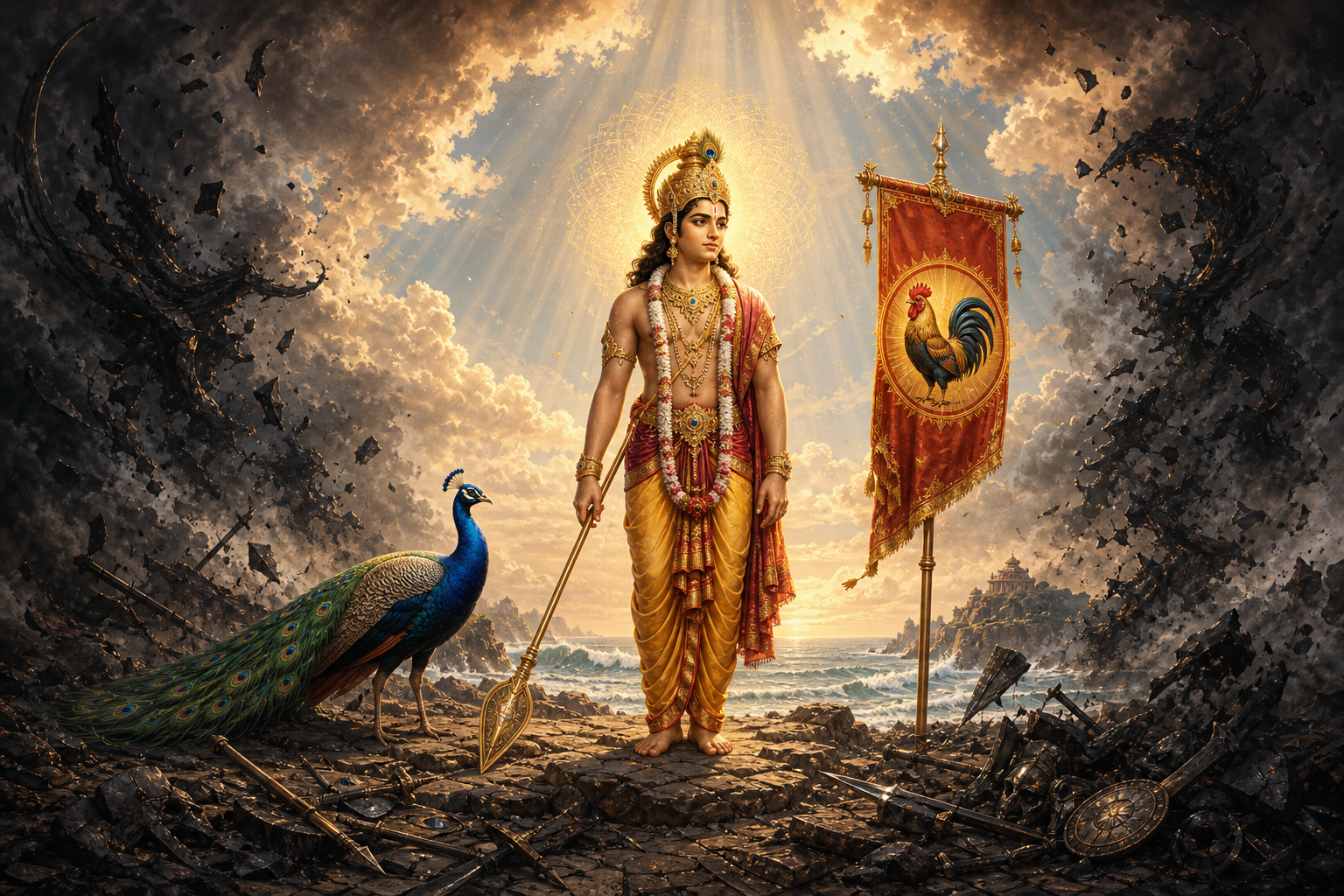
The transformation associated with Surapadman gives Seval Kodi its moral depth. A defeat-only reading imagines spirituality as the destruction of every difficult force within you. The fuller reading asks what becomes possible when that force changes direction. Courage can be separated from aggression. Intensity can serve disciplined work. The desire to prevail can become persistence in a just duty rather than domination of another person.
This is not permission to give every impulse a sacred label. Transmutation begins with the vel’s discernment. A harmful tendency cannot keep the same aim and merely acquire religious language. It must be pierced, understood, and redirected. The relevant question is not simply, “How do I get rid of this energy?” It is, “What would this energy do if it were answerable to dharma?”
Maya can be approached in the same practical way without settling every philosophical debate about the term. In an ordinary decision, illusion often appears as the distance between what is present and what fear, attachment, or ahankara insists is present. The rooster calls you to notice that distance early. The vel helps you cut through it. The peacock represents the composure required to carry the corrected understanding forward.
This pattern also explains why Seval Kodi can speak meaningfully to people across the Dharmic family without losing its Tamil Hindu identity. Buddhist wakefulness confronts ignorance; Jain discipline seeks mastery over the passions; Sikh teaching calls for vigilance against haumai, or ego. These are parallels, not interchangeable doctrines. They reveal a shared civilizational conviction that freedom requires alertness and self-conquest, while the rooster banner remains specifically rooted in Murugan’s sacred imagery and Tamil devotional culture.
Key takeaways for reading Seval Kodi correctly
- Seval Kodi is Murugan’s rooster banner or standard. The peacock, not the rooster, is his vahana.
- The vel, peacock, and rooster have related but distinct roles: insight pierces illusion, disciplined power carries the divine purpose, and the banner proclaims the resulting victory.
- The rooster’s dawn cry represents awakening before ignorance and habit take control of your response.
- Surapadman’s transformation makes victory more than destruction. Power that opposed dharma is redirected toward dharmic service.
- Vigilance does not mean nervous suspicion, and fearlessness does not mean aggression. The test is clearer perception followed by ethical action.
- Parallels with Buddhist, Jain, and Sikh disciplines can illuminate the emblem without erasing its particular place in Murugan worship and Tamil heritage.
Carry the banner into an ordinary day
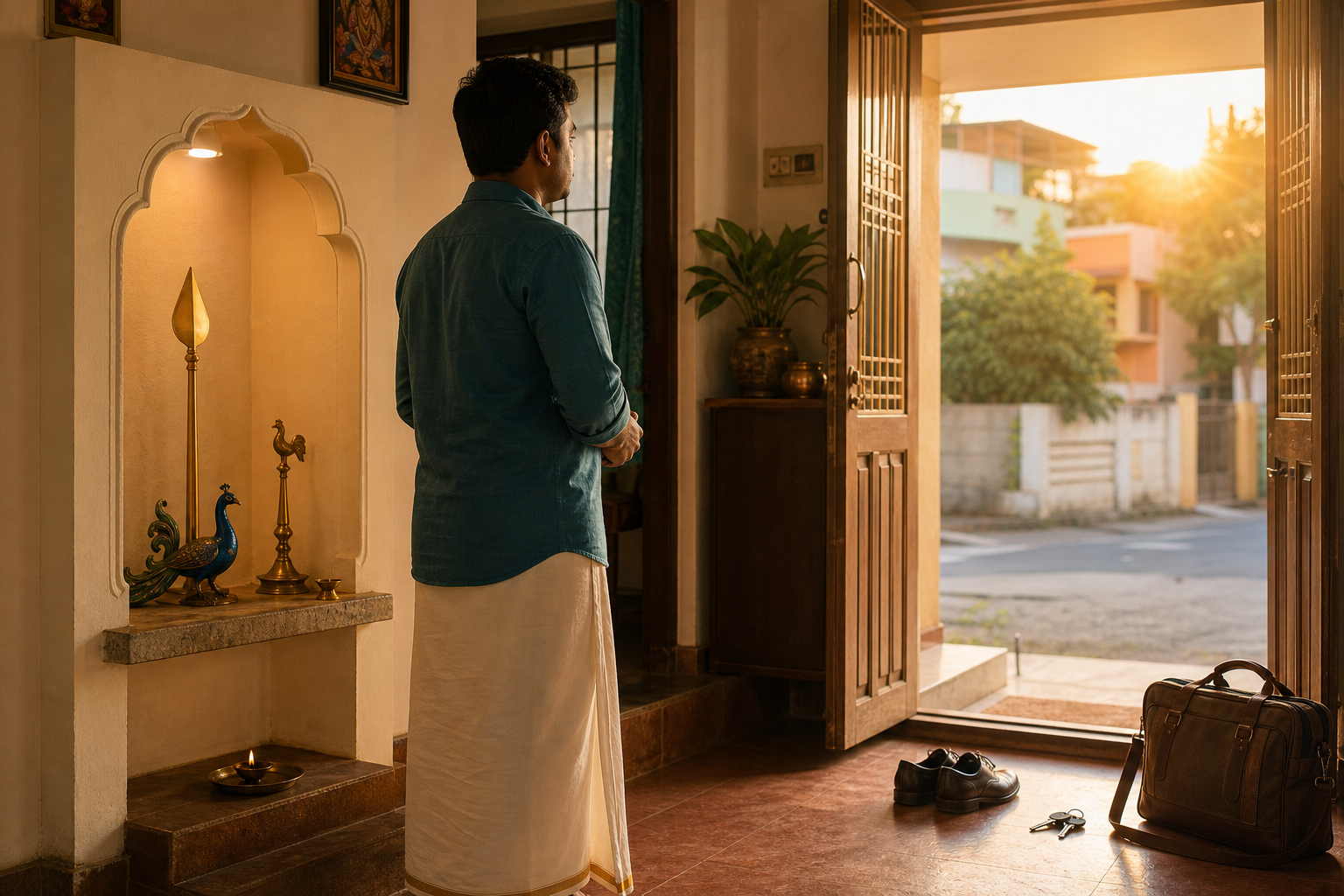
You do not need to invent an elaborate ritual to contemplate Seval Kodi. If you already follow a family, temple, or lineage practice, retain its mantras and forms. The following is simply a reflective discipline for applying the emblem’s meaning.
- Begin before the day’s noise takes over. Take a conscious breath, perform your regular japa, or read a short reflective passage. The aim is to establish attention before incoming demands establish it for you.
- Name the darkness precisely. Identify one assumption, attachment, fear, or reaction that is clouding a decision. Put it into a direct sentence. “I am treating my fear of embarrassment as proof that this action is wrong” is more useful than “I feel confused.”
- Apply the vel. Separate what you know from what you have inferred. Then ask which available response is most consistent with truth, duty, and compassion. This is the point at which discernment must cut, not merely observe.
- Redirect the energy. Do not stop at suppressing the reaction. Decide how its force can serve a better end. Restlessness may become attention to an unfinished responsibility; combative energy may become a firm boundary without humiliation or cruelty.
- Raise the banner through action. Make the insight visible. Speak the necessary truth, keep the restraint you chose, complete the duty, or repair the harm. The rooster belongs on a standard because an inner victory should leave evidence in the way you live.
When confusion returns later, reduce the contemplation to four words: awaken, pierce, redirect, act. This is not a formula for instant perfection. It is a way to interrupt Maya before it becomes momentum.
The next time you see Murugan’s rooster banner, do not stop at identifying the bird. Ask what illusion needs to be pierced, what energy needs a new direction, and what action would announce the arrival of light. Then let that action become your Seval Kodi.
References
