
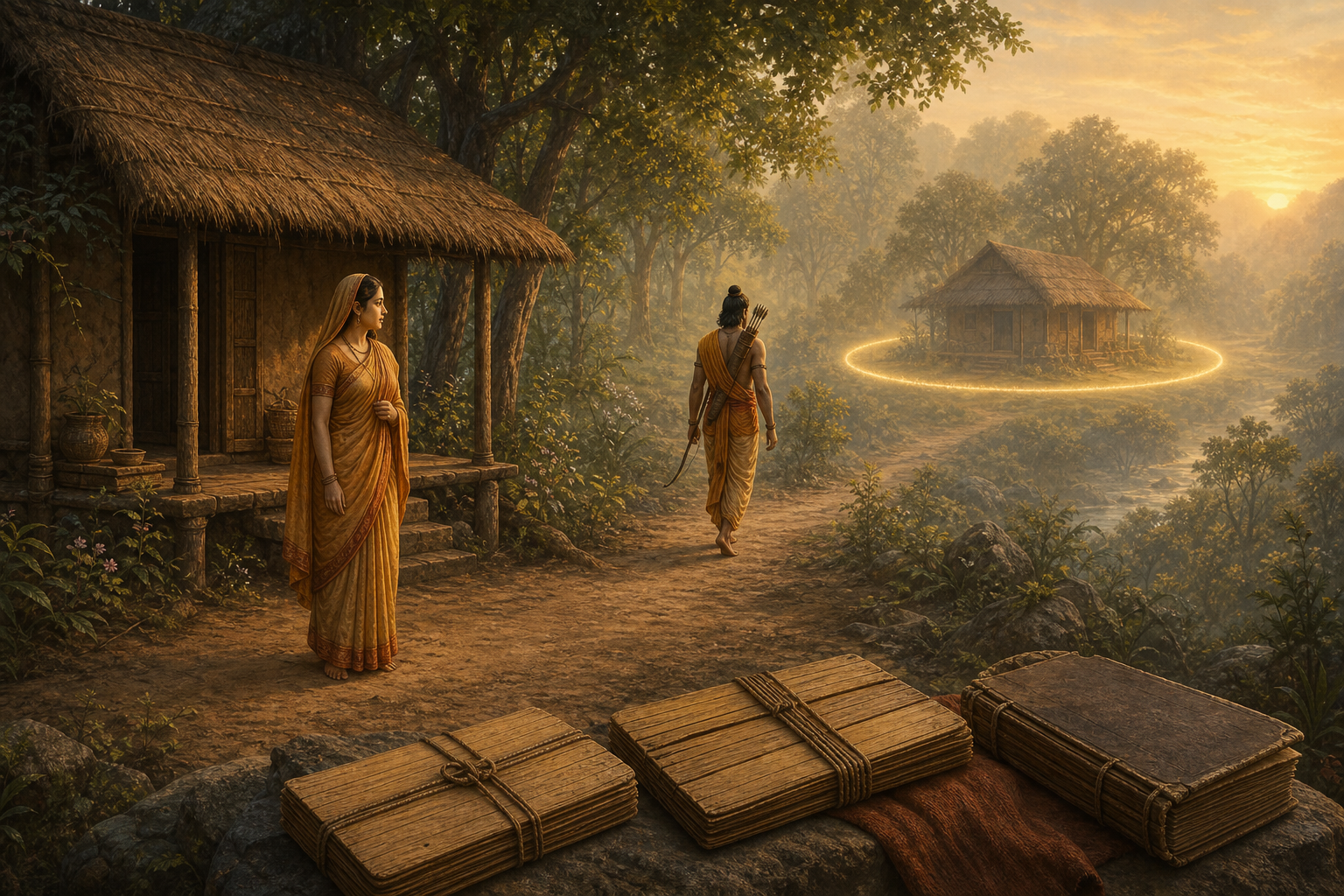
If you are trying to settle whether Lakshmana really drew a line around Sita, the first question is not whether the scene is meaningful. It is: which Ramayana are you reading?
You do not have to choose between textual accuracy and respect for a living tradition. The Valmiki narrative and the familiar Lakshmanrekha motif belong to different layers of the Ramayana’s long life. Once you separate those layers, the apparent contradiction largely disappears.
The precise answer: later tradition, not Valmiki
The Valmiki Ramayana’s Aranya Kanda does not contain a scene in which Lakshmana draws a protective line around Sita. There is no inscribed boundary, no instruction that she must remain inside it, and no literal crossing of such a line before Ravana abducts her.
That gives you a firm answer about the foundational Sanskrit account. It does not mean that the Lakshmanrekha is foreign to the Ramayana tradition as a whole. The motif acquired a recognized place in later Ramayanas, regional and vernacular retellings, popular narration, and Ram Lila performance.
The distinction matters. Saying that the Lakshmanrekha is absent from Valmiki is textually precise. Saying that it is not part of the Ramayana at all is too broad, because the Ramayana is also a many-centred tradition of retelling, performance, commentary, and devotion.
The safe historical conclusion is narrower than many confident claims: the Lakshmanrekha is generally treated as a later accretion that became highly visible across later tellings. Naming one particular work as its undisputed birthplace would require a securely identified first attestation. No single later text can be established here as that definitive starting point.
What the Aranya Kanda actually narrates
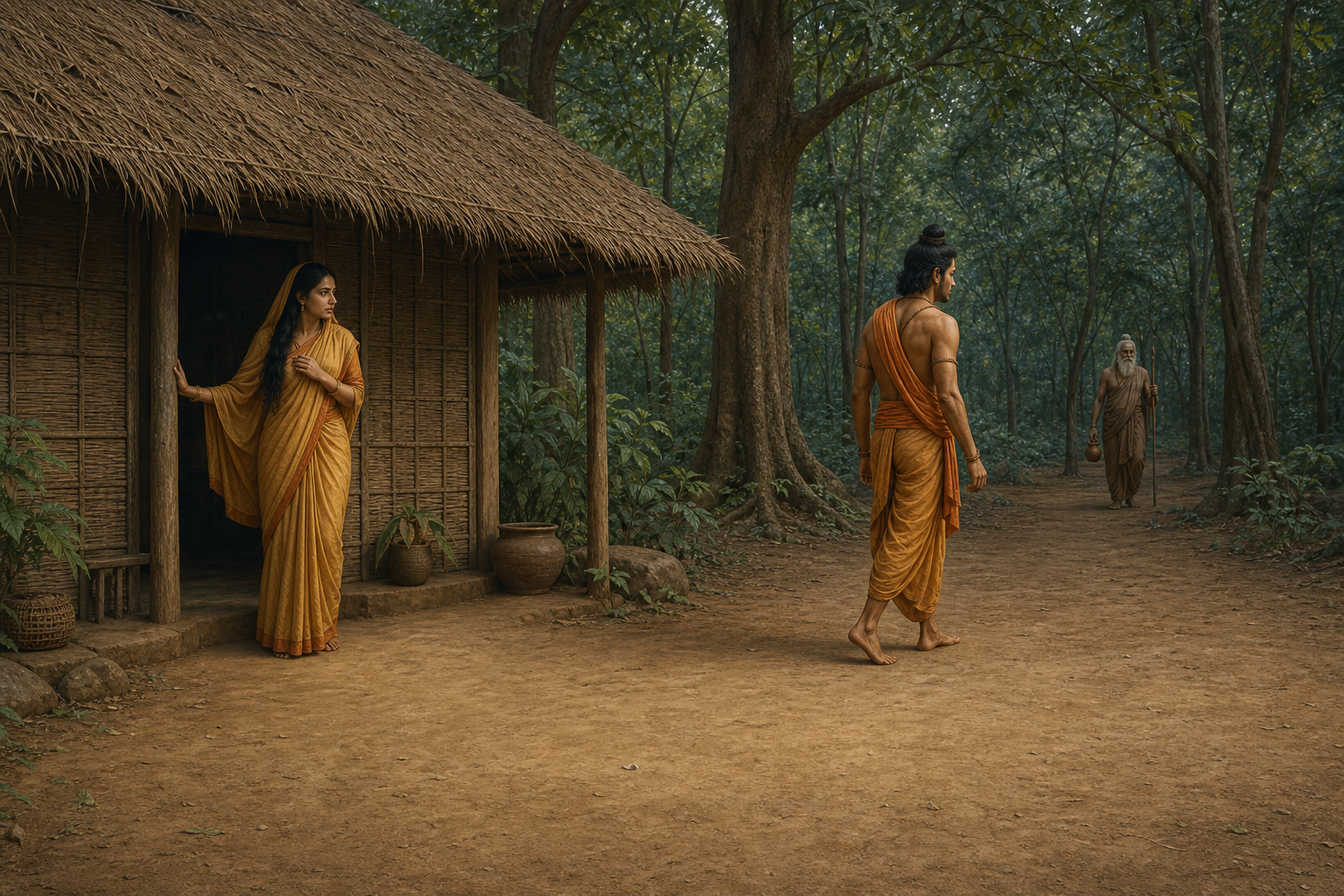
The relevant sequence in the Aranya Kanda turns on a conflict of duties. Sita, distressed about Rama’s safety, presses Lakshmana to go after him. Lakshmana is reluctant to leave her, but he eventually departs. Ravana then arrives in the guise of a mendicant.
The drama therefore moves through anxiety, painful speech, competing obligations, departure, disguise, and deception. A drawn boundary is not one of its narrative mechanisms.
This changes how you should handle a common moral claim. If someone argues that Valmiki depicts Sita violating an explicit physical restriction imposed by Lakshmana, the argument begins from a scene that Valmiki does not narrate. It may be a legitimate interpretation of a later telling, but it cannot be transferred backward and presented as the moral architecture of the Aranya Kanda.
That correction is especially important when the Lakshmanrekha is used to assign responsibility for the abduction. In the Valmiki sequence, Sita does not cause the calamity by stepping over Lakshmana’s visible boundary. The decisive elements are Ravana’s disguise and deception, set against the separation of Rama, Sita, and Lakshmana.
Textual precision also clarifies Lakshmana’s role. His dilemma is not simply that he issued a safety rule and saw it broken. He must choose between remaining with Sita and answering her urgent demand that he assist Rama. The episode asks what duty requires when love, fear, trust, and incomplete knowledge pull in different directions.
Why the drawn boundary became so persuasive
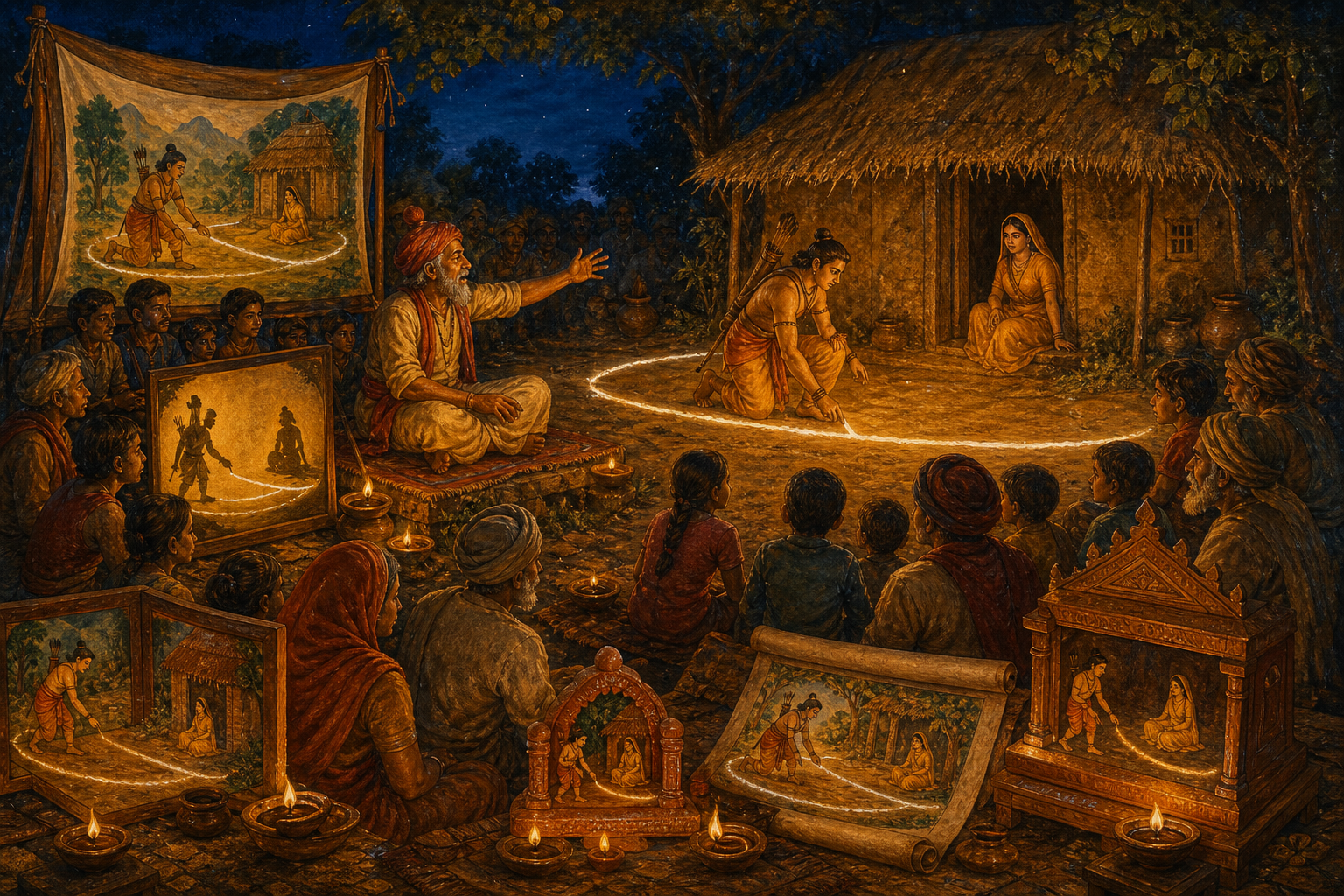
A line on the ground turns several difficult ideas into one visible action. That makes it unusually effective in oral teaching, illustration, and theatre.
- Protection becomes visible. The audience can see the space associated with safety rather than infer it from dialogue and circumstance.
- A threshold creates immediate suspense. Everyone understands that approaching or crossing a marked boundary will change the situation.
- The stage gains a clear cue. In Ram Lila, a physical line lets performers communicate danger even when spectators cannot catch every word.
- Maryada becomes concrete. A complex question about proper limits can be represented by a simple form that remains in memory.
These advantages help explain the motif’s durability. They do not prove that it originated in theatre alone, or that every later Ramayana contains it. Texts, oral narration, visual art, and performance can reinforce one another over time. The responsible claim is that these later channels helped make the Lakshmanrekha culturally central, not that one of them can automatically be declared its sole inventor.
The motif also outgrew the episode. In modern Indian usage, a Lakshmanrekha can mean an ethical, social, or legal red line that should not be crossed. That metaphor preserves the later motif’s association with protection and restraint, even when the speaker is not discussing Sita or Ravana.
Its resonance can be understood alongside other dharmic vocabularies of disciplined limits: Buddhist sīla and the monastic sīmā, Jain maryada in conduct, and Sikh maryada in communal life. These are useful parallels, not evidence of textual descent. Similar ethical concerns across traditions do not by themselves establish that one concept produced the Lakshmanrekha story.
How to evaluate any claim about the Lakshmanrekha

When you encounter a confident statement about the episode, use a five-step check. It works for family discussions, classroom material, devotional talks, television adaptations, and online claims.
- Identify the claim. Is the speaker asking whether the line appears in Valmiki, whether it appears anywhere in the wider tradition, or what it means symbolically? Those are three different questions.
- Ask which telling is meant. The unqualified phrase the Ramayana hides the difference between the foundational Sanskrit account and later regional, vernacular, oral, and theatrical versions.
- Check the actual narrative sequence. For Valmiki, look in the Aranya Kanda for the exchange between Sita and Lakshmana, Lakshmana’s departure, and Ravana’s disguised arrival. Do not treat a remembered television scene or illustration as proof of what the Sanskrit narrative contains.
- Separate first attestation from later meaning. Showing that a motif has great ethical importance does not date it. Showing that it is absent from Valmiki does not erase the meaning later communities found in it.
- Match the wording to the evidence. Say later motif or later accretion when that is what can be supported. Do not name an exact originator unless a particular text and its chronological priority have actually been established.
A precise answer can be stated in two sentences: In the Valmiki Ramayana’s Aranya Kanda, Lakshmana leaves after Sita urges him to go to Rama, and no protective line is drawn. The Lakshmanrekha belongs to later layers of Ramayana retelling and performance, where it gives visible form to protection, limits, and the danger surrounding a threshold.
Avoid the two opposite overstatements. The claim that Valmiki narrates the familiar line is inaccurate. The claim that the Lakshmanrekha is merely false and therefore culturally worthless mistakes textual chronology for a judgment on devotional meaning.
Key takeaways
- The Valmiki Ramayana does not narrate Lakshmana drawing a protective boundary around Sita.
- The Aranya Kanda builds the episode around anxiety, conflicting duties, separation, disguise, and deception rather than the crossing of a line.
- The Lakshmanrekha became prominent in later Ramayanas, regional and vernacular retellings, and Ram Lila performance.
- Its visual simplicity made it an effective symbol of protection, maryada, and dangerous thresholds.
- Its absence from Valmiki should not be confused with absence from the wider Ramayana tradition.
- No exact first textual appearance should be asserted without a securely identified and chronologically established attestation.
When you next teach, discuss, or hear this episode, name the version before drawing the lesson. Read Valmiki to understand the earliest narrative layer, and approach later tellings as interpretations that show how dharma was made visible to new audiences. That one habit preserves both accuracy and the Ramayana tradition’s creative plurality.
References
