
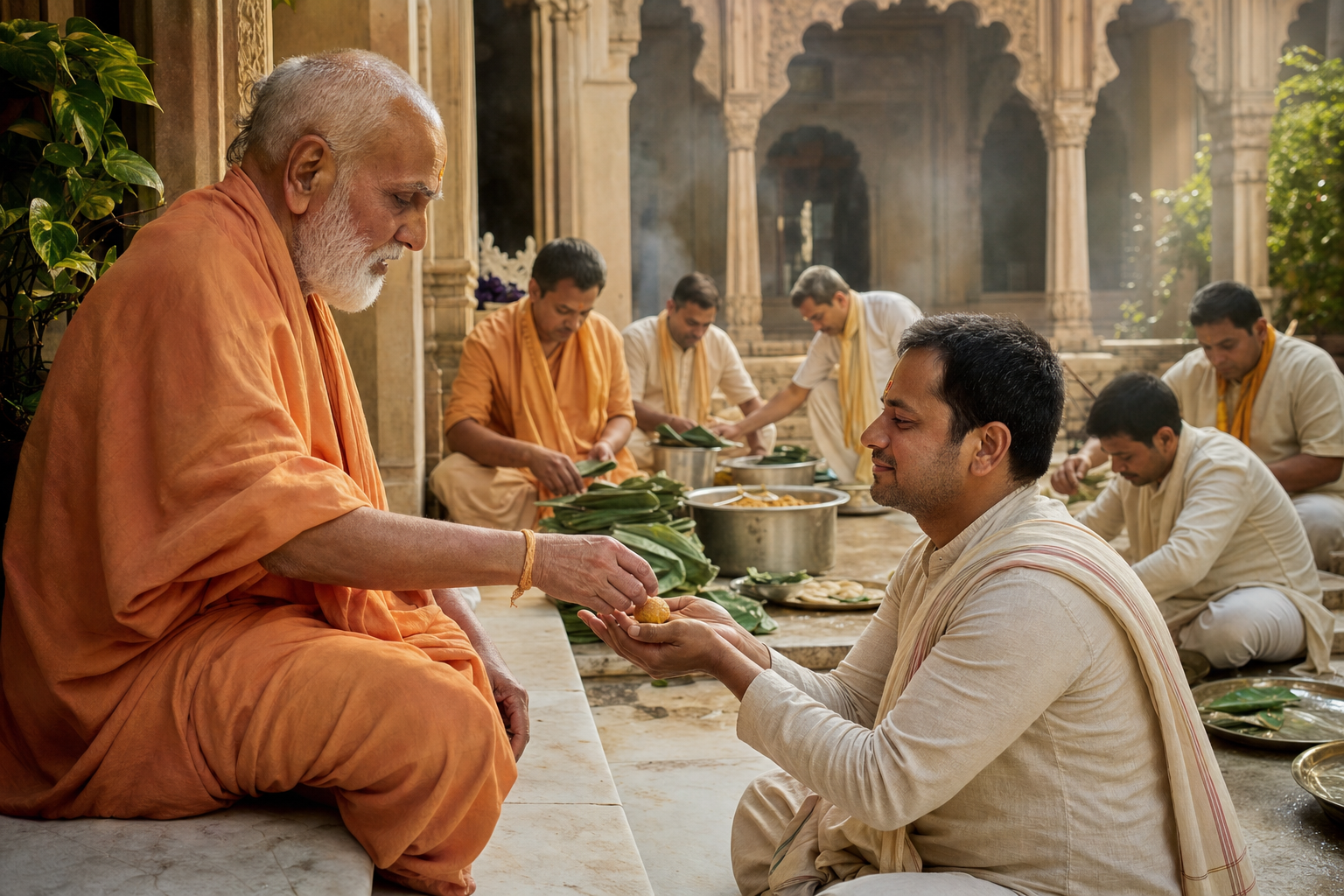
You may have watched devotees treasure food received from a guru and wondered whether ordinary prasadam carries less grace. You may also have faced a harder choice: remain near the guru and hope for a special blessing, or leave because your seva is waiting.
The answer is not to compete for proximity. Receive what comes with gratitude, and do not neglect the duty already entrusted to you. Prasadam teaches you to stop grasping at grace long enough to become capable of receiving it.
Prasadam is a relationship, not a spiritual souvenir
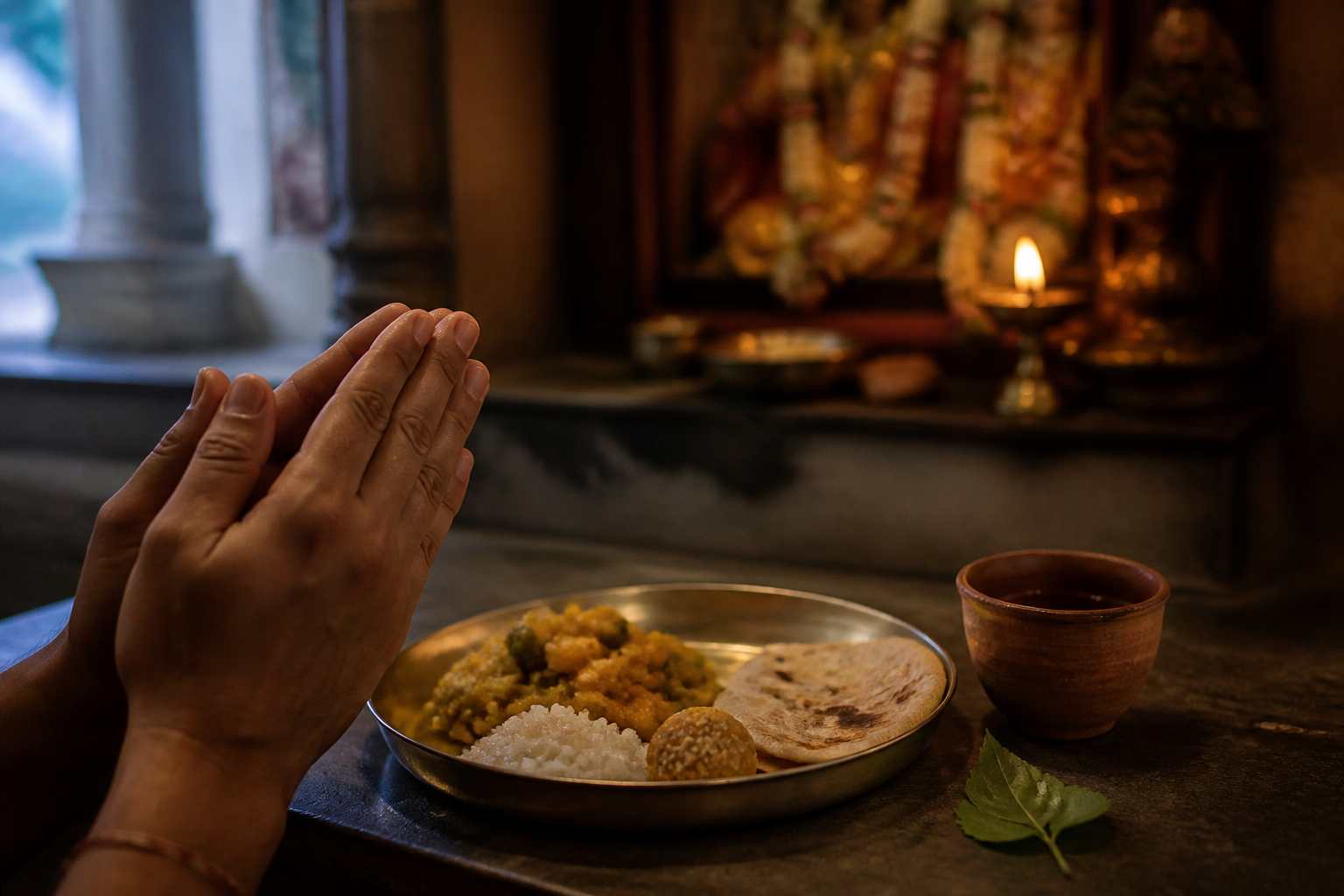
In bhakti, prasadam is food that has first been offered to Bhagavan and is then received as grace. Its meaning does not depend on price, abundance, or culinary refinement. A simple portion can carry the same essential invitation as a festive sweet: remember that what sustains you is received, not independently possessed.
A portion personally distributed by the guru can have an especially intimate meaning for a disciple. The object is connected with a remembered gesture, a teaching relationship, and a particular moment of mercy. But the guru’s grace is not a substance that can be measured by the size of the portion or the distance it travelled. The outward gift matters because of the relationship it awakens.
Three movements belong together. Offering loosens the claim that food exists only for our enjoyment. Receiving replaces entitlement with gratitude. Seva carries that gratitude into conduct. If the process stops at eating something special, prasadam has been reduced to consumption. If it changes how you perform your next duty, it has begun to educate the heart.
This also clarifies the guru’s place. The guru does not merely provide prized objects. The guru teaches the disciple how to see, serve, remember, and receive. An instruction that corrects your habits may therefore be a deeper form of mercy than the experience you were hoping to obtain.
The sweetball mattered because seva came first
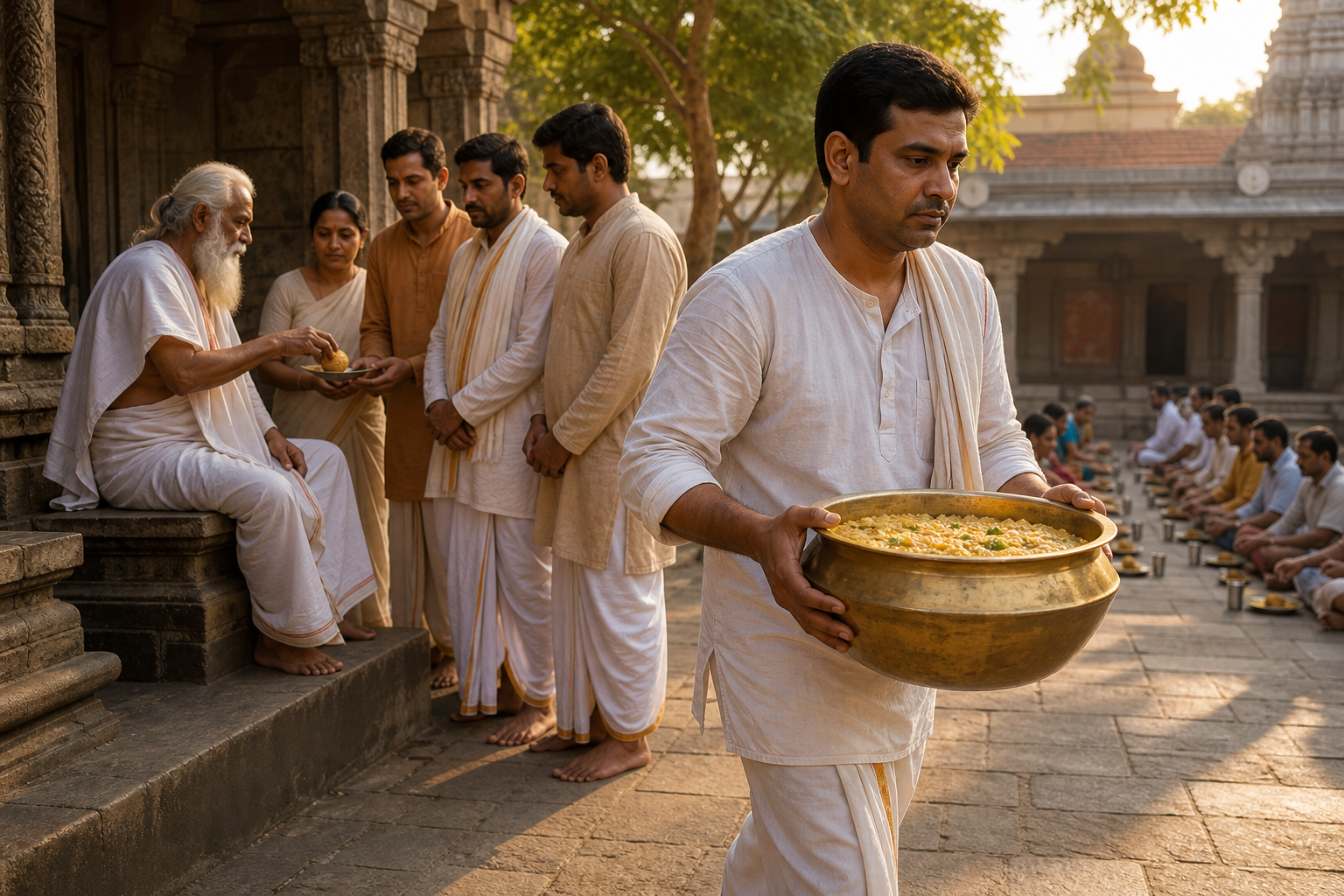
During a crowded gathering at New Dwaraka, Omkara devi dasi knew that she needed to return to the temple kitchen. She wanted prasadam directly from Srila Prabhupada, but the gathering was dense and her responsibility could not be postponed. She accepted that she would probably miss the distribution and prepared to leave.
As she bowed before going, a sweetball rolled across the packed temple floor and reached her bowed head intact. Amid the movement of many devotees, the unexpected gift became a personal experience of Srila Prabhupada’s compassion.
The order of events is the lesson: desire, duty, surrender, and then gift. Omkara did not decide that her wish was unspiritual. She simply refused to make it more important than her seva. Her surrender was not passivity; it took the active form of turning toward the kitchen.
Do not turn that sequence into a formula. Seva is not a payment made to force a reward from the guru. Leaving the distribution line does not guarantee that a sweetball, flower, or other visible sign will follow you. A transaction says, “I gave this, so grace owes me that.” Saranagati says, “This duty is mine to perform, whether or not the result pleases me.”
The useful question is therefore not, “How can I reproduce the miracle?” Ask instead, “What did the disciple place first?” You can imitate the inner ordering even though you cannot reproduce the outward event. When service and personal preference conflict, identify what has actually been entrusted to you and do that without dramatizing the sacrifice.
A practical way to receive prasadam at temple and home
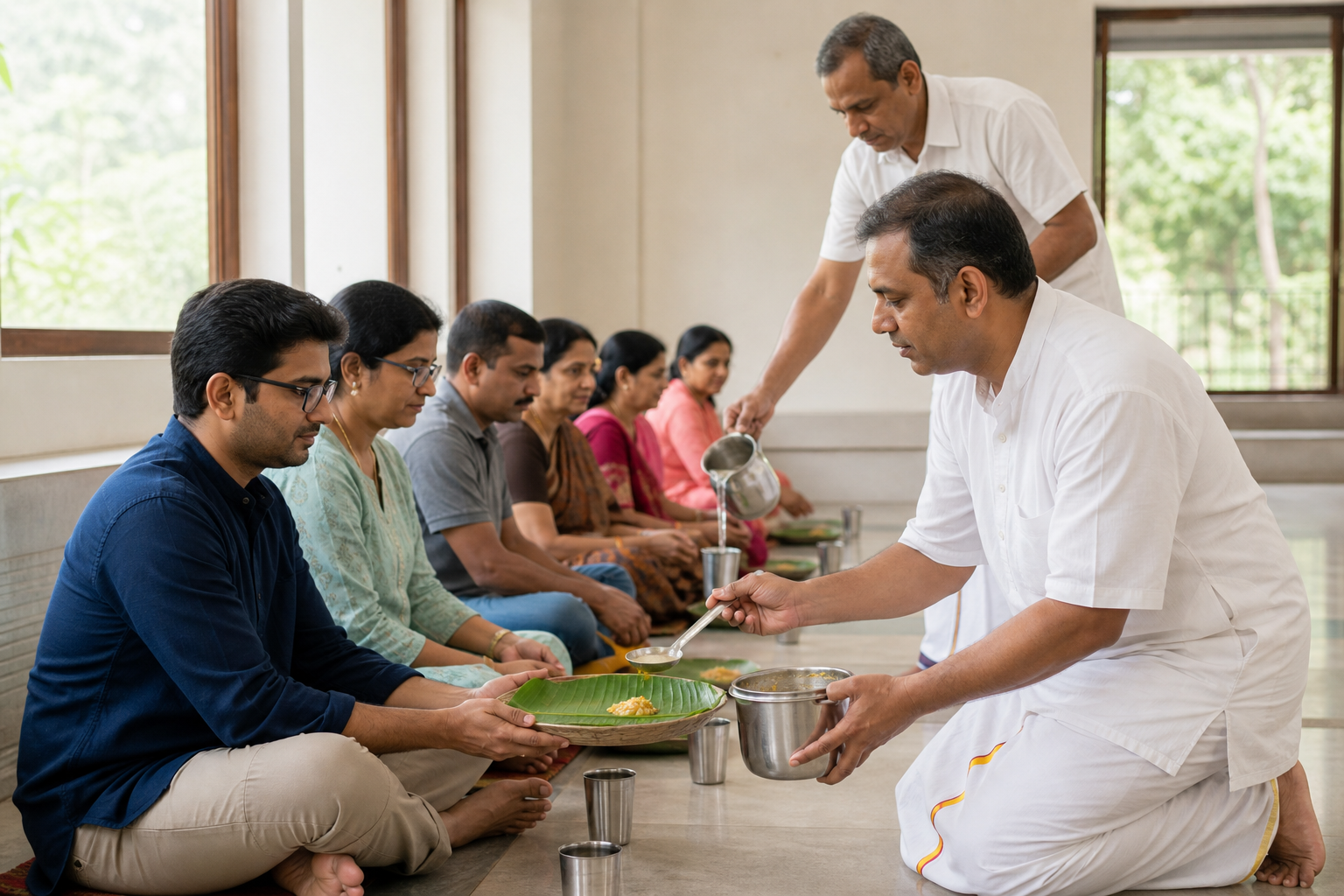
You do not need an extraordinary event to practise the same principle. Use the next temple meal or home offering as a small discipline in receiving well.
- Settle your responsibility before distribution begins. If you have kitchen, cleaning, altar, guest, or other assigned seva, find out when you are needed. This prevents a devotional opportunity from becoming an excuse to leave another person carrying your work.
- Pause before reaching for the food. Remember that you are receiving something offered, not selecting a product from a counter. Even a brief inward acknowledgement can interrupt the habit of immediate consumption.
- Take a portion you can honor. Do not measure mercy by how much you obtain. Taking more than you can eat turns eagerness into waste, while accepting a modest portion can train contentment.
- Receive what is available without ranking it. If a favored preparation is gone, do not convert temple logistics into a verdict on your spiritual worth. Plain food is not evidence of lesser grace, and a sweet is not proof of higher standing.
- Let the meal lead back to seva. After eating, notice the next concrete duty: clean your place, help with distribution, wash utensils if that is your service, welcome someone who is alone, or return promptly to the task already assigned.
A home altar gives this discipline a dependable place in household life. Its value is not decorative. Regular darshan, offering, gratitude, and remembrance create repetition, and repetition helps devotion survive days when no unusual feeling appears. Follow the offering practice taught by your lineage or spiritual teacher rather than inventing a private ritual and then treating it as authoritative.
Three questions can keep the practice honest: Has this food been offered in the way our tradition teaches? Am I receiving it with gratitude rather than demand? What act of service should follow the meal? These questions join altar practice to daily conduct instead of confining devotion to a few minutes before eating.
Do not turn grace into a transaction
Longing for the guru’s mercy is natural in the guru-shishya relationship. The difficulty begins when longing becomes a demand for a particular experience. Watch for four common distortions.
- Chasing the guru’s hand while neglecting the guru’s instruction. A directly received sweet may be memorable, but obedience, correction, and responsible seva reach further into your life.
- Treating every coincidence as a command. A personal event may deepen your faith without becoming a rule for everyone else. Receive its devotional meaning humbly; do not build doctrine from a private sign.
- Using service to bargain for recognition. Resentment after unnoticed seva often reveals an unspoken contract: “I served, so I should be seen.” Notice that expectation and release it before it hardens into comparison.
- Ranking devotees by dramatic memories. One disciple may remember an extraordinary gift, while another is transformed through years of ordinary instruction. Spectacle is not a reliable measure of spiritual depth.
Grace is often quiet enough to be overlooked. It can appear as the strength to complete an inconvenient duty, the humility to accept correction, the easing of resentment, or the remembrance awakened by a familiar plate of prasadam. These effects are less dramatic than a sweetball crossing a crowded floor, but they are directly usable. They change what you do.
When something unexpected does happen, hold it without boasting. Let it increase gratitude, steadiness, and service. A blessing that becomes a claim of superiority has been misunderstood; a blessing that makes you more available to others has been honored.
Key takeaways
- Prasadam is received grace, not a reward for gaining the best position near the guru.
- A personal gift from the guru is meaningful because of the devotional relationship it awakens, not because it gives the recipient higher status.
- When desire and assigned seva conflict, perform the entrusted duty without demanding compensation or a sign.
- Do not interpret a small portion, a missing preparation, or an ordinary meal as lesser mercy.
- Test your reception of prasadam by what follows: gratitude, less waste, steadier remembrance, and responsible service.
At your next meal, do one thing differently: pause, receive the portion without comparison, and return to the next duty with care. If nothing extraordinary happens, the practice has still done its work. If grace arrives in an unexpected form, you will be less tempted to possess it and more prepared to answer it through seva.
References
