

When a message says a Hindu woman or girl has been exploited and the police are ignoring it, waiting can feel like complicity. That is precisely the moment to slow the crowd down and speed the lawful response up.
You do not have to choose between silence and street violence. A disciplined response can get the person to safety, preserve evidence, press the authorities to act, and prevent an allegation from becoming communal punishment.
Key takeaways
- Put the woman or child’s immediate safety ahead of publicity, confrontation, or reputation management.
- Distinguish an allegation, supporting evidence, and a legal finding. They are not interchangeable.
- Preserve relevant material and use documented escalation when the initial police response appears inadequate.
- Do not publish identities, private messages, photographs, or religious labels merely to generate pressure.
- A community safety group may support, document, refer, and advocate. It must never detain, interrogate, threaten, or punish.
When an allegation arrives, separate protection from punishment

In a reported Bhopal episode, people presenting themselves as activists assaulted two Muslim men accused of exploiting Hindu girls, amid claims that police had failed to act. The allegations did not give a crowd the authority to determine guilt or impose punishment. The assault also shifted attention away from the central question: what protection and lawful remedy did the women need?
That distinction matters in every case. Protection is an immediate task. Investigation establishes facts. Adjudication determines legal responsibility. Mixing these functions invites coercion, contaminates accounts, exposes uninvolved people, and makes a just outcome harder to reach.
Start with the following sequence:
- Check for immediate danger. If someone faces an active threat, contact police or emergency services and help the person reach a safe place. Do not assemble a crowd or announce that you are going to confront the accused. If a child may be at risk, involve police and an appropriate child-protection service promptly rather than attempting a community inquiry.
- Protect the person’s agency and privacy. Let an adult woman describe what happened without family members, activists, or religious leaders supplying the answer for her. Ask what support she wants and what she fears will happen next. Protection must not become confinement, surveillance, or pressure to make a public statement.
- Distinguish disapproval from evidence of abuse. An adult relationship does not become coercive merely because relatives object to it or because the two people have different religious identities. Threats, deception, blackmail, violence, forced confinement, financial exploitation, or sexual abuse require careful attention and evidence. A slogan cannot establish any of them.
- Preserve relevant material. Keep original messages, account details, call records, threats, requests for money, and other material connected to the allegation. Prepare a factual timeline while memories are fresh. Do not edit files, seize another person’s device, access an account without permission, or circulate intimate or private material.
- Make a formal report and retain proof of it. Record when and where the complaint was made, which official received it, and any acknowledgement or reference provided. Complaint and case-registration procedures depend on the allegation and jurisdiction, so obtain qualified legal help when the correct route is unclear.
- Escalate institutional inaction through institutional channels. A senior police officer, a women-and-child protection desk, a legal-aid service, or an appropriate police-complaints or oversight body may be the next route. Keep the escalation factual: identify the danger, the evidence offered, the action requested, and the response received.
If police refusal, continuing threats, unlawful confinement, sexual violence, or a child’s safety is involved, general guidance is not enough. A lawyer or recognized legal-aid service should assess the individual circumstances and the correct legal process.
Rumor control is part of women’s safety

A forwarded allegation can collapse several different things into one emotional package: an unverified claim, the identity of an accused person, the religion of a community, and a demand for immediate punishment. Once that package spreads, hesitation is portrayed as betrayal and verification as weakness.
The woman may then lose control of her own story. Her photographs or private conversations can circulate. Relatives may pressure her to support a public narrative. The accused may be attacked before the facts are established. Neighbours who share the same religious identity may become targets. Retaliation can produce further danger without resolving the original allegation.
Before forwarding or publicly repeating a safety claim, apply a verification and privacy gate:
- Origin: Do you know the fact firsthand, or did it arrive through an unnamed or forwarded account? Label unverified material as unverified and keep it out of public circulation.
- Consent: Has the affected adult agreed to have any part of her experience shared? Concern does not create permission to expose her identity.
- Purpose: Will sharing the information help secure safety, evidence, legal assistance, or an official response? If its main function is outrage, do not forward it.
- Relevance: Is religious identity necessary to understand the alleged conduct, or is it being used to convert individual accusations into collective guilt?
- Privacy: Can the necessary warning or request for help be made without names, faces, phone numbers, addresses, private chats, or intimate material?
- Accountability: Has a formal complaint been made? If not, help the affected person reach a trustworthy support service instead of demanding public proof from her.
Do not organize an amateur sting, summon the accused for questioning, force an apology, confiscate a phone, or stage a group visit to a home. Such acts can create immediate physical danger, interfere with evidence, and expose participants to legal consequences. Public pressure is not a substitute for a properly documented complaint and lawful escalation.
A dharmic response requires restraint with strength
Dharmic restraint is sometimes misread as passivity. It is better understood as control over the means we use while fulfilling a duty. Protecting the vulnerable is a duty; so is refusing to manufacture another injustice in the name of protection.
- Ahimsa does not require abandoning someone to danger. It requires stopping harm without turning yourself into another source of violence.
- Karuna keeps the affected person at the centre. It rules out humiliation, repeated interrogation, public exposure, and treating her pain as material for communal mobilization.
- Dharma demands fidelity to rightful roles. Citizens can protect, report, document, accompany, and advocate. Police investigate and provide lawful protection. Courts determine guilt and punishment.
- Sarbat da bhala rejects the idea that our community can be secured by making every member of another community answer for an individual’s alleged conduct.
- The Buddhist middle path refuses the false choice between indifference and frenzy. It supports firm action without hatred, spectacle, or collective blame.
This framework is demanding because it does not offer the emotional release of retaliation. It asks you to stay with the less dramatic work: accompanying a complainant, preserving records, calling the responsible office again, arranging legal help, correcting a rumor, and insisting that institutions explain their response.
Due process is not a concession granted to an accused person at the victim’s expense. It is the method by which an accusation is tested, responsibility is individualized, evidence is protected, and punishment is kept out of the hands of whoever can gather the largest or angriest crowd. When due process fails through delay or indifference, the remedy is accountable escalation and institutional reform, not a parallel street court.
Build a lawful local response before the next crisis
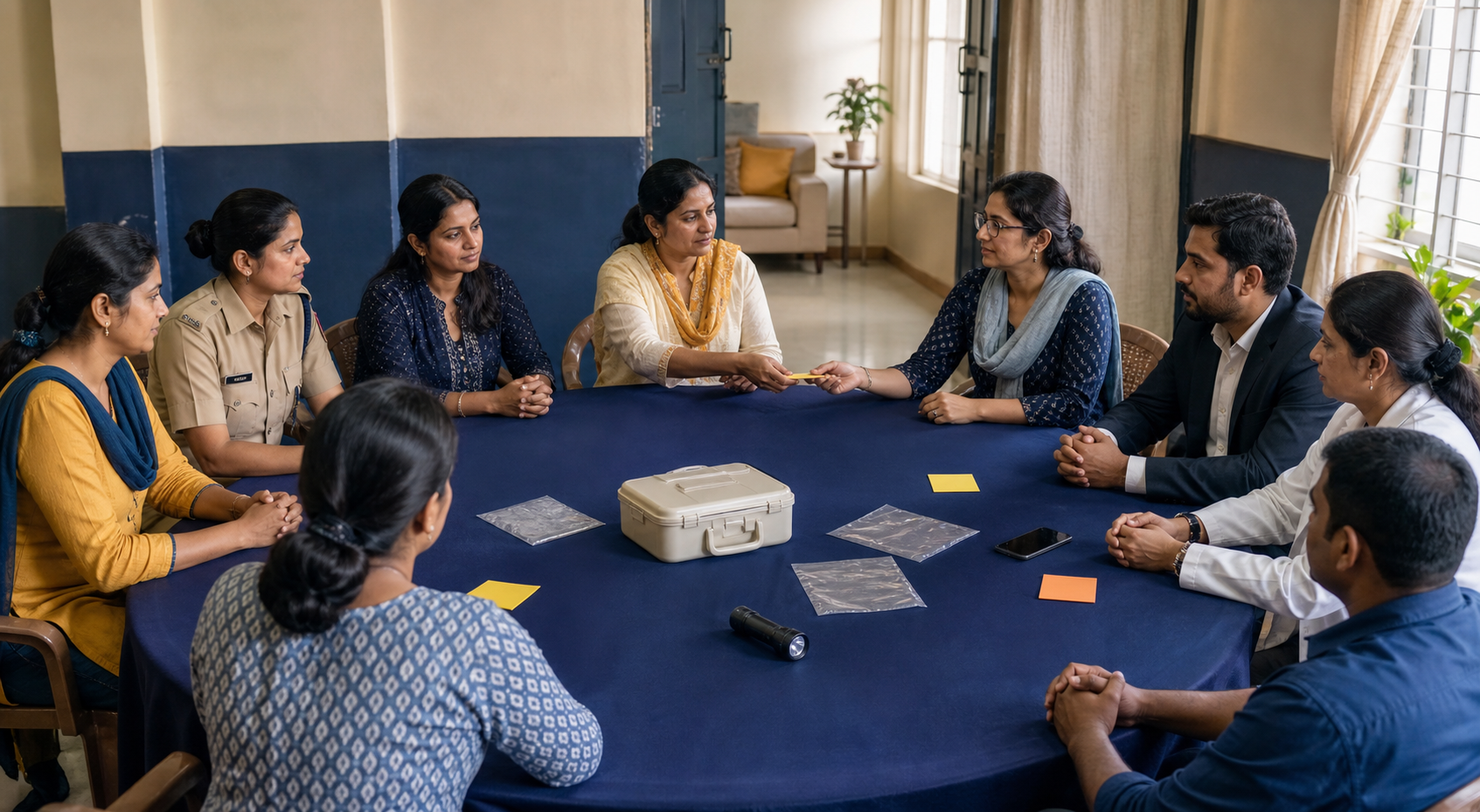
A community usually improvises badly when its first safety protocol is created inside an angry messaging thread. Mandir committees, gurdwaras, viharas, Jain sanghas, women’s groups, neighbourhood associations, and cultural organizations can prepare a short written protocol before an allegation arises.
That protocol should contain:
- A referral directory: current contacts for local police, senior police leadership, women-and-child protection services, legal aid, counselling, and other recognized victim-support services.
- A documented escalation path: where a complaint goes when the first contact does not respond, what records should accompany it, and which oversight route is available locally.
- A support roster: trained or trusted people who can accompany a complainant, help organize records, arrange transport, and connect the person with professional assistance.
- A privacy rule: sensitive details stay with those who need them for protection or legal action. Shared community records should not contain names, intimate material, or unnecessary identifying information.
- A rumor-response rule: designate a responsible contact who checks what is known, separates fact from allegation, asks members not to forward inflammatory claims, and issues corrections when false information has spread.
- A written no-force boundary: the group will not threaten, detain, interrogate, publicly shame, raid, seize property, or impose punishment. Anyone proposing those acts is directed away from the case.
- A liaison mechanism: women representatives, legal-aid workers, local leaders, and interfaith contacts can communicate during a tense case without turning the affected person into a public symbol.
Accountability should also be measurable. Communities can ask whether complaints receive acknowledgements, how long referrals take, whether escalation contacts respond, whether survivors consider the process safe and respectful, and whether rumor-driven disturbances are declining. Use de-identified information for this review. A public accountability effort should never become another database of vulnerable people.
Police responsiveness matters as much as community discipline. Accessible women-and-child desks, clear escalation procedures, transparent progress updates, independent review of alleged inaction, and regular liaison with credible community groups can rebuild trust. When citizens can see a lawful path producing a response, the claim that only mob action works becomes harder to sustain.
If you lead a community organization, adopt the written protocol before the next crisis. If you receive the next alarming message, protect privacy, preserve evidence, and help the complaint reach the proper authority. In this setting, courage is not measured by how quickly anger becomes force. It is measured by whether the vulnerable person becomes safer and whether lawful accountability continues after public attention moves on.
References
