
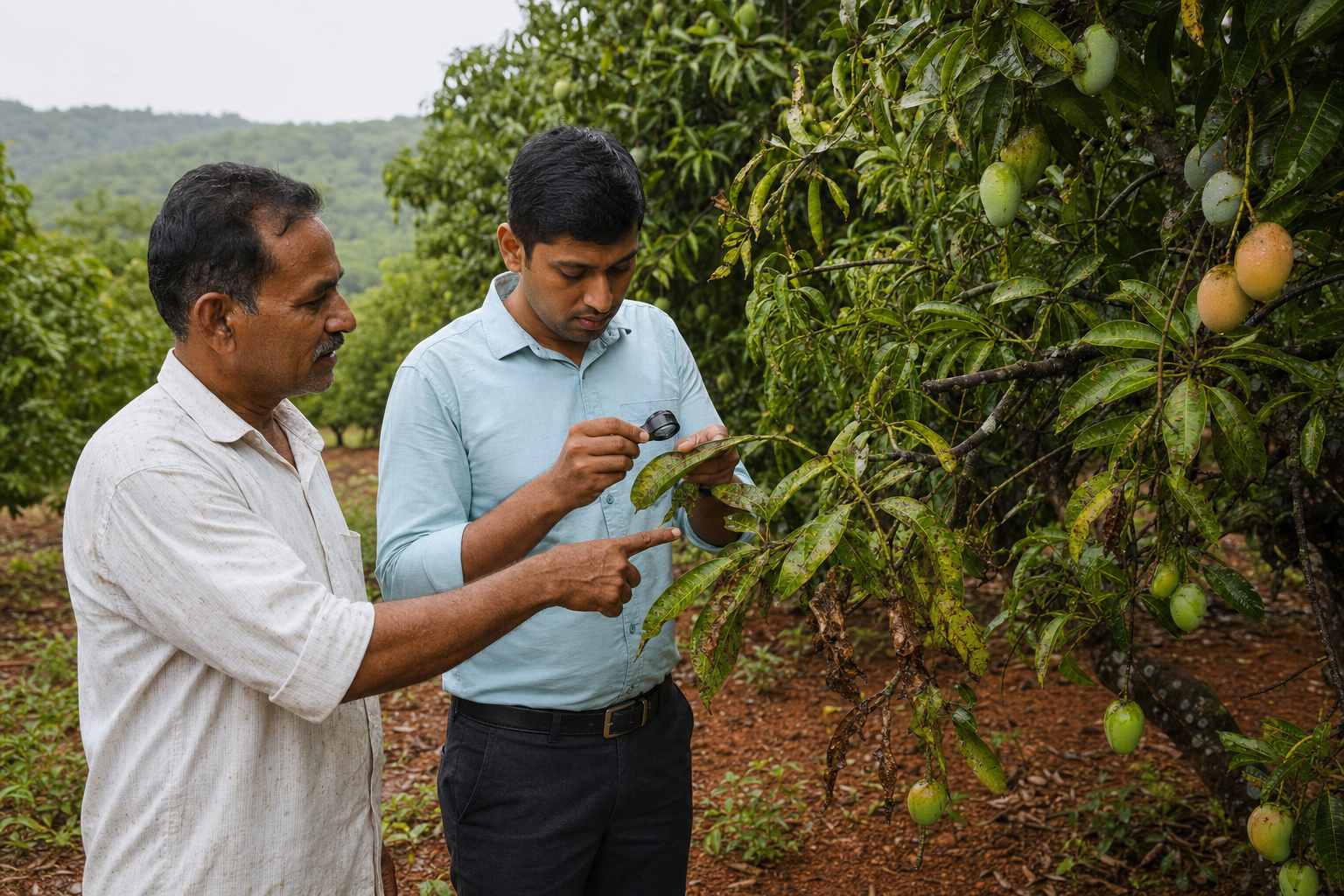
If you are watching pest damage spread through a Sindhudurg mango orchard, the practical question is not whether somebody in Mumbai has reviewed the situation. It is whether a qualified person can reach the affected trees, identify the problem and give you usable guidance while there is still time to protect the crop.
That gap has become a public governance issue. Surajya Abhiyan has alleged inactivity at the Girye-Rameshwar Mango Research Centre and questioned the value of Mumbai-based oversight when Sindhudurg’s growers need help in their orchards. The sound response is not another general assurance. It is a local system whose duties, field work and results can be checked.
Local accountability begins with a named response chain
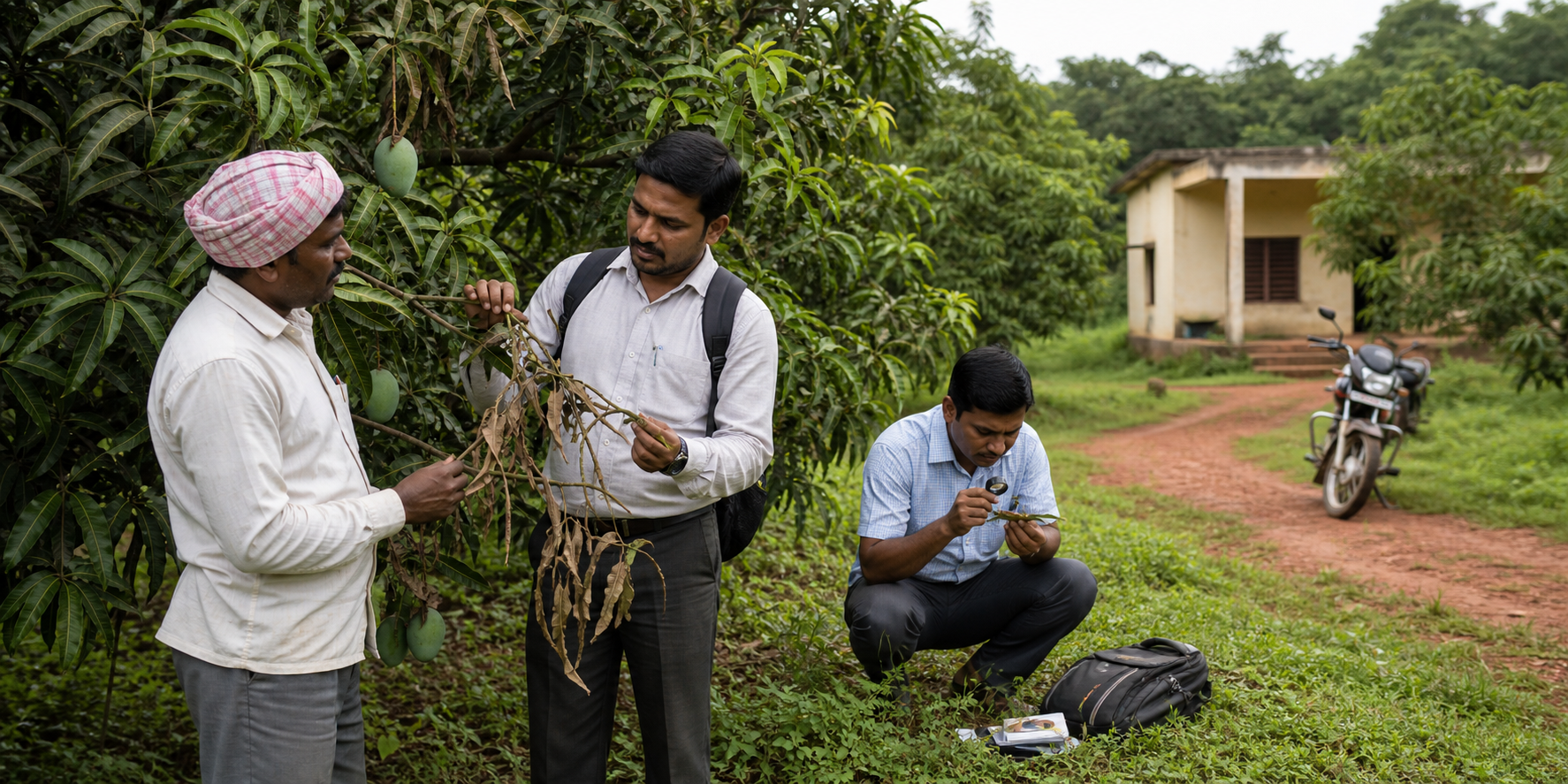
Distance is not automatically the problem. A remote office can coordinate personnel, analyse reports and allocate resources. The failure begins when remote supervision is not connected to a clearly responsible district team.
You should be able to trace a pest report from the first call to the final follow-up. If no one can explain that chain, responsibility can move between the research centre, agriculture officials and other offices while the orchard continues to deteriorate.
Growers, orchard associations and local representatives should ask five questions in writing:
- Which district-level role receives a report from a grower?
- Who decides whether an orchard requires an urgent field visit?
- How does the grower know that the report has been acknowledged and assigned?
- Who is responsible for issuing and signing the technical advisory?
- Where can the grower escalate the matter if no visit, diagnosis or follow-up occurs?
Ask for roles, contact routes and escalation steps rather than a long list of departments. Several office names do not create accountability if no one is answerable for the next action. Keep the written reply with the original complaint and any reference number. That creates a record against which the service can later be assessed.
What a functioning response should deliver in the orchard
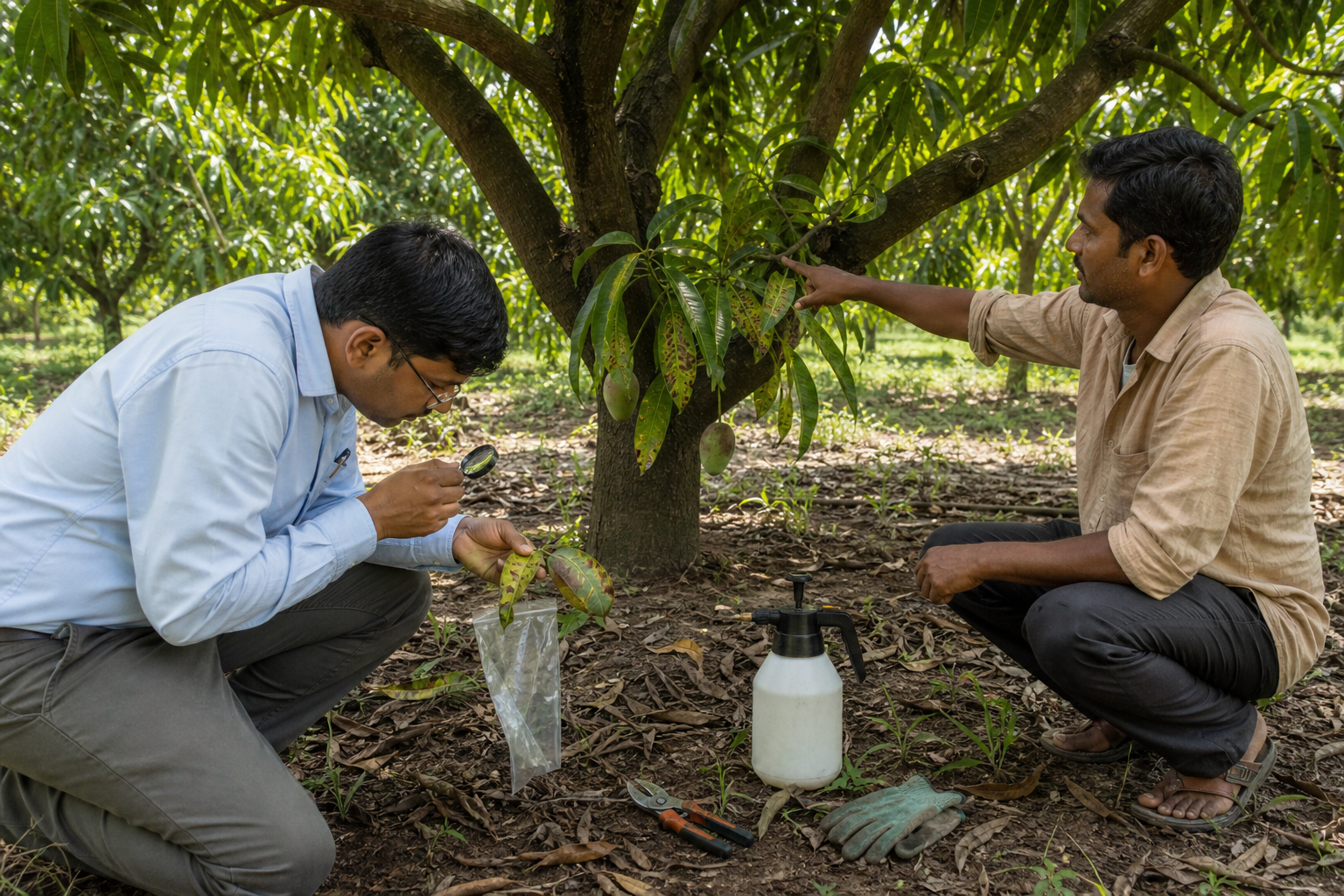
A field visit is not a ceremonial appearance. A useful visit examines affected and apparently unaffected trees, records the crop’s current stage, considers conditions within that orchard and distinguishes a provisional assessment from a confirmed diagnosis. Advice copied from a general circular cannot do all of that.
The minimum response loop should look like this:
- Receive and locate the report. Record the village, orchard section, mango variety if known, crop stage and plant parts showing symptoms.
- Check whether the problem is isolated or clustered. Similar reports from nearby orchards may justify a coordinated survey rather than separate, delayed visits.
- Inspect conditions on site. The officer should examine the pattern across the orchard, not only a single leaf, flower or fruit brought to an office.
- State the level of certainty. If the cause is not yet confirmed, the grower should be told what remains uncertain, what evidence is needed and what should be monitored meanwhile.
- Issue a written integrated pest management advisory. It should explain monitoring, relevant orchard-management measures and any carefully selected crop-protection input that may be appropriate. A product name by itself is not an IPM plan.
- Check practical availability. Recommending an input that growers cannot obtain locally leaves the technical advice unfinished. Officials should identify the authorised alternative or the route for obtaining the recommended material.
- Return to the case. The record should show whether the recommendation was followed, whether symptoms changed and whether the diagnosis or advice needs revision.
Timing matters because pest incidence can coincide with sensitive stages of flowering and fruit development. The value of technically correct advice falls when diagnosis arrives after the useful intervention window. A credible service standard must therefore cover acknowledgement, field triage, advice and follow-up, not merely the eventual closure of a complaint.
Do not treat an unverified photograph, forwarded message or neighbouring orchard’s pesticide schedule as a diagnosis for your trees. An incorrect treatment may waste money, delay the right response and harm organisms that help keep the orchard ecosystem balanced. Record the symptoms and seek locally qualified guidance before selecting or combining crop-protection inputs; when an input is advised, follow its authorised label and safety requirements.
Evidence growers can collect before officials arrive
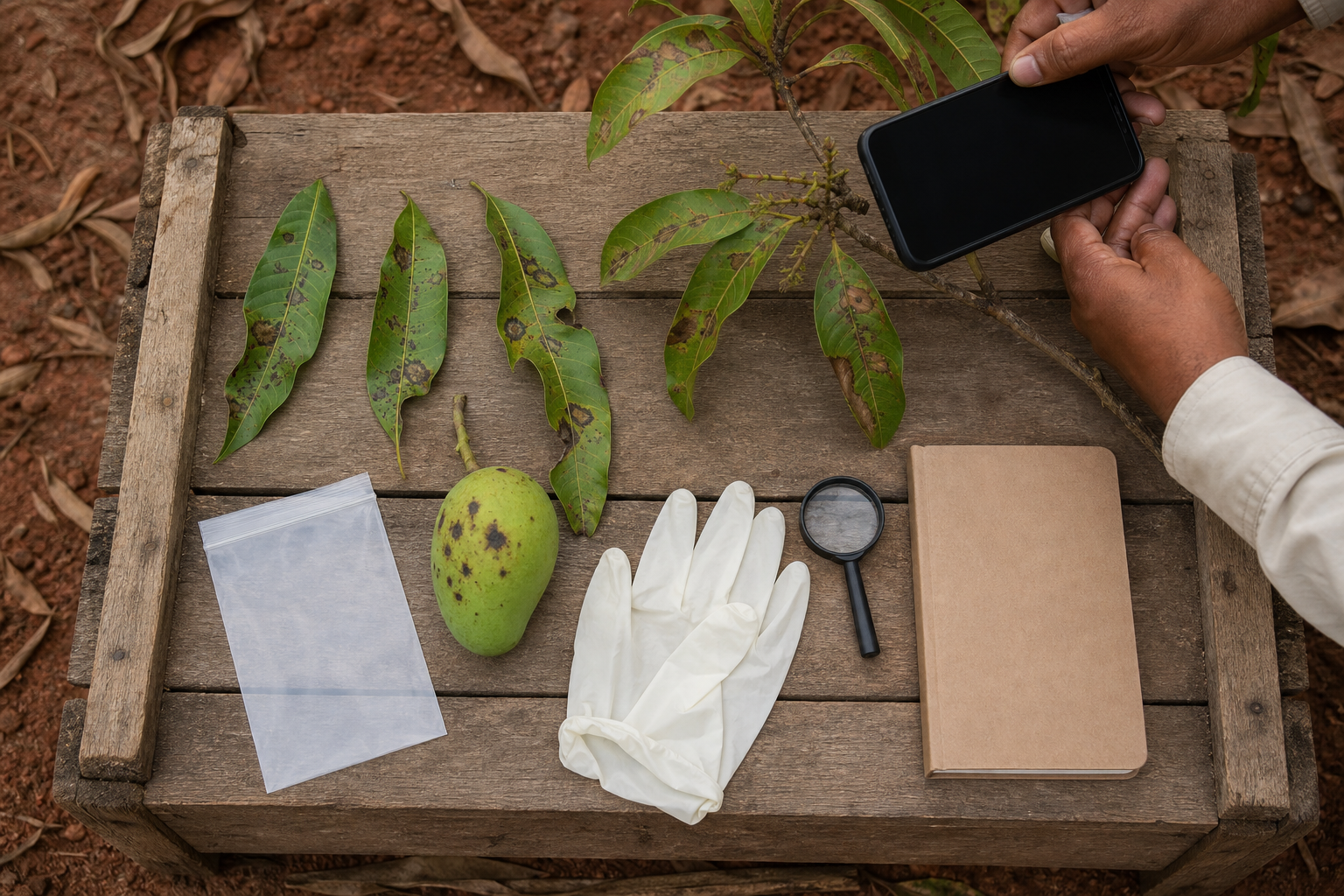
Your records cannot replace an expert inspection. They can make a report easier to triage, harder to misplace and more useful when several villages may be seeing related damage.
Create one incident sheet for each affected orchard. It can be handwritten or digital, but it should use the same fields every time:
- Date the symptoms were first noticed and the date the report was submitted.
- Village, orchard location and the section where the problem first appeared.
- Mango variety, if known, and the crop stage at the time of observation.
- The affected plant part and a plain description of what you see, without guessing the pest.
- Whether the pattern is scattered, concentrated along an edge or visible across a larger block.
- Close photographs of symptoms, wider photographs showing their position on the tree and comparison photographs of apparently unaffected growth.
- Recent conditions observed in the orchard that may help an expert interpret the case.
- Every recent input application, including the product, date and recorded dose, so the adviser does not work from an incomplete history.
- Whether neighbouring orchards appear to show a similar pattern.
- The name or role of the official contacted, the channel used, the reference number and every action promised or completed.
Use the designated reporting channel, then preserve a copy of exactly what was sent. If several growers are affected, an orchard association or village group can consolidate the records without erasing orchard-level differences. A cluster summary should identify common patterns while retaining the individual sheets for diagnosis.
Share public records carefully. Aggregate village-level information can support accountability, but personal details, land records and unnecessary images of individuals need not circulate in public groups. The purpose is to document the agricultural problem and the institutional response, not to expose a farming family.
Measure service in the field, not activity in the office
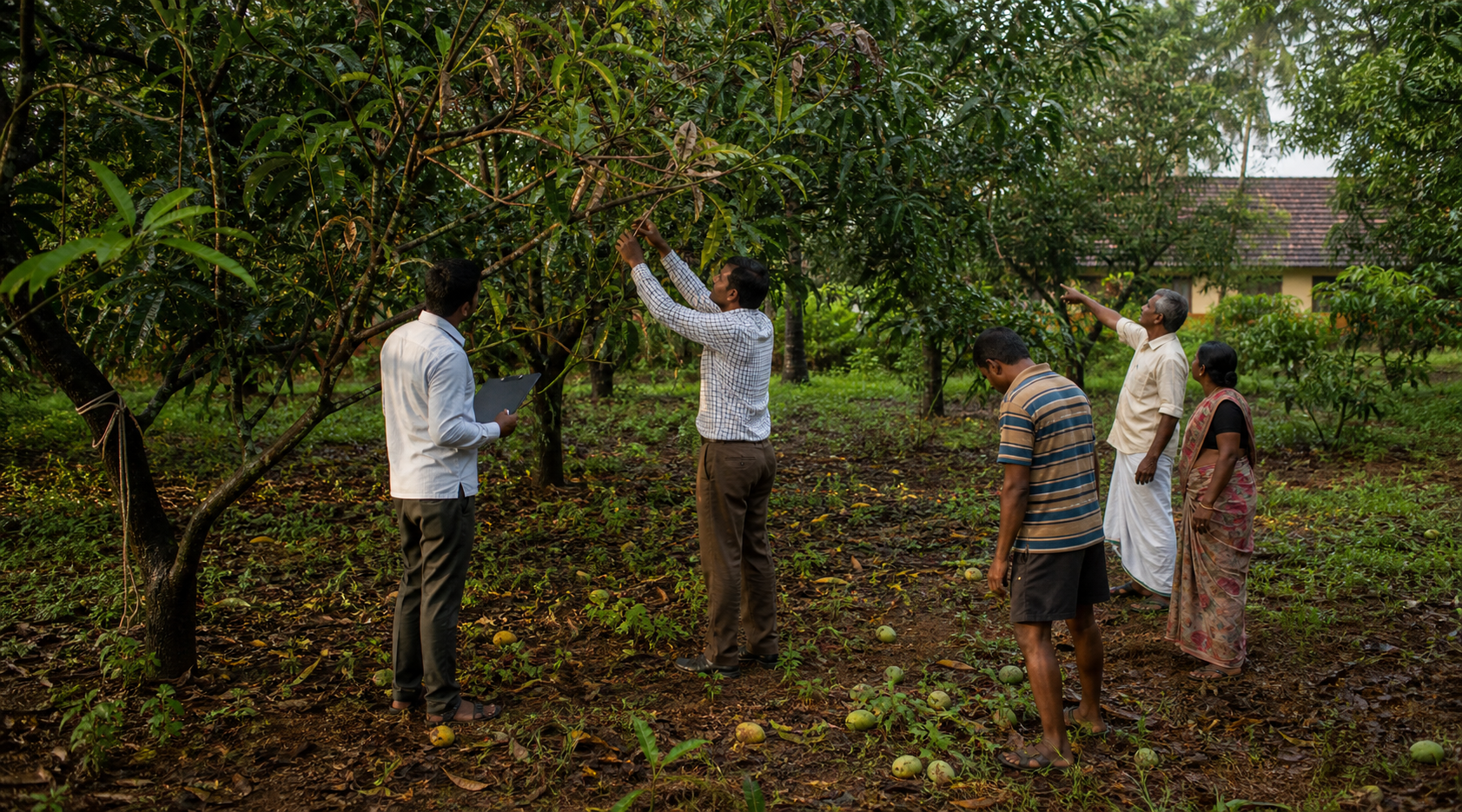
Meetings, circulars and phone calls may support a response, but they do not prove that growers received one. Public accountability should follow the actions that connect an institution to the orchard.
| Service test | Evidence growers should request |
|---|---|
| Local access | An active district contact, a defined reporting channel and a published escalation route. |
| Field response | A visit record showing the village, date and responsible official role. |
| Diagnostic quality | A written distinction between provisional and confirmed findings, with any further examination required. |
| Usable advice | An orchard- and crop-stage-specific IPM advisory with precautions and monitoring instructions. |
| Input readiness | Confirmation that recommended inputs are obtainable, or a defined process for an authorised alternative. |
| Follow-through | A scheduled review or outcome note showing whether the condition changed and whether advice was revised. |
| Public transparency | Regular aggregate reporting on complaints, villages visited, advisories issued and cases awaiting action. |
Raw visit counts are not enough. An institution could record many brief visits without producing diagnoses, written advice or follow-up. The measures must connect activity to a usable service. At the same time, crop outcome alone cannot be the only test: no public institution can guarantee that every orchard will avoid loss. It can be held responsible for responding competently, promptly and transparently.
An allegation of institutional inactivity is not the same as an audited performance record. It does not by itself explain staffing, resources, prior field work or the reason for any delay. That uncertainty is a reason to publish service records, not a reason to abandon scrutiny. Transparent logs allow growers, administrators and the research centre to argue from verifiable actions instead of competing assertions.
Mumbai-based supervision can remain useful as the back office of a local response. It can coordinate expertise, compare patterns and review performance. It cannot substitute for staff who know Sindhudurg’s villages, reach orchards, communicate in a form growers can use and remain responsible after the first visit.
Key takeaways
- Ask for a written chain of responsibility from first report through diagnosis, advice, escalation and follow-up.
- Demand field-based assessment and a written, crop-stage-specific IPM advisory rather than a generic product recommendation.
- Record symptoms, orchard context, photographs, recent inputs and every official contact in one consistent incident sheet.
- Judge performance through field visits, diagnostic clarity, usable advice, input readiness and completed follow-up, not announcements alone.
- Do not turn institutional delay into pesticide guesswork. Preserve the evidence and escalate through the named local route.
Your next step is concrete: take a completed incident sheet to your orchard association, village representative or local agriculture office and ask for one consolidated written request to the Girye-Rameshwar Mango Research Centre. That request should seek the district response chain, the applicable service standard and an on-site plan for affected orchards.
Local accountability is not hostility toward expertise located elsewhere. It is the insistence that public expertise reach the land and families bearing the consequence. A dharmic public ethic joins care for livelihood with care for soil, water and living systems. In Sindhudurg, that duty becomes real when every reported orchard has a responsible official, a usable response and a record that the community can verify.
References
