
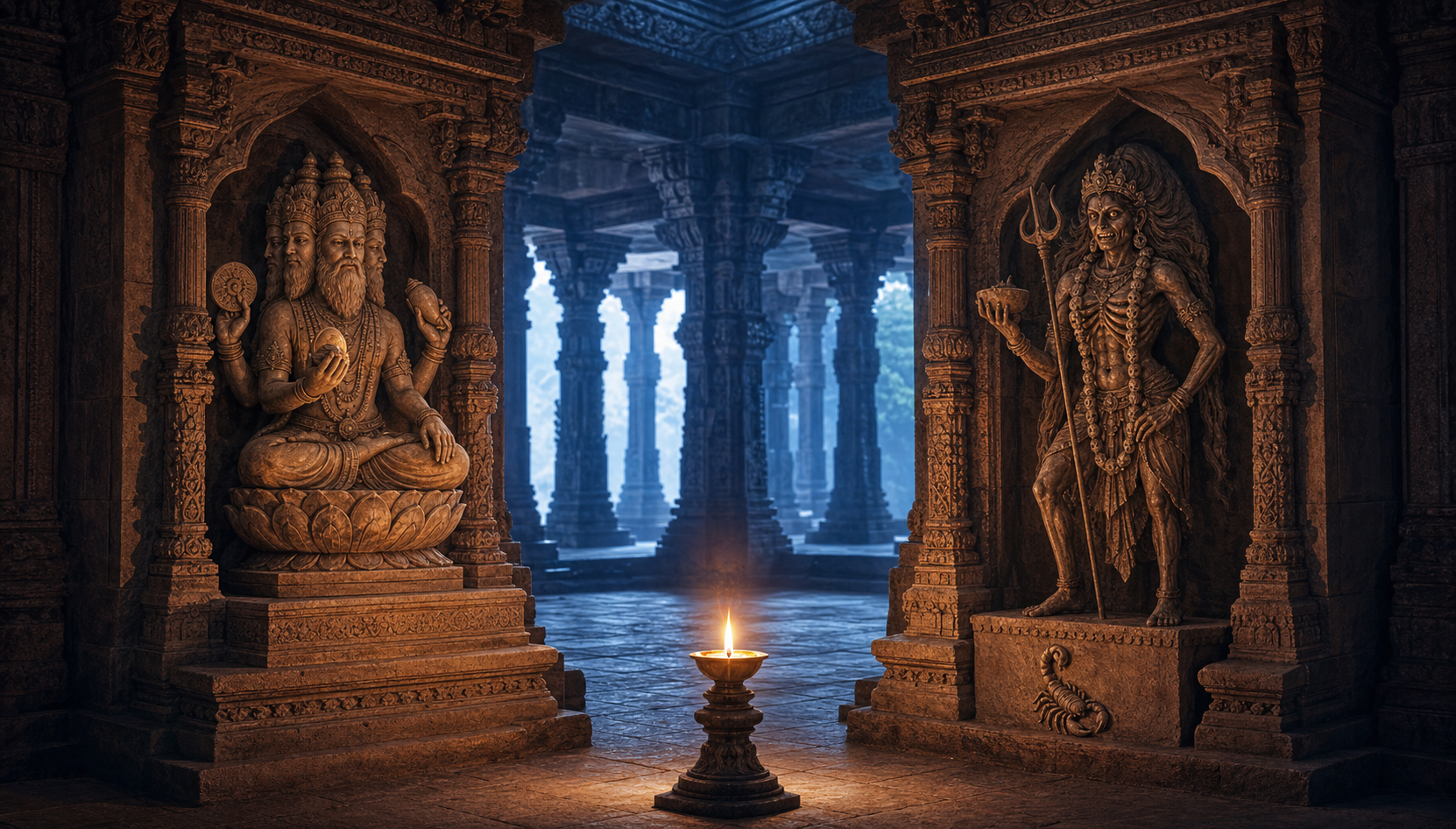
You encounter a murti in which a familiar deity carries an unfamiliar emblem. Brahma holds the conch and discus associated with Vishnu. Chamunda appears with a scorpion or governs a direction you hadn’t considered spiritually significant. Is the image mistaken, merely regional, or trying to teach you something?
Begin with a better question: what ethical work does the unusual feature ask you to perform? Rare divine iconography becomes intelligible when you read it as a relationship among powers, duties, dangers, and restraints—not as a catalogue in which every object belongs permanently to one deity.
Start with the departure, not a verdict
A conventional image gives you a baseline. A rare image alters that baseline, and the alteration is often where its teaching resides. Brahma, for example, is ordinarily recognised through the Vedas, an akshamala or japa mala, and a kamandalu. These attributes direct attention toward knowledge, creation, contemplation, and restraint. When the conch and chakra appear in his hands instead, you should notice the change before trying to explain it away.
Use this five-step method whenever an image seems unusual:
- Establish the familiar form. Identify the deity and the attributes normally associated with that form. This gives you a point of comparison rather than a rigid ownership chart.
- Describe the departure without interpreting it. Record what is actually present: an unfamiliar weapon, animal, bodily form, direction, posture, setting, or combination of emblems.
- Ask what each feature does. A wheel turns and cuts; a conch sounds and awakens; a scorpion detects proximity and strikes precisely. Function frequently opens the path to ethical meaning.
- Read the combination as a sentence. The deity is the subject, the unusual attribute supplies a verb or qualification, and the setting establishes the field in which the teaching operates.
- Convert the reading into a test for conduct. Ask what you must create, preserve, restrain, expose, correct, or protect. If the interpretation changes nothing about how you see or act, you may have stopped at description.
This method does not make every interpretation equally valid. Regional tradition, temple context, accompanying figures, and the complete set of attributes still matter. State what you can see with confidence, distinguish it from what you infer, and avoid turning one local expression into a universal rule.
Shankhu Chakradhari Brahma: creation must accept correction
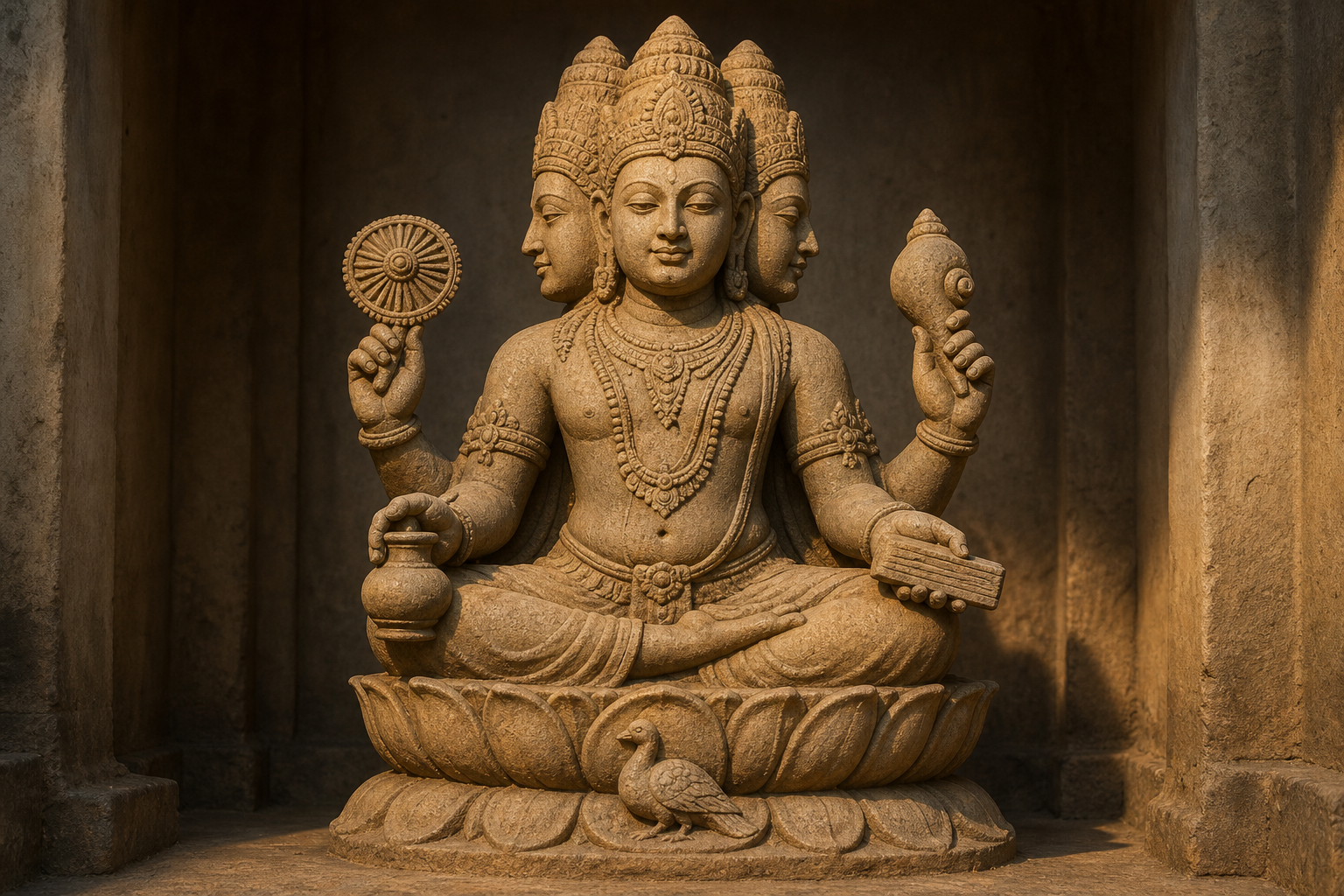
Shankhu Chakradhari Brahma places the Sudarshana Chakra and shankha in the hands of the creator. The image joins srishti, the function of creation, with sthiti, the function of preservation. Its ethical force lies in that conjunction: the ability to produce something does not release its creator from responsibility for what the creation sustains.
Puranic narratives often present Brahma granting boons in response to tapas, including boons sought by asuras. The pattern conveys the impartial operation of merit and cosmic law, but it also exposes a difficult truth: a grant can be procedurally earned and still produce consequences that disturb dharmic balance. Preservation then enters the situation as correction. Read this way, the rare form does not confuse Brahma and Vishnu. It shows their functions cooperating.
The chakra contributes more than destructive power. It evokes order, time, and sudarshana—the clear or auspicious vision capable of cutting through adharma. In Brahma’s hand, it asks whether intelligence is governed by discernment. Knowledge without ethical sight can build efficiently while failing to recognise what it is building toward.
The shankha contributes sacred sound, breath, and awakening. Its call precedes action by making dharma audible. In Brahma’s hand, it asks whether creation begins from a principle that can be declared openly. If your purpose must remain disguised because honest speech would expose it, the conch has already revealed a fault in the undertaking.
| Feature | Ethical work | Question for you |
|---|---|---|
| Brahma | Creation guided by knowledge | What am I bringing into being? |
| Sudarshana Chakra | Discernment, order, correction, and awareness of consequences over time | What will keep this creation aligned with dharma? |
| Shankha | Awakening, truthful proclamation, and enlivening breath | Can I state the governing principle clearly before I act? |
| The combined form | Cooperation between creation and preservation | Am I willing to correct what I create when its effects become harmful? |
You can apply this icon to an ordinary decision without pretending that every decision is cosmic. Before starting a project, making a promise, or granting someone authority, separate four questions: Is the act generative? Is it legitimately earned or justified? What preserves ethical order after the act? What correction will be available if the consequences diverge from the intention? The third and fourth questions are where creative enthusiasm most often needs the chakra.
Chamunda: protection begins before decay becomes obvious
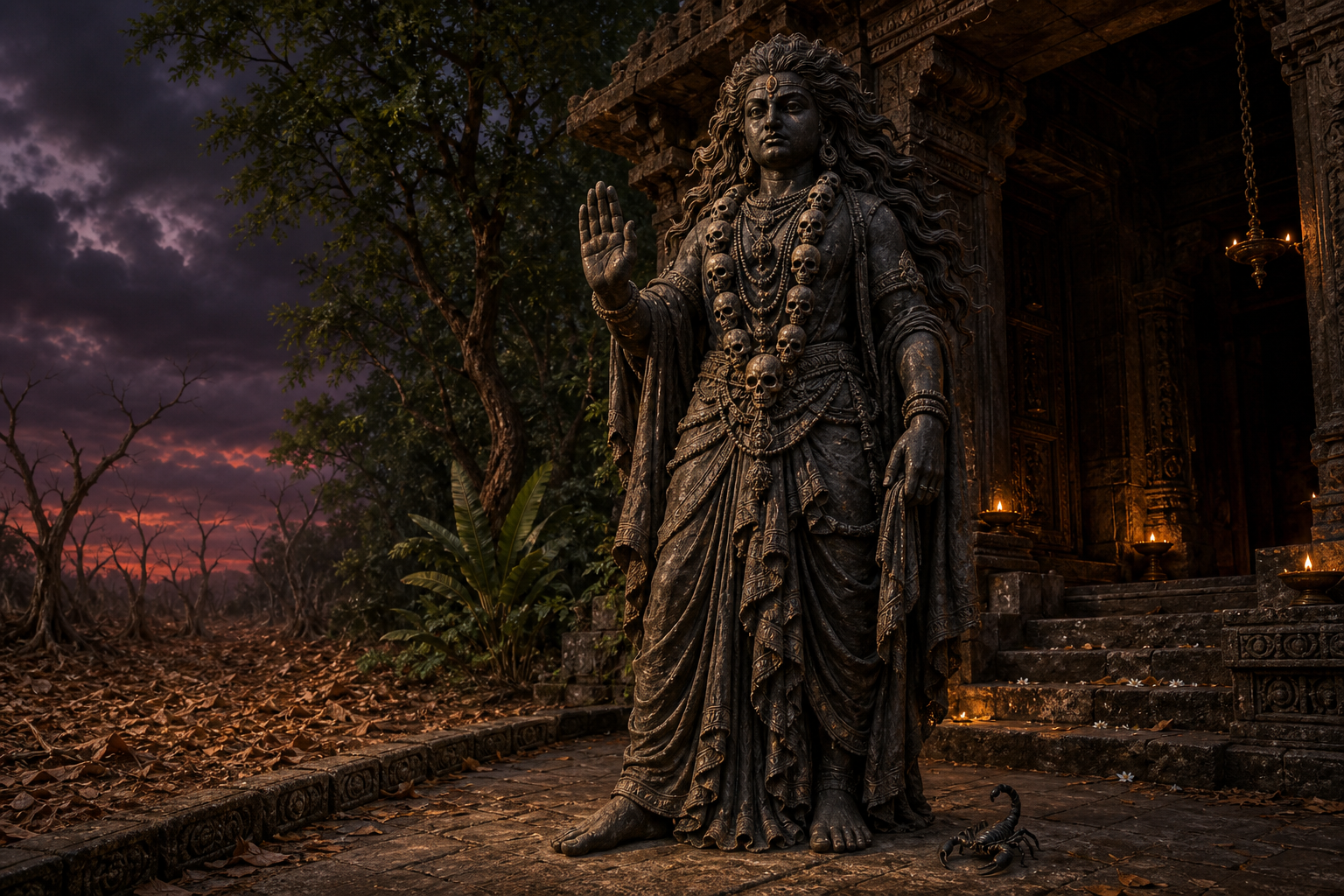
Chamunda teaches through deliberate severity. Her gaunt body, sunken abdomen, skull imagery, and cremation-ground setting refuse to make mortality and decay comfortable. A thin or skeletal form might look like weakness if read only through ordinary physical expectations. Within her fierce iconography, it signifies time’s power to consume impurity and expose what appearances conceal.
The scorpion, found with Chamunda in certain regional traditions, sharpens that lesson. It represents vigilance toward concealed danger and the need for timely, precise defence. The ethical danger is not always a dramatic enemy standing in plain view. It can begin as an indulgence you keep excusing, a dishonest convenience, resentment protected by silence, or despair allowed to govern the next choice.
Chamunda’s association with the southwest, or Nairritya, gives the image a spatial dimension. The direction carries the weight of endings, time, entropy, and responsibility. Within the Ashta Matrika setting, Chamunda stands as a boundary-keeper where decline must be arrested. Direction here is not merely location. It marks an ethical threshold: the point at which passive recognition must become disciplined response.
That fierceness should first be directed toward clarity, not projected as hostility toward other people. The scorpion is a poor excuse for uncontrolled anger because its symbolic force is precision. Chamunda does not teach you to strike indiscriminately. She teaches you to detect corruption early, stop feeding it, and defend the boundary without becoming another form of the disorder you oppose.
At the end of the day, turn her iconography into a brief examination of conduct. If southwest-facing contemplation belongs naturally within your practice, it can help establish the mood, but the moral review matters more than mechanical performance:
- Name one moment when your integrity weakened. Describe the act without self-justification.
- Identify the concealed impulse beneath it: fear, convenience, appetite, resentment, pride, or resignation.
- Notice whether you intervened early or waited until the consequence spread.
- Choose one proportionate repair: tell the truth, withdraw cooperation from a harmful act, restore a neglected boundary, or correct what your conduct damaged.
- Where it belongs to your established sadhana, use contemplation of Chamunda or recitation connected with the Devi Mahatmya to steady the intention rather than to avoid the repair.
The point is not to manufacture guilt. It is to shorten the distance between recognition and correction. Chamunda’s unsettling form is useful precisely because moral decline often survives by making itself look familiar, tolerable, or too small to confront.
Recognise shared Dharmic symbols without erasing differences
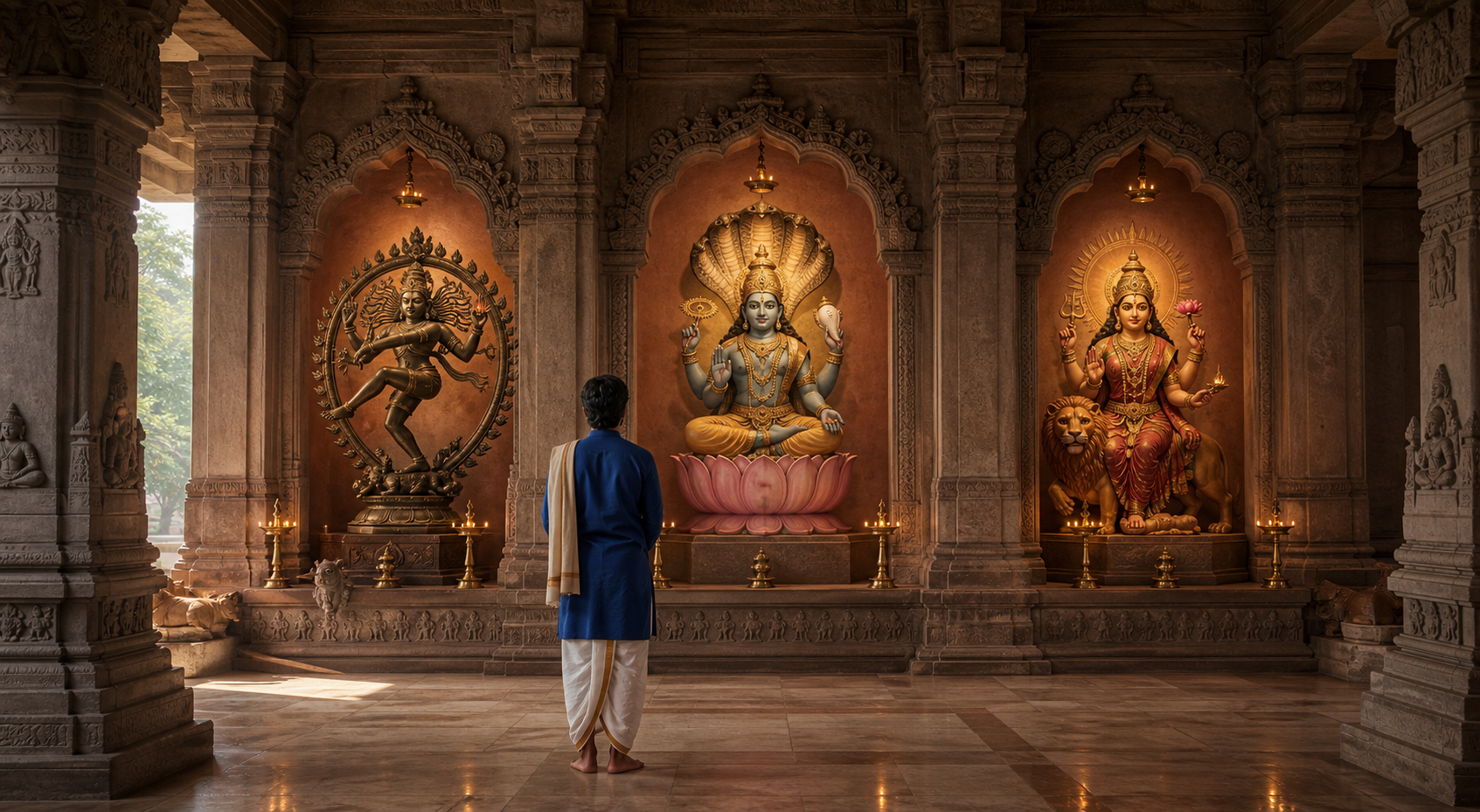
A wheel can travel across Dharmic traditions while retaining both shared resonance and distinct theological meaning. The Buddhist Dharma-Chakra, the Jain dharmachakra, and the chakkar within the Sikh Khanda each honour a wheel associated with enduring order. Hindu chakra imagery participates in that wider civilisational vocabulary. The recurrence is meaningful, but it does not make the traditions interchangeable.
Compare such symbols at three levels. First, observe the shared form: the circle, rotation, continuity, or capacity to cut. Second, identify the ethical function emphasised in the particular setting: law, discernment, disciplined continuity, or defence of order. Third, preserve the lineage-specific context instead of forcing a single explanation onto every occurrence. Unity becomes credible when it can accommodate difference.
Sacred sound offers another field of resonance. The shankha’s connection with primordial sound, breath, and awakening belongs to a civilisation in which recitation and meditative attention give sound formative importance. The shared ethical thread is not that all practices are identical. It is that disciplined attention, truthful expression, self-mastery, compassion, and resistance to inner poisons matter across Dharmic paths.
Keep observation, interpretation, and application separate
When you discuss a rare image, use three distinct kinds of statement:
- Observation: “Brahma holds a conch and chakra in this image.” This reports what can be seen.
- Contextual interpretation: “The combination can be read as creation aligned with preservation and discernment.” This explains a plausible theological relationship without claiming exclusivity.
- Ethical application: “Before creating or granting, I will decide how harmful consequences can be corrected.” This is the discipline you draw from the image, not a claim that every lineage prescribes the same exercise.
This separation prevents four common mistakes: treating emblems as the permanent property of one deity, interpreting fierceness as permission for aggression, universalising a regional motif, and collapsing Hindu, Buddhist, Jain, and Sikh symbols into one undifferentiated doctrine. It also lets you be spiritually receptive without pretending to possess certainty you do not have.
Key takeaways
- The unfamiliar feature is often the interpretive centre of a rare divine image, so establish the conventional form and then study the departure.
- Read attributes by their functions and relationships, not through a rigid chart of which deity “owns” which object.
- Shankhu Chakradhari Brahma asks whether creation is joined to preservation, truthful purpose, and a real capacity for correction.
- Chamunda’s fierce imagery asks you to recognise concealed decay early and answer it with proportionate, disciplined action.
- Shared Dharmic forms can reveal civilisational kinship without erasing the distinct meanings given to them by Hindu, Buddhist, Jain, and Sikh traditions.
- A sound interpretation ends in an ethical question you can act on while remaining honest about regional variation and interpretive limits.
The next time an image unsettles your expectations, don’t rush to domesticate it. Describe the departure, ask what each feature does, and let the complete form test one decision before you. Rare iconography earns its place in your life when darshan becomes discernment and discernment becomes conduct.
References
- DharmaRenaissance Blog — Shankhu Chakradhari Brahma: Decoding a Rare, Awe-Inspiring Icon of Sudarshana and Shankhu
- DharmaRenaissance Blog — Chamunda, the Scorpion, and the Southwest: Fierce Divine Protection from Moral Decay
