
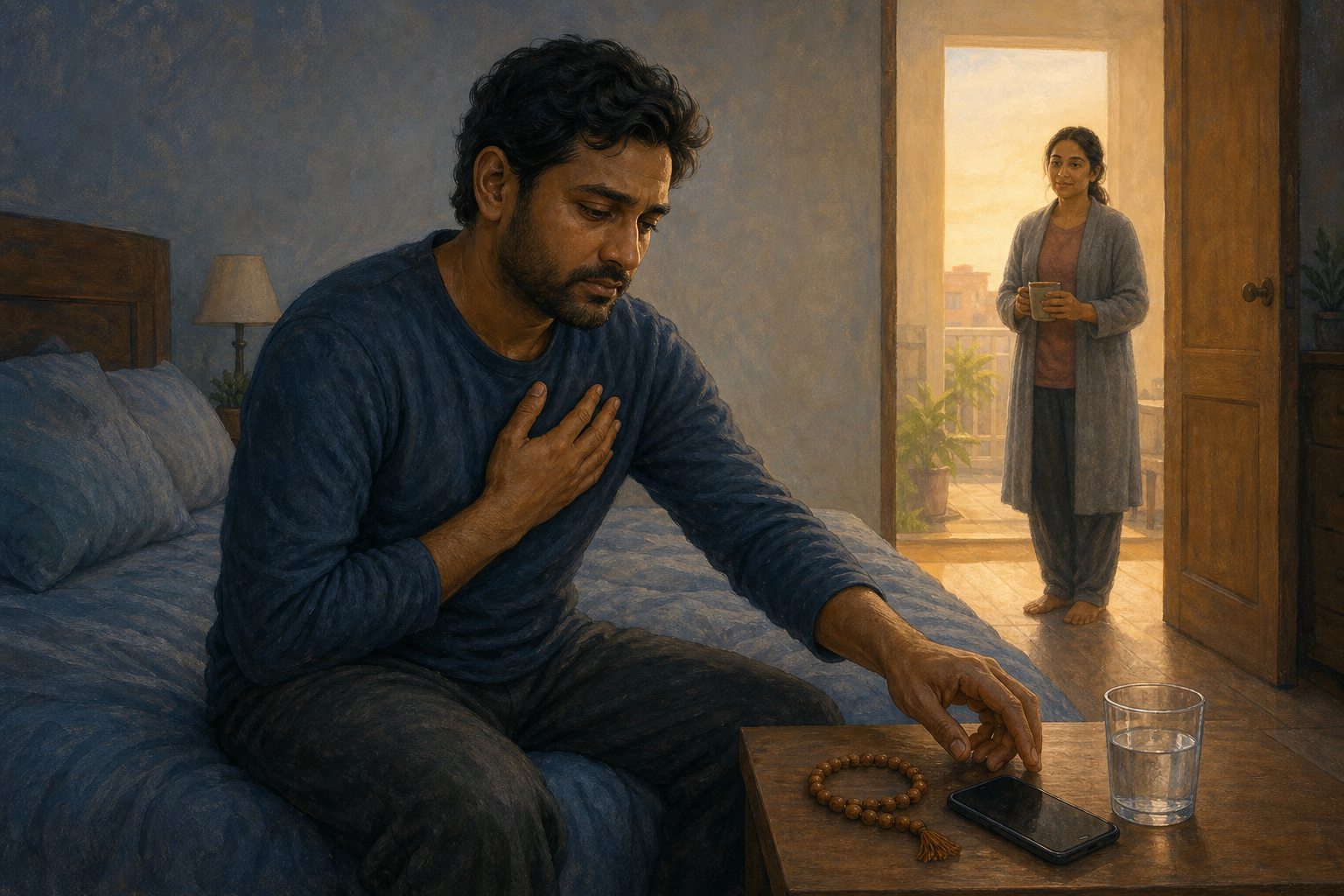
When you wake with a heavy body, little interest in ordinary life, and a mind repeating the same bleak conclusions, a spiritual question can quickly become a painful one: should you meditate through this, treat it as karma, or seek medical help?
You do not have to choose between dharma and healthcare. A Dharmic discipline can help you meet the next hour without hatred, preserve a workable routine, and remain connected to other people. It cannot diagnose depression, and it should never be used to delay medical or psychological care. The sound approach is to let spiritual practice support care rather than compete with it.
Depression is not a verdict on your karma or devotion
Dharmic language becomes harmful when it is used to blame a suffering person. Karma is reduced to accusation. Vairagya, or non-attachment, is confused with emotional numbness. Santosha, or contentment, becomes a demand to look cheerful. Seva becomes an excuse to neglect your own body. None of these interpretations gives you a responsible way to respond to depression.
Depression is also not identical to dukkha. Dukkha names the wider instability, dissatisfaction, and suffering woven through conditioned life. Depression is a health concern that may involve persistent low mood, loss of interest, exhaustion, changes in sleep or appetite, difficulty concentrating, hopelessness, or impaired daily functioning. Spiritual insight may change your relationship with these experiences, but it does not reveal their medical cause or determine the treatment you need.
Hinduism, Buddhism, Jainism, and Sikhism do not offer a single interchangeable doctrine of mind. They have distinct teachings, communities, and disciplines. Yet witness-consciousness, mindful non-aversion, inner ahimsa, and seva provide several compatible ways to stop adding hostility and isolation to pain:
- Hindu witness-consciousness: Notice that a painful state is present without making it your entire identity. Replace “I am worthless” with a more exact observation: “A thought of worthlessness is arising.” This is not wordplay. It separates the observing awareness from the conclusion produced by a distressed mind.
- Buddhist mindfulness: Notice sensation, emotion, and thought without immediately clinging to them or trying to force them away. The aim is not to approve of suffering. It is to reduce the second struggle created by aversion: “This must not be happening, and I must get rid of it now.”
- Jain ahimsa: Extend non-violence to your inner conduct. Insults, forced austerity, skipped care, and relentless self-punishment do not become virtuous because they happen inside your own mind. Ask what the least harmful next response would be.
- Sikh seva and hukam: Act within the reality that is present, remain part of the human community, and do some bounded good when you have the capacity. Hukam is not passive resignation, and seva is not self-erasure. Both can turn you away from the fiction that you must control everything alone.
These approaches change the question. Instead of asking, “What spiritual defect caused this?” ask, “What is happening in my body and mind, what response reduces harm, and who needs to know that I am struggling?” That question leaves room for practice, family support, therapy, medicine, rest, and ethical action.
Build a minimum viable day around abhyasa
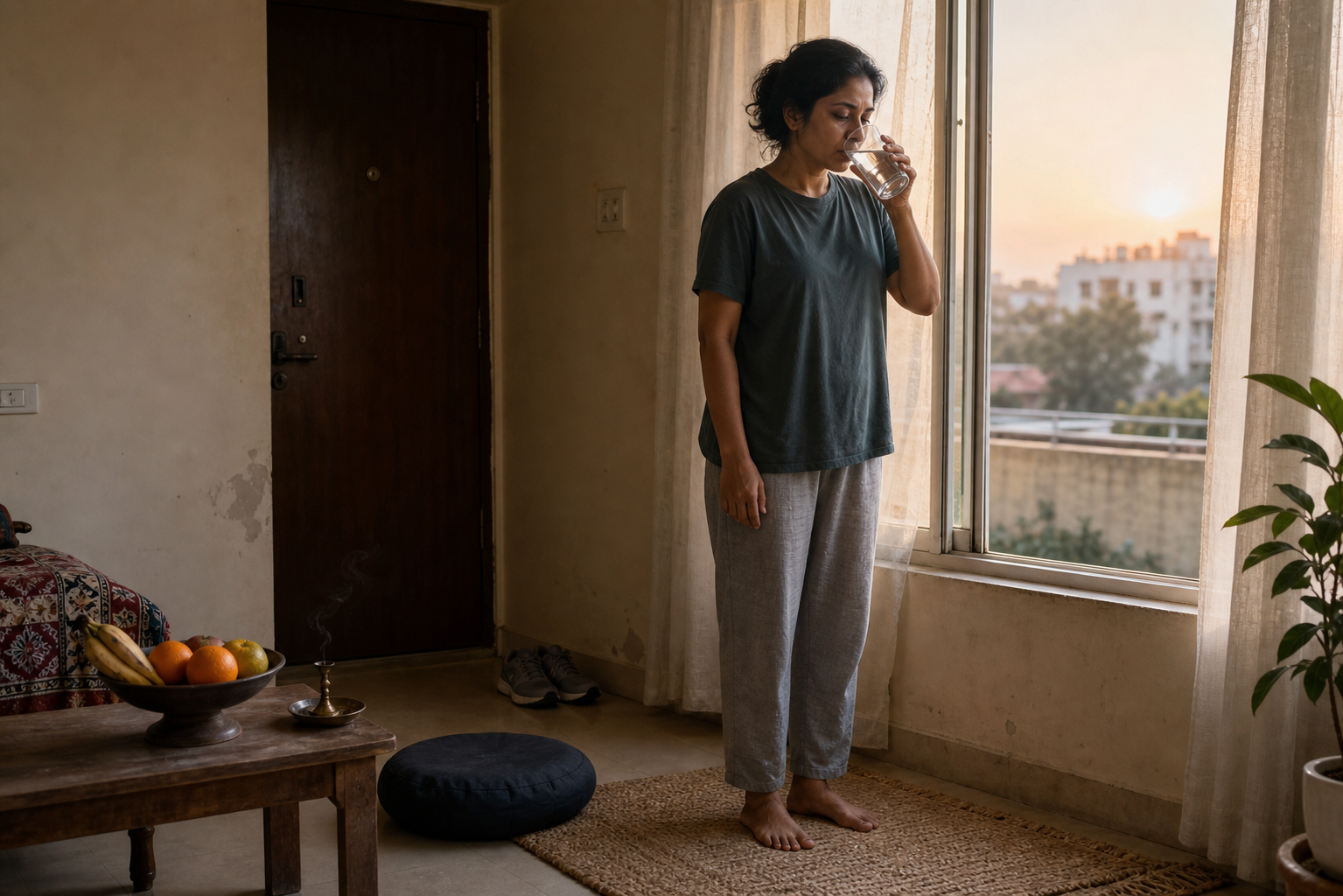
On a difficult day, an ambitious wellness routine can become another instrument of shame. Abhyasa means sustained practice, not dramatic intensity. Your immediate task is to preserve the smallest pattern that supports safety, nourishment, contact, and necessary care. Think of it as a minimum viable day, not a test of productivity.
- Check safety before starting a spiritual exercise. Ask whether you are in danger of harming yourself, unable to keep yourself safe, or unable to manage basic needs such as drinking, eating, or taking essential prescribed medicine. If the answer may be yes, contact another person and obtain urgent professional help. Do not retreat into solitary meditation.
- Stabilize the body. Drink water, eat a simple meal you can tolerate, wash, take prescribed medicine as directed, open the room to fresh air when practical, and protect a steady sleep-wake rhythm. Clean surroundings, regular nourishment, hydration, ventilation, and quiet reflection can serve as household anchors. They are supports for health, not cures for depression.
- Use gentle attention rather than force. Feel the surface supporting your body. Let the breath remain natural. Name what is actually present: pressure in the chest, tiredness behind the eyes, fear, numbness, or an urge to withdraw. Then offer a simple inward wish for freedom from fear and the possibility of peace. You do not have to manufacture a peaceful feeling for the practice to count.
- Choose a bounded dharma. Identify the smallest necessary act that protects life or relationship: attend an appointment, reply honestly to a trusted person, prepare food, care for a dependent, or say that a commitment must be postponed. Dharma here is the next responsible action, not the impossible demand to repair your entire life.
- Give the mind a truthful form. Write a few honest lines, draw, chant, play familiar music, or make something with your hands. Creativity does not have to be impressive or public. Its value is that pain becomes an experience you can observe and express rather than an unnamed atmosphere filling everything.
- Notice the effect without grading yourself. After the practice, ask whether you are steadier, unchanged, or more distressed. Repeat what increases capacity. Modify or stop what makes you less safe, more agitated, or more disconnected.
Rest belongs in this pattern. Lying down, sleeping, or becoming quiet can interrupt an escalating spiral. The useful distinction is between restorative rest and deepening withdrawal. After resting, are you a little more able to drink, eat, speak, or accept care? If so, the rest served life. If retreat repeatedly makes contact and basic care less possible, tell someone instead of treating further isolation as spiritual surrender.
Meditation also needs adjustment when inward attention intensifies panic, traumatic memories, dissociation, or frightening thoughts. Open your eyes. Look around the room. Feel your feet against the floor. Walk slowly, pray aloud, or sit near a safe person. Seek guidance from a clinician familiar with your symptoms and, if useful, a contemplative teacher who understands mental-health boundaries. Difficulty with silent meditation is not a failure of faith.
Keep pranayama gentle when you are distressed. Breath awareness can steady attention, but forceful breathing, prolonged breath retention, or a competitive attempt to overpower your state is not required. If a breathing practice produces dizziness, panic, pain, or greater disorientation, stop and return to ordinary breathing.
Let seva and sacred interdependence interrupt isolation
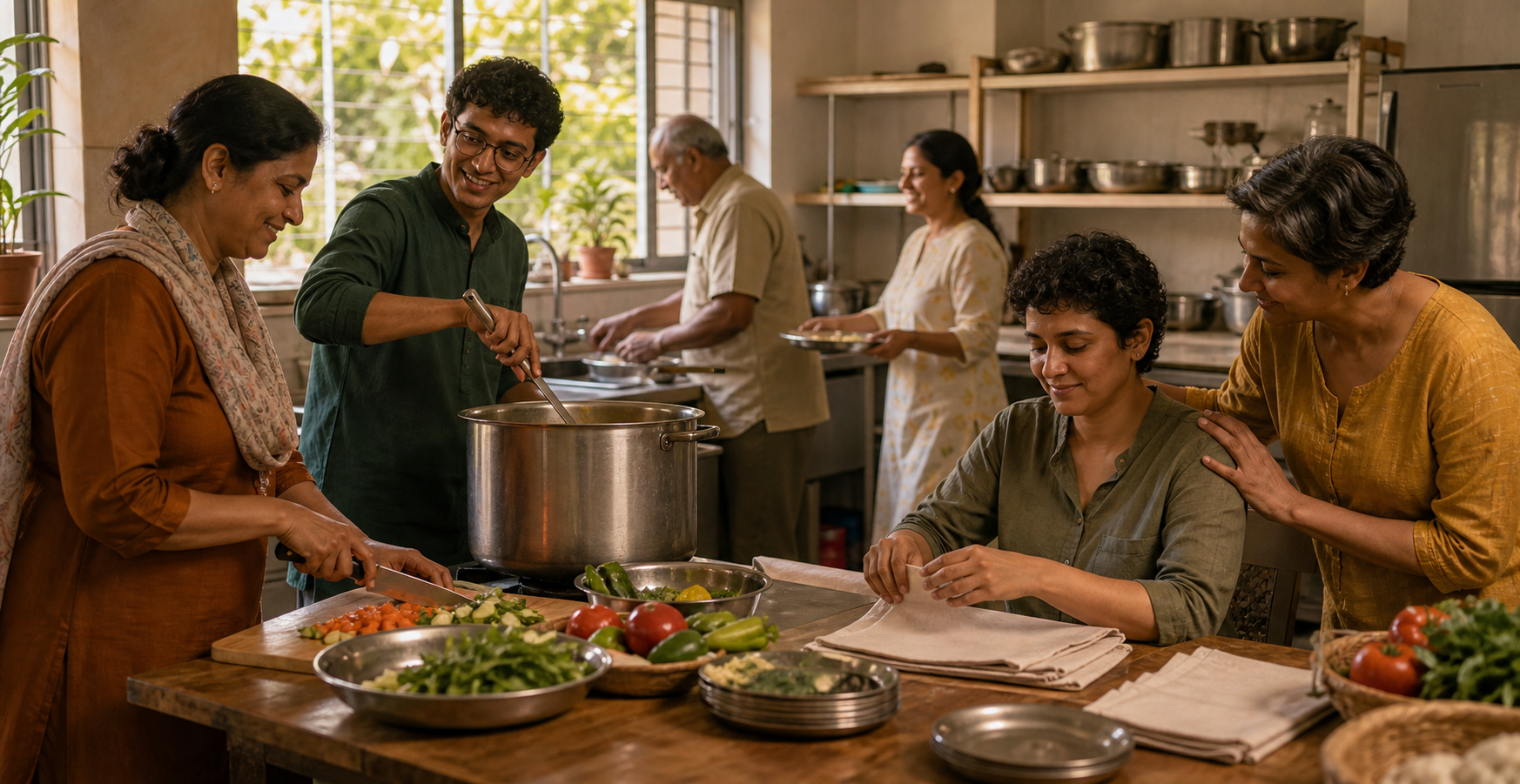
Depression can narrow the field of attention until you seem separate from everyone and useful to no one. Dharmic interdependence offers a direct correction. The Taittiriya Upanishad treats anna, nourishment or food, as sacred, while the Bhagavad Gita places nourishment within a cycle of yajna, rain, growth, and life. Buddhism describes dependent origination. Jainism joins interdependence to restraint and non-harm. Sikh practice embodies shared nourishment through seva and langar.
The practical point is that a person is sustained by exchanges that no individual creates alone. Food nourishes the body. Breath participates in a living environment. Attention feeds patterns of mind. Trustworthy presence nourishes dignity. Seeing life as a continuous circulation of nourishment, energy, attention, and care weakens the demand to be self-sufficient.
Put that insight into practice in three directions:
- Receive nourishment without apology. Ask someone to bring a meal, sit with you, drive you to an appointment, help with children, or make a difficult phone call. Receiving care is participation in interdependence, not a debt or a moral failure.
- Offer bounded seva when capacity allows. Make tea for a family member, refill water, listen without fixing, tend a shared space, or play familiar music for an elder. A modest act of caregiving or creativity can remind you that your identity is larger than the depressive state. Choose an act small enough that it does not exhaust you or replace your own treatment.
- Protect what receives your attention. Rumination repeatedly supplies the mind with the same fear, grievance, or prediction. Do not try to win an endless argument with every thought. Name the loop, turn toward a chosen physical task, and return to the concern later with another person if it requires action.
Seva can be misused as avoidance. If you keep helping so that nobody notices your pain, the service is concealing a need rather than resolving it. Pair outward care with truthful disclosure: “I can do this task, and I am also not doing well.” The sentence protects both relationship and reality.
The same test applies to household upay or health totke. A ritual may be useful when it cues cleanliness, predictable meals, gratitude, family cooperation, prayer, or quiet. Its value in this context lies in meaning and habit. Reject any practice that blames the ill person, demands secrecy, requires unsafe ingestion, exploits fear, or tells you to abandon qualified care. A symbolic remedy must never be advertised to a suffering family as a medical cure.
Aparigraha also has an inward use. You can loosen your grip on the demand to be completely fixed today. Santosha does not require contentment with illness; it permits recognition that the next adequate act is enough for the present moment. This is steadiness without pretending that pain is desirable.
Know when practice must hand over to clinical care

Spiritual practice is not the right tool for every moment. Some conditions require immediate safety measures; others require a professional assessment even when you are still able to pray, work, or care for others.
- Get urgent help if you may harm yourself or cannot stay safe. Contact the emergency or crisis service where you live, go to the nearest emergency department, or ask a trusted person to do this with you. Move away from anything you might use to hurt yourself, and do not remain alone while the danger is active.
- Arrange a clinical assessment when symptoms persist or impair ordinary functioning. Difficulty eating, sleeping, studying, working, maintaining hygiene, caring for dependents, or staying connected is not something you have to solve through discipline alone.
- Seek prompt medical attention for sudden or severe changes. Marked confusion, extreme agitation, loss of contact with reality, an abrupt change after starting or stopping a medicine, or symptoms connected with a medical condition or substance use need professional evaluation.
- Use the right kind of helper. A physician can assess physical contributors and medication concerns. A licensed mental-health professional can evaluate symptoms and provide psychological treatment. A psychiatrist can assess diagnosis and medication when appropriate. A spiritual teacher can support ethics, practice, and community, but should not substitute for a clinician unless that person is separately qualified.
Therapy or medication is not evidence of weak devotion. It may restore enough sleep, concentration, or stability for spiritual practice to become possible again. Do not stop prescribed medicine because of fasting, a totka, breathwork, or advice from someone who is not qualified to manage that medicine. Discuss concerns and religious observances with the prescribing clinician.
If you are supporting someone else, begin with belief and safety rather than philosophy. Say, “I believe that you are suffering. Are you safe right now? Would you like me to stay or help arrange care?” If the person says they are not safe, remain with them and contact urgent local help. Avoid telling them that suffering is merely karma, that others have it worse, or that more gratitude and meditation should be enough.
Key takeaways for the next difficult day
- Do not interpret depression as proof of bad karma, failed devotion, or insufficient willpower.
- Use witness-consciousness to describe the state accurately without turning it into your whole identity.
- Apply ahimsa inwardly: no self-insults, punitive austerity, forced practice, or delay in necessary care.
- Preserve a minimum viable day built around safety, water, food, prescribed care, gentle attention, honest contact, and a bounded duty.
- Let seva interrupt isolation, but keep it small and pair it with willingness to receive help.
- When safety or functioning is compromised, move from self-practice to qualified professional care.
On a clearer day, prepare a short care card. Write down the person you will contact, the local service you can use in a crisis, the simplest food you can manage, the grounding practice that usually helps, and the responsibilities that can be postponed. Keep it somewhere visible. When the difficult hour arrives, follow the card instead of asking a distressed mind to design a new path from nothing.
References
- DharmaRenaissance Blog – Facing the Inner Prowler: How Mindfulness, Caregiving, and Creativity Temper Depression
- DharmaRenaissance Blog – The Sacred Ecology of Life: Hindu Wisdom to Ease Suffering through Interdependence
- DharmaRenaissance Blog – Chamatkari Health Totke: Accha Swasthya ke Liye Saral, Holistic Upay aur Parivar ki Samriddhi
