

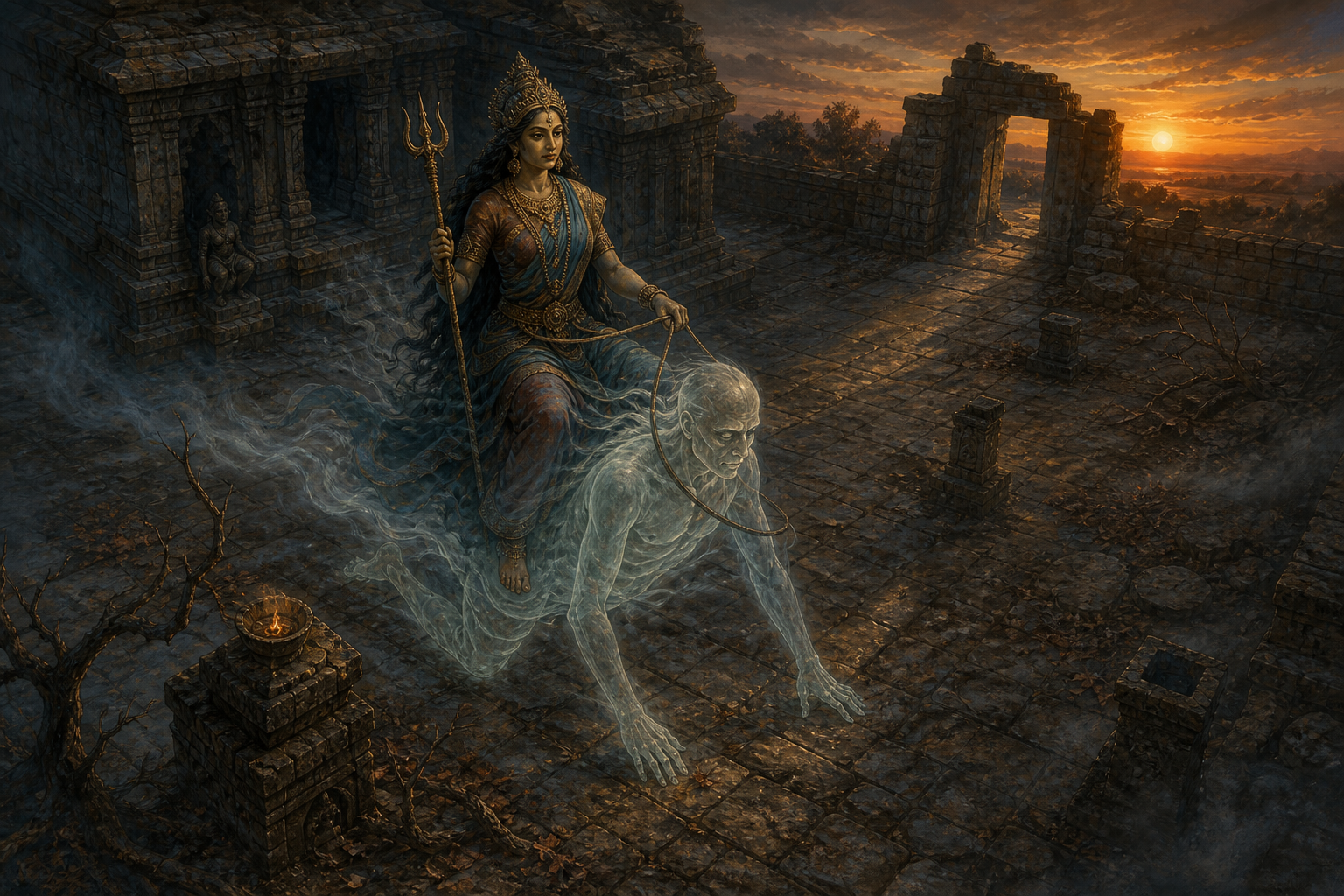
If you have encountered an image of Nirrti riding a ghost or corpse, your first question may be blunt: Why would a Hindu goddess be shown this way? Is she evil, inauspicious, or a warning to stay away?
The image becomes intelligible once you stop treating the mount as a literal endorsement of death. Nirrti confronts you with what ordinary life encourages you to hide: loss, disorder, mortality, fear, and the collapse of identities that once seemed permanent. Her transformative role begins there. She does not make decay pleasant; she shows how it can be faced, contained, and redirected through dharma.
Why Nirrti’s unsettling image deserves a second look
Nirrti has long been associated with misfortune, dissolution, and forces that disturb settled order. That association is real, but it is not the same as saying that she is a Hindu equivalent of an absolutely evil power. Within Vedic, Puranic, regional, and sectarian strands, her presence is more varied: she can mark danger and decline while also guarding the threshold through which one condition passes into another.
This distinction matters because a threshold deity does not necessarily remove every frightening thing. She may instead govern the place where frightening things must be encountered. Birth, death, exile, grief, the end of status, and the failure of a cherished plan all expose the limits of control. Nirrti’s realm is the moment when denial no longer works and a wiser response must be chosen.
Her iconography is not uniform. Some depictions emphasize dark radiance or disheveled hair; others show her seated upon a human form. The ghost, preta, or corpse, shava, belongs to certain Puranic and local expressions rather than to one compulsory image accepted everywhere. That variation should make you cautious about rigid claims. Hindu iconography often preserves several related meanings without reducing them to a single dictionary definition.
The shock of the image is therefore part of its teaching. You are not allowed to keep mortality outside the sacred world. What is feared, decaying, or socially avoided is placed beneath divine sovereignty. The darkness remains visible, but it no longer occupies the throne.
How to read the ghost, the mount, and the southwest
The ghost represents what has not been assimilated
A preta is not merely a decorative horror. Symbolically, it can represent something that continues to haunt consciousness because it has not been acknowledged or placed within an ethical order. Unprocessed grief, fear of death, resentment, shame, and destructive impulses all behave this way. They return indirectly when they cannot be faced directly.
This does not mean that every traditional depiction can be reduced to modern psychology. It means the motif can legitimately prompt psychological inquiry. When an old fear keeps deciding how you speak, withdraw, cling, or strike back, that fear has effectively become your rider. Nirrti reverses the relationship: the haunting force becomes the vehicle, not the sovereign.
The vahana shows mastery rather than identification
In Hindu imagery, a deity’s vahana can disclose a power that has been mastered, directed, or incorporated into a larger sacred function. The deity is not simply identical with the mount. That visual grammar changes the meaning of Nirrti’s ghost or corpse: she is not overcome by death, and she does not ask the devotee to worship despair. She occupies the position of command over the very condition that frightens the viewer.
Use that distinction when contemplating the image. Do not ask only, “What terrible thing does the ghost represent?” Ask, “What would it mean for this force to serve discernment instead of governing me?” Anger might become the energy needed to defend someone without cruelty. Grief might deepen compassion without becoming permanent withdrawal. Awareness of mortality might clarify priorities instead of producing panic.
The southwest marks a domain of endings
Puranic traditions, including the Skanda Purana, connect Nirrti with guardianship of the southwest, or nairrtya. Within the symbolic reading of the directions, the southwest evokes decline, dusk, dissolution, and the boundary at which an established form begins to give way.
Directional guardianship adds an important limit to the symbolism. Disorder is not permitted to spread without distinction; it is assigned a place, recognized, and held within a larger cosmos. Applied inwardly, this is the difference between acknowledging fear and allowing fear to occupy every part of life. A difficult emotion needs honest attention, but it does not deserve unrestricted authority over your speech, duties, relationships, and decisions.
Darkness and dishevelment interrupt false respectability
Dark radiance and unbound or disheveled hair can direct attention toward what lies beyond polished social order. They confront the assumption that whatever looks controlled must be spiritually sound, while whatever looks disturbing must be spiritually empty. Nirrti exposes that shallow equation. A respectable exterior can conceal fear, denial, or adharma; an unsettling sacred form can disclose a truth that comfort has concealed.
This is not permission to romanticize chaos. The image asks for discernment precisely because destructive forces are real. The point is to recognize them early, give them boundaries, and bring their energy under dharmic direction.
Transformation requires recognition, containment, and direction
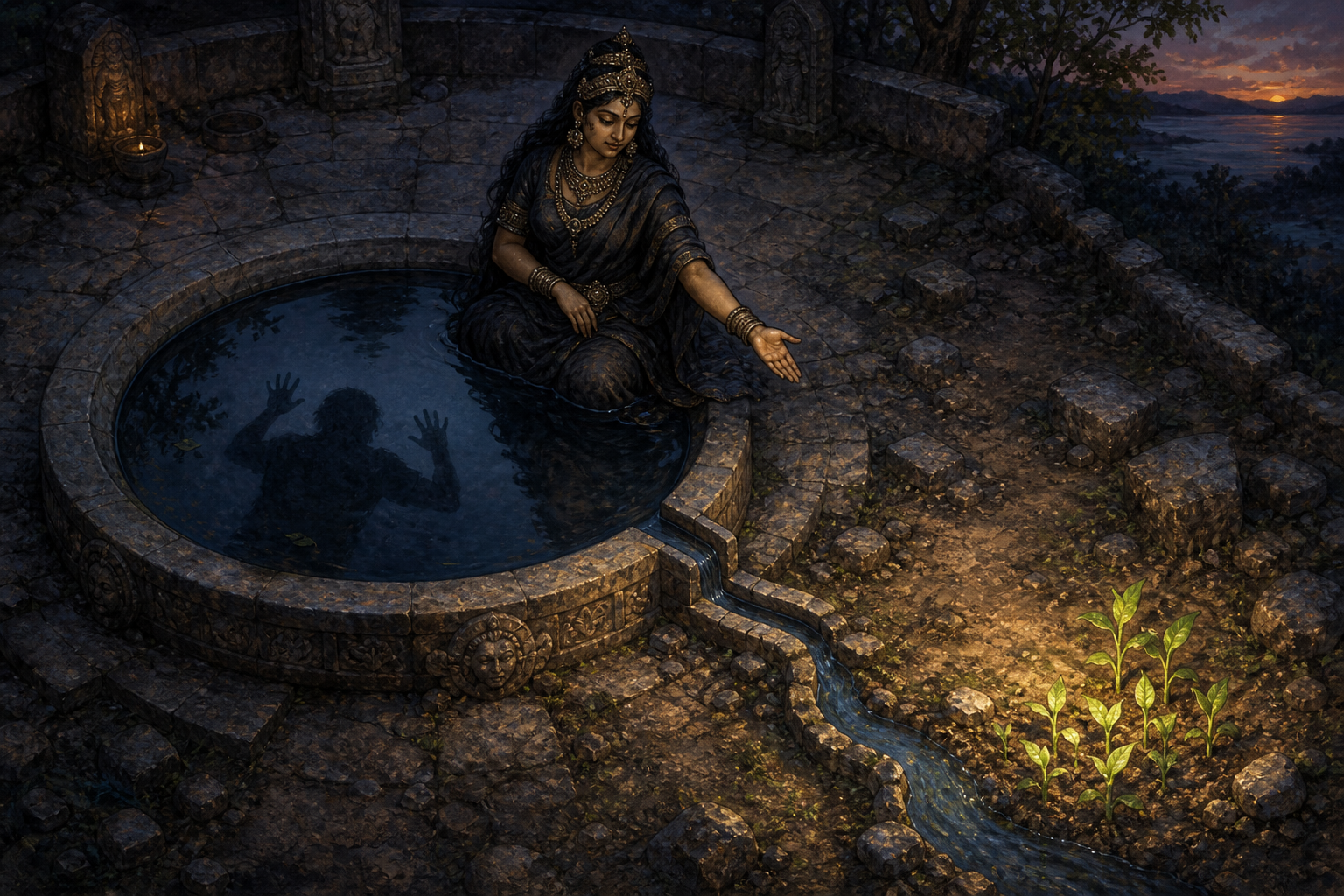
Nirrti’s transformative role is sometimes described too loosely, as though every painful event automatically produces wisdom. It does not. Loss can make a person compassionate, but it can also make a person bitter. Fear can sharpen responsibility, but it can also become aggression. Decay becomes spiritually meaningful only when consciousness and conduct change in response to it.
The movement symbolized by Nirrti has four practical stages:
- Recognition: Name the ending, fear, or destructive tendency without disguising it. You cannot transform what you insist is not present.
- Containment: Give the disturbance a defined place. Acknowledge grief without making every decision from grief; acknowledge anger without giving it permission to injure.
- Direction: Ask which dharmic duty remains possible. The answer may involve truthfulness, restraint, restitution, protection, service, or patient endurance.
- Ethical fruit: Judge the transformation by conduct. Greater clarity, responsibility, compassion, and steadiness are stronger evidence than dramatic emotion or fascination with dark imagery.
Yogic language offers another way to describe this movement. Tamas can appear as inertia, concealment, numbness, or fear. It is not overcome merely by declaring yourself positive. Practice must redirect the stuck energy toward sattva: clarity, balance, and compassionate intelligence. Nirrti’s symbolism gives this inner work a sacred form. Darkness is neither denied nor crowned; it is brought under disciplined awareness.
This is also why fatalism is the wrong conclusion. To say that endings belong within the sacred order is not to say that preventable suffering should be tolerated. Dharma still requires protection of the vulnerable, opposition to injustice, repair of harm, and responsible preparation. Acceptance concerns reality as it stands now; it does not cancel your duty to change what can and should be changed.
The wider Dharmic lesson is resonance, not sameness
Nirrti belongs to a specifically Hindu symbolic world, yet the discipline of facing impermanence resonates across Dharmic traditions. These parallels should not be used to erase theological differences. They are useful because they reveal several distinct ways of turning awareness of change into ethical strength.
Buddhist charnel-ground contemplations and maranasati, mindfulness of death, bring mortality into deliberate awareness. The purpose is not morbidity. Remembering death weakens complacency, tempers attachment, and can enlarge compassion for beings who share the same vulnerability.
Jain anitya-bhavana, reflection on impermanence, supports restraint and responsibility. When possessions, bodies, circumstances, and relationships are recognized as changing, grasping loses some of its authority. That recognition can reinforce ahimsa because the practitioner becomes less willing to harm others for the sake of what cannot be permanently possessed.
Sikh life within hukam asks a different but related form of courage. Change is met within divine order, while chardi kala sustains resilient, service-oriented spirit. Equanimity here is not passivity; it allows a person to continue acting faithfully when circumstances cannot be controlled.
The common ethical test is simple: does contemplation of impermanence make you more responsible toward living beings? If an interpretation produces contempt for life, indifference to suffering, theatrical nihilism, or withdrawal from duty, it has missed the Dharmic center. Awareness of death should make life more carefully lived.
A practical way to contemplate Nirrti at a threshold

The following is a modern reflective exercise drawn from Nirrti’s symbolism. It is not presented as a scripturally prescribed puja or a replacement for guidance within your own sampradaya. Use it when a role, relationship, plan, or period of life has genuinely ended and you need to decide what faithful action comes next.
- State one fact about the ending. Keep it free of prediction. “This role has ended” is a fact; “nothing meaningful will come after it” is a fear presented as prophecy.
- Name the ghost. Identify what keeps returning: fear of being forgotten, anger at betrayal, loss of status, guilt, or the urge to control what is no longer controllable.
- Separate the force from the command. Write, “This fear is present, but it does not decide my conduct.” This is the inner equivalent of placing the preta beneath rather than above the deity.
- Choose a boundary. Decide what the disturbance will not be permitted to govern. It may not govern how you speak to your family, whether you keep a promise, whether you retaliate, or whether you neglect a necessary duty.
- Choose one dharmic action. Make it concrete enough to complete: tell the truth without humiliation, return what is owed, ask forgiveness without demanding reassurance, perform a neglected responsibility, or offer practical help to someone facing a similar loss.
- Release the old form without denying its value. You do not need to call the past worthless in order to admit that it is over. Honour what was true, learn from what failed, and stop requiring a finished form to carry your future.
The order matters. If you jump directly from pain to a grand claim about renewal, you may only be covering the wound with spiritual language. Recognition comes first. Action follows. A new beginning becomes trustworthy when it grows from truth rather than avoidance.
You can also use the exercise before a predictable transition. When leaving a position, moving away from a community, or completing a long responsibility, ask what identity will lose its support when the external form disappears. Naming that attachment before the threshold makes it less likely to govern you afterward.
Key takeaways
- Nirrti’s association with misfortune and dissolution does not make her a simple embodiment of absolute evil.
- The ghost or corpse is a context-specific motif, not a universal image found identically across every textual, regional, and sectarian tradition.
- As a vahana, the frightening form can symbolize a force placed under divine mastery rather than a force being celebrated.
- Her southwest guardianship gives endings a defined place within sacred order: acknowledged and contained, but not allowed to govern everything.
- Transformation is not automatic. It requires honest recognition, ethical boundaries, dharmic direction, and conduct that produces greater clarity and compassion.
- Buddhist, Jain, and Sikh approaches to impermanence offer meaningful resonances without making their teachings interchangeable with Nirrti’s Hindu symbolism.
The next time an ending unsettles you, begin with three lines: one fact, one recurring fear, and one duty that remains. That small discipline captures Nirrti’s challenge. Let what has ended become knowledge, let fear lose the seat of command, and take the next action that dharma still asks of you.
References
