
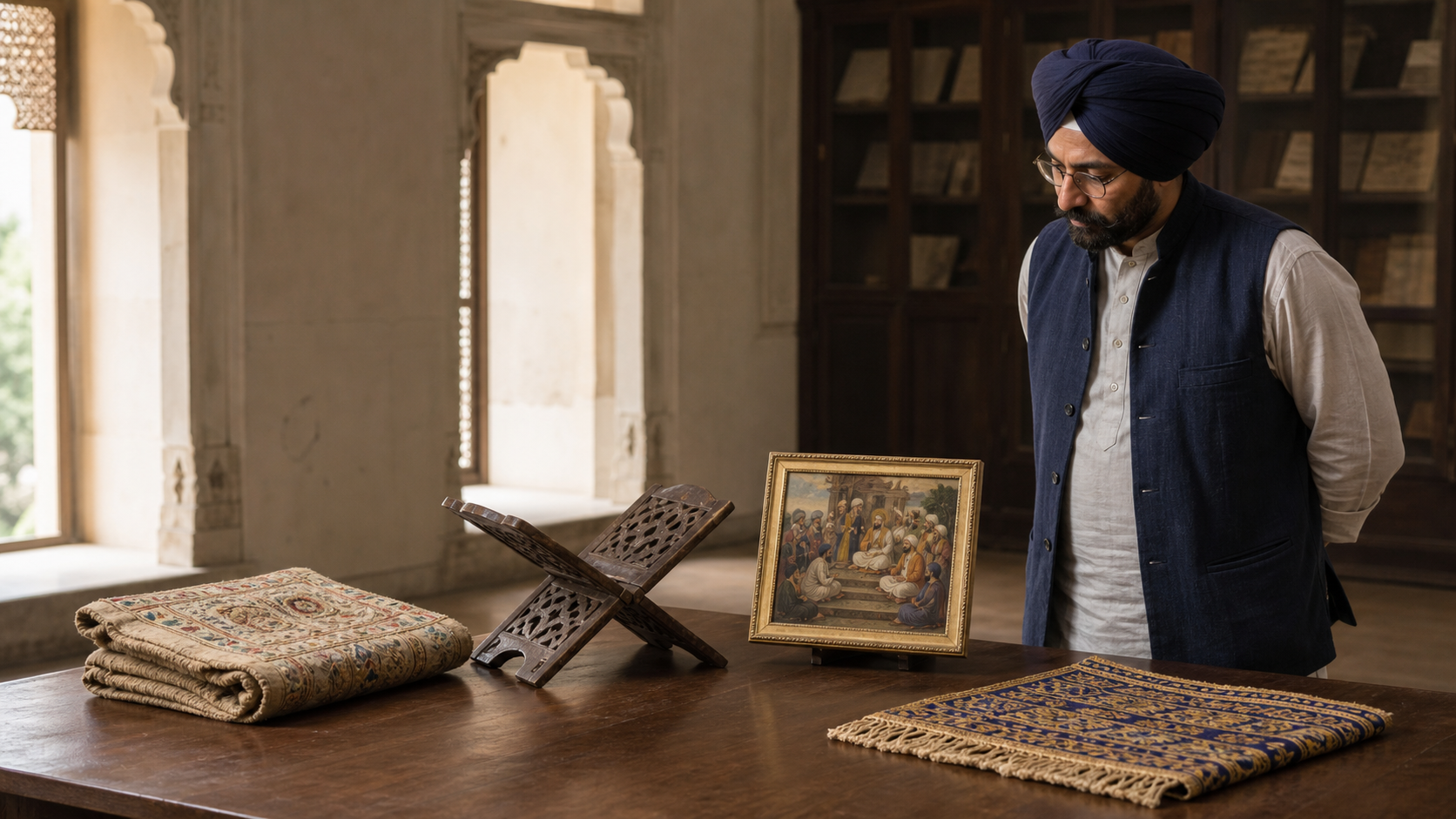
You can admire a Sikh painting, manuscript, textile, or piece of calligraphy and still leave with the hardest question unanswered: what belongs specifically to Sikh tradition, and what reflects a wider Dharmic inheritance? Resemblance alone won’t tell you. Treat every shared motif as proof of sameness, and Sikh distinctiveness disappears. Refuse all comparison, and you miss the civilizational relationships visible in the work.
A more reliable reading moves in a deliberate order: identify the object’s function, establish its subject, examine its visual form, look for the ethic it expresses, and check what is actually known about its history. You can use that sequence in a gallery, a classroom, a gurdwara exhibition, a family collection, or an online archive.
Begin with the object’s purpose, not its decoration

In an exhibition, Sikh heritage may appear through paintings, calligraphy, manuscripts, textiles, and ritual objects. These aren’t interchangeable containers for religious imagery. A manuscript may organize words for reading or preservation. Calligraphy makes language visually present. A textile may have been worn, displayed, offered, stored, or used in a ceremonial setting. A painting may teach, commemorate, narrate, or invite contemplation. The exact purpose has to come from the object, its label, or its documented context; it shouldn’t be guessed from appearance.
Start by copying the label’s most basic information: the name of the object, its medium, its subject, its place of origin, and its stated use. When a label doesn’t supply one of those details, mark it as unknown. An honest blank is more useful than an attractive assumption.
- Name what you are looking at. Is it a painting, manuscript leaf, textile, inscription, or ceremonial object?
- Describe only what is visible. Record figures, words, actions, repeated forms, colour relationships, borders, and the arrangement of space before interpreting them.
- Ask what the object did. Was its purpose devotional, educational, communal, commemorative, decorative, or some combination of these?
- Identify the tradition-specific centre. Does the label connect the work to a Guru, a teaching, scripture, seva, kirtan, or a particular Sikh memory?
- Separate certainty from inference. Keep what the label establishes distinct from what you think the imagery might mean.
This order matters because decoration is visually immediate while function is often quiet. A floral border can catch your eye before the sacred words it frames. Balanced geometry can look familiar across traditions even when the object serves a distinctly Sikh purpose. Never let a resemblance answer a functional question.
Compare shared visual language without merging traditions
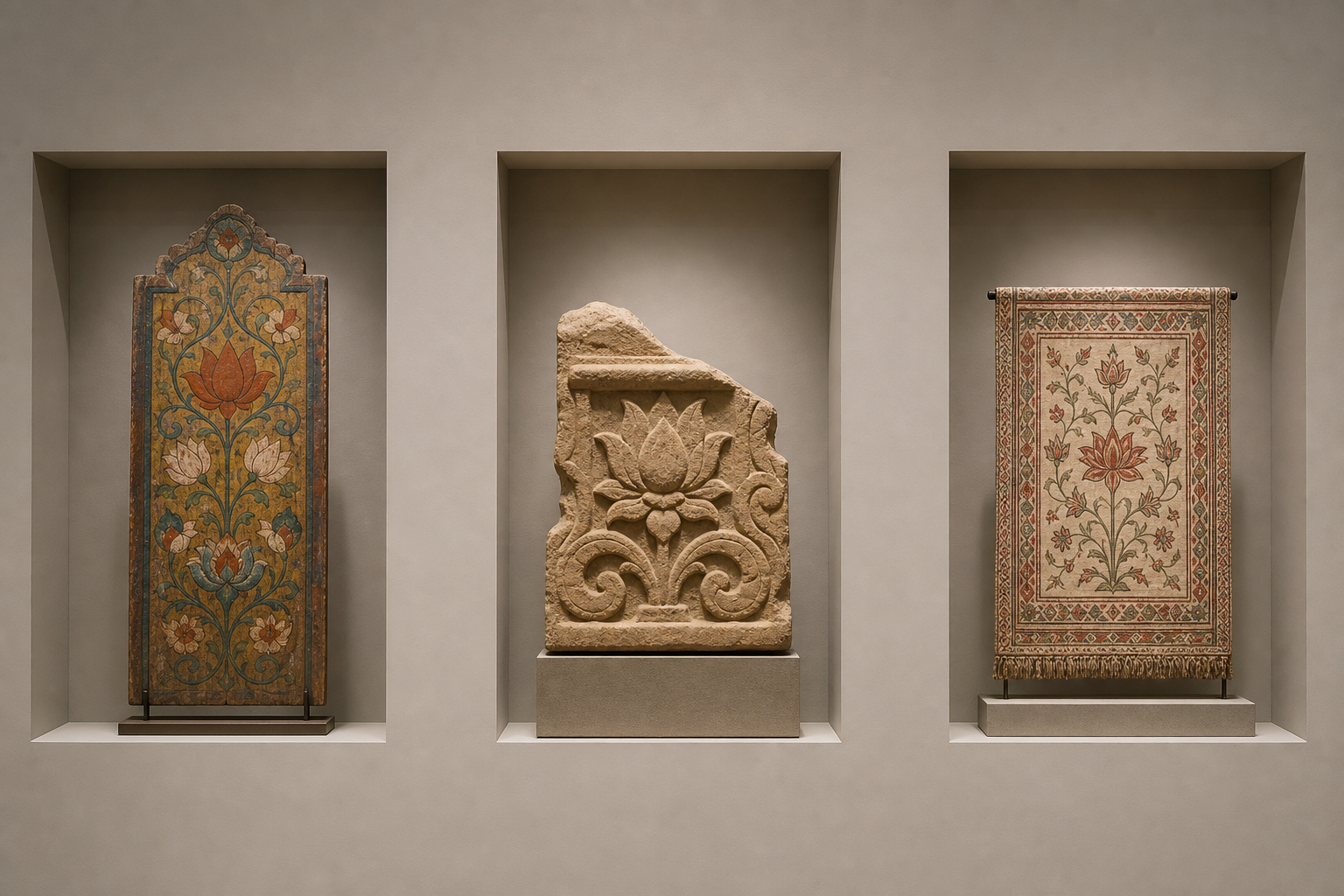
Sikh, Hindu, Buddhist, and Jain works can participate in a wider visual vocabulary that includes floral arabesques, geometric balance, narrative panels, and disciplined uses of script. That is a meaningful civilizational relationship. It is not, by itself, evidence that the traditions teach the same doctrine or assign the same meaning to every form.
The safest comparison moves from what is directly visible toward what requires context. Use the following distinctions when a motif feels familiar.
| What you notice | What you can reasonably say | What you still need to verify |
|---|---|---|
| Floral arabesques | The work uses an ornamental language also visible across Dharmic artistic settings. | Whether the pattern has a specific symbolic, regional, workshop, or merely decorative role here. |
| Geometric balance | The composition uses order, proportion, or repetition to structure attention. | What occupies the visual centre and why that centre matters in this tradition. |
| Narrative panels | The work organizes a teaching, memory, or event through a visual sequence. | The identity of the figures, the narrative being shown, and its community-specific meaning. |
| Calligraphy or prominent script | Words contribute to the visual discipline of the object rather than functioning as incidental labels. | The language, exact content, scriptural or historical context, and intended use of the text. |
It helps to keep three levels of comparison separate:
- Shared form: two works use a similar border, compositional balance, script treatment, or narrative structure.
- Shared ethical orientation: two traditions may honour compassion, service, disciplined conduct, or inward cultivation.
- Shared doctrinal meaning: two works make the same theological or philosophical claim.
Evidence for the first level doesn’t automatically establish the second, and neither establishes the third. If two works use balanced geometry, say that. If their labels also connect that order to inner discipline, you can compare the ethical orientation. Don’t leap from either observation to the claim that their doctrines are identical.
This distinction lets you recognize a common Dharmic inheritance without turning it into a vague statement that every tradition is essentially the same. A work can belong to a shared civilizational visual grammar while retaining a clearly Sikh centre through its subject, text, purpose, and communal memory.
Read Sikh ethics as lived action, not decorative symbolism
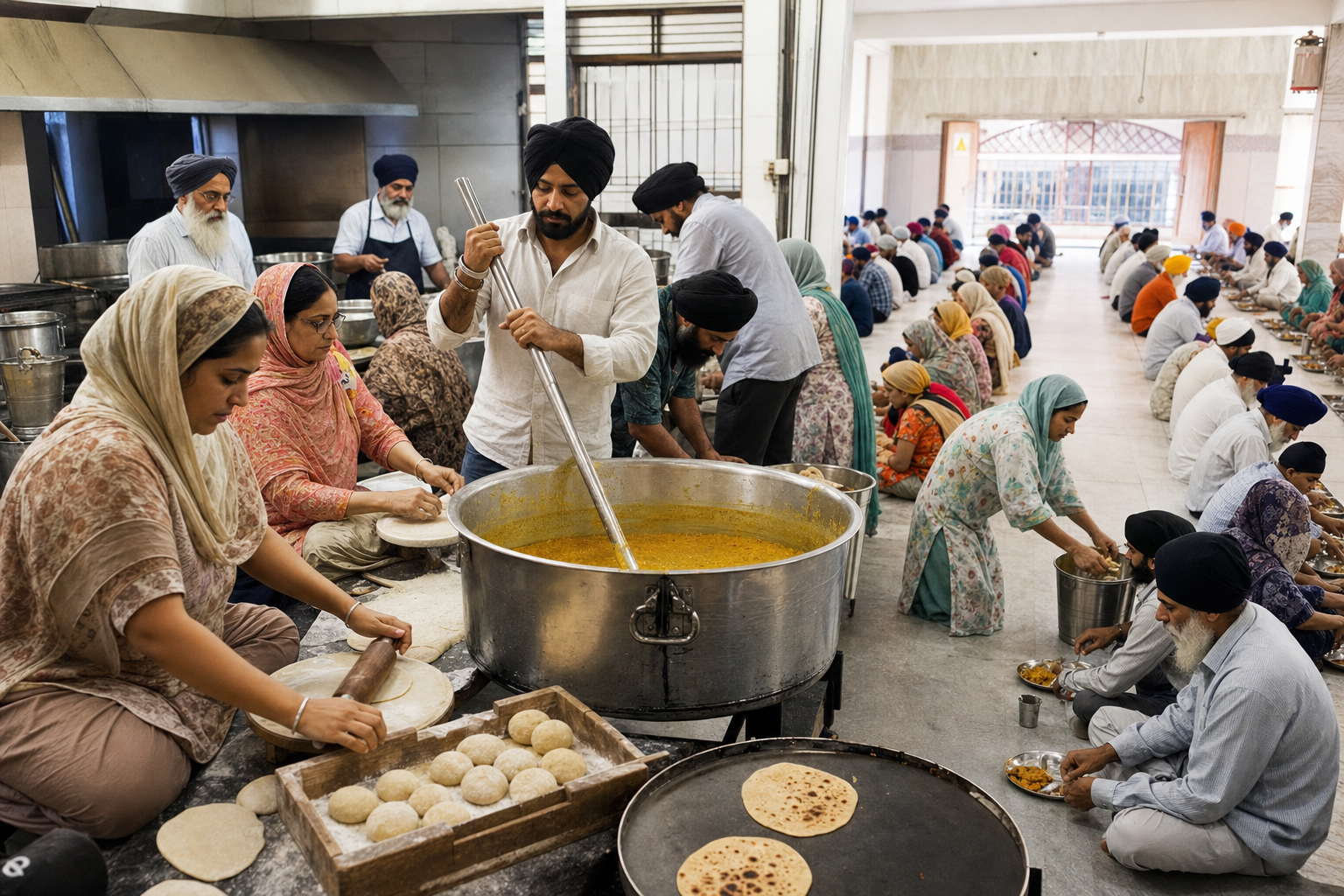
Sikh art is most illuminating when you connect form to the life it serves. Recurring interpretive anchors include the Gurus and their teachings, seva, kirtan, courage, and humility. These aren’t boxes that every object must tick. They are questions that help you test whether your reading reaches beyond ornament.
- Teaching: What does the work ask the viewer to remember or honour? Identify a Guru or scriptural connection only when the inscription, label, or documented context supports it.
- Practice: Does the scene present service, musical devotion, collective participation, study, or another disciplined activity? Describe the action before naming its spiritual significance.
- Character: How are courage and humility held together? Look for the difference between strength displayed as domination and strength placed in the service of duty.
- Community memory: Does the object connect sacred teaching with family inheritance, collective history, or present practice? If the connection is documented, it is part of the object’s meaning rather than an optional anecdote.
Seva is especially easy to flatten into the generic phrase “being helpful.” In a careful reading, you ask who acts, who benefits, what labour is shown, and whether recognition is central or absent. Kirtan can likewise be reduced to “music” unless you attend to the relationship among sacred words, disciplined performance, participation, and remembrance. The visual details may not answer every question, but they tell you what to seek in the accompanying interpretation.
Courage and humility should also be read together rather than assigned to opposite kinds of imagery. Courage without ethical restraint can become mere force. Humility without courage can be misread as passivity. When an exhibit places both virtues within the same Sikh moral frame, ask how the work directs power toward protection, service, fairness, or responsibility.
A comparison you can actually defend
If you are teaching children, leading a community discussion, or writing about inter-Dharmic heritage, compare works on one dimension at a time. Comparing “Sikhism and Hinduism” or “Sikhism and Buddhism” as complete systems is too broad for a painting or textile to sustain. Compare a use of script, a narrative arrangement, an image of service, or the visual treatment of disciplined action instead.
- Choose a single feature that both works visibly contain.
- State the similarity without interpreting it beyond the available evidence.
- Name a difference in subject, function, sacred authority, or community use.
- Check the label or catalogue for the contextual fact that explains the difference.
- End with an unresolved question rather than forcing a grand conclusion.
For example, “both works use disciplined script as part of their visual composition” is a defensible observation when the lettering is visible. “Both works therefore express the same theology” is not. The first statement opens inquiry; the second closes it before context has done its work.
Make the exhibition label earn your trust
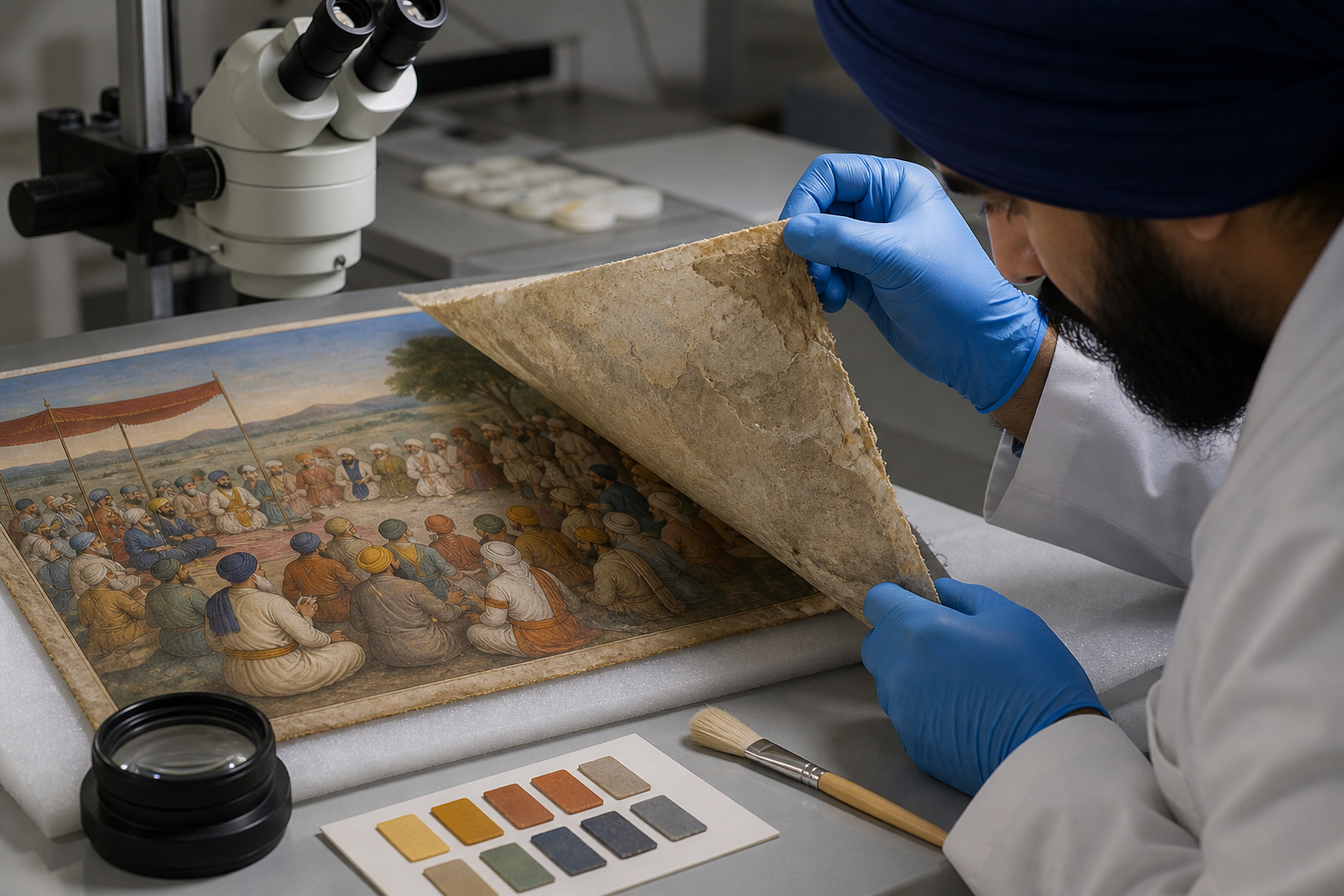
A beautiful display can still provide weak cultural interpretation. Strong presentation joins historical accuracy, clear iconographic explanation, ethical interpretation, and readable treatment of original terms. You should be able to tell what an object is, why it matters, what is known about it, and where interpretation begins.
Use this checklist before relying on a gallery label, website caption, classroom handout, or social-media description:
- Identity: Does it name the type of object, subject, medium, and cultural setting precisely?
- Original terminology: Are Sikh terms retained and explained instead of being replaced by loose English approximations?
- Iconographic clarity: Does it identify figures, actions, words, and symbols without expecting the visitor to guess?
- Historical limits: Does it distinguish a documented fact from a curatorial interpretation or community memory?
- Function: Does it explain how the object related to devotion, teaching, service, music, commemoration, or daily life?
- Provenance: Does it say what is known about the object’s origin, ownership, movement, or custodial history?
- Community knowledge: Has interpretation made room for informed Sikh participation rather than treating the community as merely the subject of display?
- Accessibility: Can a newcomer follow the explanation without stripping away the original vocabulary and religious context?
Provenance deserves special attention because an object’s physical survival and its cultural meaning are related but not identical. Documentation helps establish where an object came from and how it entered a collection. Community-informed interpretation helps explain how people understood, used, and remembered it. When information is missing, the responsible response is to identify the gap, not fill it with certainty.
Preservation also includes more than placing an object behind glass. Conservation, careful documentation, digitization, and consistent metadata can keep works usable for future community members, teachers, and researchers. If you care for a family object, begin with a non-invasive record: photograph it without altering it, copy any inscription exactly, record what relatives know about its use, and keep remembered history clearly distinguished from verified dates or names. Don’t clean, repair, reframe, or remove old labels merely to improve its appearance; those features may hold contextual information that cannot be recovered once discarded.
Key takeaways
- Establish an object’s function and Sikh context before interpreting its decorative forms.
- Compare traditions through a specific feature, practice, or value rather than claiming that entire religions are the same.
- Treat shared visual form, shared ethical orientation, and shared doctrine as separate levels of evidence.
- Use the Gurus and their teachings, seva, kirtan, courage, and humility as interpretive questions, not as labels imposed on every work.
- Trust explanations that preserve original terms, identify provenance, separate fact from inference, and include informed community knowledge.
- When documenting family heritage, preserve uncertainty alongside the object. A known gap is safer than an invented history.
The next time you encounter Sikh art, resist the urge to understand the whole tradition at a glance. Stay with a single work long enough to record its purpose, Sikh centre, shared visual features, ethical action, and one unanswered question. That modest discipline turns admiration into cultural literacy while protecting both sides of the inheritance: Sikh distinctiveness and its wider Dharmic relationships.
References
