

When you find a ruler called Great in a school chapter, the practical question is not whether your family admires that ruler. It is whether the textbook has delivered a verdict before your child has examined the historical record.
A sound standard is straightforward: identify people accurately, describe documented conduct plainly, and make every evaluative label earn its place. That removes inherited praise without requiring anyone to forget conquest, coercion, accommodation, reform, patronage, resistance, or the experiences of affected communities.
An honorific answers the question before the evidence

An office tells you what position someone held. An honorific tells you how someone is supposed to be regarded. Emperor and Sultan identify political status; Great assigns stature. That difference is small on the page but large in a young reader’s mind.
The word Great is especially imprecise. Does it mean military success, administrative ability, territorial reach, cultural influence, moral character, or simply later fame? A student cannot test the claim until the textbook identifies the criterion. Left unexplained, the honorific turns a bundle of debatable judgments into an apparently settled fact.
The removal of Great from references to Akbar and Tipu Sultan in Assam history textbooks therefore raises a useful question larger than either ruler: should a compulsory lesson tell students whom to revere, or give them the evidence needed to form a reasoned judgment? The limited scope matters. When discussing the change, keep the claim at its stated level – Assam history textbooks – rather than turning it into an unsupported assertion about every textbook in Bharat.
Assam Chief Minister Shri Himanta Biswa Sarma publicly supported the revision, making the decision politically prominent. Political endorsement, however, is not a historiographical method. The educational case stands or falls on a consistent editorial rule that can be applied even when the ruler, dynasty, or tradition changes.
That rule must cover negative labels too. Words such as glorious, benevolent, cruel, and fanatical can all pre-judge the record. This does not mean that cruelty or religious persecution must be hidden where they are documented. It means the textbook should name the conduct, identify the evidence, describe who was affected, and then allow the moral judgment to rest on visible facts rather than an unsupported adjective.
Neutral wording must not become historical amnesia
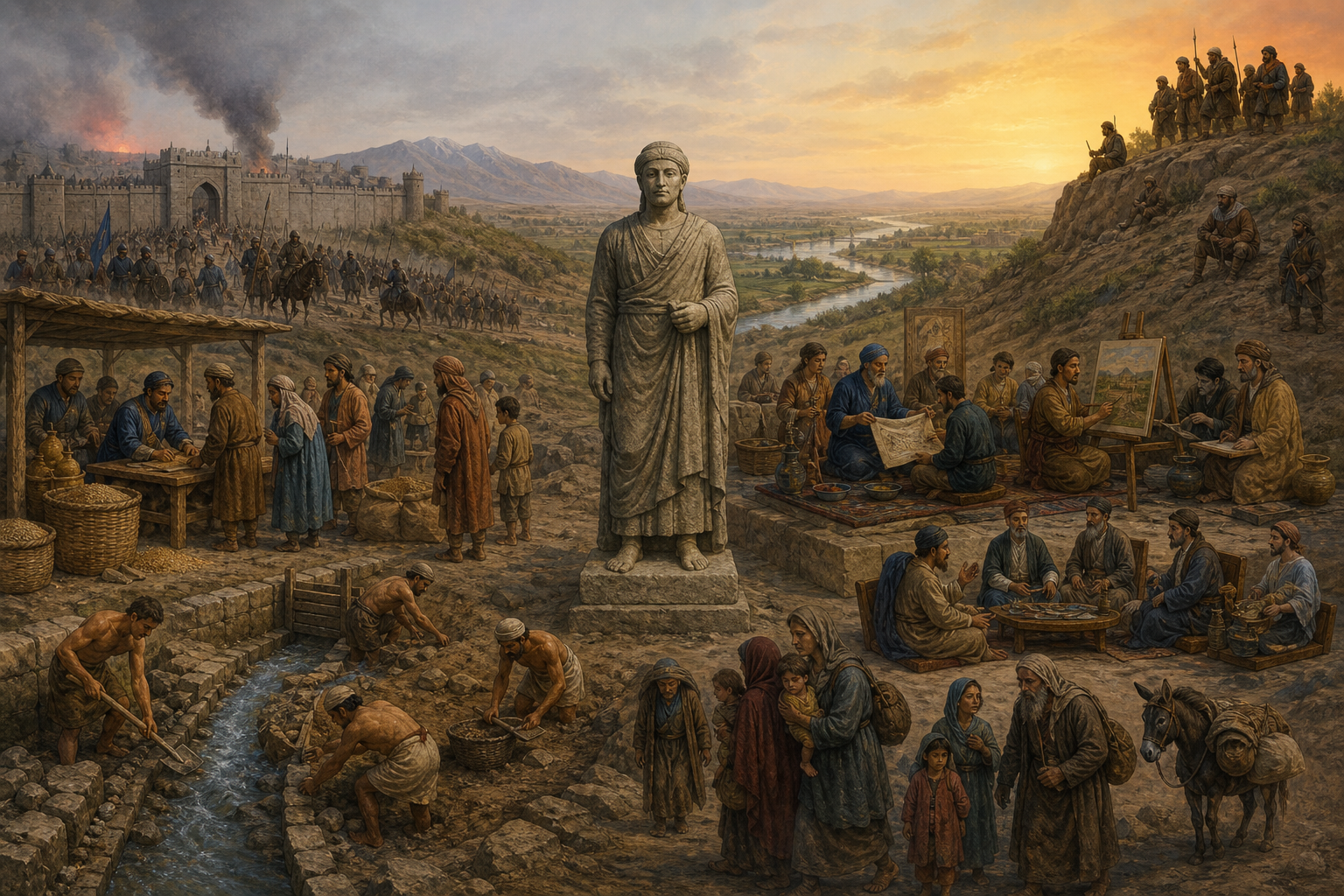
Removing an honorific is only the first edit. If the chapter then reduces a ruler to a name, a battle, and a date, the lesson has not become more rigorous; it has merely become thinner. Neutrality should replace a verdict with an evidentiary path.
That means Akbar’s administrative reforms and Tipu Sultan’s military and technological strategies remain legitimate subjects of study. The textbook should also examine alliances, conflicts, cultural effects, and competing interpretations where the evidence warrants them. Removing automatic praise neither proves nor disproves any claim about those records.
A useful historical explanation proceeds in four moves:
- Name the action. Identify the policy, alliance, campaign, institution, act of patronage, or restriction under discussion.
- Show the basis. Point students to the relevant primary material, documented event, or clearly identified scholarly interpretation.
- Describe the effects. Ask who benefited, who bore the cost, where the consequences appeared, and whether they changed over time.
- Mark the dispute. Separate what is documented from what historians interpret differently.
This sequence prevents two opposite failures. One is hagiography, in which success is treated as virtue and the experiences of conquered or marginalised communities disappear. The other is euphemism, in which neutral-sounding prose conceals documented violence or coercion. Clear verbs are better than loaded adjectives in both cases.
Students may still reach strong conclusions. Neutral language is a discipline for beginning an inquiry, not an order to end with moral equivalence. If one ruler’s record withstands scrutiny and another’s does not, the lesson should make the difference visible through evidence, scope, and stated criteria.
Use one rule across rulers, dynasties, and traditions

Consistency does not mean declaring every historical figure equally admirable or equally harmful. It means applying the same burden of proof. A ruler should not receive automatic praise because an older syllabus normalised it, nor automatic condemnation because current politics makes that position convenient.
Editors and teachers can sort disputed terms into four practical categories:
- Office or role: Retain a term when it accurately identifies a political, religious, intellectual, or institutional position.
- Historically significant name or title: Retain it when students need it to recognise the person or understand the period, but explain its origin and use.
- Attributed reverence: Preserve a community’s respectful vocabulary when teaching that community’s self-understanding, while making clear who uses the term and why.
- Authorial evaluation: Remove praise or blame from the textbook’s narrative voice unless the chapter defines the criterion and presents sufficient evidence for students to examine it.
This distinction matters in Dharmic history. A blanket search-and-delete operation could strip Hindu, Buddhist, Jain, or Sikh vocabulary of terms that convey a genuine office, lineage, teaching role, or form of community memory. The answer is not mechanical erasure. Define the term, identify its users, explain its significance, and avoid silently converting reverence within a tradition into a compulsory judgment for every reader.
If you suspect selective treatment, run a symmetry check:
- Would the textbook accept the same kind of praise for a ruler from a rival dynasty?
- Does it demand evidence for negative judgments as carefully as it does for positive ones?
- Does it examine administration, warfare, alliances, patronage, restrictions, and social consequences rather than choosing only the convenient category?
- Are the voices and experiences of affected communities visible?
- Are contested interpretations identified as contested, or presented as unquestionable fact?
For a Dharmic audience, this is more than a stylistic preference. Unity among Hindu, Buddhist, Jain, and Sikh communities does not require a flattened past. It requires enough intellectual confidence to examine praise, injury, exchange, and disagreement without imposing a predetermined verdict. Shared respect becomes stronger when it is joined to truthful memory.
Audit a textbook page before you object to it

A precise objection is harder to dismiss than a general accusation of bias. Before approaching a teacher, school, publisher, or education authority, inspect the actual wording.
- Record the exact location. Note the book, chapter, page, heading, and complete sentence. Do not rely on a cropped image that removes context.
- Classify the disputed term. Decide whether it is an office, a historical name, an attributed expression of reverence, or the textbook author’s judgment.
- Delete it temporarily. If the factual meaning remains intact, the word is probably evaluative rather than necessary for identification.
- Look for the supporting record. Check whether the chapter names policies, actions, consequences, primary materials, or scholarly disagreements that justify the label.
- Test consistency elsewhere. Examine how the same book describes at least two other rulers or traditions. A neutral-language policy is credible only when comparable cases receive comparable treatment.
You can then make a focused request: Page [number] describes [person] as [term]. Is this an office, an attributed historical title, or an evaluation by the textbook? If it is an evaluation, what criterion and evidence support it? Please apply the same editorial rule to comparable figures throughout the book.
That wording does three useful things. It identifies the exact problem, allows for a legitimate historical explanation, and asks for a general standard rather than a politically convenient one-off edit.
Teachers need not wait for a revised edition. Cover the honorific and let students examine a timeline, a map, and more than one account. Ask them to assess administration, alliances, conflicts, warfare, cultural patronage, and consequences for different communities. Only after that should they reconsider the label and state which meaning of greatness, if any, the evidence supports.
Comparing the Mughal period with the Marathas and regional kingdoms can also expose selective standards. The purpose is not to force unlike polities into one template. It is to show students that historical importance, military power, administrative competence, cultural influence, and ethical conduct are separate questions. A ruler may score differently on each, which is exactly why one inherited adjective is inadequate.
Key takeaways
- An office identifies a position; an honorific assigns esteem. Textbooks should not confuse the two.
- Removing Great is defensible when the same rule governs praise and blame across comparable figures.
- Neutrality must not erase documented achievement, violence, coercion, patronage, resistance, or effects on communities.
- Strong historical judgments are legitimate when the criterion, evidence, scope, and uncertainty are visible.
- A useful challenge names the exact page and wording, classifies the label, asks for evidence, and tests consistency elsewhere in the book.
The next time you encounter a loaded historical label, do not begin by demanding a different hero. Ask three questions: What does this word claim, what evidence supports that claim, and would the book use the same standard for someone else? Those questions move the classroom away from inherited reverence and political substitution, and toward the historical judgment students should learn to make for themselves.
References
