

You may have met Parijata in two very different places: as a celestial treasure in Krishna’s lila, and as delicate, fragrant flowers gathered from the ground at daybreak. That contrast is the key to the symbol. The highest tree does not merely possess abundance; it releases abundance without noise.
If you are wondering whether Parijata is a wish-granting object, a sacred living tree, or a metaphor for spiritual fulfilment, the most useful answer is that it operates on all three levels. Its mythology becomes practical when you stop asking only, “What can this tree give me?” and begin asking, “What would receiving well require of me?”
Key takeaways
- Parijata is called a Kalpavriksha, but its symbolism is not a promise that every craving deserves fulfilment.
- Its journey from the Ocean of Milk to Indra’s garden, and later into Krishna’s lila, connects abundance with stewardship rather than possession.
- Kashyapa, Aditi, Indra, and Krishna illuminate different responsibilities: discernment, compassionate resolve, guardianship, and non-attachment.
- The fallen blossom turns a celestial idea into a daily discipline of gratitude, offering, and service.
- Wish-fulfilling tree motifs resonate across Dharmic traditions, but those parallels should be recognised without pretending that every tradition tells the same story.
Follow the tree’s journey, not just its splendour

Parijata first appears in a setting of strenuous cosmic action. During the Samudra Manthan, devas and asuras churn the Ocean of Milk in pursuit of amrita. Parijata is among the treasures that emerge. This is not an image of effortless magic. Something auspicious is disclosed while disorder, rivalry, effort, and shared dependence are being worked through.
That setting gives you the first interpretive rule: do not detach the blessing from the churning. A wish-fulfilling tree does not teach passive wishing. It appears within a process that demands sustained effort. When you invoke Parijata while facing a difficult situation, identify the part of the churning that belongs to you. It may be study, honest conversation, disciplined practice, patient service, or the relinquishing of resentment. Prayer can orient the work, but it does not erase the work.
The tree is then placed in Indra’s Nandana garden, where it signifies the prosperity of Svarga restored after cosmic imbalance. Placement matters. The treasure does not remain ownerless, and its power is not treated as private indulgence. It enters an ordered realm under guardianship.
Later traditions bring Parijata into the lila of Sri Krishna, with accounts in which Krishna carries the tree from Svarga. The dramatic movement between realms can easily be reduced to a contest over ownership. That reading is too small. The deeper question is whether celestial abundance will become a badge of status or a means of nurturing relationship and harmony. Love, stewardship, and non-attachment provide a better interpretive frame than conquest alone.
When you hear or retell the narrative, track four verbs: the tree emerges, is placed, is guarded, and is brought. Each movement adds an obligation. A gift must be recognised, situated within dharma, protected responsibly, and allowed to benefit life beyond the prestige of its custodian.
Let the wish-fulfilling tree test the quality of your desire

Calling Parijata a Kalpavriksha can produce a shallow image of a cosmic vending machine. Ask correctly, receive immediately, and measure devotion by the result. That interpretation misses the moral setting of the tree. Parijata is associated with divine grace, restored harmony, and the renewal of cosmic order. The wish therefore cannot be separated from the kind of order it creates.
Before placing a desire before the divine, pass it through four questions:
- Does this desire repair something, deepen something, or merely enlarge my status?
- If it is fulfilled, who besides me will benefit?
- What new duty will arrive with the blessing?
- What can I give now, before I know whether the desired outcome will come?
This does not mean that personal needs are unworthy. A student may pray for success, a householder for stability, or a community for protection. The Parijata lens asks each person to join the desired fruit to its proper root. Success calls for honest study and responsible use of knowledge. Stability calls for care of those who depend on the household. Protection calls for strength governed by restraint rather than hatred.
The fourth question is especially important. If generosity begins only after you receive everything you requested, generosity remains conditional. A small act of seva, truthful speech, or restraint performed now breaks the bargaining habit. The wish becomes a way of aligning yourself with dharma rather than attempting to place the divine under contract.
You can also use this test after receiving something good. Instead of asking whether the blessing proves personal favour, ask what it now entrusts to you. Knowledge may need to be taught. Wealth may need to circulate. Authority may need to protect. Time may need to be offered. Parijata fulfils its symbolism when abundance becomes responsibility.
Four figures reveal four forms of dharmic responsibility
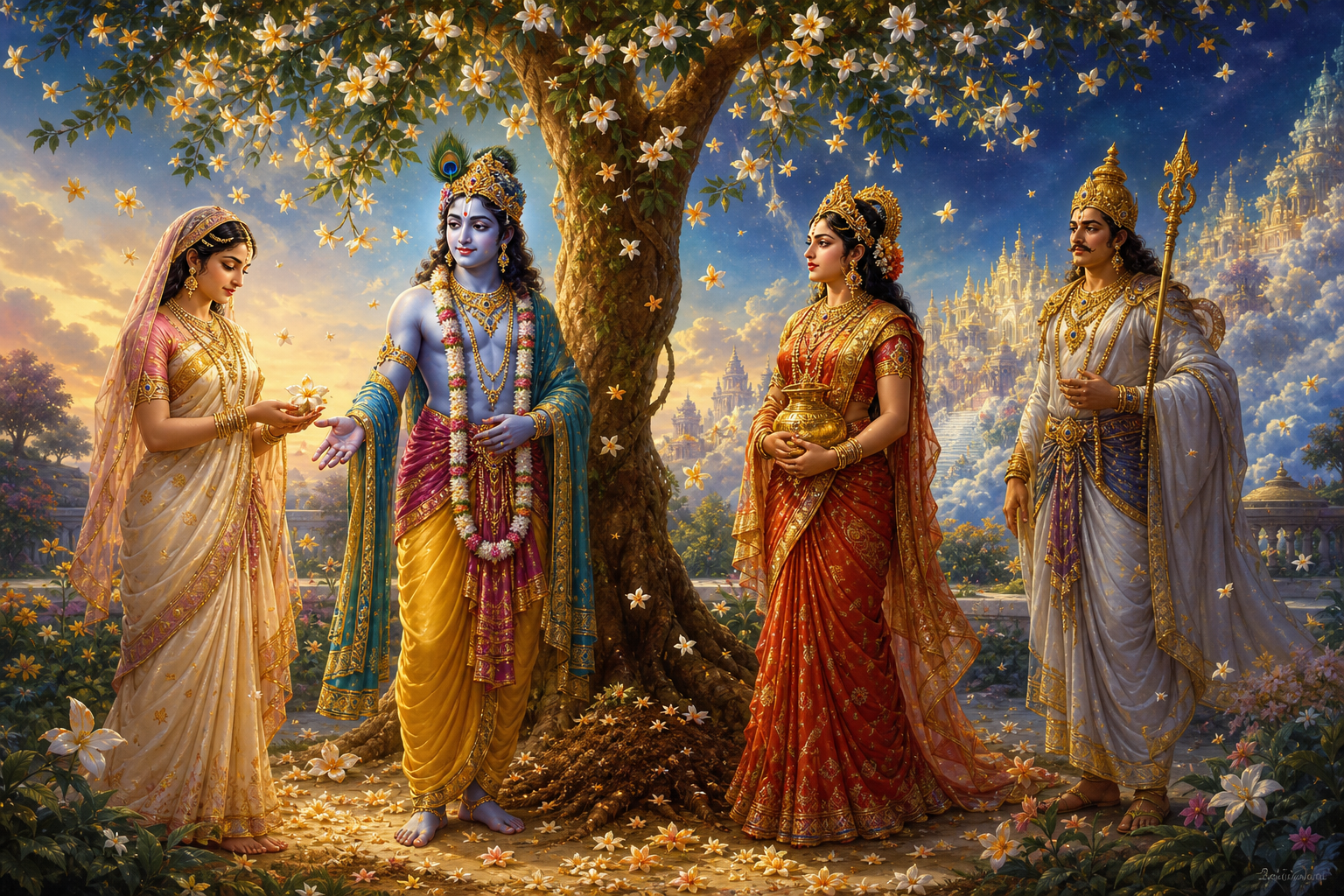
The tree belongs to a larger moral world shaped by Kashyapa, Aditi, Indra, and Krishna. They should not be collapsed into one role, and Aditi should not be treated as the direct cause of Parijata’s emergence. Their importance lies in the different forms of responsibility surrounding cosmic restoration.
- Kashyapa represents measured discernment. His steadiness reminds you that compassion without judgment can become confused, while strength without wisdom can become reckless. Invoke this quality when urgency is pushing you toward a decision that has not been thought through.
- Aditi represents compassionate resolve. Her vrata and prayerful appeal to Vishnu, culminating in the Vamana avatara, are directed toward the restoration of justice without the cultivation of malice. Her example is useful when a real wrong must be opposed but anger is beginning to determine your methods.
- Indra represents guardianship. His association with Parijata places prosperity under the care of leadership. If you control money, knowledge, land, institutional authority, or communal trust, ask whether you are preserving it for legitimate benefit or confusing custody with absolute ownership.
- Krishna represents loving non-attachment. When Parijata enters his lila, the tree becomes a test of whether beauty and abundance can serve relationship without becoming fuel for rivalry. This quality matters whenever being recognised as the owner has begun to matter more than the good a possession can do.
These figures give you a practical way to diagnose a conflict. Turn to Kashyapa’s steadiness when emotion outruns discernment. Remember Aditi when justice is hardening into bitterness. Remember Indra when something valuable has been placed under your control. Remember Krishna when attachment to prestige is blocking reconciliation. The point is not to imitate the outer circumstances of a celestial narrative, but to identify the dharmic capacity your present situation lacks.
Bring Parijata into practice without reducing it to ritual
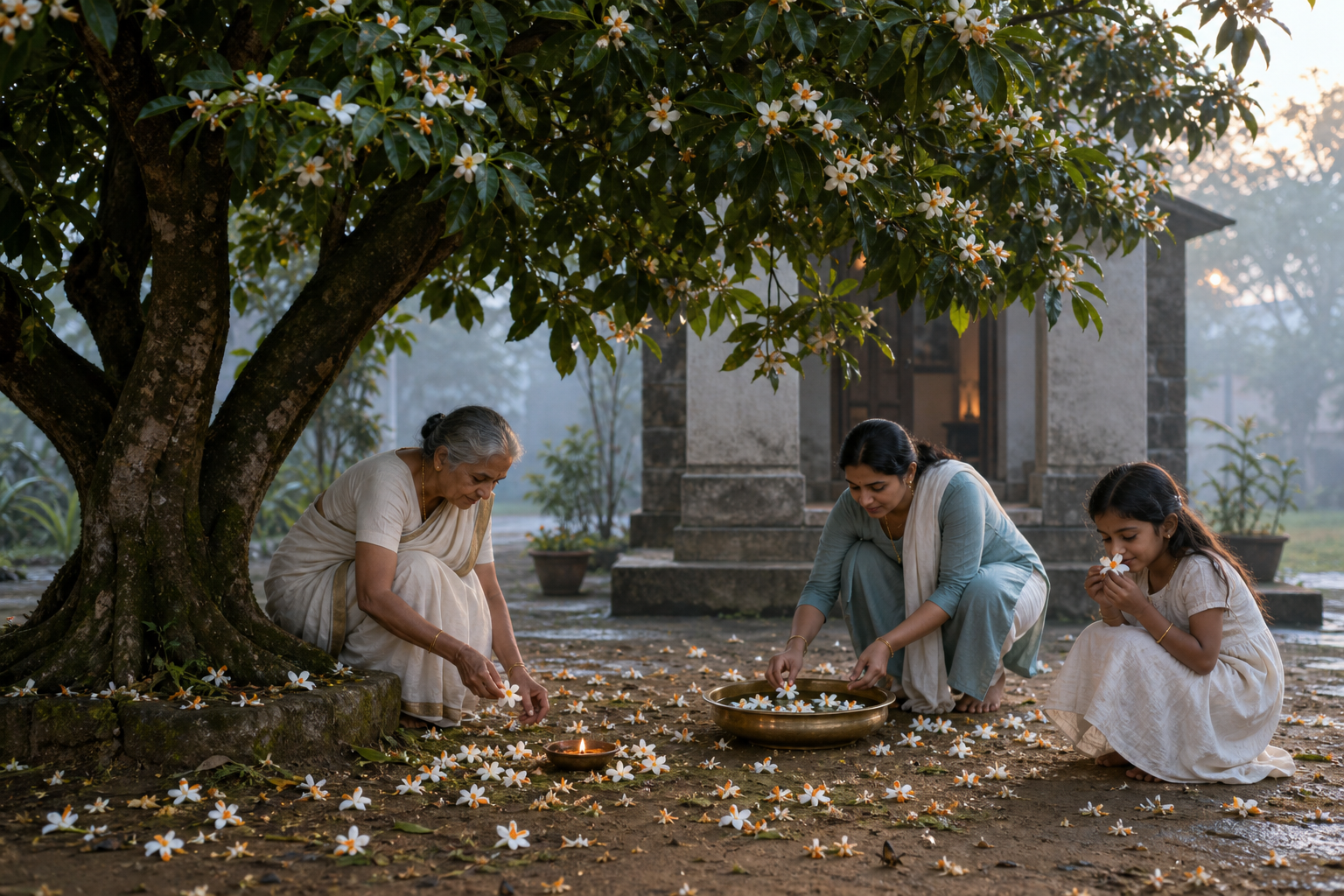
A simple reflection with the flower
The living parijat commonly associated with the sacred name is Nyctanthes arbor-tristis. Its blossoms are often encountered after they have fallen, and in households or temples where local custom permits, they may be gathered at dawn for worship. The flower offers a remarkably exact lesson: it gives fragrance and beauty while relinquishing its hold.
You can turn that observation into a short contemplative practice. This is a reflective discipline, not a claim that every sampradaya prescribes an identical rite:
- Where you have permission to gather a blossom, receive what the tree has released without damaging the living plant.
- Before making a request, name one blessing already present in your life.
- State one desire clearly, then name the responsibility you accept if it is fulfilled.
- Choose one act of service, generosity, truthful speech, or non-harm to perform that day.
- Complete the practice by caring for something living: the sacred tree itself, another plant, an animal, or a person who depends on your attention.
This sequence prevents ritual from becoming extraction. You do not approach the sacred tree only to obtain something. You receive, offer, accept duty, and return care to the world. If your family or temple follows a particular rule for handling flowers, that inherited practice should govern the ritual details.
A shared Dharmic motif without forced sameness
The wish-fulfilling tree has resonances in Hindu, Buddhist, and Jain traditions, where fulfilment is joined to virtue, discipline, and insight. Sikh teachings on truthful living and selfless service offer a closely related ethical parallel: well-being becomes meaningful when it is shared.
Recognising this family resemblance does not require saying that all four traditions possess an identical Parijata narrative. They do not need to be made interchangeable in order to reveal a civilisational conversation. The common ground lies in a disciplined understanding of abundance. Inner and outer prosperity must be governed by truth, non-harm, restraint, compassion, and service.
That distinction is useful in inter-Dharmic discussion. Begin with the specific Hindu narrative: Samudra Manthan, Nandana, Indra, and Krishna. Then identify the ethical resonance in another tradition without transferring every name or episode into it. Unity becomes stronger when it respects difference instead of erasing it.
The next time you see a parijat blossom or hear the celestial tree invoked, resist stopping at the promise of wish fulfilment. Choose one desire, identify the duty attached to it, and perform one act that shares fragrance before the desired fruit arrives. That is how Parijata moves from mythic memory into a life governed by dharma.
References
