
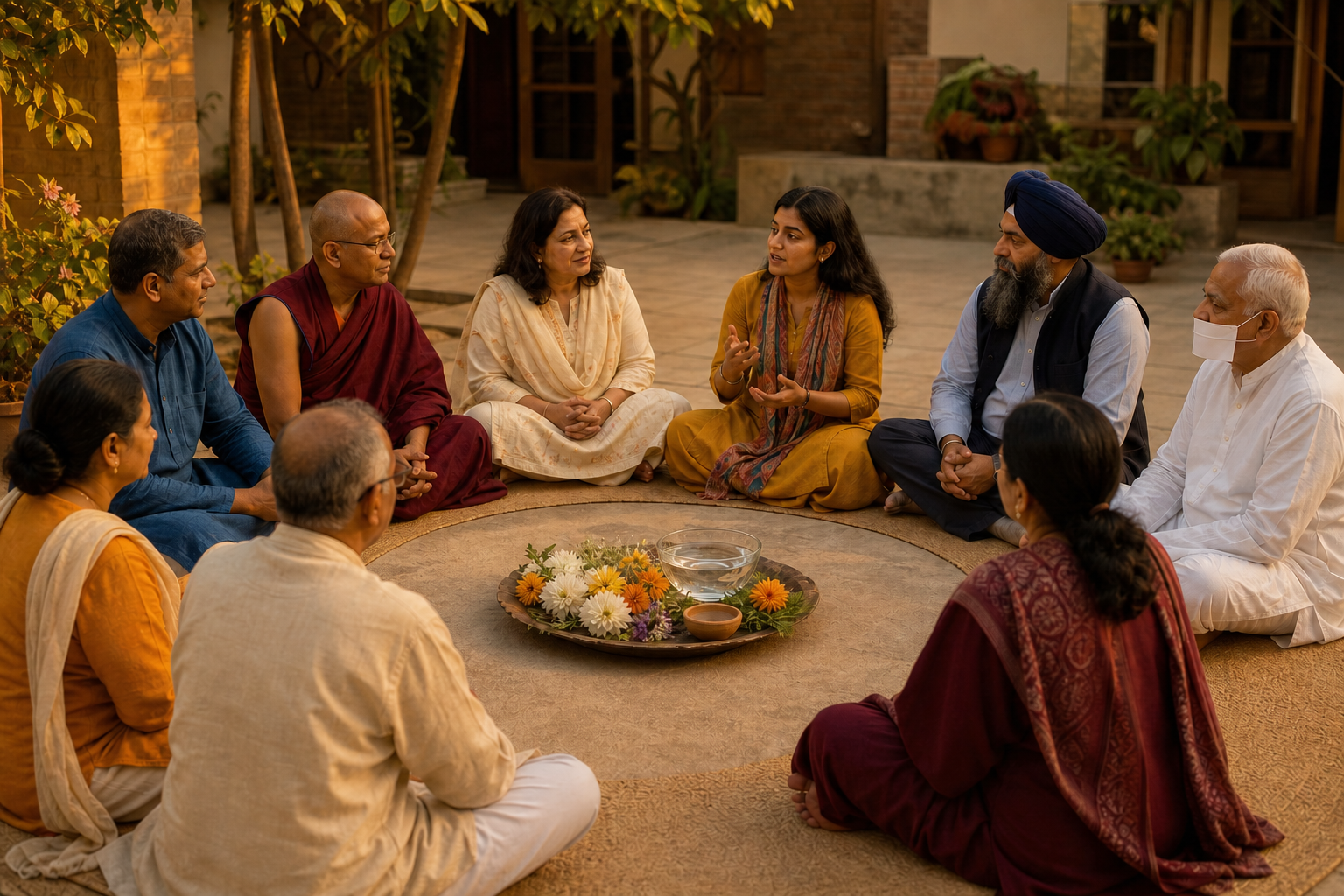
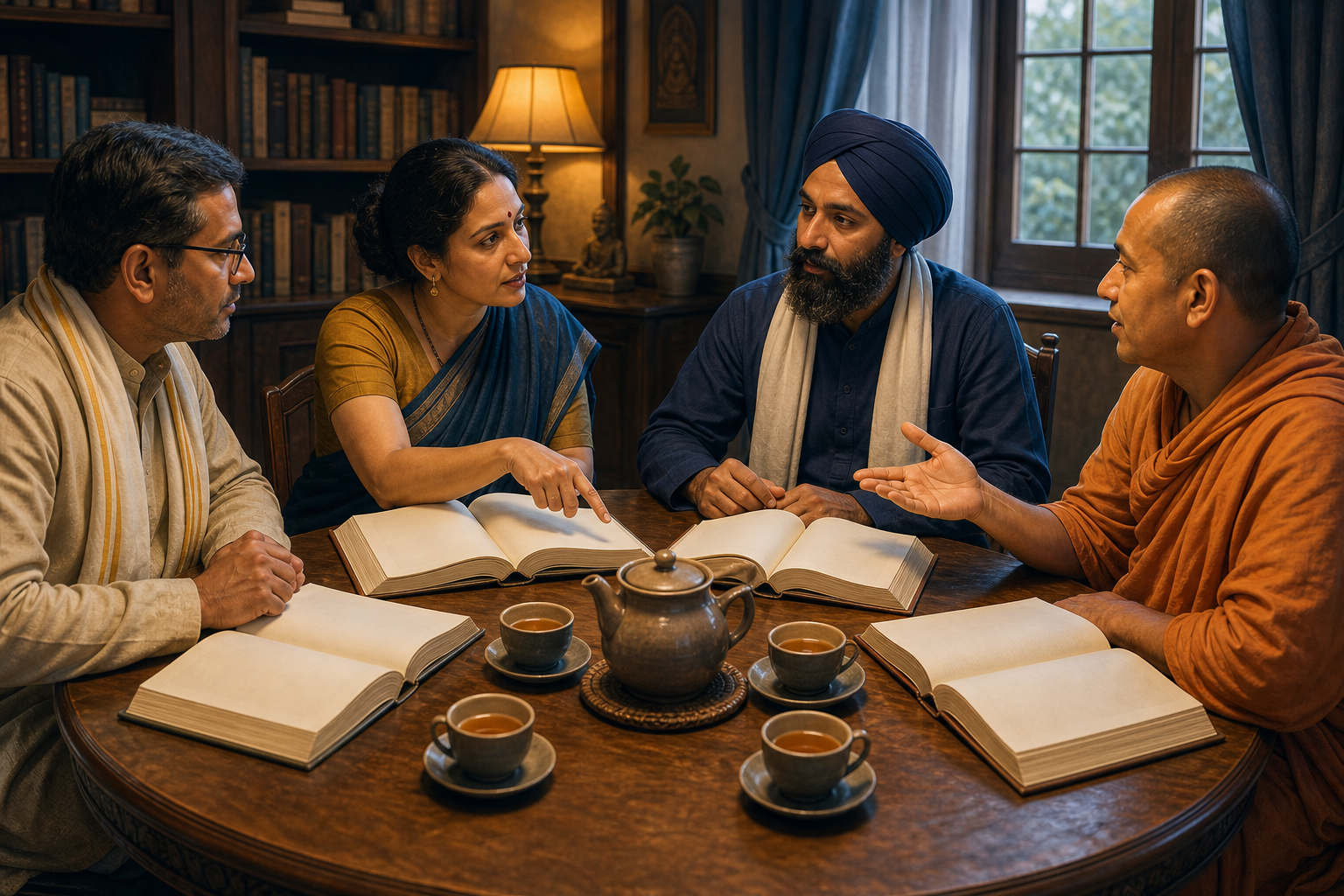
You may be planning a family observance, a campus gathering, a temple programme or a conversation among Hindu, Buddhist, Jain and Sikh friends. You want genuine fellowship, but you do not want to pretend that four distinct traditions teach the same doctrine or use the same practices in the same way.
The sound approach is neither separation nor forced sameness. Build unity around disciplines people can practise together, preserve the name and meaning each tradition gives them, and make every devotional element an invitation rather than a test of belonging.
Build on a shared ethic, not a merged theology
Comparative Dharma becomes confusing when resemblance is treated as identity. Two communities may value non-violence, sacred sound or service while explaining those practices through different teachings. The overlap is real, but so is the difference.
Before organising a shared programme, separate three layers on your planning sheet: the value you share, the form through which each tradition expresses it, and the meaning that form carries within its own setting. This prevents a useful ethical connection from turning into an inaccurate theological claim.
| Tradition | A practical doorway to unity | A distinction to protect |
|---|---|---|
| Hindu traditions | OM can anchor Vedic mantra and Surya worship, while ahimsa and sattvic nourishment connect conduct with clarity. | Hindu practices vary among lineages and households. A Hindu devotional form should not automatically be presented as the common liturgy of every Dharmic tradition. |
| Buddhist traditions | Compassionate eating may be cultivated through metta, and OM appears in meditative formulas such as Om Mani Padme Hum. | Do not imply that every Buddhist lineage uses the same mantra or follows an identical food discipline. |
| Jain traditions | Ahimsa shapes food practice with particular precision, while OM expresses reverence for the Panch Parameshti. | Jain discipline should not be reduced to a generic wellness preference. Its careful avoidance of harm has its own religious depth. |
| Sikh tradition | Vegetarian langar joins seva, equality and a shared meal, while Ik Onkar affirms divine oneness. | Ik Onkar should not be renamed as a Sikh version of OM, and langar should not be treated as merely a menu category. |
Treat these as doorways, not translations. The practical question is not whether every term can be made interchangeable. Ask whether people can recognise a shared moral direction while hearing each tradition describe its own path accurately.
- Can everyone participate without professing a doctrine they do not hold?
- Have you named which tradition a chant, prayer, posture or food custom comes from?
- Can a participant observe silently without being treated as less committed to unity?
- Has a practitioner from the represented tradition checked how its practice is described?
If any answer is no, revise the format before issuing the invitation. A smaller but honest point of connection creates more trust than an impressive programme built on false equivalence.
Plan the shared meal before planning the speeches
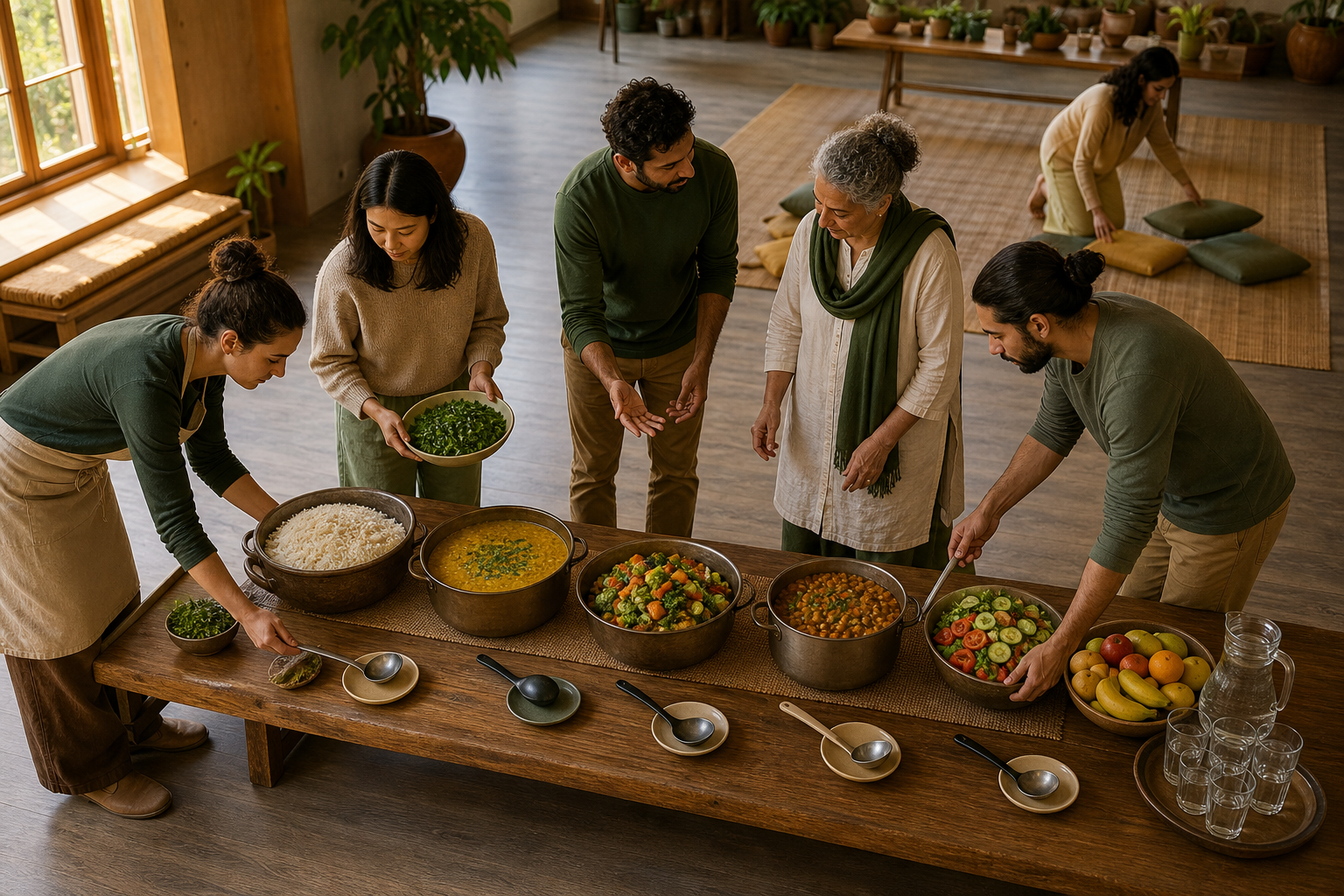
Food turns an abstract claim of unity into a visible practice. It also reveals whether organisers have listened. A meal cannot accommodate every discipline merely because it is called vegetarian, so use plant-based food as a strong baseline and ask participants about their actual requirements rather than guessing.
- Ask invited communities and guests about ingredients they avoid. Do this while setting the menu, not after the food has been prepared.
- Build the meal around clearly identified grains or millets, legumes, seasonal vegetables, fruit, nuts and seeds. Fresh food, mild spices and gentle preparation also fit the aim of calm, attentive gathering.
- Make the main dishes vegan where practical. If dairy is offered, keep it optional and label it plainly rather than assuming that every vegetarian guest wants it.
- Display a complete ingredient list. A vague label such as pure, sattvic or traditional does not tell a guest what is actually in the dish.
- Let service and cleanup be shared responsibilities. The point is not only to eat compatible food but to practise dignity, hospitality and seva together.
Use religious names carefully. Prasada, annadanam and langar each place food within a particular sacred or communal relationship. You can learn from the gratitude of prasada, the generosity of annadanam and the equality embodied by langar without casually applying those names to an unrelated buffet. When no one tradition is hosting the meal in its own form, community meal is often the more respectful description.
If plant-based eating becomes a long-term household discipline rather than a single shared meal, good intention still needs nutritional planning. Vitamin B12, iodine, iron and omega-3 intake deserve deliberate attention. Personal medical needs should be discussed with an appropriately qualified clinician or dietitian; an ethical food commitment is not a substitute for individual health guidance.
The meal succeeds when no guest must choose between conscience and hospitality. That is a concrete measure of unity, not a ceremonial extra.
Use a shared sequence without inventing a blended religion
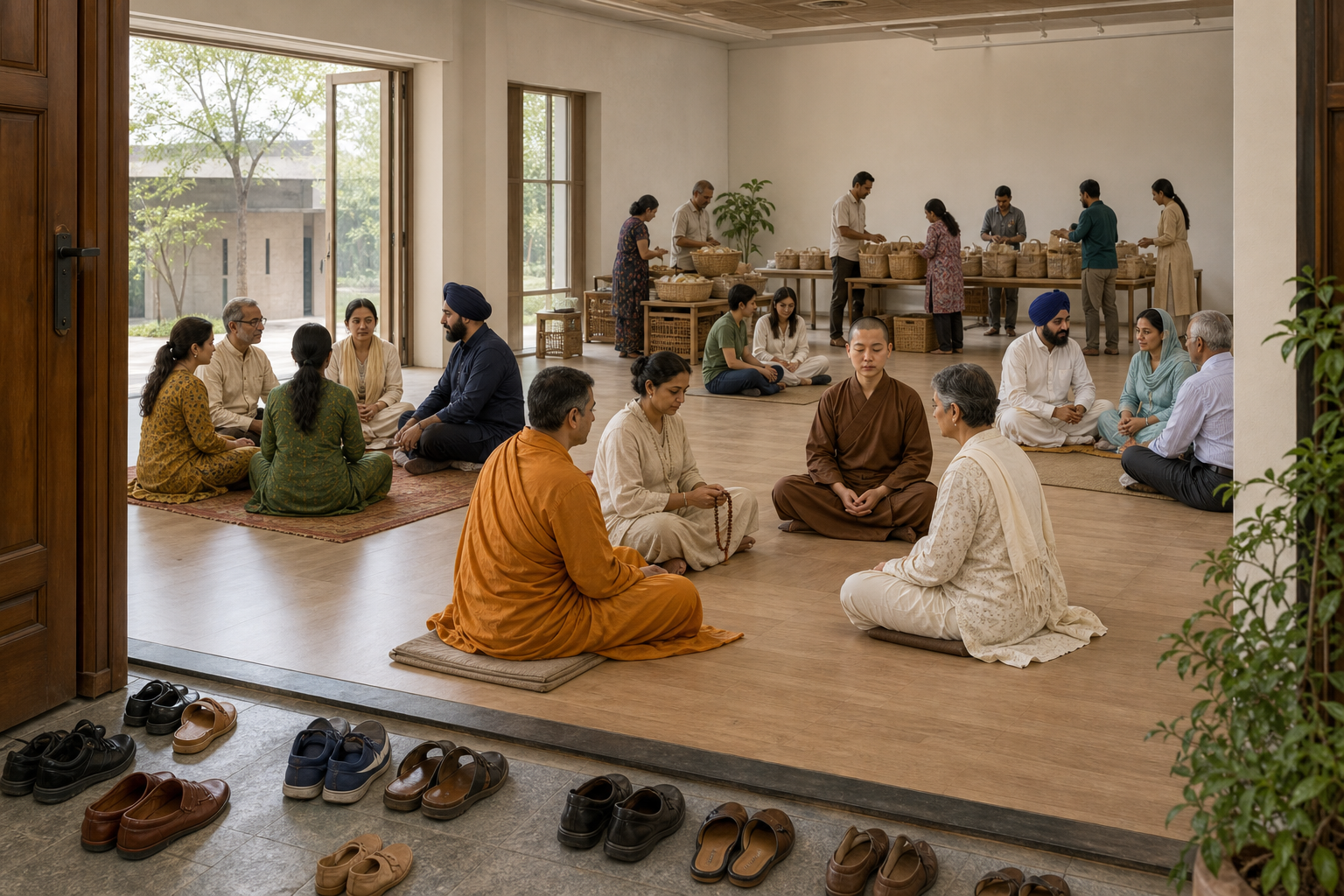
A good inter-Dharmic gathering has a clear centre and clear boundaries. It gives participants something to do together while allowing devotional forms to remain distinct. The following sequence works for a family, community or educational setting because it moves from common intention to particular expression and then to common action.
- Open with the purpose. State that the gathering honours shared commitments such as ahimsa, truth-seeking, compassion and service without declaring every teaching identical.
- Begin with silence or attentive breathing. This creates a common threshold without requiring anyone to repeat unfamiliar sacred words.
- Invite distinct offerings one at a time. A Hindu participant might offer OM or a Surya-oriented practice; a Buddhist participant from a relevant lineage might offer Om Mani Padme Hum; a Jain participant can explain OM in relation to the Panch Parameshti; and a Sikh participant can present Ik Onkar in its own vocabulary. Do not splice them into a composite chant.
- Let practitioners supply the explanation. Each contribution should identify its tradition, its intended meaning and whether listeners are invited to recite, observe or reflect silently.
- Turn contemplation into conduct. Follow the devotional portion with a plant-based meal, food service, compassionate action or another defined act of care.
- Close with one commitment people can carry home. It could be preparing a less harmful meal, correcting a misleading claim without ridicule, or serving someone without regard to status.
Participation must remain voluntary during sacred sound. Listening respectfully is participation; it is not a lesser form of it. If only one tradition is represented by an informed practitioner, present only that tradition’s practice. Do not impersonate the others in the name of balance.
A sunrise gathering makes the boundary especially important. Surya Namaskar, OM japa and mindful breathing can create a powerful sense of gratitude and cosmic order. Surya worship and OM japa should be identified as Hindu offerings, while silence or mindful breathing can remain available to guests who wish to share the moment without adopting that devotional form.
This is pluralism with substance. Nobody has to surrender a sacred distinction, yet everyone leaves having practised restraint, attention, compassion or service beside one another.
Correct extraordinary claims without breaking fellowship
Unity is tested when a spiritually moving claim does not hold up literally. The viral assertion that the Sun chants OM is a useful case. Mockery needlessly humiliates believers, but repeating a scientific-sounding falsehood weakens the commitment to satya. You can preserve both truth and reverence by separating observation, processing, perception and meaning.
- Identify what was observed. Scientists can study solar oscillations, pressure waves and plasma vibrations through helioseismology.
- Identify what was done to the data. Sonification converts such data into a range humans can hear. The resulting audio is a representation, not an ordinary microphone recording.
- State the physical limit plainly. Audible sound is not transmitted from the Sun through the vacuum of space.
- Leave room for interpretation. A listener may hear a resemblance to the sustained resonance of OM. That resemblance can inspire contemplation without proving that Surya is literally producing a recorded mantra.
- Discuss the symbolic meaning after clarifying the science. The Sun can represent illumination, order and life, while OM can direct attention toward primordial resonance and ultimate reality. Symbolic meaning does not become worthless merely because it is not a laboratory finding.
A clean correction sounds like this: the audio was created from solar data placed within the human hearing range; hearing OM in it may be spiritually meaningful, but it is not literal chanting captured across space. That sentence protects scientific clarity and leaves devotional reflection intact.
Use the same method with other viral claims. Ask what was measured, what transformation occurred, what conclusion the evidence actually supports and what symbolic interpretation a practitioner may still draw. This keeps disagreement focused on the claim rather than turning it into a contest over whose community deserves respect.
Key takeaways
- Unite around shared disciplines such as ahimsa, compassion, truthful inquiry and seva; do not manufacture a single theology.
- Name the home tradition of every chant, prayer, food custom and devotional act.
- Make sacred recitation optional and treat respectful observation as valid participation.
- Use a carefully labelled plant-based meal as a practical starting point, then ask guests about requirements that the baseline does not cover.
- Separate scientific observation from sonification, personal perception and spiritual symbolism when evaluating extraordinary claims.
- Judge unity by what people practise together after the ceremony, not by how many distinct terms an organiser can declare equivalent.
For your next gathering, begin with one shared discipline and one clearly named difference. Serve food people can accept, let every tradition speak in its own voice, and end with a concrete act of care. Repeated patiently, that pattern creates a stronger Dharmic fellowship than any declaration that we were all saying the same thing all along.
References
- DharmaRenaissance Blog – Does the Sun Chant ‘OM’? Solar Science, Sacred Sound, and Dharmic Unity
- DharmaRenaissance Blog – Ahimsa in Eating: A Sattvic Guide to Hindu, Jain, Buddhist, Sikh Plant-Based & Vegan Living
