
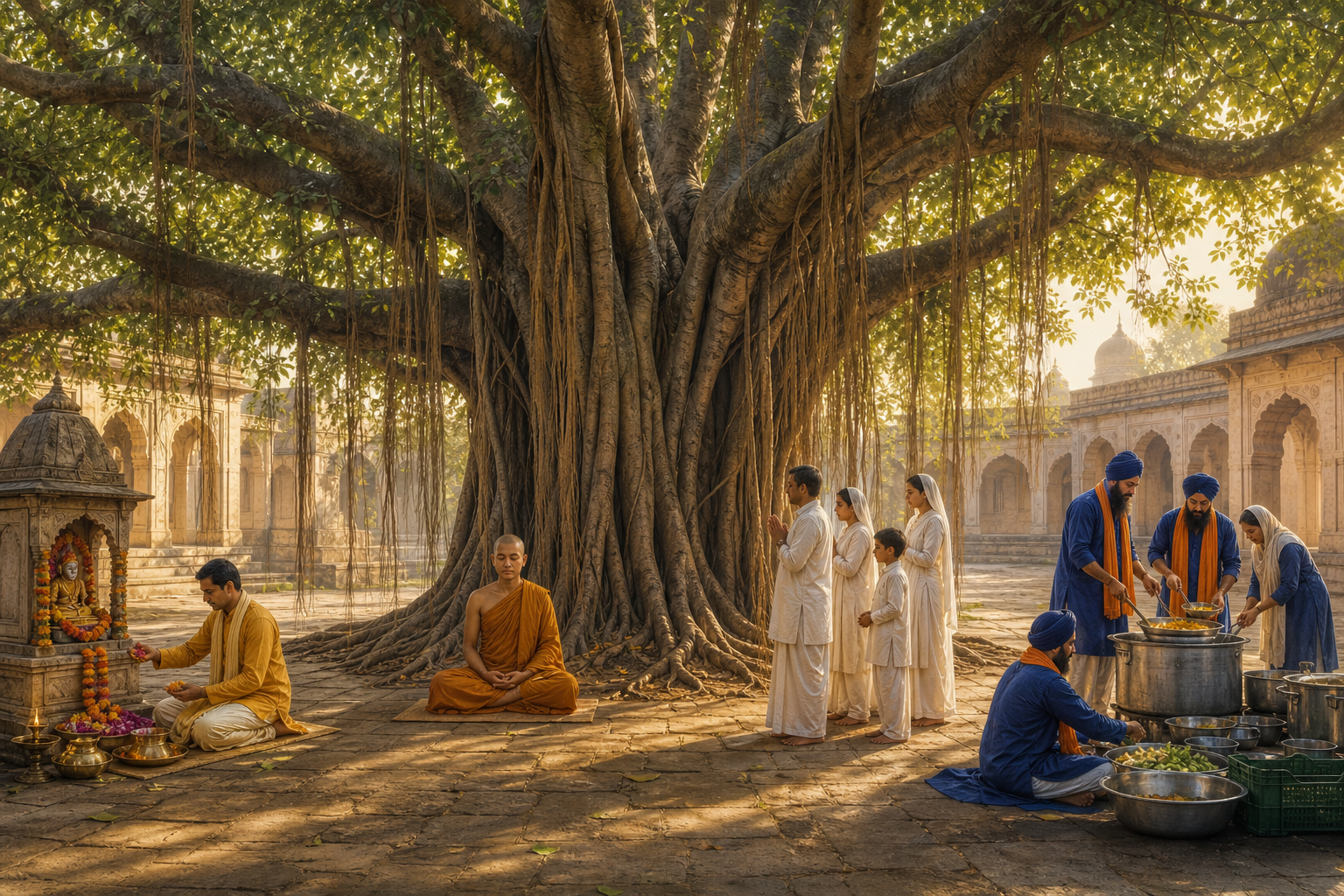
You do not have to choose between firm spiritual conviction and respect for other paths. If devotion to Krishna or your chosen form is central to your life, honouring another tradition does not make that devotion weaker. The real challenge is learning how to recognise kinship without pretending that every doctrine, name, and practice means the same thing.
Divine oneness offers a disciplined way forward. You can remain rooted in your own sadhana, understand differences accurately, and let the recognition of a shared sacred horizon shape how you speak, serve, celebrate, and disagree.
Oneness is deeper than sameness

There are two easy mistakes. The first is exclusivism: assuming that your familiar name for the Divine must refer to the only reality worthy of reverence. The second is careless universalism: declaring that all religions are identical and brushing aside their real disagreements. Neither position asks you to understand another person on their own terms.
A better starting point is that names often disclose attributes and relationships. Almighty points to power. Omniscient points to knowledge. The Sanskrit name Krishna carries the sense of the all-attractive Supreme. These are not automatically rival beings simply because their names arise in different languages. They can be distinct ways of approaching and praising one Supreme Reality.
This is especially useful when comparing theistic traditions. Before deciding that another sacred name is foreign or false, ask what the name is doing. Does it express power, compassion, timelessness, beauty, nearness, sovereignty, or another divine quality? That question moves the encounter away from labels and towards meaning.
Hindu thought already gives you a grammar for plurality. The Vedic formulation ekam sat vipra bahudha vadanti places many expressions beside an underlying truth. Hindu traditions also accommodate different disciplines, including bhakti, jnana, karma, and raja yoga. The methods differ because human temperaments and duties differ; plurality of method need not imply spiritual chaos.
Yet oneness must not become a shortcut that erases theology. Buddhism and Jainism should not be forced into the language of a creator God merely to make an interfaith slogan work. Their accounts of self, causation, liberation, and ultimate truth retain their own integrity. Divine oneness is most precise among paths that explicitly speak of the Supreme; across the wider Dharmic family, unity also appears as civilisational kinship, ethical responsibility, contemplative discipline, and reverence for liberation.
When you meet an unfamiliar teaching, use a three-part test:
- Identify the referent. Is the person speaking about a personal Divine, ultimate reality, the nature of consciousness, liberation, or an ethical ideal?
- Identify the aspect. What quality, relationship, or insight does the name or teaching bring into focus?
- Observe the fruit. Does the practice cultivate truthfulness, restraint, compassion, courage, humility, and responsibility, or does it feed contempt and domination?
This test lets you notice genuine common ground without making claims that the traditions themselves would reject.
Let your Ishta deepen devotion rather than narrow it

The principle of Ishta gives personal devotion a stable centre. You may be drawn to a particular divine form, name, mantra, lineage, or discipline because it fits your temperament and duty. The point is not to sample every available path. The point is to practise one path sincerely without needing every other path to be illegitimate.
This distinction matters because depth requires repetition. Japa becomes formative when you return to it. Meditation becomes clarifying when it is regular. Scriptural study becomes wisdom when it changes judgement and conduct. Constant comparison can keep you intellectually occupied while preventing any practice from reaching the roots of your character.
At the same time, attachment to an Ishta can become mixed with attachment to identity. You can detect that shift by asking three uncomfortable questions:
- Do you become defensive as soon as another sacred name is mentioned, before learning what it means?
- Do you treat another path’s existence as a threat to the sincerity of your own?
- Is your practice making you steadier and more compassionate, or merely more certain that your group is superior?
If the answers trouble you, do not abandon your Ishta. Examine the ego that has attached itself to the Ishta. Strong devotion should make reverence more available, not less.
The Bhagavad-Gita presents the Divine as responding to seekers through the modes in which they approach. That does not require you to collapse all modes into one practice. It asks you to leave room for the Divine to be greater than your preferred vocabulary.
A useful rhythm combines one anchor with one widening discipline:
- Keep one anchor. Maintain your regular japa, meditation, worship, study, or other core sadhana instead of changing direction whenever you encounter a new idea.
- Add one widening discipline. Learn how another Dharmic community describes itself. Use its own terms before translating them into yours.
- Review the result. After practice, ask whether you are more truthful, patient, and ready to serve. Spiritual intensity without ethical change deserves examination.
- Respect your boundaries. You can decline a ritual or belief you cannot sincerely affirm while remaining quiet, courteous, and attentive in another community’s sacred space.
Some people experience peace, clarity, or compassion when hearing sacred names outside their own tradition. Such resonance can open a door to mutual respect, but it is not a logical proof that every theology is identical. Receive the experience as an invitation to humility rather than as permission to define another person’s faith for them.
Recognise Dharmic kinship in each tradition’s own language
Unity becomes credible when each tradition remains recognisable within it. Hinduism, Buddhism, Jainism, and Sikhism share a civilisational field, but they do not contribute interchangeable doctrines. Their kinship is better understood through complementary insights and practices:
- Hindu traditions make room for many divine forms, philosophical standpoints, ritual lineages, and yogic disciplines. In important Hindu schools, the relationship between atman and Brahman provides a language for seeing a shared spiritual essence beneath apparent separation.
- Buddhism brings attention to interdependence through pratityasamutpada. It challenges the assumption that beings and events exist as sealed, self-sufficient units. You can learn from that insight without redescribing it as belief in a creator deity.
- Jainism joins rigorous ahimsa with anekantavada, the recognition that reality cannot be exhausted by one limited standpoint. This does not mean every opinion is equally correct. It means intellectual humility is necessary because a partial view should not masquerade as the whole.
- Sikhism speaks of Akal Purakh, the timeless Divine, and turns devotion outward through seva, langar, and the aspiration of sarbat da bhala. The welfare of all is not an optional sentiment added after worship; it is a test of how remembrance enters public life.
These traditions can therefore cooperate without signing a common metaphysical statement. A Buddhist, Jain, Sikh, and Hindu may explain ultimate reality differently while serving food together, protecting life, opposing cruelty, and treating every person at the table with dignity. Interdependence, many-sided understanding, ahimsa, seva, and concern for the welfare of all offer strong points of practical meeting.
Replace the vague claim all religions are the same with a more honest sentence: Our doctrines are not identical, but our differences do not prevent mutual respect or shared responsibility. That formulation gives you room to be truthful and cooperative at the same time.
When disagreement does arise, follow a clear sequence:
- Describe the other view accurately. Ask whether its practitioner would recognise your description.
- State your own location. Say that you are speaking from your lineage or school instead of making every Hindu, Buddhist, Jain, or Sikh answer for you.
- Locate the difference. Is it about the name of the Divine, the nature of self, the authority of a text, the means of liberation, ritual participation, or ethical conduct?
- Separate assent from cooperation. Decide what you cannot affirm and what good work you can still do together.
- Protect dignity. Critique a claim or action directly without treating an entire community as spiritually worthless.
This approach prevents two common failures: a debate so polite that nobody says what they believe, and a debate so aggressive that nobody can hear what is true.
Put oneness into speech, service, celebration, and care
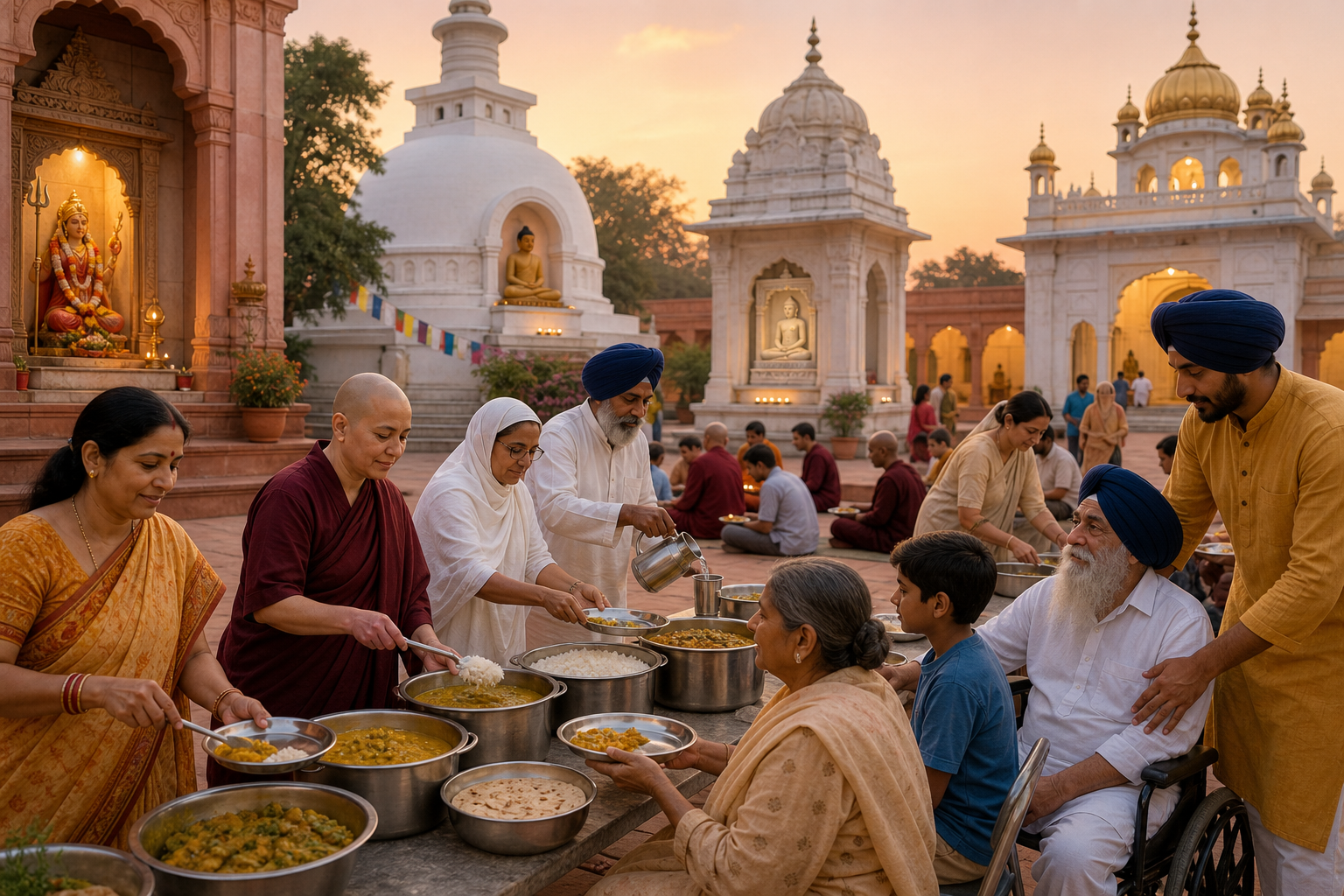
Oneness is easy to affirm while everyone agrees. Its value appears when difference becomes inconvenient. If the idea never changes your speech, your treatment of a neighbour, or your use of the natural world, it remains a pleasing abstraction.
Begin with speech. Before making a public claim about another tradition, perform a short accuracy check:
- Have you used the tradition’s own name for the belief or practice?
- Have you confused one school, teacher, or local custom with the whole tradition?
- Have you stated your disagreement precisely, or substituted a caricature that is easier to defeat?
- Would you use the same words if a knowledgeable practitioner were sitting beside you?
Next, give unity a shared task. Seva works because it does not demand that participants settle every theological question before helping someone. A langar welcoming people without distinction, neighbours sharing prasad, or worshippers passing an aarti lamp hand to hand makes belonging tangible. Festivals, sacred food, song, light, and service can bind a community while preserving regional and devotional particularity.
Choose service that expresses a principle your practice already teaches. If ahimsa is central, care for animals, rivers, forests, soil, and vulnerable people should not be treated as a secular activity detached from dharma. If seva is central, select work in which status matters less than usefulness. If your path emphasises the Divine dwelling in beings, notice whether your daily treatment of workers, relatives, strangers, and opponents reflects that conviction.
A simple weekly rhythm can keep the principle from fading:
- During daily sadhana, bring to mind one person or group you instinctively treat as other. Resolve to meet them without surrendering truth or dignity.
- During disagreement, restate the other person’s actual claim before presenting your response. If they correct you, revise the description first.
- In community life, support a recurring act of seva that brings people together around a real need rather than a ceremonial photograph.
- At the end of the week, identify one moment when identity overruled understanding. Decide on the sentence or action you will change next time.
Unity does not require passivity towards adharma. You can oppose coercion, cruelty, dehumanisation, or desecration without denying the spiritual worth of every person associated with the offending group. Respect belongs to persons; claims and actions remain open to moral judgement. This is how oneness avoids becoming either weakness or tribalism.
Key takeaways
- Many sacred names can disclose different attributes or relationships to one Divine Reality, especially within explicitly theistic paths.
- Unity is not a claim that Hindu, Buddhist, Jain, and Sikh teachings are doctrinally interchangeable.
- Your Ishta should provide depth and discipline without requiring contempt for another person’s path.
- Describe every tradition in its own vocabulary before identifying common ground or disagreement.
- Test spiritual oneness through accurate speech, shared seva, ahimsa, hospitality, and responsibility towards the natural world.
- Firm boundaries and human dignity can coexist; you need not affirm a belief in order to treat its adherent fairly.
At your next encounter with a different sacred name or practice, resist the urge either to reject it immediately or absorb it into your own system. Ask what it means to the practitioner, identify where you genuinely agree, name any difference accurately, and choose one worthy action you can still undertake together. That is how unity in diversity moves from a slogan into dharmic character.
References
- Dandavats – One Divine Reality Beyond Many Names: A Powerful, Unifying Insight into Krishna and God
- DharmaRenaissance Blog – Threads of Oneness: How Hinduism Inspires Unity in Diversity Across Dharmic Traditions
