

If you are considering a pilgrimage to Kshirgram, the important question is not merely whether the shrine appears on a list of Shakti Peethas. You need to understand what you are approaching: why Maa Jogadya is revered as Bhadrakali, why Hanuman stands within her sacred memory, and how several traditions can inhabit one place without cancelling one another.
At Kshirgram, near Katwa in the Bardhaman region of West Bengal, the Shakta memory of Sati, a regional Ramayana tradition, and the continuing worship of the Divine Mother meet. Understanding those layers can turn your visit from a shrine-checking exercise into a disciplined encounter with courage, gratitude, service, and protective grace.
Understand the three sacred layers of Kshirgram

Kshirgram, also written as Khirogram, is best understood through three related but distinct identities. Keeping them distinct prevents a common mistake: forcing every sacred memory into a single literal sequence and then treating any variation as a contradiction.
- The place: Kshirgram belongs to Bengal’s living sacred geography. Its location near Katwa connects a village shrine to the wider pilgrimage landscape of Bharat.
- The Goddess: The presiding Mother is Maa Jogadya, revered locally as a form of Bhadrakali. Her fierce form signifies vigilant protection, moral strength, and compassion capable of confronting adharma.
- The Shakti Peetha memory: Kshirgram is associated with the fall of a part of Sati’s foot. Traditions differ over the precise identification, so the uncertainty should be preserved rather than replaced with false precision.
- The Ramayana memory: The shrine is also connected with Hanuman’s confrontation with Mahiravana, his invocation of Bhadrakali, and his consecration of the Mother’s presence after rescuing Rama and Lakshmana.
These layers answer different questions. The Shakti Peetha tradition places Kshirgram within the subcontinent-wide sacred body of the Goddess. The name Jogadya expresses the form in which the local community knows and worships her. The Hanuman tradition explains the ethical relationship among divine power, devoted service, and victory over adharma.
You therefore do not have to choose between the Peetha tradition and the Hanuman tradition. Sacred places often preserve several memories because worship is cumulative. One layer can establish cosmic significance, another can preserve regional devotion, and another can teach the pilgrim how power ought to be used.
Read the Mahiravana episode as a discipline of service
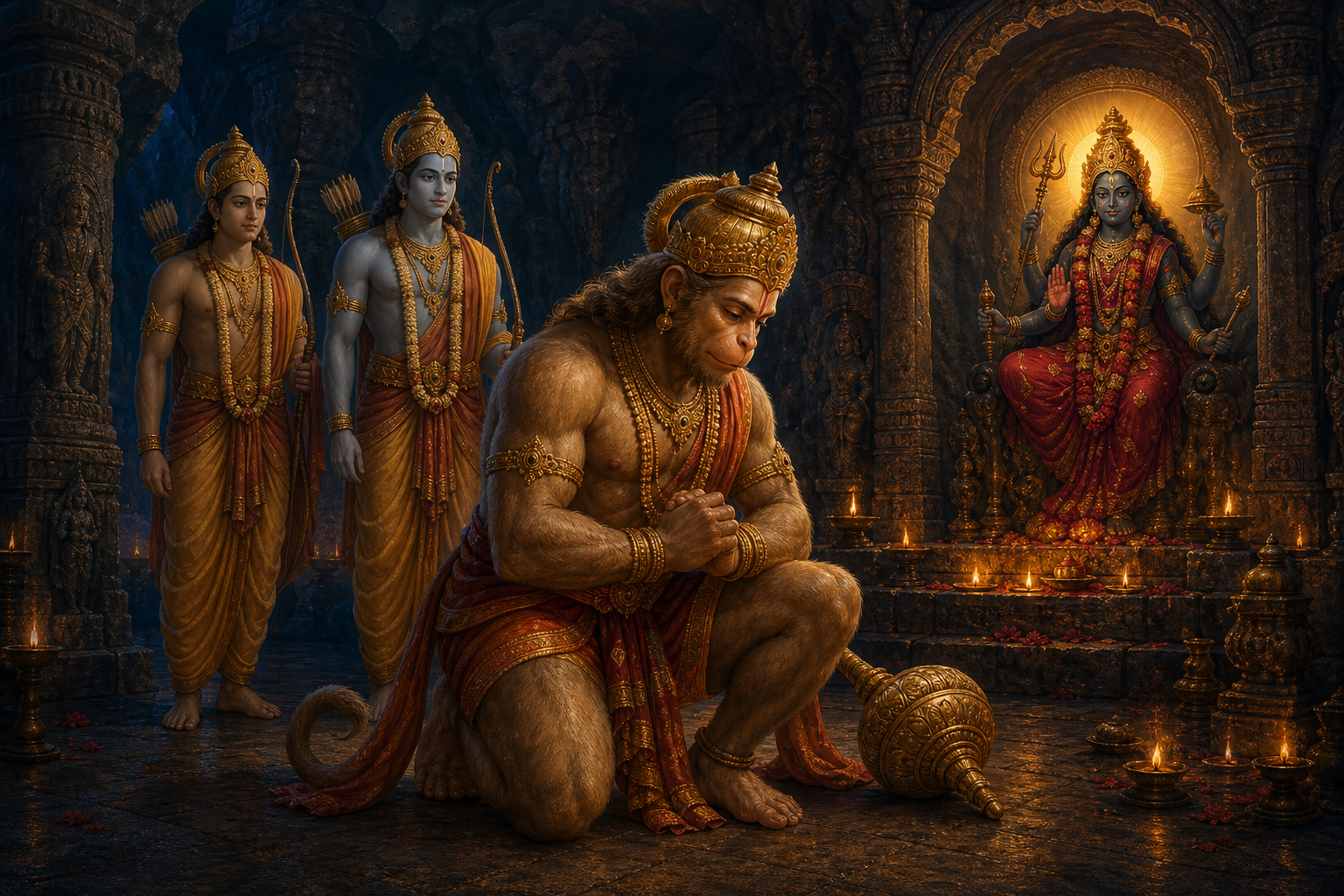
In the regional Ramayana tradition remembered at Kshirgram, Mahiravana, an underworld ally of Ravana, abducts Rama and Lakshmana during the Lanka war. Hanuman descends into Patala to rescue them. He discovers that Mahiravana’s protection depends on five lamps burning in different directions and assumes the Panchamukhi form so that he can extinguish them together.
Before the decisive confrontation, Hanuman invokes Bhadrakali for righteous strength. After defeating Mahiravana and freeing Rama and Lakshmana, he consecrates the Mother’s presence in gratitude. In Bengal’s devotional memory, that presence is associated with Maa Jogadya.
The heart of this tradition is not spectacle. Hanuman’s many-faced form and the five lamps matter because they reveal disciplined attention. The threat cannot be overcome by unfocused force. Hanuman first learns what sustains the danger, then acts in complete alignment with his vow to serve Rama. Strength follows discernment; victory remains subordinate to seva.
Bhadrakali’s place in the episode is equally important. Hanuman does not treat divine grace as permission for ambition. He seeks strength for a duty larger than himself. He then answers success with gratitude and consecration, not self-glorification. That sequence offers you a practical way to contemplate the tradition without pretending that your private reflection is a temple-prescribed ritual:
- Name the duty clearly. Ask what must be protected or completed, rather than beginning with what you want to obtain.
- Identify what sustains the obstacle. Hanuman’s success depends on understanding the lamps, not merely attacking Mahiravana with greater force.
- Seek strength in service of dharma. Courage becomes sacred when it is directed toward protection, truth, and the fulfilment of a rightful responsibility.
- Act with full attention. Devotion does not replace action; it steadies and directs it.
- Consecrate the outcome. When a difficult task succeeds, convert gratitude into service rather than treating the result as a monument to the ego.
This is also why the Panchamukhi episode should not be reduced to a promise of supernatural advantage. Its sharper teaching is that a devotee must become equal to the duty before him. Prayer, knowledge, courage, and action belong together.
See the Vaishnava-Shakta bridge without erasing difference
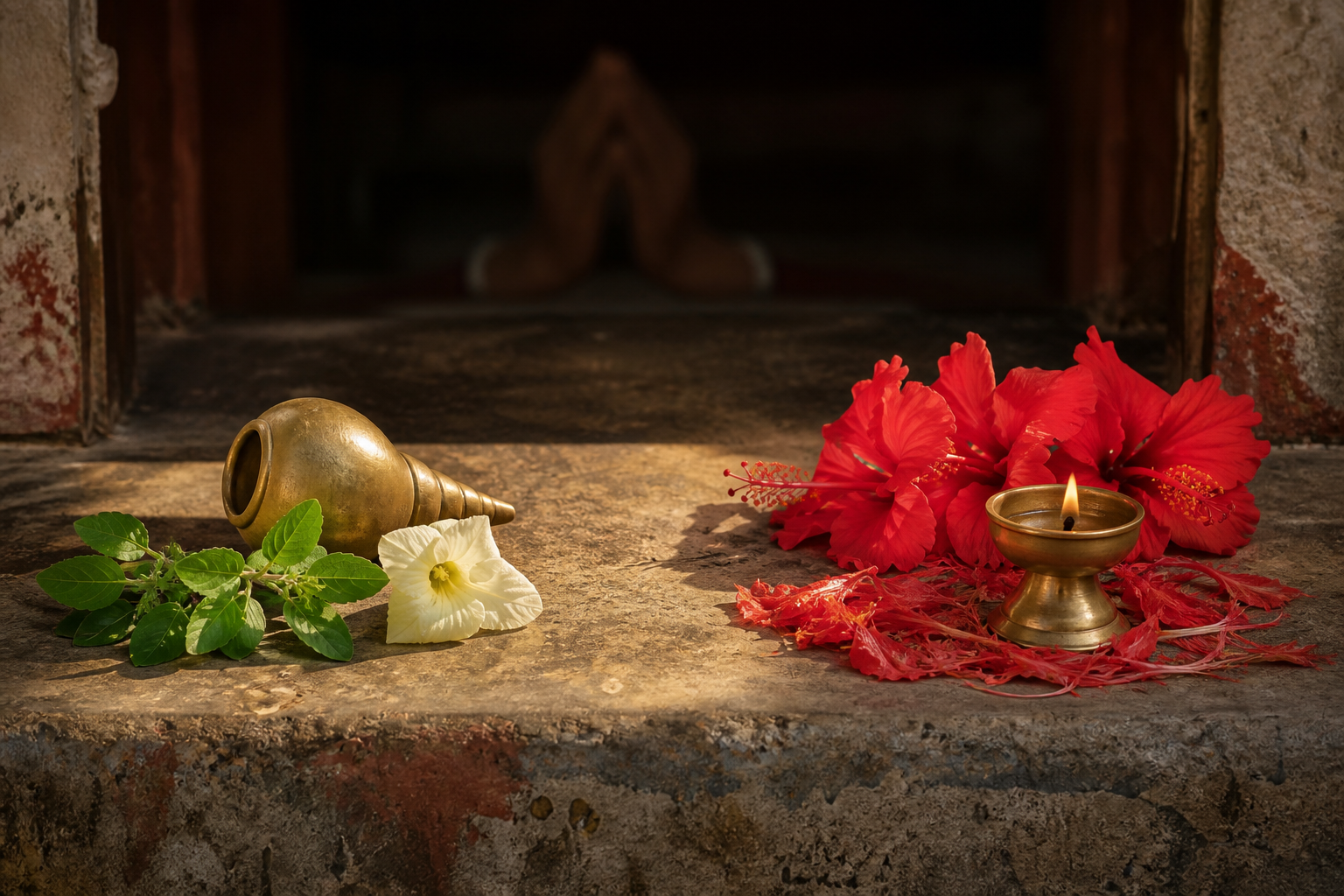
Kshirgram can be confusing if you have been taught to place Vaishnava and Shakta devotion in separate compartments. Hanuman is the exemplary servant of Rama, yet the decisive memory at this Shakti Peetha includes his invocation of Bhadrakali. The relationship is not presented as a contest over which deity or path is superior.
Hanuman remains wholly devoted to Rama. Bhadrakali is not reduced to a decorative figure in somebody else’s victory. Her Shakti protects righteous action and enables the defeat of tyranny. Hanuman’s courage gives that power an ethical direction through loyalty, humility, and seva. Each element retains its character while participating in a shared work of dharma.
This distinction matters beyond theology. Calls for dharmic unity sometimes become demands for sameness, but unity does not require every sampradaya to use identical language or dissolve its own discipline. Kshirgram offers a better pattern: honour a tradition on its own terms, notice where its virtues meet other paths, and refuse to turn difference into hostility.
The shrine’s moral vocabulary – courage, compassion, truthfulness, service, protection, and restraint – can be recognized across Hindu, Buddhist, Jain, and Sikh communities. Recognition does not make their doctrines interchangeable. A Jain understanding of non-harm, a Sikh commitment to seva, a Buddhist discipline of compassion, and the Hindu relationship among Shakti, bhakti, and dharma arise within distinct histories and teachings. The honest form of unity respects those differences while allowing practitioners to cooperate around worthy conduct.
If you visit with family or a mixed group, avoid asking everyone to give the story the same theological interpretation. Ask a more fruitful question: what does this tradition require strength to serve? That keeps the conversation on conduct while leaving room for genuine religious difference.
Prepare for darshan without inventing local customs
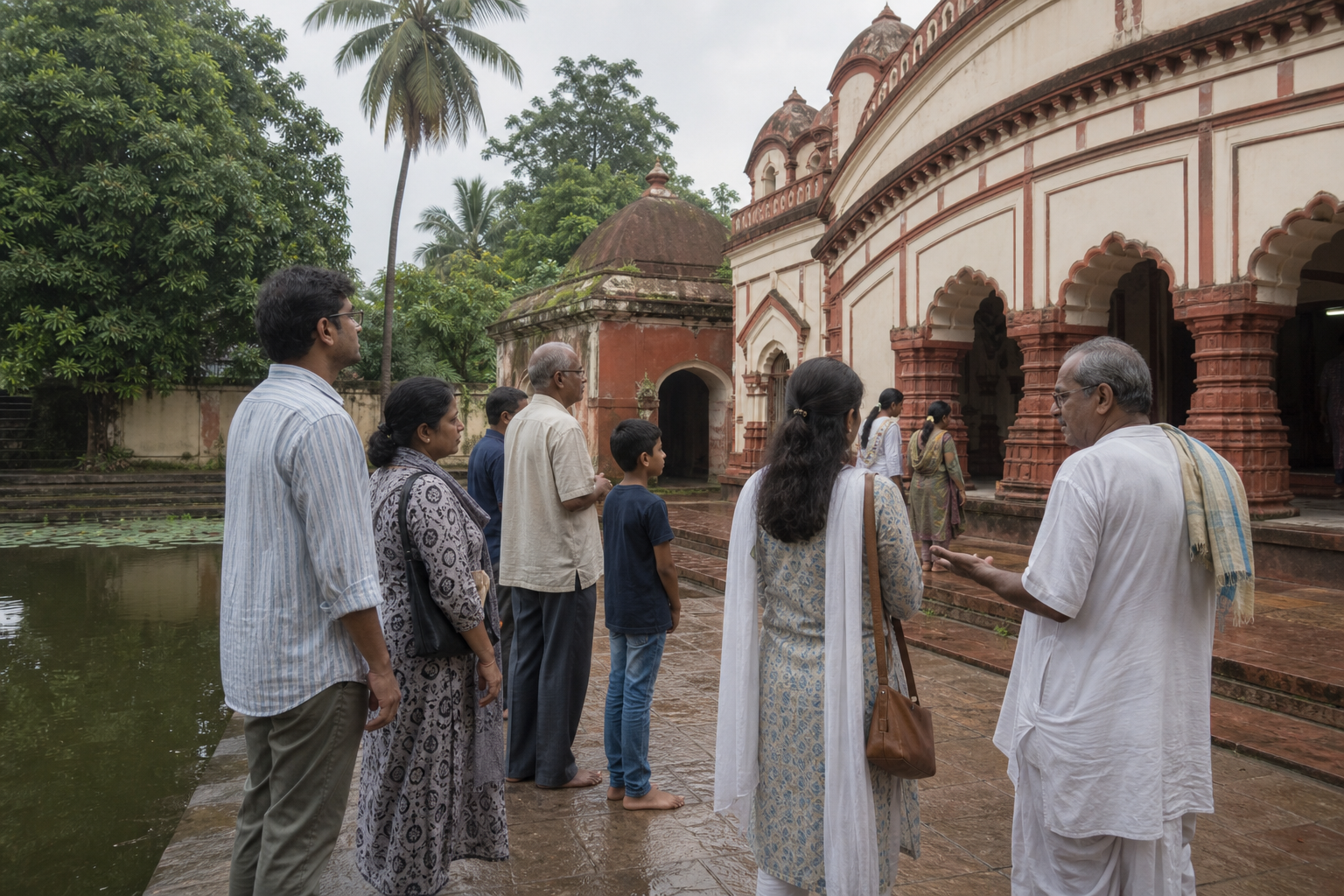
A respectful pilgrimage begins by recognizing the limits of a general description. The sacred identity of Kshirgram is clear, but exact opening times, accepted offerings, photography rules, accessibility arrangements, and festival procedures can change or depend on local practice. Do not import a routine from another Shakti Peetha and assume it applies here.
Before travelling, confirm the practical details directly with a current local contact or the temple administration. Use both spellings, Kshirgram and Khirogram, when checking the destination. Specify that you mean the Maa Jogadya shrine near Katwa in the Bardhaman region; this is more reliable than searching by the Goddess’s name alone.
- Confirm the day’s access: Ask about opening periods and whether a seasonal observance changes the usual sequence.
- Ask about offerings: Bring only what local custodians presently accept. A sincere offering does not become more appropriate merely because it is customary at another temple.
- Check before photographing: Treat the sanctum and worshippers as participants in a living tradition, not as visual material collected from a heritage site.
- Plan around major observances: Navaratri is especially important to the shrine’s devotional life, so verify how it affects darshan rather than assuming that an ordinary-day plan will apply.
- Prepare a clear sankalpa: Decide what duty, fear, or moral confusion you are placing before the Mother. Keep it simple enough that you can remember it without consulting a phone in the temple.
Once there, pause and observe before acting. Follow the directions of the people responsible for the worship. Listen to how the Goddess is addressed locally. If a practice is unfamiliar, ask respectfully rather than performing an imitation based on something seen elsewhere.
Your inner preparation should follow the shrine’s ethical emphasis. Hanuman arrives in the story because Rama and Lakshmana must be rescued, not because he is seeking a private display of power. Maa Jogadya is remembered through protection and fierce compassion, not aggression for its own sake. A fitting prayer therefore joins what you seek with what you are prepared to do.
If you ask for courage, name the responsibility in which you will use it. If you ask for protection, consider whom you are obliged to protect without becoming unjust toward others. If you ask for an obstacle to be removed, examine whether inattention, pride, or avoidance is one of the lamps keeping it alive. This makes darshan morally specific rather than merely emotional.
Notice what the shrine teaches about sacred power
Bhadrakali’s fierce form is easy to misunderstand if fierceness is equated with uncontrolled anger. At Kshirgram, the Mother is remembered as vigilant grace: power that confronts danger in order to protect. Her fierceness has a moral boundary. It is directed against adharma and joined to compassion for those under threat.
Hanuman supplies the complementary lesson. Courage alone does not establish righteousness. His courage is trustworthy because it is governed by devotion, humility, intelligence, and fidelity to a vow. He does not seek power as an identity. He accepts the form and strength required for service, completes the duty, and returns the victory to the sacred.
This relationship gives you three things to notice during darshan. First, strength should protect rather than dominate. Second, knowledge of an obstacle must precede decisive action. Third, success creates an obligation of gratitude. These are not abstract virtues added to the shrine from outside; they arise from the way Bhadrakali’s grace and Hanuman’s service are remembered together.
Kshirgram also shows how Bharat’s sacred geography preserves civilizational memory. A local name, a Bengali form of worship, a Shakti Peetha tradition, and a Ramayana narrative can coexist without the village losing its particular identity. The place is connected to a wider sacred world precisely through its local continuity.
That continuity deserves more than passive admiration. Treat the temple as a community of worship before treating it as a historical attraction. Use the names its devotees preserve. Allow variations in the Peetha tradition to remain visible. Support respectful custodianship when an appropriate opportunity for seva is available. Cultural heritage survives when living practice is honoured, not merely when a location is added to an itinerary.
Key takeaways
- Kshirgram or Khirogram is a Shakti Peetha near Katwa in West Bengal’s Bardhaman region, where Maa Jogadya is revered as Bhadrakali.
- The Peetha is associated with a part of Sati’s foot, but the precise identification varies among traditions and should not be stated with false certainty.
- The regional Ramayana memory connects the shrine with Mahiravana, Panchamukhi Hanuman, the rescue of Rama and Lakshmana, and Hanuman’s grateful consecration of the Mother.
- The shrine joins Vaishnava devotion and Shakta theology through action: Bhadrakali’s protective power guides Hanuman’s devoted courage toward the defeat of adharma.
- A responsible visitor confirms current local arrangements, follows the temple’s own customs, and carries a sankalpa tied to a real duty rather than a vague wish for power.
- The tradition’s practical test is what happens after darshan: courage should become service, protection should remain just, and gratitude should produce an action.
Before you travel, write your duty in one plain sentence. After darshan, decide the first act that will make that sentence real when you return home. Kshirgram’s tradition does not ask you merely to admire Hanuman’s courage or Maa Jogadya’s power. It asks whether your own strength can be placed under the discipline of dharma.
References
