
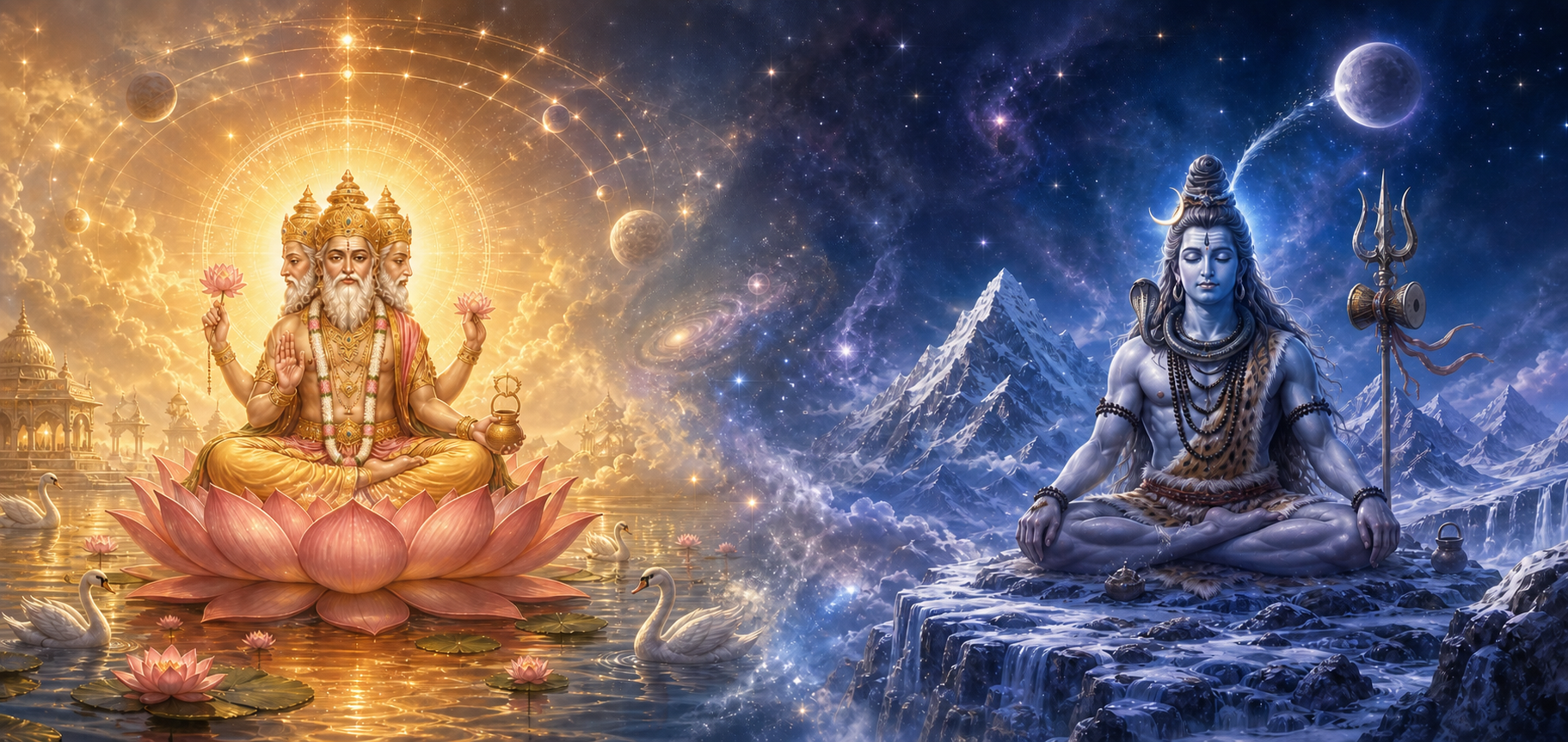
If you have seen both Satyaloka and Shiva Loka described in elevated terms, the obvious question is whether one sits above the other. That question is understandable, but it can create false precision. Hindu cosmology does not require every divine abode to be a floor in one universally fixed celestial building.
The practical distinction is clearer. Satyaloka directs you toward Brahma, truth, knowledge and cosmic order. Shiva Loka directs you toward Shiva, grace, renunciation, transformation and inner stillness. Once you identify which spiritual question a teaching is answering, the two realms stop looking like rivals.
Key takeaways before you compare the realms
- Satyaloka, also called Brahmaloka, is the realm of Brahma and the luminous ideal of satya, or truth. It occupies the summit in many layered descriptions of the cosmos.
- Shiva Loka is the transcendental abode of Shiva. Mount Kailash is revered as its earthly reflection, not merely as a coordinate on the same celestial chart as Satyaloka.
- The word highest must be read within a particular theological frame. Cosmographic height, closeness to a chosen deity and final liberation are related ideas, but they are not automatically identical.
- Residence in an exalted realm should not be confused with moksha. Satyaloka can be understood as a gateway to liberation through krama-mukti rather than as the final state in every interpretation.
- For daily practice, Satyaloka tests whether your thought, speech and action agree with truth. Shiva Loka tests whether devotion is making you less reactive, less attached and more capable of compassionate action.
One word, loka, can do three kinds of work
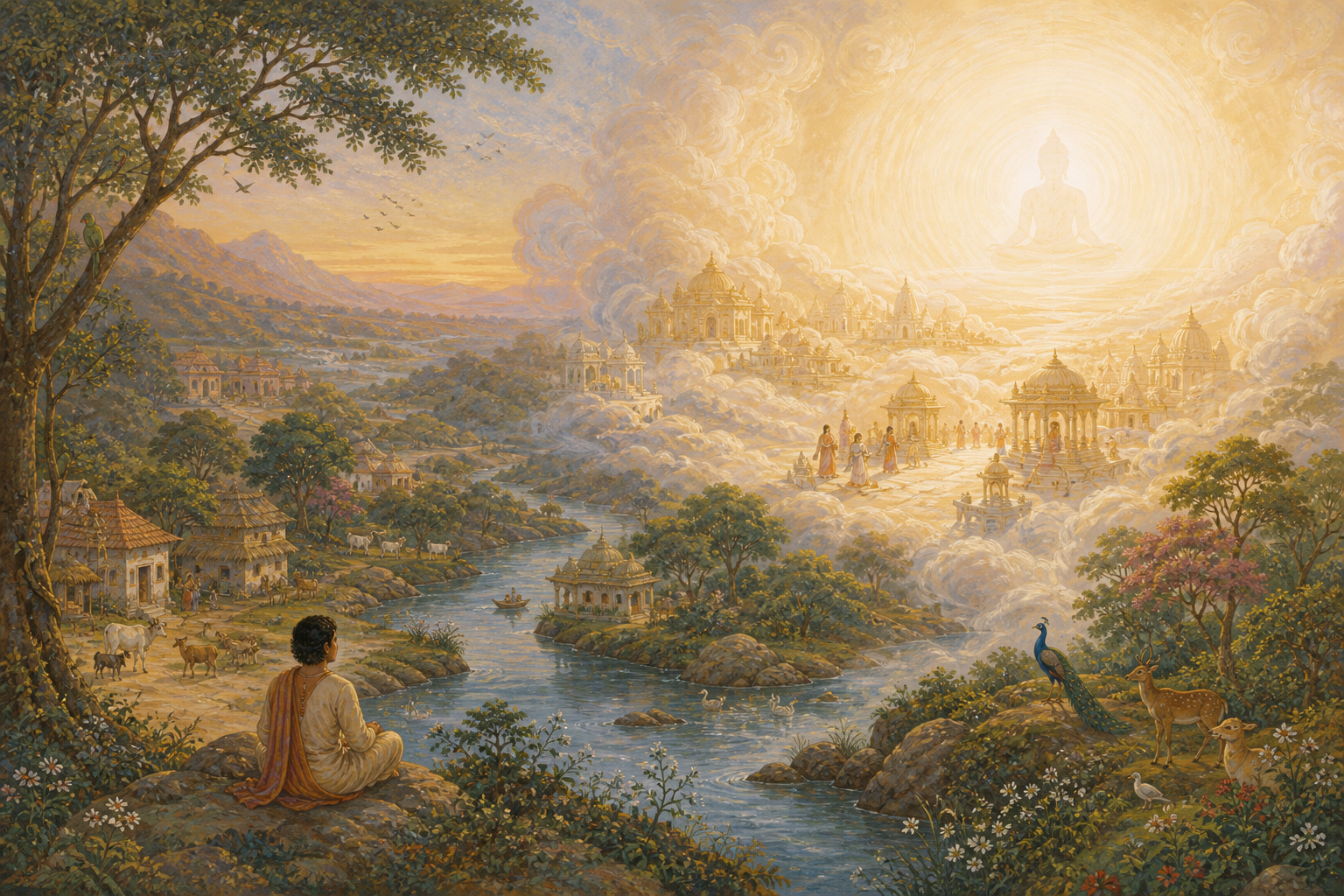
Confusion usually begins when loka is assumed to mean only a physical place. In Hindu discourse, a loka can function as a cosmic plane, a divine abode and a spiritual condition represented through sacred imagery. A passage may emphasize one of these meanings without excluding the others.
In a cosmographic register, Satyaloka is a lofty plane within an ordered universe. In a devotional register, Shiva Loka expresses nearness to Shiva and participation in his grace. In a contemplative register, both can illuminate transformations of consciousness: the removal of falsehood and confusion in the first case, and the release of agitation and attachment in the second.
This is why the choice between literal and symbolic is often too crude. Calling Satyaloka a symbol of consciousness does not require you to deny its sacred cosmological reality. Calling Kailash an earthly reflection of Shiva Loka does not reduce the mountain to a metaphor. Sacred geography can support pilgrimage, humility and disciplined attention while still pointing beyond geography.
When you encounter a claim about either realm, ask three questions before drawing a diagram. Which deity or theological vision stands at the center? Is the passage describing cosmic location, devotional relationship or realized awareness? Does it promise an exalted mode of existence, progressive liberation or liberation itself? These questions prevent the word highest from doing more work than the teaching permits.
What Satyaloka and Shiva Loka each mean
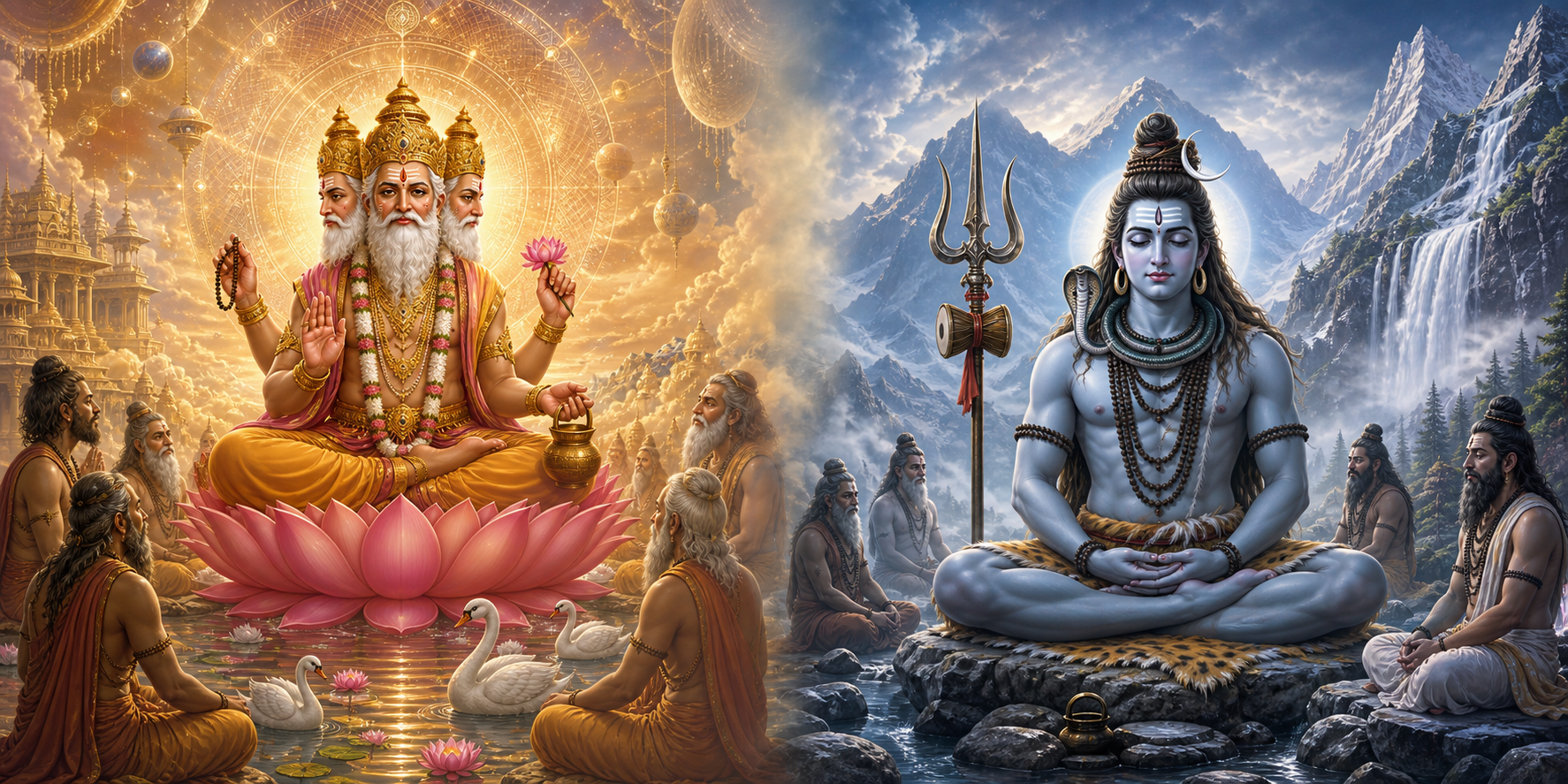
| Question | Satyaloka | Shiva Loka |
|---|---|---|
| Primary association | Brahma and Brahmaloka | Shiva and his transcendental abode |
| Dominant spiritual emphasis | Truth, clarity, wisdom, sattva and cosmic order | Grace, stillness, renunciation, transformation and devotion |
| Relation to liberation | An exalted attainment that can lead to krama-mukti; it is not treated as final liberation in every account | An abode approached through Shaiva devotion and an ideal of freedom through Shiva’s grace |
| Geographic expression | Presented chiefly as Brahma’s celestial realm | Reflected on earth by Mount Kailash |
| Practical question | Are thought, speech and conduct aligned with truth? | Are stillness and devotion transforming attachment and reaction? |
Satyaloka is more than a heavenly reward
The name joins satya, truth, with loka, realm. That gives Satyaloka an ethical and contemplative force as well as a cosmological one. It represents a condition in which reality is no longer clouded by the ordinary distortions of maya. Its association with sattva emphasizes purity, luminosity and balance rather than power or pleasure.
This realm is associated with the maturation of knowledge, meditation and dharmic conduct. Yet Brahmaloka is not automatically identical with moksha in every classical presentation. Some accounts understand it through krama-mukti, or progressive liberation: a seeker reaches Brahmaloka and advances beyond cyclic existence when the great cosmic cycle concludes.
That distinction matters whenever someone treats Hindu liberation as celestial promotion. A very high realm can still be discussed in relation to cosmic time, whereas moksha means freedom from binding cyclic existence. When reading about Brahmaloka, look for whether the teaching presents it as the highest conditioned attainment, a station on the way to liberation or a symbol of truth fully realized. Do not silently merge those meanings.
Shiva Loka joins transcendence to the presence of Kailash
Shiva Loka is centered on Shiva rather than on Brahma’s place within the rhythm of cosmic manifestation. Shiva holds together qualities that appear opposed: stillness and dynamism, austerity and compassion, dissolution and grace. His abode consequently signifies more than rest in a pleasant heaven. It points toward freedom through transformation.
Mount Kailash gives this transcendent orientation an earthly focus. Its austere landscape, devotional associations and tradition of circumambulation make the body participate in what the mind contemplates. The mountain is therefore neither a casual synonym for Shiva Loka nor an unrelated symbol placed beside it. It is a terrestrial manifestation through which devotees orient themselves toward Shiva.
That relationship should not be turned into spiritual automation. Physically approaching Kailash is not the same claim as attaining Shiva Loka, and completing a pilgrimage does not by itself prove inner freedom. The useful test comes after worship or parikrama: has reverence produced humility, restraint, presence and more responsible conduct? Sacred geography has done its deepest work when it changes the pilgrim rather than merely expanding the pilgrim’s itinerary.
Turn the cosmology into a disciplined practice
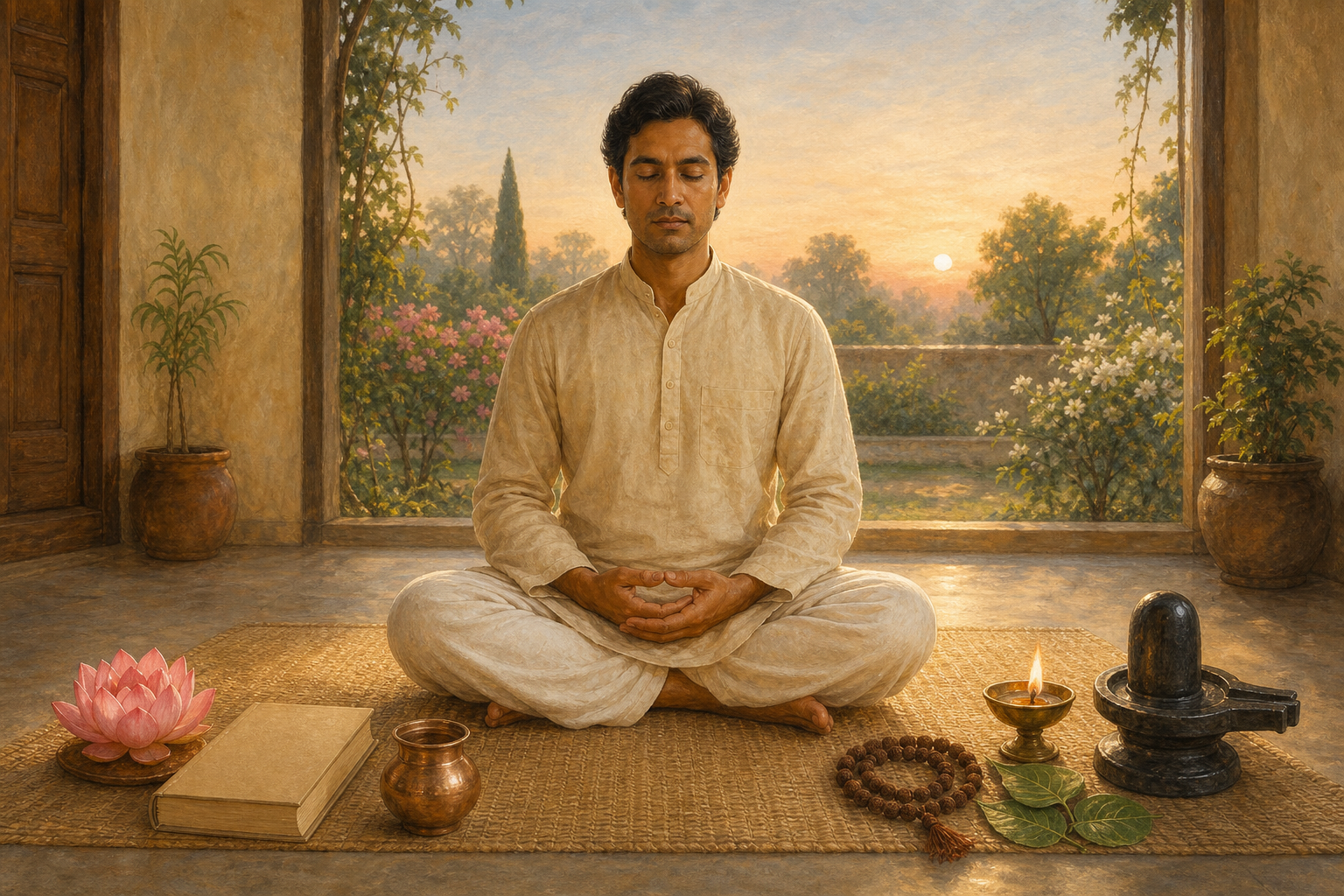
You do not have to settle every metaphysical disagreement before these teachings can shape your life. You do need to resist using cosmology as an escape from conduct. A simple reading and reflection method keeps the transcendent claim intact while bringing its demand into the present.
- Name the frame. Before interpreting a passage, identify whether its center is Brahma and cosmic truth, Shiva and divine grace, a layered universe, a pilgrimage landscape or an interior realization.
- Delay the ranking. If a realm is called highest, ask what scale is being used. Do not convert devotional supremacy in one tradition into a neutral measurement binding every Hindu school.
- Apply the Satyaloka test. At the end of the day, notice where your thought, speech and action separated. If you concealed a relevant fact, exaggerated a claim or acted against what you knew to be right, choose a concrete correction. Satya becomes spiritual practice when alignment costs you something.
- Apply the Shiva Loka test. Sit in silence, use japa if it belongs to your practice, and observe the attachment or reaction dominating your attention. Then choose an act of restraint, compassion or responsible release. Stillness is not withdrawal if it returns you to action with greater clarity.
- Examine the fruit. Knowledge that increases pride has missed Satyaloka’s ethical force. Devotion that excuses irresponsibility has missed Shiva’s transformative force. Keep the interpretation that strengthens truthfulness, humility and dharma.
Compare Dharmic traditions without collapsing them
The wider Dharmic family contains meaningful resonances. Buddhist teachings on conventional and ultimate truth, Jain commitments to satya and Siddhashila, and Sikh devotion to Sachkhand and Satnam all place truth or liberation near the center of spiritual life. Hindu, Buddhist and Jain traditions also revere Mount Kailash, though they preserve distinct accounts of its meaning.
Use these parallels to deepen respect, not to declare every realm identical. Compare the function of an idea before comparing its name: what bondage is being overcome, what practice is prescribed, and whether the destination is an exalted realm or irreversible liberation. Shared civilizational intuitions become more valuable when differences are allowed to remain intelligible.
Next time you meet a claim that one loka is simply higher than the other, pause before accepting the diagram. Identify the tradition, the register and the promised spiritual end. Then let the teaching demand something of you: repair what is untrue, quiet what is reactive and act with greater clarity. Cosmology earns its place in daily life when it changes how you live beneath the sky, not only how you imagine what lies beyond it.
References
- DharmaRenaissance Blog – Satyaloka Unveiled: The Awe-Inspiring Symbolism of Brahma’s Highest Realm of Truth
- DharmaRenaissance Blog – Shiva Loka Unveiled: Mount Kailash and the Timeless Abode of Lord Shiva
