

You sit down to study, but your mind is still carrying the noise of the day. Or perhaps your child is working hard, yet every exam has become a cycle of pressure, distraction and disappointment. A prayer, diya or traditional remedy may help, but only if it leads back to disciplined effort rather than promising marks without it.
The most useful Dharmic study practices are simple: prepare the place, steady the breath, remember the purpose of learning, work in focused blocks, retrieve what you learned and offer some of that knowledge to another person. The ritual is the threshold. Study remains the work.
A Dharmic remedy must pass an ethical test
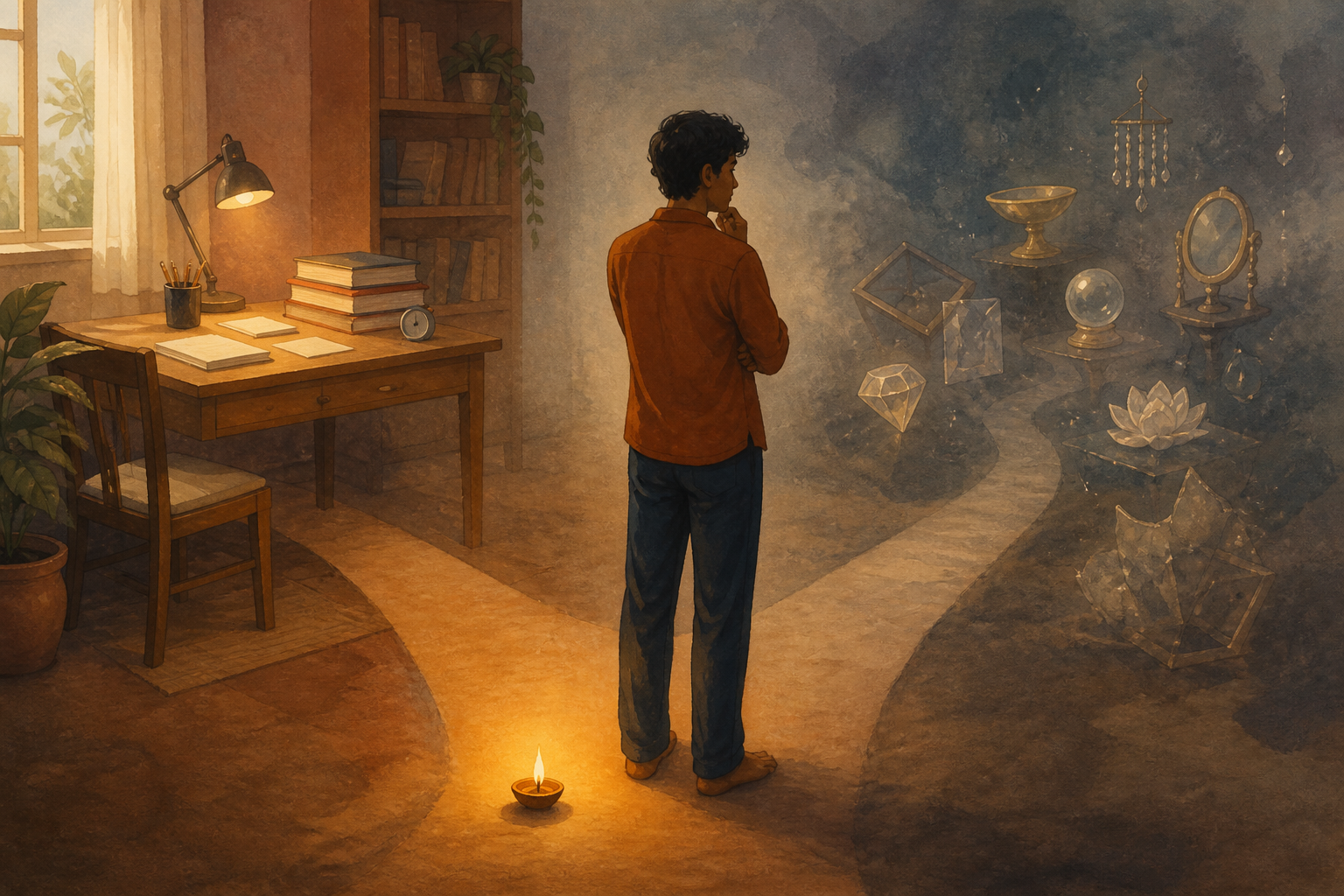
In many Indian homes, a totka is a small customary action performed with intention: lighting a lamp, reciting a mantra, placing the books neatly or beginning at a preferred time. For a student, its legitimate purpose is to settle attention and support a reliable routine. It is not a transaction in which an offering purchases a result.
You can test any proposed remedy with four questions:
- Does it direct you toward study, or claim to make study unnecessary?
- Does it cultivate steadiness, gratitude or self-discipline, or does it create fear?
- Is it harmless to you, other people, animals and the environment?
- Can it be practised honestly, without pretending that success is guaranteed?
If the practice passes those tests, it can serve as a useful sankalpa: a deliberate commitment to begin. If it promises a particular score, blames another person for your difficulty or asks you to replace preparation with magical certainty, leave it aside. Dharma cannot become an excuse to evade karma in its most immediate sense: the work in front of you.
Hinduism, Buddhism, Jainism and Sikhism are not interchangeable traditions. A student does not need to blur their distinct teachings in order to recognise shared educational virtues such as reverence for knowledge, disciplined conduct and gratitude toward teachers. Follow the practice that belongs naturally to your family or chosen path. Respectful depth is better than collecting sacred words as productivity tools.
Build a five-minute threshold between distraction and study

A good opening ritual removes decisions. When the same small sequence precedes each session, you no longer have to wait until you feel motivated. The sequence itself tells the mind that wandering time has ended.
- Clear the immediate workspace. Keep only the books, notes and tools needed for the present task. Put distracting devices out of reach when they are not required.
- Make the setting usable. Choose a clean, well-lit place and keep water nearby. Some families prefer a desk facing East or North-East. Treat that direction as a meaningful household convention, not as a guarantee. The practical priorities are adequate light, an upright working position and fewer distractions.
- Mark the beginning. You may light a lamp or diya if the setting permits it safely. Keep the flame away from books and loose paper, and never leave it unattended. If a flame is unsuitable, simply arranging the books and sitting in silence can perform the same transitional function.
- Offer a brief invocation. Recite gently for 1-2 minutes. A Hindu student might choose Om Aim Saraswatyai Namah or the Gayatri Mantra; a Jain student may recite the Namokar Mantra; a Buddhist student may use Buddham Sharanam Gacchami; a Sikh student may begin with Ik Onkar Satnam. Choose one practice you understand and respect. Eleven repetitions may provide a simple boundary, but attention matters more than counting.
- Settle the body. Spend 2-3 minutes with Nadi Shodhana, Bhramari or ordinary slow breathing. Ten conscious breaths are enough when time is short. Keep the breath comfortable; if a technique feels unpleasant, return to natural breathing.
This opening does not need to produce a special feeling. Its job is more modest and more dependable: it moves you from scattered activity into a defined act of learning. Once the sequence is complete, open the book and begin the planned task immediately. Adding more ritual at that point can become another form of delay.
Pair devotion with a study method that exposes forgetting

Reading the same page repeatedly can feel productive because the words become familiar. Familiarity, however, is not the same as being able to produce an answer when the book is closed. Your routine therefore needs a moment in which memory is tested rather than merely fed.
Use 45-50 minutes of focused work followed by a 5-10 minute break. Give each block a visible output: a solved problem, an explanation written from memory, a diagram reconstructed without looking or answers to questions you prepared earlier. A vague intention such as “study history” gives distraction too much room. “Explain the causes without opening the notes” tells you exactly what success means.
A practical study block looks like this:
- Decide what you should be able to recall or do by the end of the block.
- Read, listen or practise with that target in mind.
- Close the material and reproduce the idea in your own words.
- Reopen the material, identify what was missing and correct the answer.
- Mark the topic for another review after a longer interval.
The closed-book step is active recall. Returning to the same material after increasing intervals is spaced repetition. They complement the opening prayer because they turn intention into accountable effort. The gaps revealed by recall are not signs that the ritual failed. They are the information you need in order to study intelligently.
Early morning can be valuable when the home is quiet and your mind is fresh. It is not inherently superior if reaching it requires chronic late nights. Preserve regular sleep, then use the quietest sustainable period available to you. A supposedly auspicious timetable that leaves you exhausted defeats the purpose of seeking clarity.
Shape the support around study, not just the study session

Concentration is affected by what happens before and after you sit at the desk. Heavy, oily meals immediately before study may leave you sluggish, while excessive sugar can make steady attention harder. A light sattvic meal built around simple grains, fruit or nuts, together with adequate water, is usually a more supportive choice. Sattvic food is not an exam charm; it is part of creating conditions in which sustained work is easier.
Limit late-night screen use, keep sleep regular and take a short walk during a longer break. None of these actions replaces revision. They protect the clarity and stamina revision requires.
Service can also become part of the learning method. Explain a difficult idea to a friend, share well-organised notes or help a younger sibling understand a lesson. Teaching forces you to notice weak links in your own explanation. This gives vidya daan an immediate academic form: knowledge is offered generously, and the act of offering strengthens your command of it.
Generosity still needs an ethical boundary. Help another student understand the method; do not complete assessed work for them or enable cheating. Assistance that removes another person’s responsibility is neither sound learning nor meaningful service.
Parents shape this environment as strongly as any lamp or mantra. Calm encouragement, a realistic schedule and recognition of small improvements make it easier for a child to return after a disappointing result. Pressure can make every session feel like a verdict on the child. Support makes it a place to practise.
Instead of asking only, “How many marks did you get?”, ask questions that reveal the process:
- What could you recall without looking today?
- Which part still needs another explanation or attempt?
- What is the next review you have already planned?
Before an examination, the family can keep the same quiet rhythm. The student may touch the books to the forehead, remember the Guru, teachers and parents, offer silent gratitude and take ten slow breaths. The value lies in returning to a familiar state of attention, not in negotiating with the divine for a particular question paper.
Key takeaways
- An ethical Dharmic remedy supports effort, causes no harm and makes no guaranteed promise about marks.
- A clean desk, water, light, a brief invocation and 2-3 minutes of breathing can form a repeatable threshold into study.
- Use 45-50 minute focus blocks with 5-10 minute breaks, then test memory with the material closed.
- Review the material again at increasing intervals instead of relying on one long session.
- Protect sleep, choose light food before study and use vidya daan to deepen understanding without enabling dishonesty.
- Parents should notice preparation and improvement, not turn every study session into a judgement based only on marks.
For your next session, choose one invocation, one breathing practice and one clearly defined learning target. Complete a single focused block, retrieve the lesson without looking and decide what needs to be revisited. Keep the opening simple enough to repeat. Its success is not measured by whether it felt mystical, but by whether it helped you begin the right work with a steadier mind.
References
