
If you are wondering whether Gita Jayanti requires a full fast, an unbroken recitation, or a temple visit, begin with a simpler question: what form of observance can you complete with attention? A modest practice done carefully is better than an elaborate programme rushed for the sake of completion.
The purpose is to remember Krishna’s counsel to Arjuna at Kurukshetra and allow that counsel to correct something real in your life. Reading, vrata, satsang, seva, and daan support the observance. They should lead you toward clearer duty, steadier action, and less attachment to recognition or reward.
Key takeaways
- Gita Jayanti falls on Margashirsha Shukla Ekadashi, also widely observed as Mokshada Ekadashi. Confirm the local date through a Panchang rather than copying a civil date from another location.
- Choose the scale of your observance before the day arrives: a selected reading, household recitation, community satsang, or full parayan.
- Read with one live question about dharma, motive, attachment, or conduct. Completion without reflection can leave your actual difficulty untouched.
- Fasting or sattvic food may support the vrata, but food rules differ by tradition and must not override genuine health needs.
- End with one concrete sankalpa and a corresponding act of seva or daan. The observance should change what you do after the recitation ends.
Find the correct day and choose a realistic form
Confirm the local observance date
Gita Jayanti is observed on the 11th lunar day of the bright fortnight of Margashirsha. That tithi is Shukla Paksha Ekadashi and is widely known as Mokshada Ekadashi. The Gregorian date can differ when tithi boundaries and sunrise-based observance rules are applied in different regions.
Resolve the calendar question before planning the ritual. Use this sequence:
- Check a Panchang calculated for your location, especially if you live outside Bharat or near a time-zone boundary.
- Confirm which civil date your family, sampradaya, or temple follows for Margashirsha Shukla Ekadashi.
- Check the temple or community schedule separately. A recital or discourse may be arranged around the tithi rather than at the time most convenient for your household.
- Write the confirmed date beside your chosen reading so that the observance does not become a last-minute decision.
A national date printed on a poster may be useful for public coordination, but it does not replace the local Panchang when tithi observance matters to you.
Choose a form you can sustain
You do not need to imitate the longest programme available. Match the form to your responsibilities:
- For a working day, choose a selected chapter, read it without distraction, reflect on one passage, and make a sankalpa.
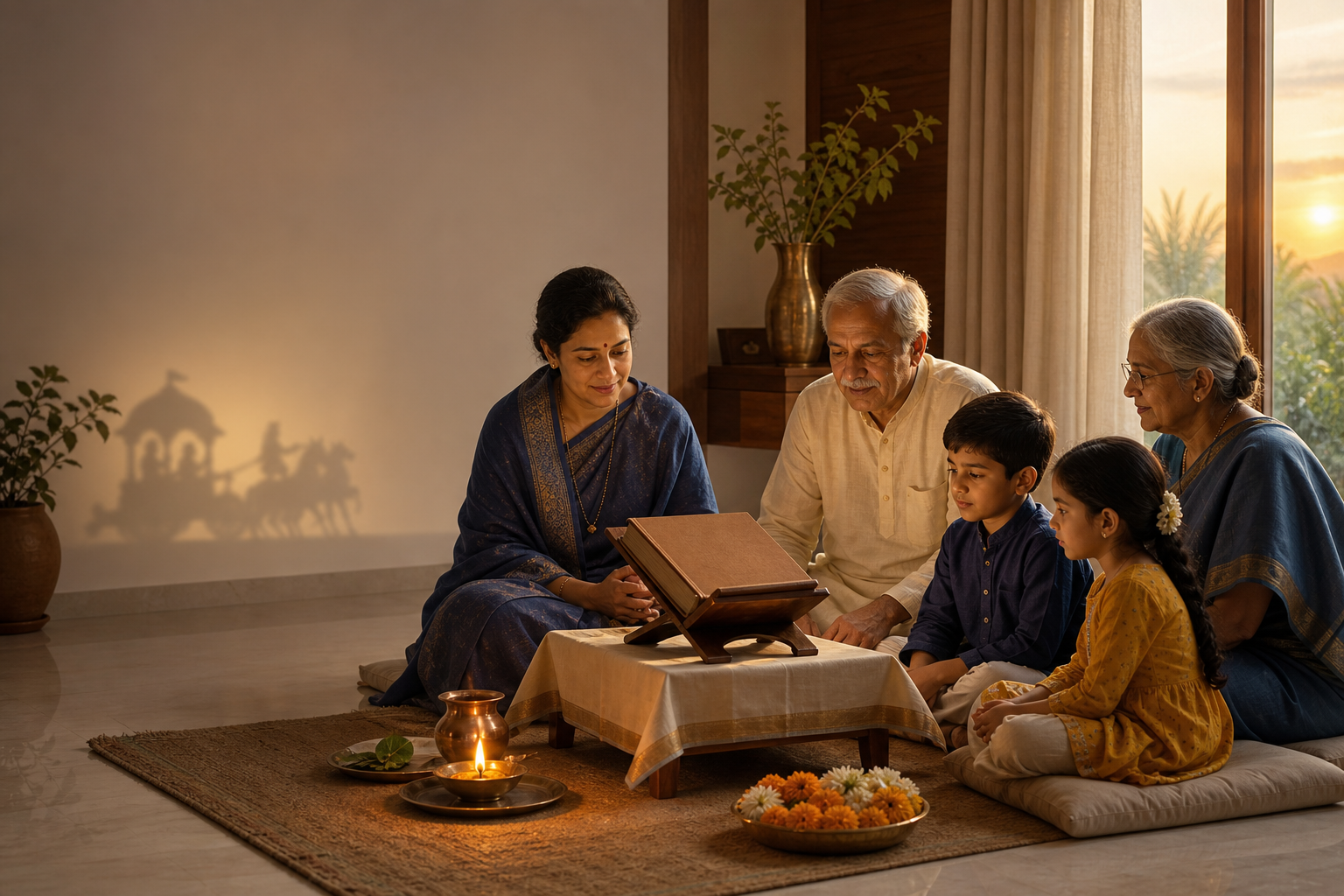
- For a household observance, divide the reading among willing participants, allow each person to name one practical lesson, and close with a shared act of service.
- For a community observance, join collective recitation or satsang and arrive knowing which question you want the discussion to clarify.
- When you have adequate time and preparation, undertake a full parayan without treating speed as the measure of devotion.
The essential distinction is between reducing the scale and reducing the attention. A shorter observance can retain its spiritual centre. An overloaded programme can lose it.
Read the Gita against a duty you actually face

Gita Jayanti commemorates a dialogue delivered in the middle of a crisis of action. Read in that spirit. Bring a genuine question to the text: a responsibility you are avoiding, a conflict in which anger is directing you, an outcome you are trying to control, or a duty entangled with the wish for approval.
Full parayan has its place, but selected reading is also a recognised form of observance. Chapters 2, 12, and 18 are commonly chosen because they open different doors into the Gita’s teaching:
- Turn to Chapter 2 when your central problem is confusion about action, attachment to results, or loss of inner balance.
- Turn to Chapter 12 when you want to examine devotion as a way of living, including the qualities you bring into your treatment of others.
- Turn to Chapter 18 when you are weighing duty, renunciation, responsibility, or the decision that must follow reflection.
Do not use the Gita as a device for predicting whether your preferred outcome will occur. Use it to inspect the person who is choosing and acting. That requires a deliberate reading method:
- Before opening the text, write the duty or conflict in one plain sentence. Remove complaints about other people and state what is yours to decide.
- Read the chosen passage slowly enough to notice where it challenges your motive, not only where it confirms your existing view.
- Identify the result to which you are most attached. Ask whether fear of losing it is distorting your judgement.
- Name the next right action that remains possible even if praise, success, or immediate relief does not follow.
- Write that action as your sankalpa before moving on to prayer, discussion, or the rest of the day’s programme.
This turns karma-yoga and samatva from admired concepts into a test of conduct. You may still face uncertainty after reading. The useful change is that uncertainty no longer excuses inaction or impulsiveness.
Keep vrata, seva, and satsang aligned with the teaching
Let the vrata strengthen attention
Many devotees observe the Ekadashi vrata through fasting or simple sattvic meals. The discipline can reduce distraction and make the day feel intentionally different, but it should not become a competition in severity. Follow the practice of your family or lineage where you have one, and avoid presenting that practice as the only valid form.
If fasting conflicts with your health needs or prescribed treatment, do not alter treatment for the sake of the fast. Choose an appropriate sattvic discipline instead and seek qualified medical guidance if you are uncertain. Restraint can also govern speech, anger, entertainment, and needless consumption; the purpose is attentiveness, not physical display.
Choose seva and daan that meet an actual need
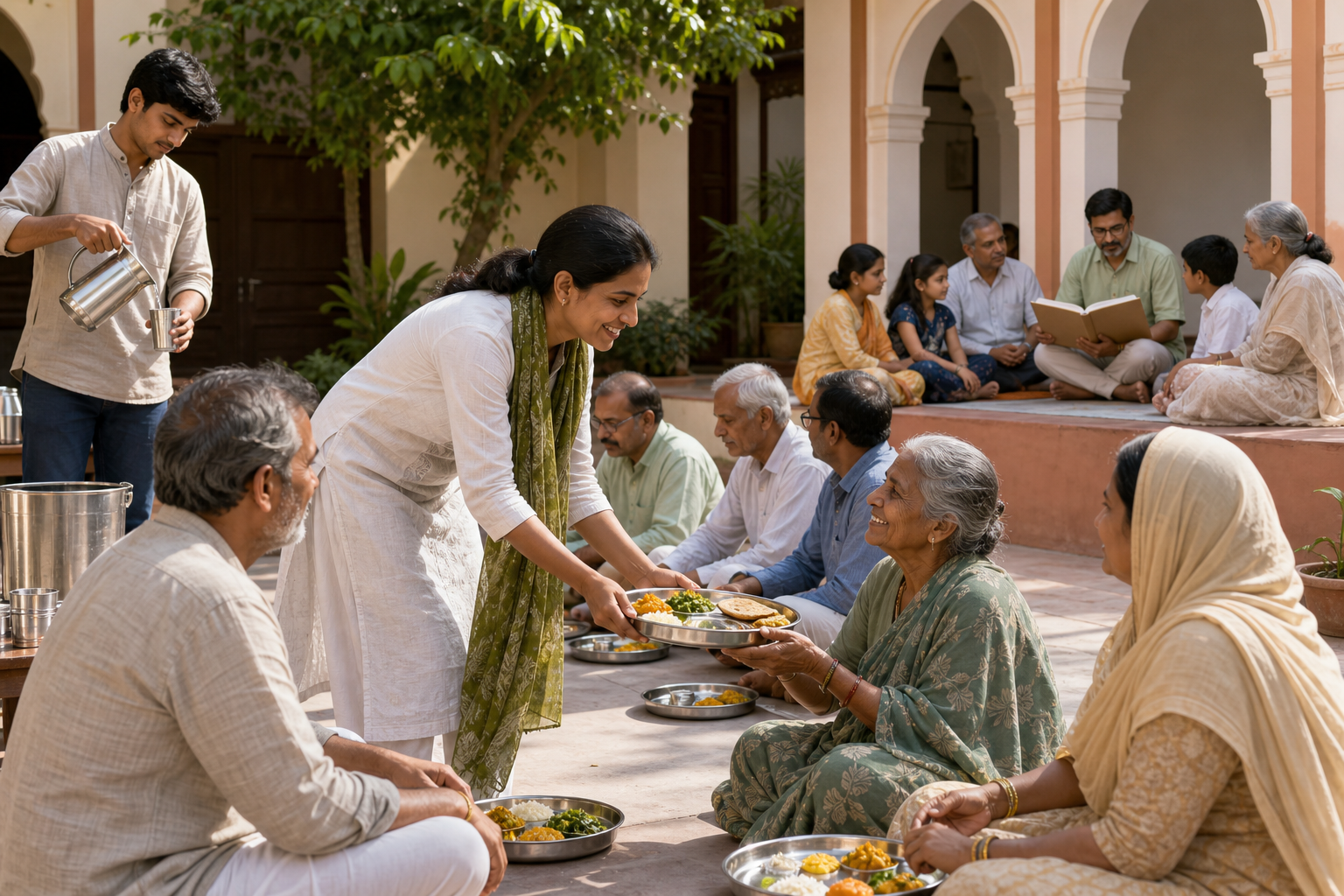
Seva should be concrete enough to complete. Help someone whose need you already know, contribute to a responsible community effort, offer food or practical assistance, or perform an overdue duty for a person who depends on you. Daan should likewise be directed thoughtfully rather than given merely to finish a ritual checklist.
Keep the connection to the Gita visible. If your reflection exposed attachment to recognition, serve without announcing it. If it exposed neglect of family responsibility, begin there. If it exposed indifference to suffering, choose an act that requires your attention as well as your resources.
Make satsang a conversation about practice
A useful satsang does more than place several readings side by side. Begin with recitation, allow space for the meaning of the passage, and ask each participant what it changes in conduct. Discourage the discussion from becoming a contest over who can display the most terminology.
Gita Jayanti also offers an honest point of connection across the dharmic family. Ethical living, ahimsa, self-discipline, meditation, compassion, and service resonate in Hinduism, Buddhism, Jainism, and Sikhism. That common ground does not require claiming that all traditions are identical. The sacred memory of Krishna and Arjuna remains specific, while guests and neighbours can still participate respectfully in reflection and service.
Make your sankalpa survive the festival day

A vague resolution such as becoming more spiritual gives you nothing to do when pressure returns. A workable sankalpa names the trigger, the conduct, and the dharmic reason for it. Use this pattern: when a recurring situation arises, you will perform a defined action in order to practise a chosen teaching.
- Trigger: a difficult message arrives. Conduct: read it again and settle your first reaction before replying. Principle: samatva.
- Trigger: an unpleasant duty is postponed. Conduct: complete the necessary part before choosing a more attractive task. Principle: disciplined action.
- Trigger: you help someone. Conduct: avoid seeking public recognition for the act. Principle: reduced attachment to reward.
- Trigger: disagreement becomes personal. Conduct: state the issue without contempt and listen before answering. Principle: self-mastery and respect.
Keep the written sankalpa with your copy of the Gita. Read it before later study sessions and mark each occasion on which you followed it or abandoned it. That small record prevents a devotional intention from dissolving into memory.
Before Gita Jayanti arrives, fill four blanks: the locally confirmed date, the passage you will read, the seva or daan you will perform, and the behaviour you will carry forward. Once those are settled, the observance has a clear path from remembrance to action.
References
