
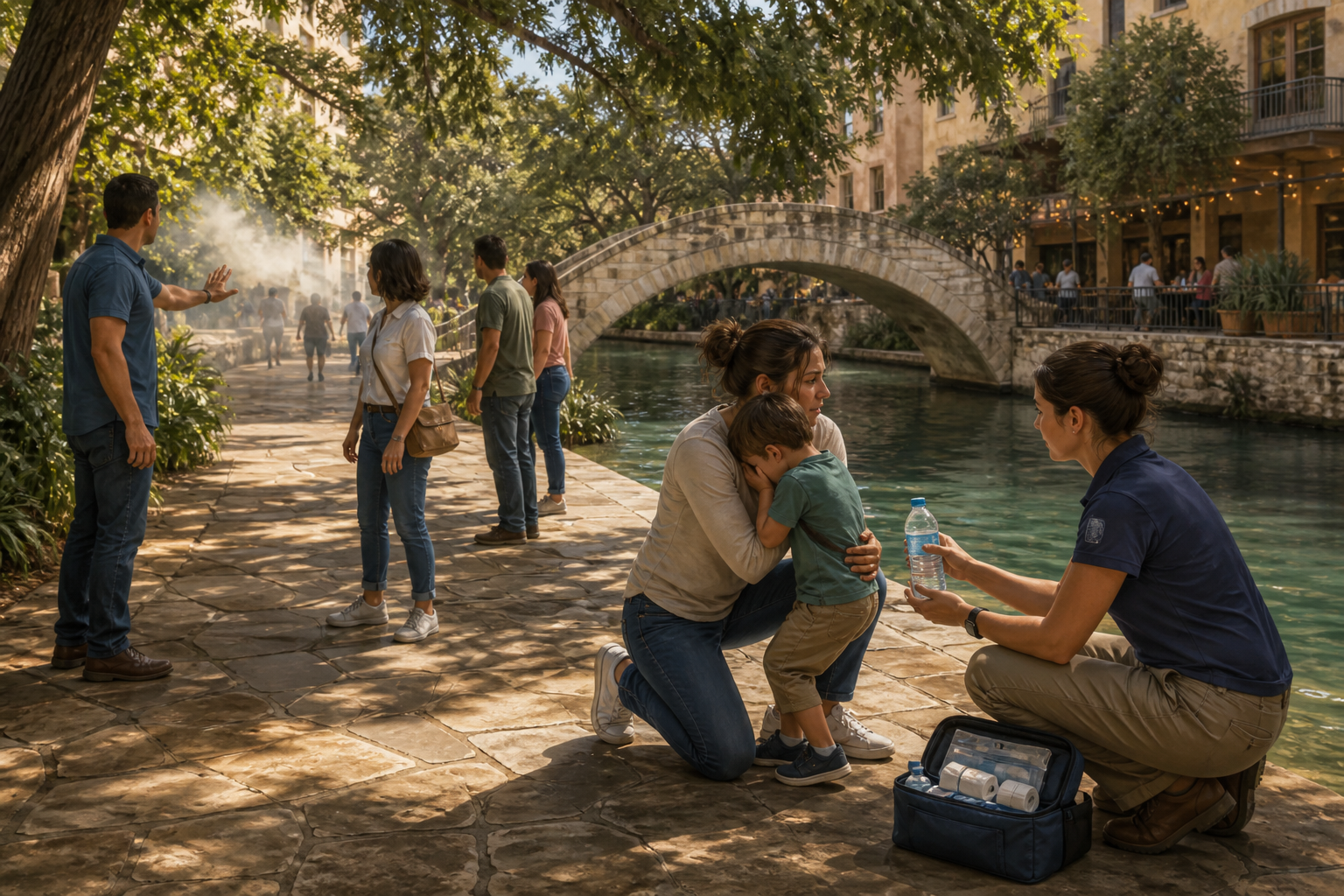
If you are deciding whether to share the San Antonio River Walk footage, or wondering how to protect your family in a similar incident, separate urgency from certainty. A toddler needed help after a serious assault. The alleged motive and several claims circulating online have not been established.
You can respond firmly without outrunning the evidence. Start with what is known, put exposed people before the camera, preserve information for investigators, and demand practical safety measures from the venue.
What is established, and what remains unverified
The incident began during a River Walk boat ride after the operator asked a woman to lower the volume on her phone. The woman reportedly left the boat, discharged pepper spray toward its passengers, and fled before law enforcement arrived. At least eight passengers were affected, including a toddler from an Indian family.
People at the scene reported immediate burning and difficulty breathing. A young child required urgent attention. The family reportedly filed a complaint, and the police inquiry was described as ongoing. No arrest had been confirmed at the time covered by the available reporting.
Social media accounts have also circulated a claim that the woman later expressed no remorse on TikTok. That assertion depends on verifying the account, its ownership, the complete recording, and its context. Until those elements are established, treat it as an allegation rather than a fact.
An Indian family was harmed. That fact deserves attention. It does not, by itself, prove that the family was selected because of Indian identity, much less establish an anti-Hindu motive. Do not assign a religion to the family unless the family identifies it, and do not turn one accused person’s conduct into a judgment about an ethnic, racial, religious, or local community.
Key takeaways
- At least eight passengers, including a toddler from an Indian family, reportedly suffered the effects of pepper spray during a River Walk boat ride.
- The family reportedly complained to authorities, but no arrest had been confirmed at the time covered by the available account.
- The alleged TikTok statement and any claim about the attacker’s motive require independent verification.
- After exposure, move to fresh air, flush the eyes with clean water if available, do not rub them, and seek prompt medical evaluation for children or medically vulnerable people.
- If you witnessed the incident, preserve original files and provide a direct statement to authorities instead of relying on a social media upload.
If pepper spray reaches you or your child
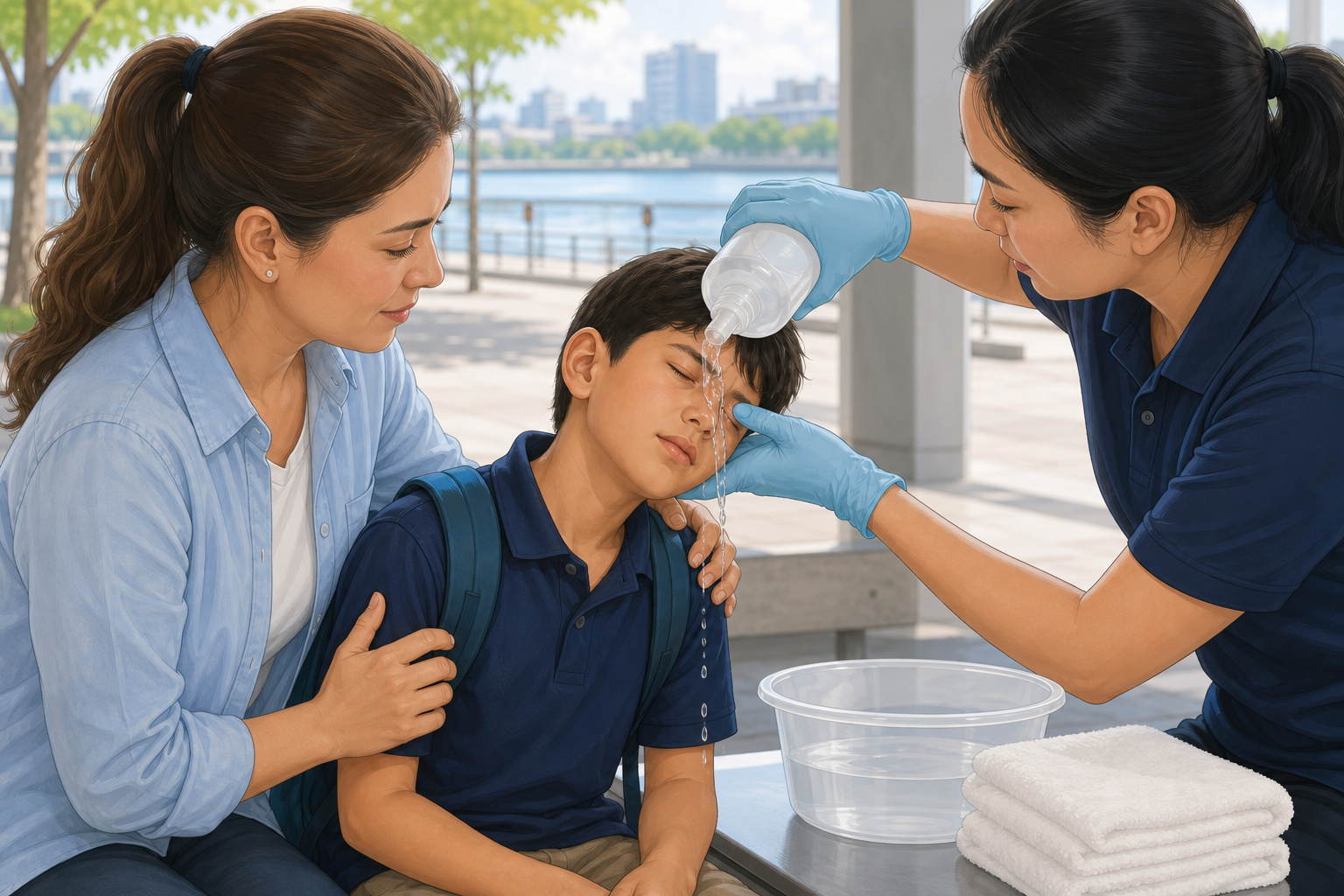
Pepper-spray exposure can create burning and breathing difficulty within moments. In a crowd, the first danger is losing time because everyone starts filming, arguing, or trying to identify the aggressor. Give one person responsibility for the exposed child while another contacts staff and emergency responders.
- Move away from the contaminated area. Get into fresh air without pushing through the crowd or placing yourself in the path of further spraying.
- Check breathing first. Difficulty breathing warrants urgent professional help. Tell responders that the person may have been exposed to a chemical irritant.
- Flush affected eyes with clean water if it is available. Do not rub the eyes. Do not delay care while searching for an improvised household remedy.
- Arrange medical evaluation for a child or medically vulnerable person. A toddler cannot reliably describe changes in breathing, vision, or pain, so adult reassurance is not a substitute for professional assessment.
- Move evidence collection behind immediate care. Record the location and sequence only after exposed people are out of danger and help has been requested.
If you are a bystander, ask one direct question: “What do you need me to do?” Useful answers may include guiding the family to fresh air, finding clean water, calling for help, watching another child, identifying witnesses, or meeting responders at the nearest access point. Do one assigned task instead of surrounding the victim with competing instructions.
Do not minimize breathing trouble as ordinary irritation, especially when a child is involved. Conversely, do not give medical assurances based on how someone looks in a short video. The safe decision is to let qualified responders assess the exposed person.
Turn viral footage into usable evidence, not rumor

A widely shared clip may draw attention to an assault, but attention and proof are different things. Cropping, captions, reposting, and missing footage can blur the sequence of events. Before repeating a claim, label it by the kind of knowledge you actually have.
- Observed: something you personally witnessed or can see clearly in a sufficiently complete recording.
- Reported: a witness has described it, but you cannot independently confirm every part of the account.
- Alleged: a circulating assertion, such as the claimed TikTok response, whose authorship or context has not been authenticated.
- Officially confirmed: a status or finding announced by the relevant authority. An ongoing inquiry is not the same as an arrest, charge, or final determination.
If you recorded the event, keep the original file. Do not trim it, add music, cover faces with captions, or discard the minutes before and after the visible confrontation. Write down the approximate time, precise location, boat or operator details visible to you, the order of events, and the names or contact information of willing witnesses. Give investigators the unedited material and distinguish what you saw from what somebody later told you.
If you encounter a relevant public social media claim, save the public URL, account name, visible timestamp, and full surrounding context. Do not contact or threaten the alleged perpetrator, publish a home address, expose a minor’s identity, or encourage strangers to conduct their own punishment. Those actions can endanger uninvolved people and distract from the evidence authorities need.
If you were not present, your most responsible contribution may be modest: share the verified facts, state clearly what remains alleged, and correct an inaccurate caption as visibly as you shared it. Outrage does not become more effective when uncertainty is removed from the wording.
A dharmic response joins compassion to accountability
Ahimsa is not passive acceptance of violence. Applied to a public-safety incident, it means protecting those under attack, refusing retaliatory harm, and pursuing accountability through truthful and lawful action. Compassion keeps attention on the affected passengers. Truthfulness prevents a disturbing video from becoming permission to invent a motive. Seva turns concern into practical assistance.
A temple, gurdwara, Jain sangh, Buddhist community, or Indian association can help without claiming to speak for a family it has not consulted. Appoint one liaison to collect verified updates, relay practical needs the family has actually expressed, and direct witnesses to the appropriate authorities. This is more useful than multiple organizations publishing conflicting names, motives, and legal conclusions.
Community advocacy should also move beyond condemning the act. Ask the River Walk operator or relevant venue management concrete safety questions:
- What must an operator do immediately when a chemical irritant is discharged on or near a boat?
- How will passengers be moved toward fresh air, and where can staff obtain clean water?
- Who contacts emergency responders while another staff member assists children and vulnerable passengers?
- How are boat records, surveillance footage, staff observations, and witness details preserved for law enforcement?
- What procedure allows staff to manage an escalating passenger dispute without leaving other passengers exposed?
- How will the operator communicate verified changes to passengers and staff after the investigation?
These questions produce an answer the next family can use. A generic promise to review safety is not enough; a workable protocol identifies who calls for help, who assists exposed passengers, where supplies are kept, and how evidence is retained.
The strongest pro-dharma response refuses the false choice between silence and speculation. If you witnessed the attack, preserve your originals and make a statement. If you did not, share only what can be supported and press for a visible safety protocol. Let the next development come from evidence, and let the lasting result be a public space better prepared to protect families.
References
