
You may be weighing a better-paying role, a profitable deal, a major purchase, or an opportunity to expand a family enterprise. The money may be attractive while the consequences remain unclear. Will this choice strengthen your life, or will it quietly consume your health, relationships, integrity, and peace?
The Lakshmi-Vishnu relationship gives you a practical way to answer. Do not judge prosperity only by what enters your hands. Examine how it was obtained, what must sustain it, whom it affects, and whether it can remain without producing disorder. Ethical prosperity is abundance that you can receive, preserve, circulate, and eventually pass on without abandoning dharma.
The divine pair is a decision rule, not a promise of riches
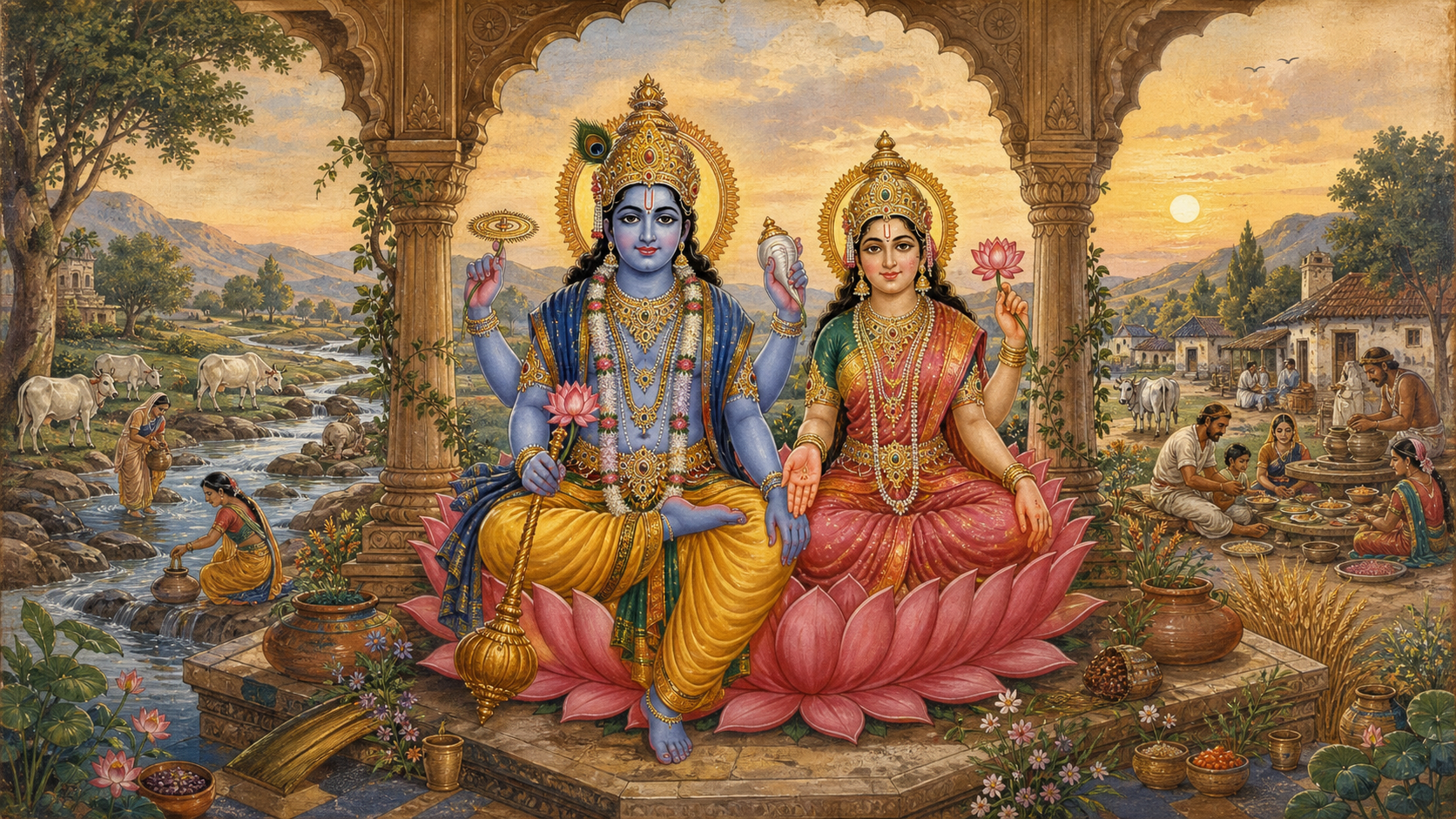
Lakshmi signifies prosperity, auspiciousness, grace, and the fruitful possibilities of life. Vishnu embodies preservation, order, and the intelligence that keeps a world from falling apart. Their union does not teach that devotion mechanically produces money. It teaches that abundance becomes a blessing only when it rests within a sustaining order.
The symbolism is especially clear in the Samudra Manthan. Lakshmi emerges from the churned cosmic ocean and chooses Vishnu, placing her garland upon the preserver. The Shrivatsa mark on Vishnu’s chest carries the same intimacy: prosperity abides at the heart of preservation. Churning can produce treasures, but only guardianship can keep those treasures from becoming causes of conflict, waste, or ruin.
This makes artha, material prosperity, a legitimate aim rather than something spiritually suspect. The qualification is decisive: artha must operate under dharma. Earning, building, trading, saving, enjoying, and giving can all belong to a dharmic life. The moral question is not whether you possess resources. It is whether your way of possessing them protects truth, duty, restraint, reciprocity, and the conditions on which future life depends.
Three common misreadings disappear once you see the pair together:
- Wealth is not automatically impure. Its origin, use, and consequences determine whether it serves dharma.
- Wealth is not proof of virtue. A large fortune can coexist with deception, exploitation, fear, or neglected obligations.
- Preservation is not hoarding or resistance to change. Vishnu’s work includes maintenance, repair, adaptation, protection, and renewal.
When an opportunity appears, therefore, ask one question before calculating the gain: what must be preserved for this prosperity to remain good? Your answer might include health, family duty, customer trust, honest records, skilled workers, clean water, institutional memory, or time for spiritual practice. If the opportunity has no place for those conditions, it is treating extraction as prosperity.
Run every opportunity through four tests

A dharmic financial choice needs more than good intentions. Use these tests before accepting income, making a purchase, expanding an organisation, or committing community resources.
- Test the origin. Ask how the value was created. Did all parties understand the exchange? Does the income depend on concealment, manipulation, coercion, avoidable harm, or someone else’s inability to refuse? A respectable use of money cannot cleanse a persistently adharmic way of acquiring it. Redesign the transaction, add disclosure and consent, or be willing to refuse it.
- Test the stewardship. Identify what the new asset or responsibility will require after acquisition. A house needs repair, a business needs controls, a technology system needs security, and a larger income may create tax or contractual duties. If nobody owns the maintenance work, the apparent gain is already carrying hidden decay.
- Test the distribution of effects. List who receives the benefit and who bears the cost. Include people who are easy to overlook: dependants, employees, suppliers, neighbours, future users, and those relying on shared natural resources. If the gain is private while the damage is pushed onto others, prosperity has been separated from responsibility.
- Test the endurance. Ask whether the arrangement can continue without constant pressure, dishonesty, exhaustion, or depletion. A choice that works only while one person sacrifices sleep, a river absorbs waste, a worker accepts unfair treatment, or a family avoids difficult conversations is not stable. It is borrowing order from the future.
These tests do not require you to reject profit, ambition, or comfort. They require you to count the whole transaction. The salary is not the whole value of a job. The sale price is not the whole cost of a product. The visible account balance is not the whole wealth of a household. Trust, capability, health, time, and a functioning environment are also forms of capital, even when they do not appear on a statement.
Symbolism cannot determine a suitable investment, debt strategy, tax position, or legal structure for your circumstances. Where a decision creates serious financial or legal exposure, use this ethical screen first and then take the figures and documents to an appropriately qualified adviser. Dharma clarifies what you are trying to protect; professional advice helps you choose a sound instrument for protecting it.
Make preservation visible at home and at work
In the household
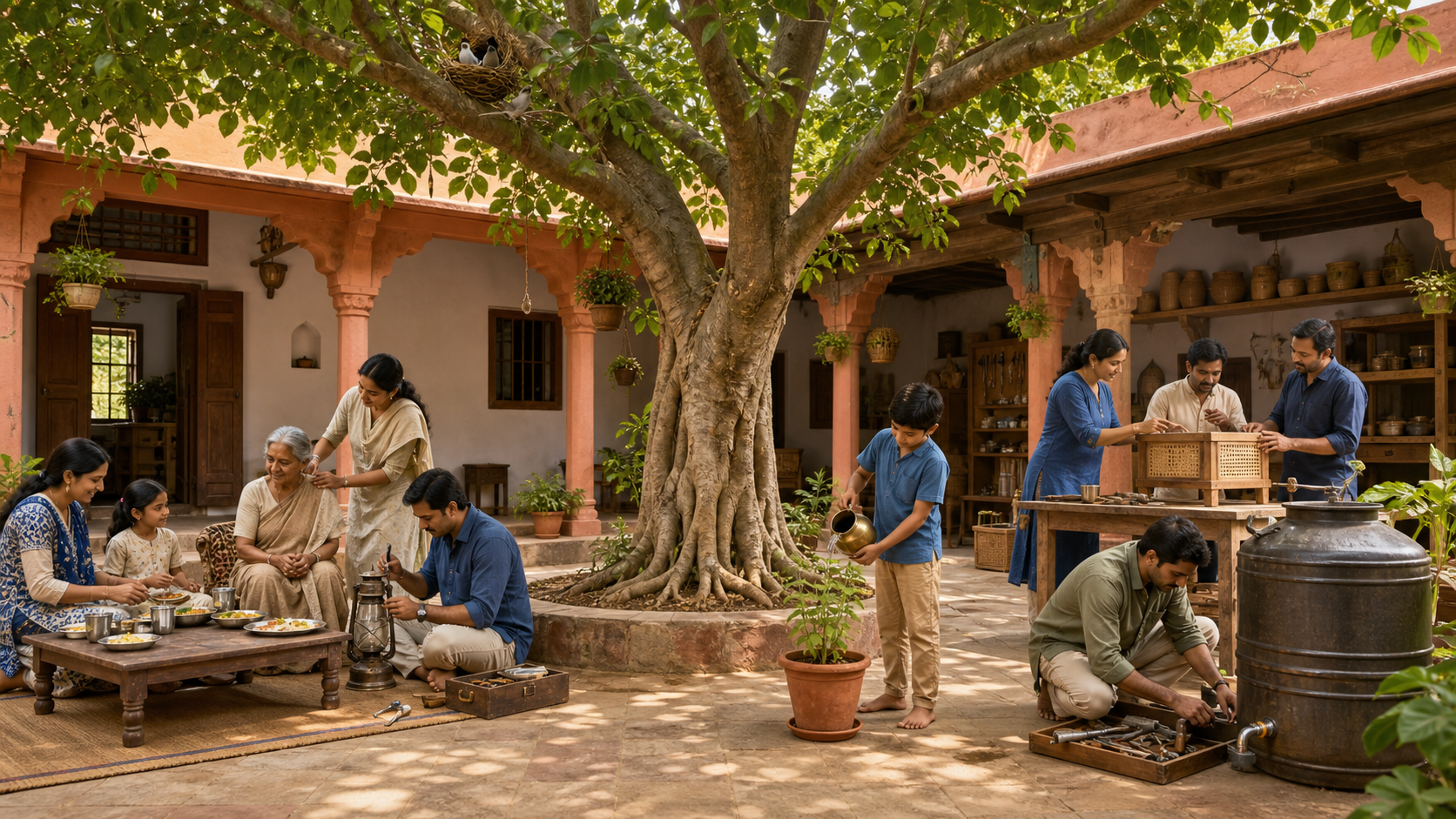
A household often experiences disorder not because income is absent, but because nobody has agreed on what the income is for. Before a windfall, promotion, inheritance, or major purchase changes your expectations, name the household goods that money must serve. These may include dependable care, freedom from concealed obligations, education, hospitality, spiritual practice, and the ability to help without destabilising the family.
Then make the invisible cost visible. Before buying an asset, write down its continuing demands: storage, repair, insurance, attention, training, or dependence on another service. Before accepting more work, name what will supply the extra hours. Before giving generously, account for duties already owed to dependants. Dāna is not strengthened by transferring avoidable insecurity to someone for whom you are responsible.
A simple household practice is to place each important use of money under one of four purposes: providing, preserving, developing, or giving. The categories need not receive equal amounts. Their purpose is to expose imbalance. If every rupee or dollar goes toward display while repairs, obligations, skills, and generosity remain neglected, Lakshmi is present as appearance but disconnected from Vishnu’s work.
In a business, institution, or community
Ethical prosperity becomes credible when it can be seen in decisions, records, and assigned responsibility. A mission statement about values does little if incentives reward the opposite behaviour. Use evidence that can be inspected.
| Area | Question to ask | Evidence to inspect | Action when weak |
|---|---|---|---|
| Earning | Would the other party still consent if the terms were stated plainly? | Contracts, disclosures, complaints, refund decisions, and sales incentives | Simplify the terms, remove deceptive incentives, and create a genuine path for correction |
| Preserving | What people, systems, knowledge, and resources keep this value alive? | Maintenance logs, documented responsibilities, training, and ownership of essential work | Assign an owner, provide resources, and repair the backlog before expanding |
| Sharing | Who enjoys the gain, and who absorbs its hidden cost? | Pay practices, supplier terms, workload, waste, and effects on common resources | Change the terms, compensate fairly, reduce the harm, or abandon the gain |
| Continuity | Can the work survive a handoff, setback, or leadership change? | Succession plans, documented processes, safeguards, and concentrations of dependency | Transfer knowledge and reduce dependence on a single person or fragile condition |
The most revealing moment is when preservation becomes expensive. Will leadership still repair a defective product, honour a fair commitment, protect a vulnerable worker, or slow expansion to avoid damaging a common resource? Ethical prosperity is not established by the language used when duty is convenient. It is established by the boundary held when violating that duty would be profitable.
Let ritual train the habits that prosperity needs

During Diwali, inviting Lakshmi is traditionally joined to cleaning, ordering, and illuminating the household. Read that sequence as practical pedagogy. Before seeking more, restore your capacity to care for what is already present. Clean what has been neglected. Repair what still has useful life. Reconcile an unclear account. Complete an overdue obligation. Thank the people whose work sustains your home.
This prevents puja from becoming a transaction in which an offering is expected to purchase good fortune. Worship should refine the worshipper. A Lakshmi observance can therefore include a concrete act of Vishnu-like preservation: settling a fair payment, maintaining a shared place, organising essential documents, conserving a resource, teaching a useful skill, or restoring trust through an honest conversation.
The idea of yajna deepens the practice. Prosperity rarely appears through isolated effort. Food depends on soil, water, labour, knowledge, transport, and social order. A livelihood depends on customers, colleagues, inherited institutions, and countless people you may never meet. The web of mutual care associated with yajna asks you to return something to the conditions that made your gain possible.
You can apply this by tracing one blessing backwards. If it is knowledge, identify the teachers and institutions that preserved it. If it is business income, identify the workers, customers, infrastructure, and natural inputs behind it. If it is a family property, identify the labour and restraint that carried it across generations. Then choose a form of return that strengthens the same web rather than merely displaying generosity.
Related disciplines appear across the dharmic family without making these traditions interchangeable. In Buddhism, dāna is strengthened by sīla, so generosity and ethical conduct belong together. Jain ahimsa and aparigraha test acquisition against harm and possessiveness. Sikh seva and sarbat da bhala direct capacity toward service and the welfare of all. These are distinct religious vocabularies, yet each can help you notice the same practical danger: giving, earning, or accumulating loses moral coherence when it is detached from the way you treat living beings.
Preservation also has an inward dimension. A mind dominated by craving, comparison, and fear cannot reliably govern abundance. Discipline, restraint, mindfulness, and steady practice cultivate the balanced quality associated with sattva. The practical test is simple: does greater prosperity give you more capacity for lucid action and service, or merely create more agitation about losing status? If possession continually erodes peace, the next task is not necessarily acquisition. It may be restoring order to desire.
Use a Lakshmi-Vishnu audit before your next major choice

Put one pending decision on a page and work through this sequence. Writing matters because vague hopes often hide contradictions that become obvious in plain language.
- Name the Lakshmi. State the abundance being offered. It may be money, time, knowledge, influence, property, reputation, access, or creative opportunity.
- Name the Vishnu-work. List the people, disciplines, systems, relationships, and natural conditions that would preserve that abundance.
- Expose the displaced cost. Write down who could pay for your gain through extra labour, risk, silence, pollution, anxiety, or neglected duty.
- Set the dharmic boundary. Decide what you will not sacrifice, even if crossing that line makes the opportunity more profitable.
- Choose the circulation. Identify how part of the gain will replenish the people or conditions that enabled it. Circulation may take the form of fair payment, maintenance, teaching, service, conservation, or carefully chosen giving.
- Define the warning sign. Name the observable condition that would tell you the arrangement is becoming corrosive: concealed terms, chronic exhaustion, missed obligations, recurring complaints, a maintenance backlog, or damage shifted onto others.
Consider a higher-paying role that assumes permanent availability. The salary is the visible Lakshmi. Sleep, family responsibilities, integrity, and the ability to work without chronic disorder are part of the Vishnu-work. The audit does not automatically tell you to decline. It tells you to negotiate clear boundaries, understand what the new responsibility displaces, and refuse to describe preventable damage as success.
The same reasoning applies to a business deal built on an opaque supply chain. Faster growth is not enough. Ask for the information needed to judge how the value is produced. Change the terms where harm or unfairness can be corrected. If the deal requires deliberate ignorance, its profitability does not make it dharmic.
For a gift or donation, test continuity as well as generosity. A dramatic commitment that you cannot honour may burden the recipient and neglect prior duties. A sustainable act, carried out truthfully and without display, can preserve trust while serving real need. The point is not to give timidly. It is to unite generosity with reliability.
Key takeaways
- Lakshmi represents abundance; Vishnu represents the order that allows abundance to remain beneficial.
- Artha belongs within dharma, so the origin, custody, effects, and endurance of wealth all matter.
- Preservation is active work: maintenance, fair dealing, protection, adaptation, knowledge transfer, and renewal.
- Generosity is strongest when it does not depend on hidden harm or neglected obligations.
- A profitable choice fails the test when its apparent stability relies on another person, a community, or nature silently absorbing the damage.
- The best next step is to audit one real decision and set its dharmic boundary before money or status makes that boundary harder to defend.
Take the most consequential opportunity currently before you and name both sides of the pair: the Lakshmi you hope to receive and the Vishnu-work required to keep it wholesome. If you cannot yet name what will preserve the gain, pause before pursuing more. When preservation guides possession, prosperity can support a household, nourish a community, and travel beyond one lifetime.
References
