
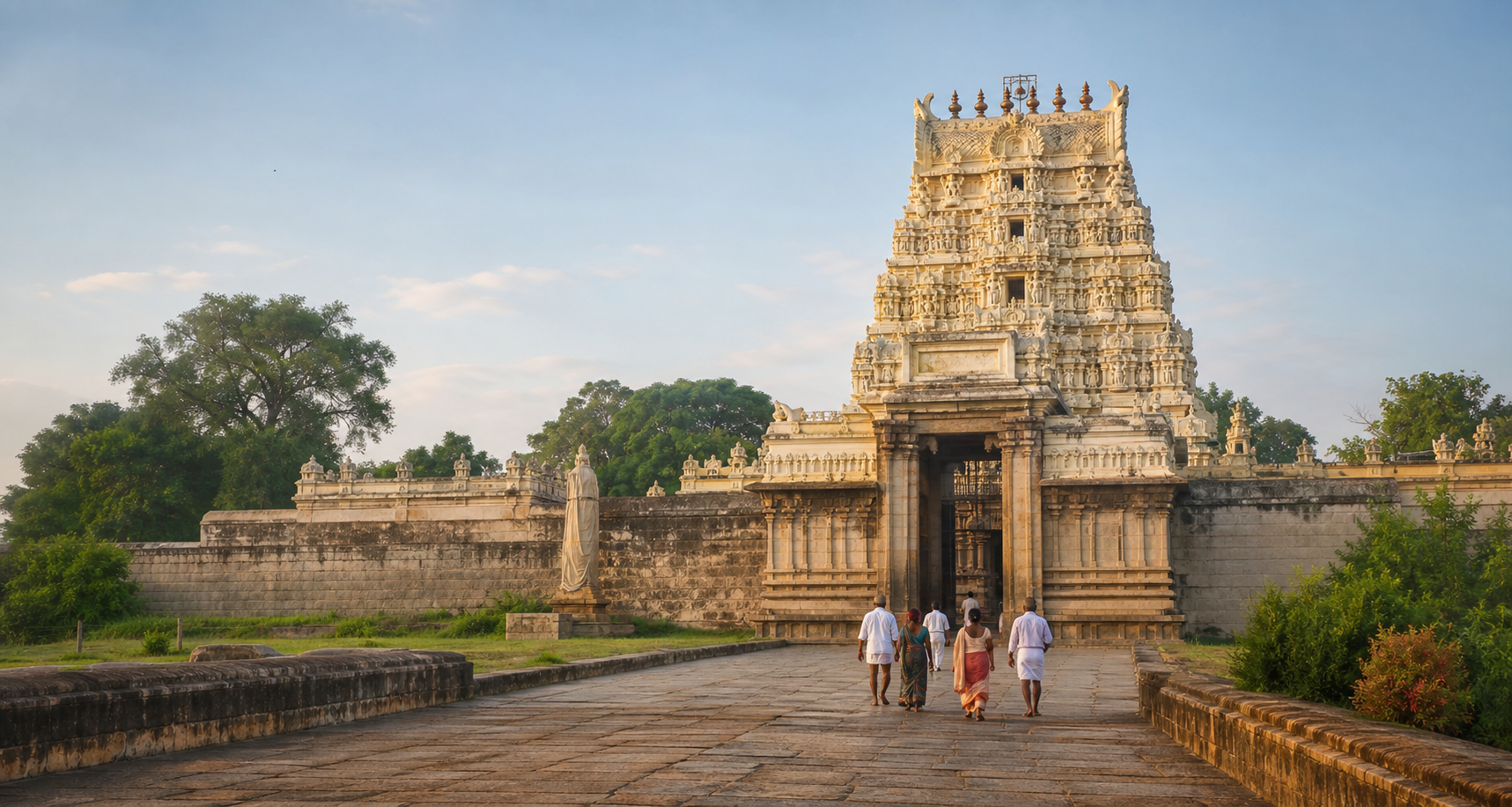
If you are going to Srirangapatna for darshan, the easiest mistake is to treat the temple as one more stop on a crowded heritage itinerary. You may see the sanctum, admire the stonework, and still miss the idea that holds the entire place together.
A more rewarding visit begins before you enter and continues after you leave. Read the Cauvery, the architectural enclosures, the reclining form of Vishnu, and the ongoing worship as parts of one sacred landscape. You do not need specialist knowledge. You need a clear order of attention.
Begin with the river island, not the gateway
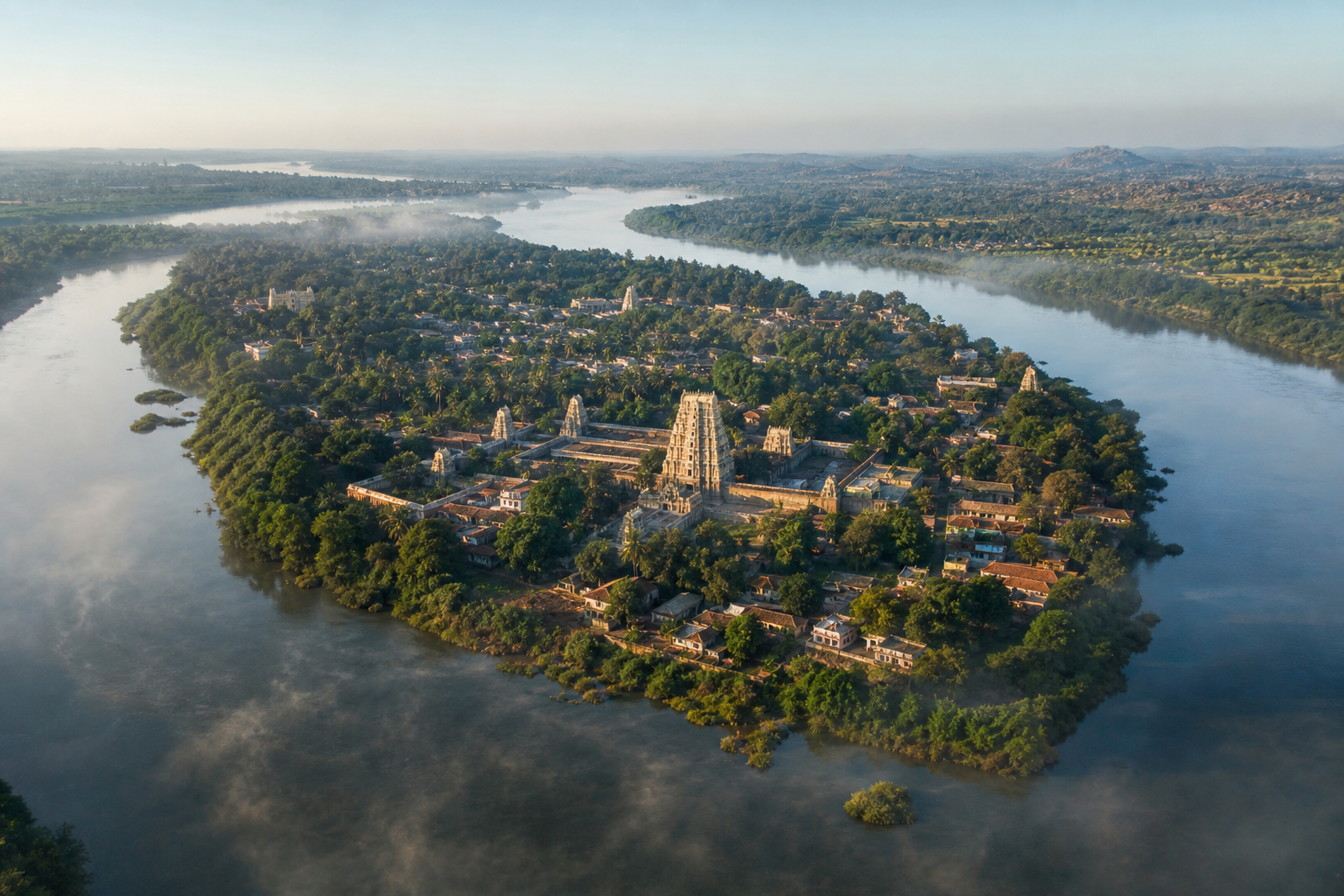
Srirangapatna is an island town held within the flow of the Cauvery. That setting is not incidental scenery around the temple. The meeting of river, settlement, and shrine gives your approach its first theological cue: sacred space is being entered through a living landscape, not isolated from it.
Before joining the movement toward the sanctum, take a moment to register the Cauvery’s encircling presence. Notice how water changes the mood of the town and how the temple belongs to that geography. If you visit a river ghat, pause without turning the moment into a photography exercise. The point is to understand why purification, renewal, and inward preparation became natural associations here.
This first pause also prevents a common interpretive error. The temple is not simply a monument placed on a picturesque island. River and shrine participate in the same devotional field. The water prepares your attention; the temple gives that attention form.
Use a simple question as you approach: what changes when you cross from the town into the temple’s ordered enclosures? Look for the shift in sound, pace, light, and human behavior. That transition will teach you more about sacred architecture than a hurried inventory of carvings.
Read the reclining Ranganatha as a theological statement

The central encounter is with Sri Ranganatha, the reclining manifestation of Bhagavan Vishnu. He rests in Ananta Shayana upon Adisesha. Do not reduce this posture to decorative repose or ordinary sleep. It presents divine stillness as the ground of sustenance and cosmic order.
The reclining form on Adisesha links worship with balance and continuity. The image asks you to reconsider the relationship between stillness and action. Vishnu does not have to appear hurried in order to sustain the cosmos. Repose can signify mastery, stability, and an order deeper than visible motion.
For darshan, keep three ideas in mind:
- Ananta Shayana: Attend to the divine repose itself. Let the posture set the pace of your viewing.
- Adisesha: Notice that Sri Ranganatha’s rest is supported and ordered, not empty or passive.
- Sustenance: Remember that this is Vishnu as the preserver. The still image points toward the continuing maintenance of life and cosmic balance.
You may have only a brief view when other devotees are waiting. That is enough if you arrive with the right question. Instead of trying to inspect every visual detail, ask what kind of divine presence this posture communicates. Carry that question out of the sanctum rather than blocking the movement of worshippers in search of a longer look.
The name matters as much as the form. Listen for Sri Ranganatha or Srihari Vishnu in recitation, music, and ritual speech. A temple becomes legible not only through what you see but through the sacred names repeated within it. Those sounds connect an individual moment of darshan to a Vaishnava practice sustained beyond any one visitor.
Use the architecture as a sequence, not a checklist
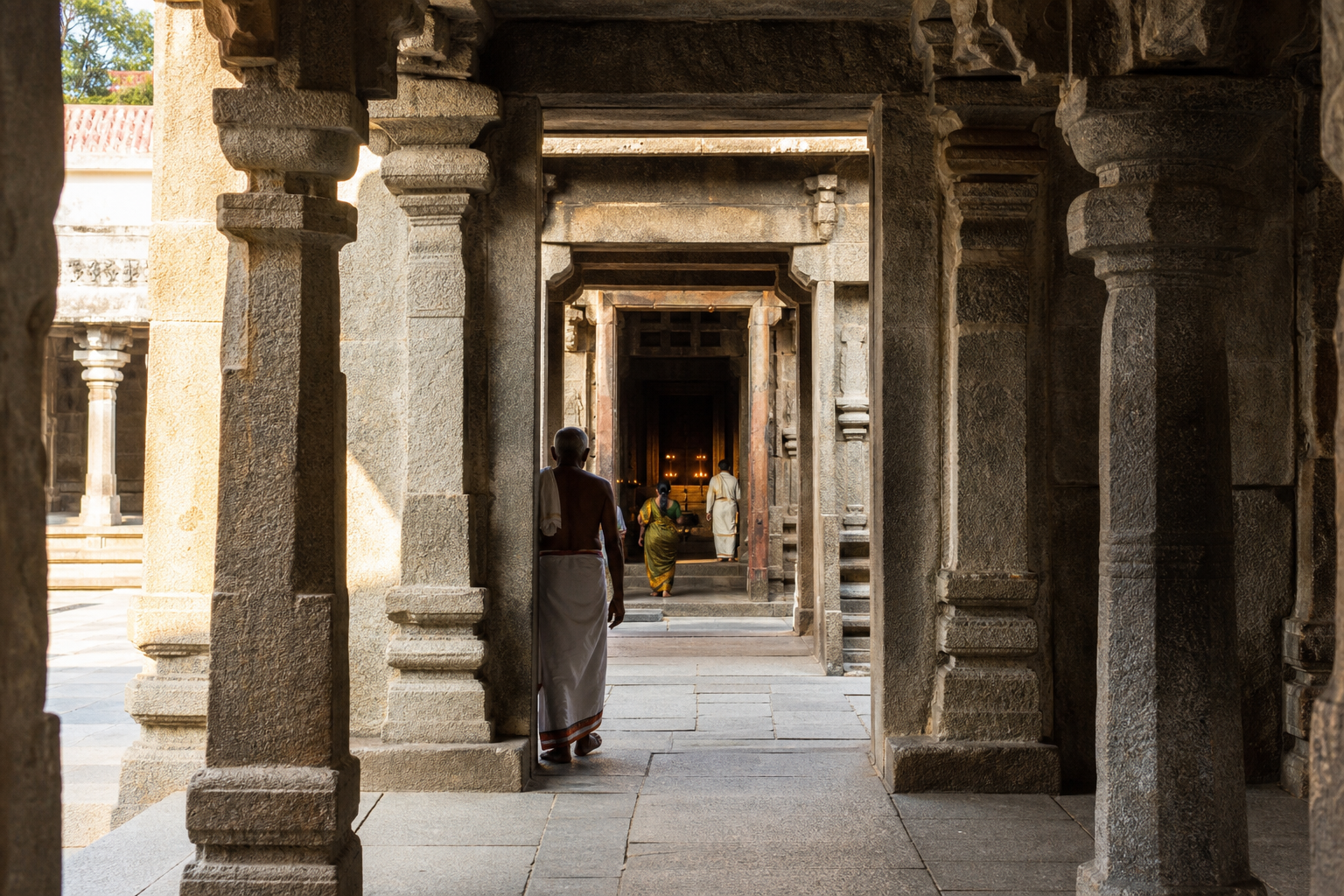
South Indian temple vocabulary becomes easier when you connect each element to what it does. A gopura marks passage, a prakara orders enclosure and movement, and a mandapa creates a space in which people can gather, pause, or participate in ritual life. You do not need to identify every component by style. Follow the movement from outer approach toward sacred center.
Try reading the complex in four passes:
- Threshold: Notice how the gateway announces that you are leaving ordinary circulation and entering a disciplined space.
- Enclosure: Observe how the prakaras regulate direction, proximity, and anticipation.
- Gathering: See how mandapas accommodate the human life of the temple rather than serving merely as architectural ornament.
- Center: Let the sanctum resolve the movement of the outer spaces toward Sri Ranganatha.
This sequence also helps you read history responsibly. The complex bears inscriptions, renovations, structural layers, and continuing ritual practices. It should not be imagined as the untouched creation of a single moment or patron. Different communities and generations contributed to its preservation.
When one wall, hall, or surface appears different from another, resist the urge to force everything into a single date or style. Variation may be evidence of continuity: repair, enlargement, renewed patronage, and changing needs can all leave visible traces. The better historical question is not simply, “How old is this?” Ask, “What had to continue for this place to remain worshipped and cared for across centuries?”
That question restores people to the story. Stone survives because artisans know how to work it, ritual specialists preserve forms of worship, patrons provide resources, and devotees continue to regard the shrine as sacred. Heritage here is not just material inheritance. It is transmitted knowledge and collective responsibility.
Behave as a participant in a living temple
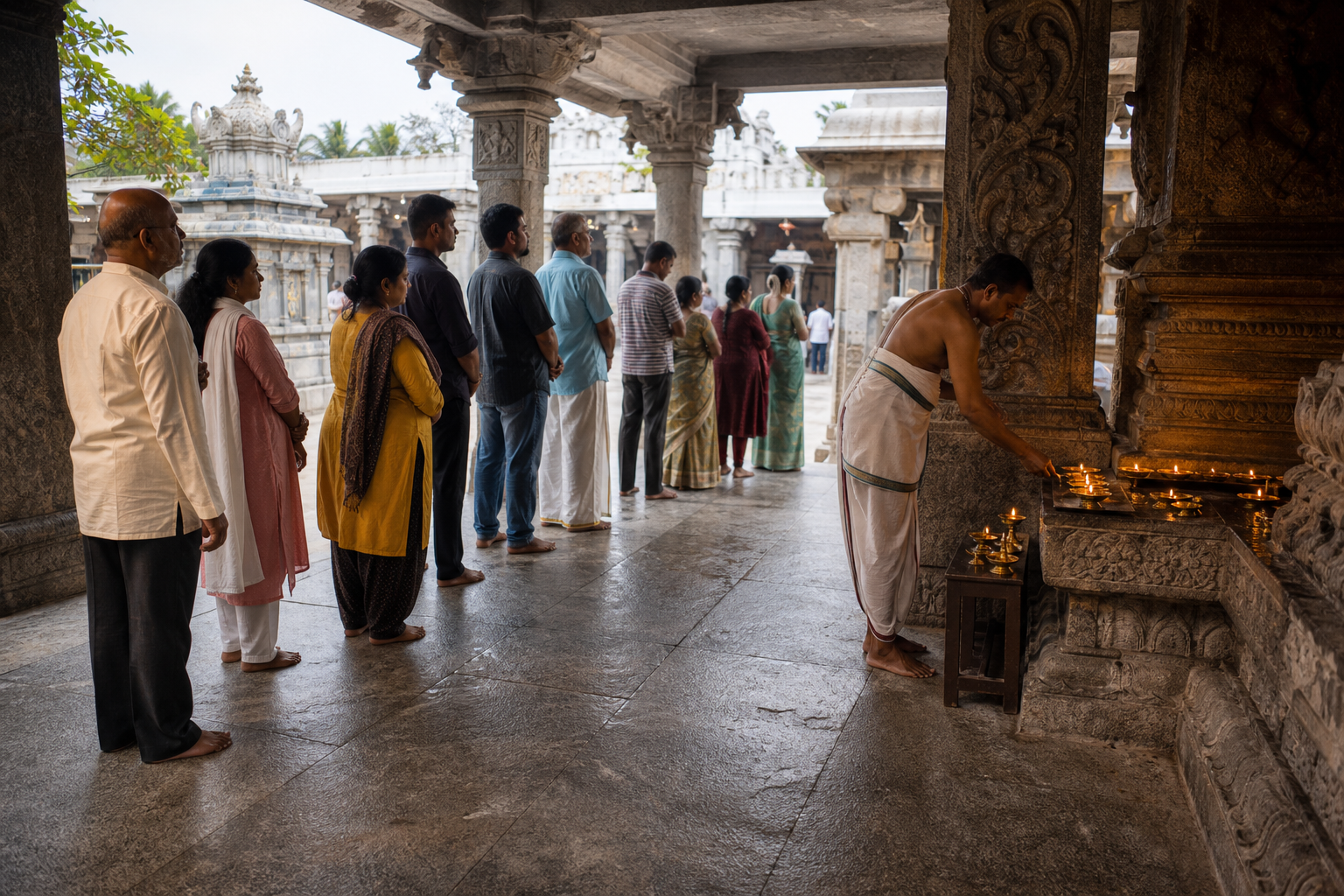
Sri Ranganathaswamy Temple is not an archaeological ruin with worship added for atmosphere. Daily pujas, festival observances, recitation, music, and community activity are part of its identity. Your visit should therefore be organized around the needs of worship rather than around unrestricted sightseeing.
A few choices make that distinction practical:
- Follow the movement established by temple personnel and devotees, especially near the sanctum.
- Keep conversation low where recitation or puja is underway.
- Do not assume that every area or ritual moment exists for visitor access. Ask locally when you are uncertain.
- If a particular puja or darshan period matters to you, confirm the day’s arrangements locally before organizing the rest of your outing around it.
- Give worshippers space. Observation becomes intrusive when it interrupts prayer, offerings, or circulation.
This is also the right place to make an important distinction about dharmic unity. The shrine is specifically Vaishnava: its center is Sri Ranganatha, and its worship is shaped by devotion to Vishnu. Its wider resonance with compassion, disciplined learning, reverence, and respect for multiple paths does not erase that specificity. Hindu, Buddhist, Jain, and Sikh traditions can share civilizational values without becoming interchangeable.
You will understand the temple more clearly when you hold both truths together. Honor its particular theology first. Then notice how its long life expresses a broader dharmic commitment to preserving sacred knowledge, sustaining communities, and making room for reverence across generations.
Key takeaways for a more attentive visit
- Start with the Cauvery. The river-island setting is part of the sacred experience, not a backdrop to it.
- Read Sri Ranganatha’s repose as ordered divine sustenance, not inactivity.
- Move from gopura to prakara, mandapa, and sanctum as a sequence of increasing attention.
- Treat differences in the structure as possible evidence of continuing patronage and preservation rather than demanding one uniform historical layer.
- Remember that puja, recitation, festivals, and community life make this a living institution.
- Respect its specifically Vaishnava identity before drawing broader conclusions about shared dharmic values.
When you leave, return briefly to the river or pause before re-entering the town’s ordinary movement. Carry one detail with you: the encompassing Cauvery, the ordered enclosures, a sacred name heard in recitation, or the stillness of Ranganatha upon Adisesha. One carefully understood detail is more valuable than a hurried collection of impressions.
References
