
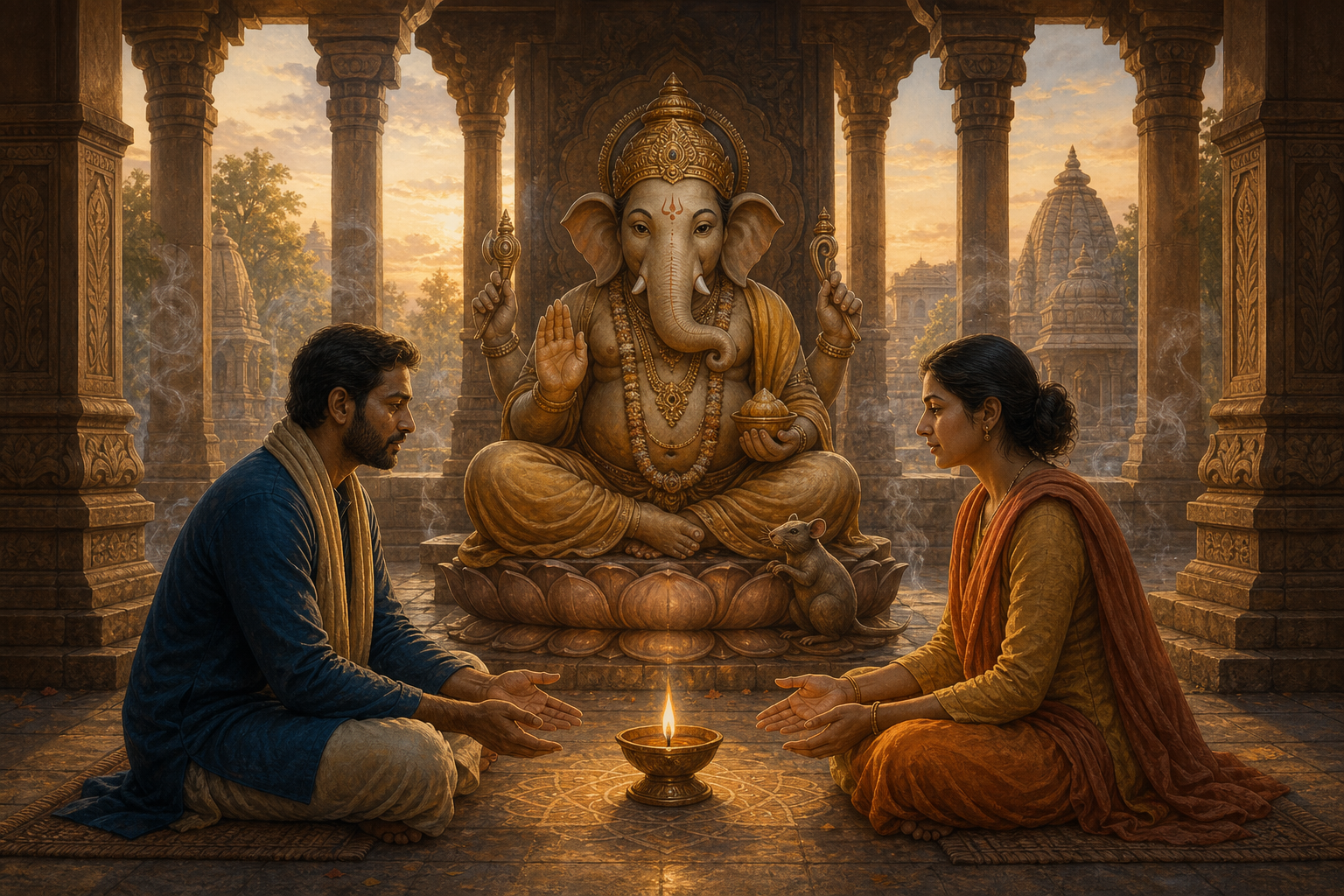
You may know that a relationship needs repair, yet one fear keeps stopping you: if you apologize first, will you betray the truth? Or perhaps an apology has already been offered, but your mind still wants the satisfaction of defeating the other person. Ganesha offers a choice more demanding than either surrender or victory.
His sacred imagery asks whether the force obstructing reconciliation can be disciplined and given a dharmic purpose. Reconciliation does not mean pretending that no wrong occurred. It means restoring as much right relationship as the truth permits – through accountability, a clear boundary, a concrete repair, or, when closeness would renew the harm, respectful distance.
Read the mouse at Ganesha’s feet as a map of ego

In Ganapatya lore and regional tellings, Gajamukha is a powerful asura whose strength becomes hubris. He disrupts rituals, disturbs ascetics, challenges the devas, and turns personal power into a threat to cosmic order. Ganesha subdues him, but the encounter does not end in annihilation. The defeated force is transformed into Mushika, the mouse who serves as Ganesha’s vahana.
The details and names are not uniform across every telling; Gajamukhasura and Mushikasura are sometimes connected or conflated. The stable ethical insight matters more for your present conflict: Ganesha does not allow destructive pride to remain in command, but neither does he treat its energy as useless. What obstructed dharma is made to carry dharma.
The mouse is an especially precise image for this work. It is restless, quick, difficult to contain, and able to enter hidden spaces. So are desire, resentment, and the ego’s private calculations. Ganesha seated above Mushika does not portray a lifeless mind. It portrays an active mind under wise direction.
Before trying to resolve a disagreement, look for the mouse-like movement in yourself. It often appears as one of these impulses:
- You rehearse a devastating reply instead of preparing a truthful one.
- You keep retelling the conflict to people who cannot help repair it.
- You reject a valid point because accepting it would let the other person be partly right.
- You protect your public image more fiercely than the principle supposedly at stake.
- You demand an immediate answer because uncertainty feels like a loss of control.
- You want the other person humiliated, not merely held accountable.
Do not answer these impulses with self-hatred. Name each one accurately: ‘I want the last word,’ ‘I want witnesses on my side,’ or ‘I am afraid that an apology will make me look weak.’ Then ask what usable capacity is trapped inside it. The wish to dominate may conceal courage. Resentment may contain a sharp memory of an ignored boundary. Argumentativeness may contain precision. Persistence may have become vengeance. Your task is to separate the capacity from the ego’s demand and assign that capacity a better job.
Separate self-respect from the need to win
Humility is often confused with making yourself smaller so that conflict will disappear. That is not reconciliation. You do not have to deny a fact, accept a false accusation, or reopen access to someone who repeatedly violates your boundaries. A false confession may purchase silence, but it cannot restore dharma.
For the purpose of a difficult conversation, distinguish self-respect from ahankara by testing what each one asks you to protect. Self-respect protects truth, duty, and legitimate boundaries. Ahankara protects an image of yourself that must remain superior, blameless, or invulnerable.
- Remove the audience. If no one else would ever hear about this dispute, would you still insist on the same principle? If the demand weakens without spectators, reputation may be driving it.
- Remove the insult. Can you state what must change without attacking the other person’s intelligence, family, motives, or worth? A boundary does not become firmer when contempt is added to it.
- Name an acceptable repair. What would actually help: a correction, repayment, changed conduct, an acknowledgment, restored responsibility, or distance? If no possible action would satisfy you, you may be pursuing punishment rather than repair.
- Identify your portion without manufacturing equality. You may have spoken cruelly even if your underlying complaint was right. You may have delayed speaking until resentment exploded. Own what is yours, but do not invent shared blame when responsibility is plainly unequal.
- Test the future. Is your proposed response likely to prevent the wrong from recurring, or does it merely promise a satisfying moment of retaliation?
Anger itself is not proof of ego. Anger can alert you to betrayal, neglect, or a breached boundary. Ego becomes visible in the work you give anger: whether it must clarify and protect, or humiliate and control. Place anger beneath discernment, as Mushika is placed beneath Ganesha.
Turn disagreement into sacred dialogue, not a courtroom

The divine household does not teach harmony by erasing difference. Shiva and Parvati embody complementary principles: still awareness and creative energy, renunciation and engagement. Their tensions are understood as sacred samvada, a dialogue through which apparent opposition can be brought into a higher order. Ardhanarishvara makes the principle visible: unity is not achieved by making the two sides identical.
The rupture surrounding Ganesha’s beheading and restoration carries the same practical gravity. A boundary is misunderstood, the consequences are devastating, and order is not restored by pretending that the rupture never happened. Recognition, humility, and transformative action are required.
You can carry that pattern into a family dispute, friendship, temple committee, workplace, or community organization with a disciplined sequence:
- Write the disputed facts before discussing motives. Record what was said, done, promised, or omitted. ‘The decision was announced before I was consulted’ is discussable. ‘You have never respected me’ invites a contest over an entire relationship.
- State the dharmic purpose of the conversation. Say what you are trying to protect: trust, a responsibility, family stability, fair procedure, truthful public information, or the ability to cooperate. This keeps the discussion oriented toward order rather than prestige.
- Describe the effect without exaggeration. Explain who or what was affected. Avoid ‘always’ and ‘never’ unless they are literally accurate. Inflated language gives the other person an easy escape from the real issue.
- Listen for the part you did not see. Ask the other person to describe the same event in their own terms. Then restate their position before replying. Restating is not agreement; it is proof that you are answering what they meant rather than what anger imagined.
- Own your exact fault. A useful acknowledgment names conduct and consequence: ‘I dismissed your concern in front of others, and that made a private disagreement humiliating.’ Avoid vague phrases such as ‘mistakes were made’ or apologies that immediately turn into accusations.
- Request an observable repair. Ask for conduct that can actually occur: correct the claim, return the responsibility, replace what was damaged, include the excluded person, stop disclosing private matters, or follow an agreed process next time.
- Decide where the recovered energy will serve. Turn stubbornness into consistent follow-through, competitiveness into excellence, vigilance into protection, and eloquence into truthful explanation. This is the inner movement from obstacle to vahana.
A clean opening can be simple: ‘When this happened, this was the effect. My part was this. I need this boundary or repair if we are to continue well. What do you understand differently?’ If you do not bear responsibility for the original wrong, do not fabricate a confession. You can still take responsibility for the clarity, restraint, and proportion of your response.
Reconciliation does not always mean renewed closeness

Ganesha’s compassion toward Gajamukha is not permissiveness. The destructive force is first stopped. Only then is it redirected. This order protects the meaning of sacred reconciliation: grace does not require adharma to remain active.
That distinction matters whenever pressure to ‘keep the peace’ falls mainly on the person who was harmed. An apology may begin repair, but it does not automatically restore trust, authority, intimacy, or access. Trust returns through conduct that remains different when inconvenience, temptation, or disagreement returns.
A reconciled outcome may therefore take more than one form:
- Restored closeness when the wrong is acknowledged, repaired, and unlikely to recur.
- A revised relationship when goodwill is possible but firmer limits are needed.
- Limited cooperation when people must share a family, institutional, or community duty but personal trust remains damaged.
- Respectful separation when continued proximity would reward repeated dishonesty, coercion, or violation.
None of these outcomes requires hatred. They do require honesty about what the relationship can presently bear. Forgiveness, where you choose it, can release the demand to keep reliving the injury. It need not erase memory or cancel consequences.
If a relationship involves threats, coercion, stalking, violence, or repeated retaliation for setting boundaries, do not arrange a private confrontation merely to imitate an ideal of reconciliation. Create distance and seek appropriate support from trustworthy people or qualified services. Sacred language should never be used to pressure someone back into preventable harm.
Use Ganesha’s image before your next difficult conversation

A short contemplative practice can prevent the roaming mind from entering the conversation first. Sit before an image of Ganesha, or recall the image of Mushika at his feet, and work through the following questions in writing:
- What happened? Describe the event in one factual sentence, without diagnosing anyone’s character.
- What does dharma require? Name the duty, truth, boundary, or relationship that needs protection.
- What does my ego demand? Name the desired spectacle: total surrender, public vindication, the last word, or proof that you were blameless.
- What ability is trapped inside that demand? Look for courage, attention, discipline, memory, persistence, or the capacity to speak clearly.
- How can that ability serve? Give it one observable task in the next relevant interaction.
- What outcome can I accept? Choose the minimum honest repair and the boundary you will keep if it is refused.
After the conversation, do not judge success only by whether the other person agreed with you. Ask whether the truth became clearer, whether each person’s responsibility was named, whether a repair was proposed, and whether the boundary can now be followed. You control your participation in that process, not the other person’s willingness to transform.
Key takeaways for your next conflict
- Begin with the dharmic purpose you want to protect, not the opponent you want to defeat.
- Treat ego as energy requiring direction; do not give it command, and do not waste useful strength by turning it into self-hatred.
- Humility means owning your exact conduct. It does not mean accepting a false accusation or abandoning a necessary boundary.
- Ask for a concrete repair instead of a theatrical apology.
- Do not confuse forgiveness with restored access. Changed trust requires changed conduct.
- When reunion would continue adharma, respectful distance can be the most truthful form of reconciliation available.
At the next flare of resentment, find the Mushika before it finds a hidden route into your words. Name the impulse, recover the ability inside it, and place that ability in Ganesha’s service. Then make one truthful request, accept one rightful responsibility, and keep one necessary boundary. That is how ego stops obstructing the path and begins to carry you along it.
References
- DharmaRenaissance Blog – From Arrogance to Awe: How Demon Gajamukha Became Ganesha’s Sacred Mouse Vahana
- DharmaRenaissance Blog – When Gods Disagree: The Cosmic Wisdom in Shiva-Parvati’s Sacred Debates Guiding Everyday Harmony
