

If you have seen the number 1200 beside a Malayalam date in 2025, you may have wondered whether it was a typo, a religious count, or the regnal year of a forgotten ruler. It is none of those. The number points back to 825 CE, the epoch of the Kollam Era, also called Kollavarsham or the Malayalam Era.
The harder question is what happened in 825. The safest answer is more precise than any single-origin legend: Kerala began reckoning time from the inauguration and political elevation of Kollam during a major reorganization of Venad. The port’s commercial importance then gave that local beginning enough reach to become an enduring regional calendar.
Key takeaways
- The Kollam Era begins in 825 CE; July 2025 falls in ME 1200.
- Its most coherent historical setting is the Chera consolidation of Venad and the establishment of Kollam as a capital and major port.
- The expression Kollam tonri in two local inscriptions connects dated events to Kollam’s inauguration and provides the strongest internal evidence for the epoch.
- A Nestorian settlement under Mar Sapir Iso may belong to Kollam’s wider history, but the evidence does not require treating it as the primary cause of the era.
- The calendar matters because it preserves the memory of political authority, regional identity, and Indian Ocean commerce in an everyday system of timekeeping.
What actually began in 825 CE
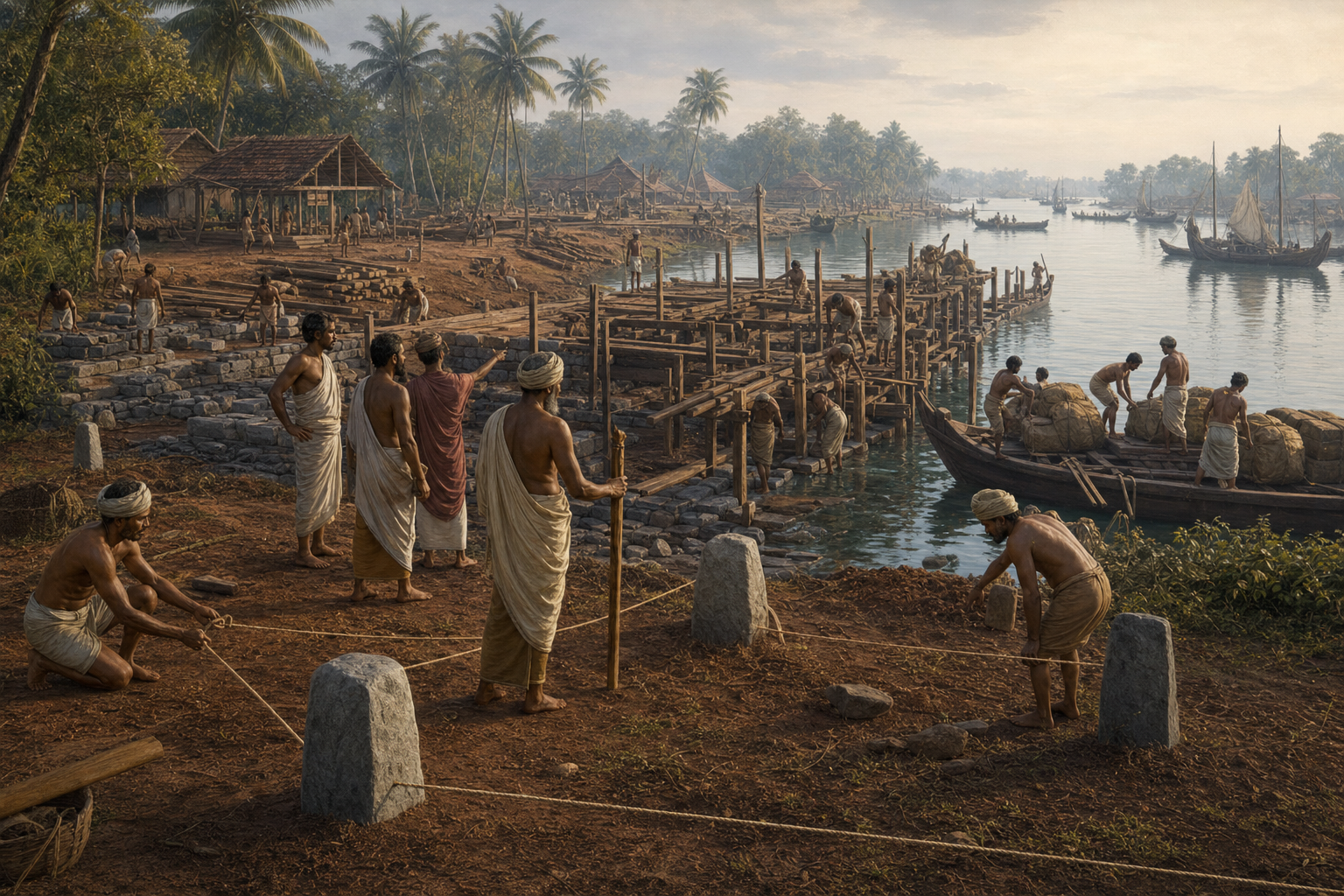
An era is a numbered system for locating years from an agreed starting point. Its first year need not mark the creation of a kingdom, the birth of a people, or the first habitation of a city. It marks the event a community considered important enough to become its chronological anchor.
Historical records in Bharat used several kinds of anchors. A date might be reckoned from the beginning of Kaliyuga, the accession of a ruler, the inauguration of a temple, the Hijra, or a known celestial configuration involving the sun or Jupiter. Such systems worked when the people reading a record knew which benchmark its writer had assumed. Confusion arose when that local knowledge did not travel with the record.
The Kollam Era solved that problem for a growing part of Kerala by supplying a durable regional benchmark. If you encounter a Kollam Era date, therefore, read it first as evidence of a shared chronological convention. Do not assume that its year one proves the physical site of Kollam had been empty until 825.
This distinction also resolves an apparent contradiction in debates about the city’s age. An earlier settlement, anchorage, or place-name could have existed without possessing the political status commemorated by a new era. The event behind the calendar is better understood as an inauguration, refounding, or elevation of Kollam within a transformed polity, not necessarily the first footprint on the land.
Why Kollam was important enough to reset the clock

The origin of the era becomes clearer when you look south of Kerala’s older political centres. Venad extended along the southern coast between Tiruvalla and Nagercoil. During the eighth century, Pandyan expansion placed pressure on this region. Chera forces responded by moving south, incorporating Venad, and establishing Kollam as its capital.
Making Kollam a capital changed more than the residence of a ruler. A capital concentrated authority, administration, record-keeping, and public memory. Its inauguration offered administrators, temples, landholders, merchants, and civic communities a date they could recognize without continually referring to the reign of a particular king.
That helps explain why the epoch outlived the immediate political arrangement that produced it. A regnal year becomes ambiguous when a ruler dies or a dynasty changes. An era attached to a city can persist as long as the city and the communities using its calendar retain their importance. Kollam supplied that continuity.
This was also a distinctly Bharatiya way of remembering a turning point. The calendar did not need to isolate political, sacred, and economic life into separate compartments. A change in regional power could become a civic inauguration; the civic centre could become a maritime gateway; and the memory of both could enter daily timekeeping.
Maritime trade turned a local epoch into a regional institution

Political sponsorship explains why the era could begin. Trade helps explain why it spread and endured. From the ninth through the twelfth centuries, Kollam was one of the leading harbours of the Malabar coast. Its connections with China placed it within an Indian Ocean network much larger than Venad itself.
A busy port has a practical need for shared dates. Cargo movements, obligations, grants, payments, and public decisions become harder to coordinate when every record depends on knowing the current ruler or decoding a highly local reference. A civic epoch made Kollam’s dates intelligible across successive reigns and among communities whose commercial relationships lasted longer than any one administration.
Kollam’s international stature remained visible after the era’s opening centuries. Marco Polo in 1294, Jordan Catalani in 1330, and Ibn Battuta in 1343 recorded a Chinese presence associated with the port. Their accounts are not eyewitness testimony for what occurred in 825; they arrived centuries too late for that. They do show that Kollam’s eastern maritime connections were durable enough to remain conspicuous to later visitors.
The qualification matters. Later fame can explain why a calendar survived, but it cannot by itself identify the precise ceremony that created the epoch. You should use the travellers as evidence for Kollam’s commercial reach, not as proof of a founding event they never witnessed.
The centre of Malabar commerce eventually shifted north, first toward Cochin and then Calicut. The Kollam Era nevertheless remained. By then it was no longer merely a port’s local convention. It had become part of Kerala’s cultural infrastructure.
This history also corrects a misleading picture of Dharmic civilization as either sealed off from outsiders or dependent on them for its institutions. Kollam belonged to a locally governed political world while trading across a plural ocean. Chinese merchants and Christian communities could participate in that world without becoming the sole explanation for Kerala’s calendar. Openness and civilizational self-confidence were not opposites.
What the inscriptions establish, and what remains debated

The strongest evidence comes from within the chronological tradition itself. Two inscriptions from Kollam use the formula Kollam tonri, placing recorded events after the inauguration or coming into being of Kollam. The phrase shows that the city supplied a recognized point from which elapsed time could be counted.
That is strong evidence for an epoch associated with Kollam’s inauguration. It is not proof of every detail sometimes attached to 825. An inscriptional era can identify the benchmark while leaving modern historians to reconstruct the political act, ceremony, or institutional change that made the benchmark memorable.
One alternative explanation assigns the era to the establishment of a Nestorian Christian colony under Mar Sapir Iso. Such a settlement fits the cosmopolitan character of a major port, but its presence and the origin of the calendar are separate questions. Professor M. G. S. Narayanan rejects the colony as the primary trigger because the founding and elevation of a capital would have carried broader public significance than the settlement of one religious community.
Claims that Kollam was known before 825 also require careful identification. Letters associated with the Nestorian Patriarch of Babylon have been invoked in this debate. The sixth-century merchant Cosmas Indicopleustes mentioned a place called Koulam Male, but that name is more plausibly connected with Kolam or Kolapattanam in North Kerala than with Kollam in Venad. Ma Huan’s statement that Kollam was known to Tang China raises a similar chronological question because the relevant knowledge may belong closer to the ninth century.
Other proposed explanations are weaker still. Connecting the epoch to Cheraman Perumal’s supposed departure for Mecca relies on a legendary narrative rather than firm chronological evidence. Associations with Shankaracharya likewise do not explain as well as the combined inscriptional, political, and commercial setting does.
The responsible conclusion is therefore firm but limited: the Kollam Era begins in 825 CE, and its best-supported setting is Kollam’s inauguration and elevation during Chera consolidation in the south. The exact ceremony that opened the count remains less certain than the epoch itself.
When you encounter a confident claim about the calendar, test whether it keeps three questions separate: Did an earlier place with a similar name exist? What public change occurred at Kollam in 825? Why did communities across Kerala continue using that year as their benchmark? A theory that answers only the first question has not explained the era.
The next time ME appears beside a date, read it as a compact historical record. It joins an eighth-century struggle for the south, a ninth-century capital, a major Indian Ocean port, and a living Malayalam calendar. Preserving that distinction between established evidence and attractive legend is the most meaningful way to honour the continuity the Kollam Era represents.
References
- DharmaRenaissance Blog — Why 825 CE Still Matters: The Kollam Era that Rewired Kerala’s Calendar and Trade
- M. G. S. Narayanan — Perumals of Kerala
