
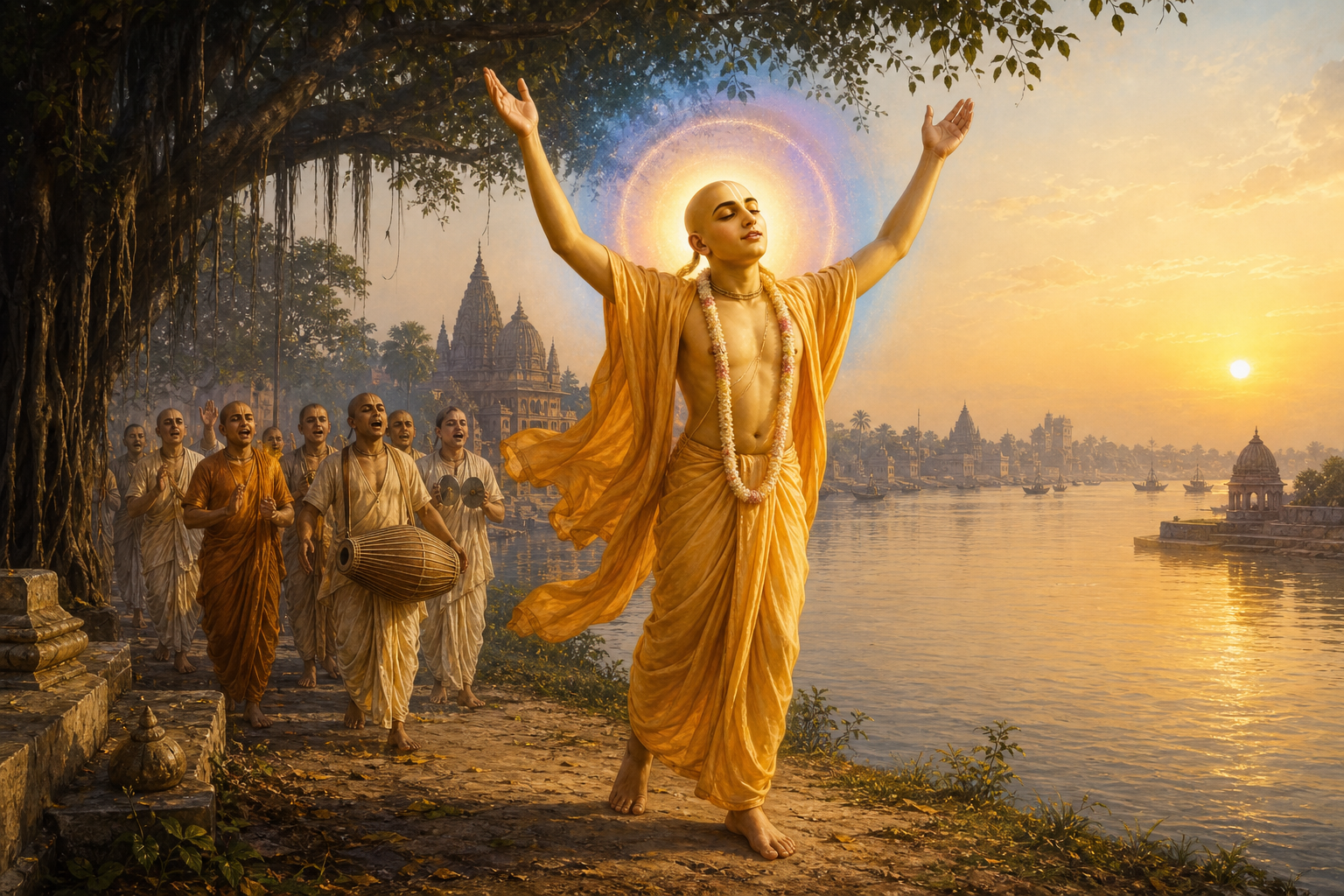
If you have heard Lord Caitanya described as a saint, a devotee, an avatara, Krishna, or the combined reality of Radha and Krishna, you may wonder which description is actually correct. The apparent conflict comes from mixing historical description, devotional example, and theological identity into a single answer.
You can understand Lord Caitanya more clearly by keeping those levels distinct without separating them. That approach also helps you enter a kirtana, hear a teaching, or speak with a practitioner without either dismissing the tradition’s claim or treating one sampradaya’s theology as an uncontested conclusion shared by every Hindu school.
Keep three levels of Caitanya’s identity distinct
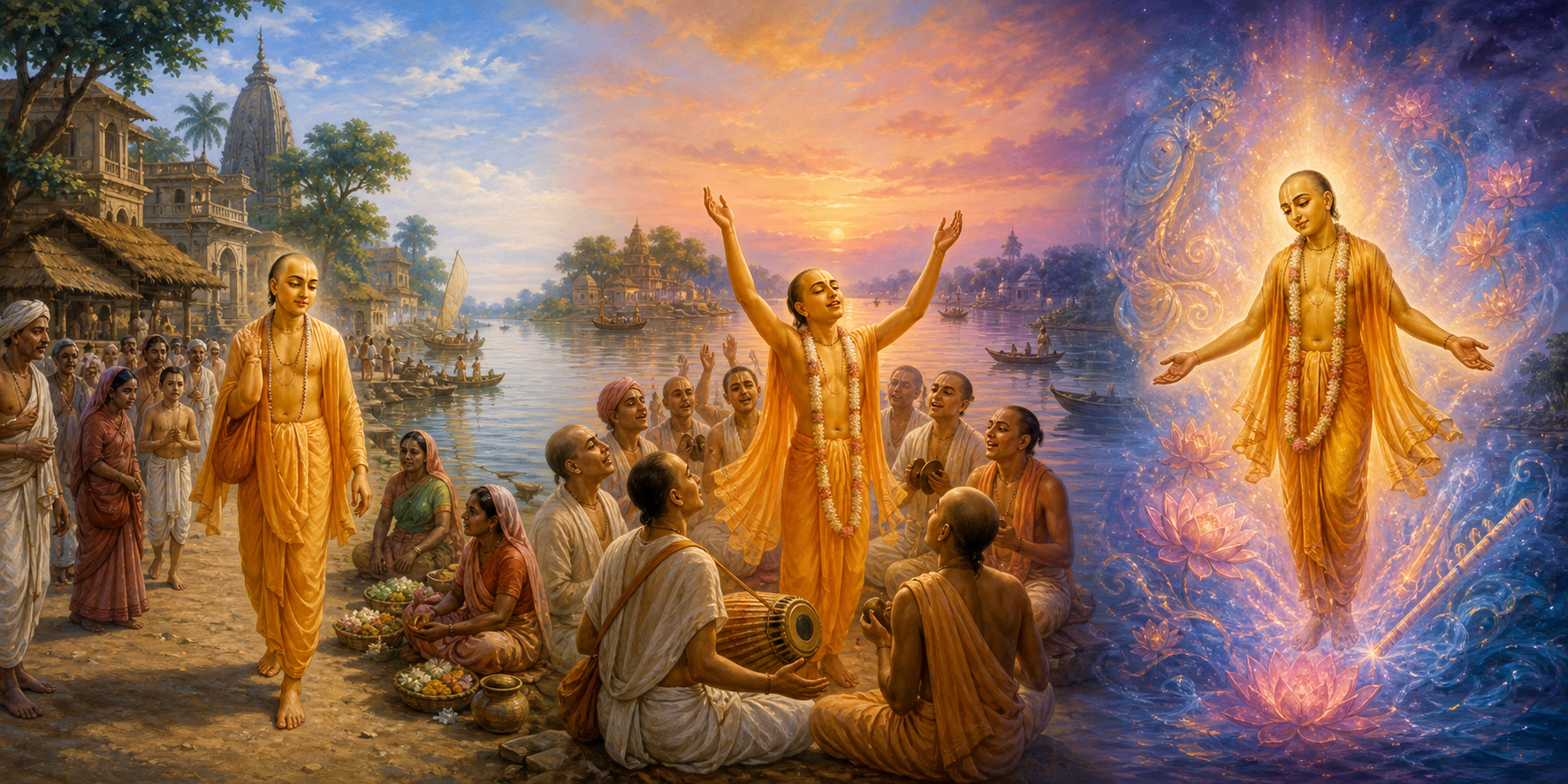
The question “Who is Lord Caitanya?” receives several answers because it can be asked from several standpoints. Before deciding whether two answers disagree, identify which standpoint each one uses.
- At the historical level, Lord Caitanya is remembered as a bhakti teacher and devotional leader who placed the remembrance of Krishna, public chanting, and loving service at the centre of religious life.
- At the practical level, he is the exemplary devotee. His significance lies not only in what he taught but in the devotional disposition he embodied: longing for Krishna, humility, absorption in the divine name, and service offered without calculation.
- At the theological level, Gaudiya Vaishnavas worship him as the Divine appearing in the role and inner mood of a devotee. He is therefore not merely someone pointing toward Krishna; within that tradition, he is Krishna teaching Krishna-bhakti from the devotee’s side of the relationship.
These levels call for different kinds of judgment. Historical inquiry can examine a teacher, community, and devotional movement. It cannot, by its own methods, prove or disprove an avatara’s divine identity. That identity is a theological claim interpreted through revelation, lineage, and devotional experience.
This distinction protects you from two common mistakes. The first is to call every theological statement a historical fact. The second is to assume that anything history cannot establish must be meaningless. A Dharmic tradition can make a strong metaphysical claim while remaining clear about the standpoint from which it is made.
The Gaudiya claim is stronger than “great saint”
Within Gaudiya Vaishnavism, Lord Caitanya is understood as Krishna appearing in the devotional mood of Radha. Calling him a saint or reformer may describe part of his visible role, but it does not convey the tradition’s full answer to his identity.
The familiar phrase “Radha and Krishna combined” is useful only if handled carefully. It does not mean that two limited beings were mechanically fused. The theological point is that Krishna appears with Radha’s bhava, or devotional disposition, so that the object of supreme love assumes the standpoint of the supreme lover. The Divine is presented not only as the one to be sought but also as the one demonstrating how love of God is lived.
This is why Lord Caitanya’s apparent identity as a devotee does not weaken the Gaudiya claim to his divinity. It is central to it. His humility, chanting, longing, and dependence upon Krishna are not embarrassing contradictions that need to be explained away. They disclose the purpose of his appearance as understood by the tradition.
The distinction also tells you what to listen for when someone explains him. An account that presents only a social teacher leaves out the claim of divine identity. An account that speaks only of divinity, without explaining why he lived in the mood of a devotee, leaves out the form in which that identity becomes spiritually significant. A complete Gaudiya explanation has to preserve both.
None of this requires you to claim that every Hindu sampradaya interprets Lord Caitanya in the same way. Some people may honour him primarily as a saint, acharya, or bhakti teacher. Gaudiya Vaishnavas make the stronger avatara claim. Respect for Hindu plurality means stating that difference accurately, not dissolving every lineage’s theology into a vague common denominator.
Why sankirtana is central rather than ornamental

Lord Caitanya’s significance becomes practical in sankirtana: the shared, audible chanting and glorification of divine names. In this practice, the message and the method meet. The name of Krishna is not merely discussed as a theological object; it is voiced, heard, remembered, and received in community.
That structure matters. One person calls and others respond. Your voice participates, but your ears must also receive. The practice therefore interrupts the idea that spiritual life is either a private intellectual achievement or a performance delivered by a specialist to passive spectators.
- It makes participation immediate. You do not have to master an elaborate philosophical vocabulary before you can begin hearing and repeating a divine name.
- It joins individual attention to community. The group supports remembrance, but no crowd can listen on your behalf. You still have to bring your own attention back to the sound.
- It places relationship before control. Chanting is an appeal and an offering, not a mechanism by which sound forces the Divine to obey the practitioner.
- It gives devotion a practical test. Intensity during chanting is not the only measure. Humility, remembrance, steadiness, and willingness to serve after the chanting matter as well.
If you attend a kirtana, do not worry about imitating another person’s emotion. Begin more simply. Listen for the divine name, join the response as you are able, and bring your attention back whenever it wanders. Notice whether the leader leaves room for the congregation to respond and whether the atmosphere directs attention toward the name or toward the performer.
Afterward, ask a more useful question than “Did this feel dramatic?” Ask whether the practice made remembrance easier, softened self-importance, or strengthened the impulse to serve. Lord Caitanya’s path does not make emotion irrelevant, but it does not reduce bhakti to visible emotional display.
Sankirtana should not be used to dismiss ethics, disciplined conduct, study, or other forms of worship. Its accessibility is not a claim that nothing else matters. Its centrality means that loving remembrance of the Divine must remain the animating purpose of those other practices rather than becoming an accessory to status, learning, or ritual accomplishment.
Acintya-bheda-abheda protects both intimacy and devotion
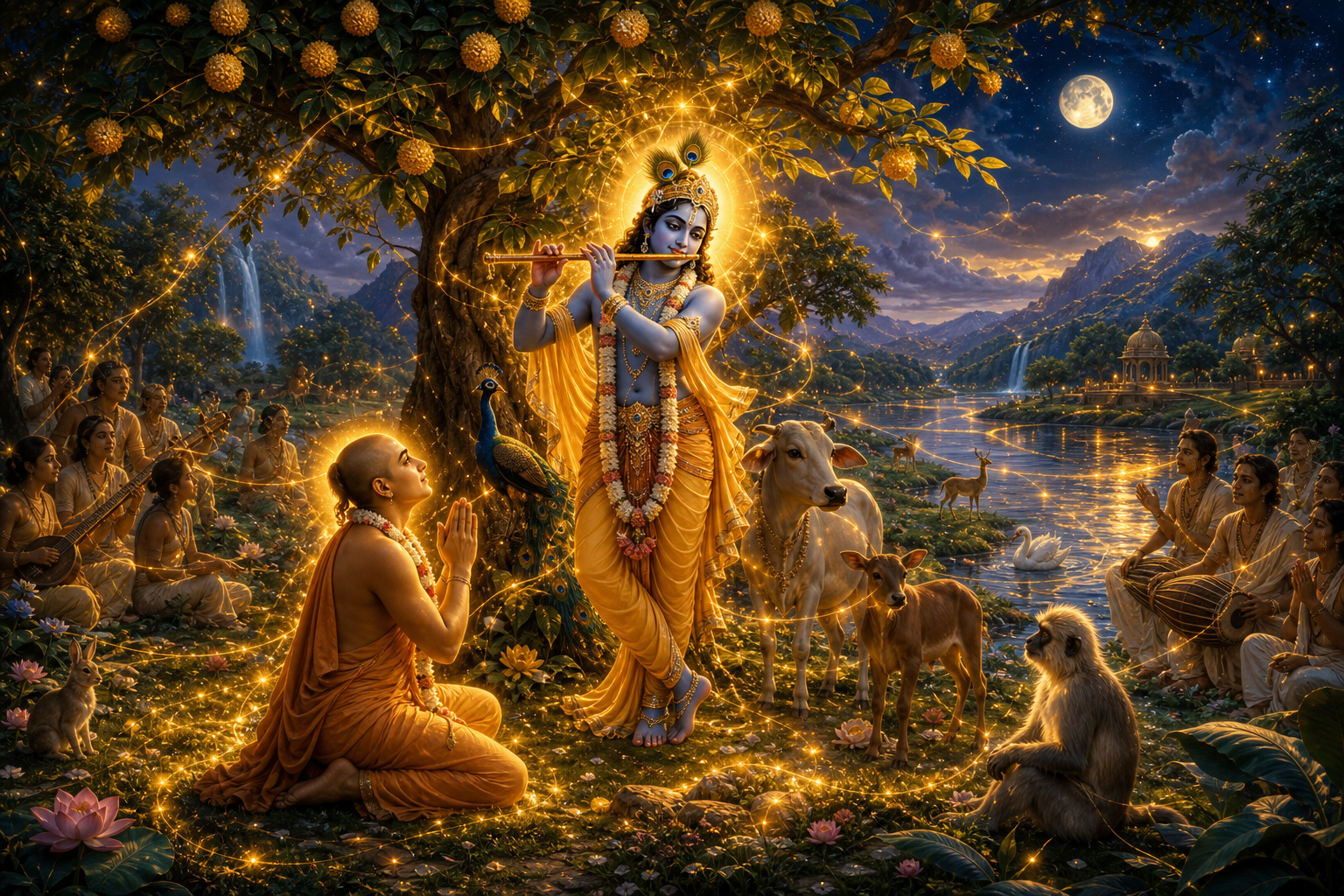
Lord Caitanya’s tradition is associated with acintya-bheda-abheda, usually rendered as inconceivable simultaneous difference and non-difference. The teaching addresses the relationship between the Divine, individual souls, and the world without forcing that relationship into either absolute separation or an identity that erases every distinction.
Non-difference means that nothing possesses an independent existence outside divine reality. Difference means that the worshipper is not simply collapsed into the worshipped and that loving relationship retains genuine meaning. Bhakti requires closeness, participation, and dependence, but it also requires an “I” capable of loving a “Thou.”
The word acintya does not mean that any contradiction can be protected from examination by calling it mysterious. It marks a limit in ordinary categories: finite reasoning can identify real aspects of the relationship without claiming to exhaust the nature of the Divine. Reason remains useful, but it does not appoint itself the measure of everything that can be real.
You can use two questions to test an explanation of this teaching:
- Does the explanation preserve the soul’s participation in and dependence upon divine reality? If not, difference may have become complete separation.
- Does it preserve a meaningful distinction between the devotee and the object of devotion? If not, non-difference may have erased the relationship that bhakti requires.
This is also why calling Caitanya’s teaching simply monism or simply dualism creates confusion. If someone applies either label, ask how the interpretation accounts for the other half of the doctrine. The answer should preserve both unity and distinction rather than quietly sacrificing one.
Key takeaways
- Lord Caitanya can be described historically as a bhakti teacher, practically as the exemplary devotee, and theologically as a divine avatara. Identify the level before evaluating the claim.
- Gaudiya Vaishnavism does not regard him merely as a saint pointing to Krishna. It worships him as Krishna appearing in Radha’s devotional mood.
- His life as a devotee is part of the theological claim, not an exception to it. The Divine teaches bhakti by taking the devotee’s standpoint.
- Sankirtana is central because it makes remembrance participatory, audible, relational, and open to immediate practice.
- Acintya-bheda-abheda preserves unity with divine reality without erasing the distinction needed for love, worship, and service.
- The Gaudiya understanding should be presented as a strong sampradaya-specific claim, not imposed as a consensus held identically by every Hindu tradition.
You do not have to pretend that historical description and theological conviction are the same thing in order to approach Lord Caitanya seriously. Let the tradition state its own claim in its strongest form. Then examine how that identity, its philosophy, and the practice of sankirtana illuminate one another.
For your next encounter with a talk, temple programme, or discussion about Lord Caitanya, make three headings in your notes: historical, devotional, and theological. Place each claim under the heading it actually answers. Then participate in the practice with the same clarity: listen to the divine name, respond without performance, and notice whether remembrance becomes service. That is a more faithful beginning than either immediate dismissal or unexamined assent.
References
