

You want to observe Kamika Ekadashi properly, but the practical questions arrive first: Which local date should you follow? What may you eat? What should you do besides fasting? And how should you understand the extraordinary promises attached to the vrata?
The clearest answer is to treat Kamika Ekadashi as a disciplined day of Vishnu or Krishna remembrance. Confirm the date and breaking time locally, choose a form of fasting you can keep safely, and let worship rather than hunger define the day.
Confirm the local Ekadashi and Dvadashi times first

Ekadashi is the eleventh lunar tithi, not a fixed midnight-to-midnight date. A tithi can begin or end partway through a civil day, and observance rules take local sunrise into account. That is why calendars prepared for different cities or lineages can occasionally place a fast on neighboring dates.
Use a temple or panchanga that gives timings for your location and follows the tradition in which you normally practise. A generic date copied from another country may identify the festival but still give you the wrong fasting or parana window.
- Fasting date: Record the civil date on which your local calendar instructs you to keep Kamika Ekadashi.
- Parana window: Record when the fast should be broken on Dvadashi, the following tithi. Do not assume that any time after midnight is suitable.
- Lineage instructions: If your family, guru or temple applies a particular calendrical rule, follow that rule consistently instead of combining several online calendars.
If a calendar merely says Kamika Ekadashi without providing a location or parana time, it is incomplete for practical observance. Ask your temple for those two details before planning the fast.
Build the day around remembrance, not an empty stomach
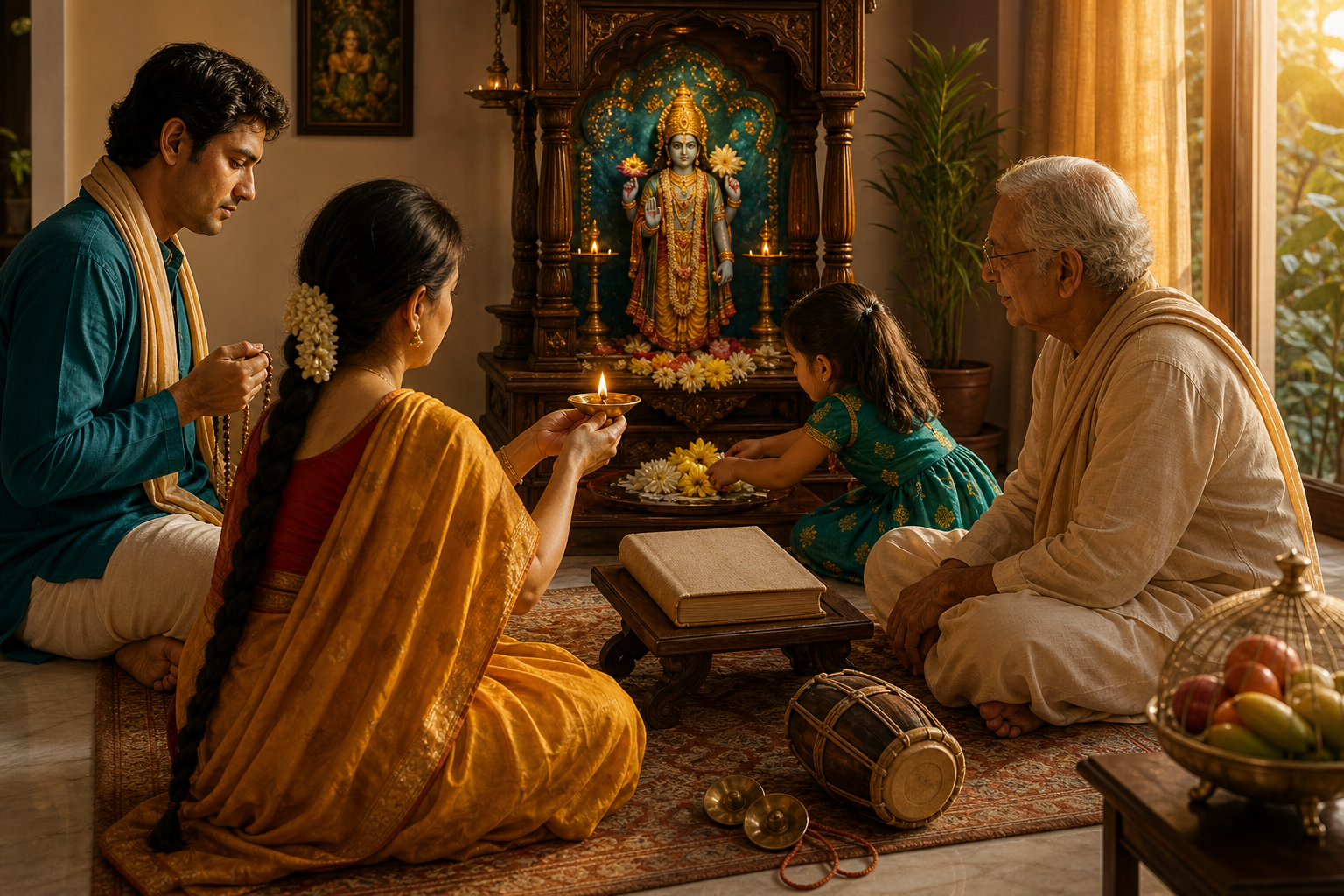
The food restriction supports the vrata; it is not the whole vrata. A person can avoid grains while spending the day in irritation, distraction and argument. That may satisfy a menu rule, but it misses the inner work of Ekadashi.
A modest plan kept attentively is better than an elaborate programme abandoned by midday. You can use the following sequence at home and adapt it to your temple commitments.
- Prepare the evening before. Check the local fasting and parana times, decide what level of fasting you will keep, obtain any permitted food, and reduce avoidable work. Make a simple resolve to dedicate the observance to Vishnu or Krishna.
- Begin cleanly and deliberately. Bathe, put the worship space in order, light a lamp where it is safe to do so, and offer a flower, water or permitted fruit according to your practice. State your intention in plain words if you do not know a formal sankalpa.
- Choose a fixed devotional anchor. Chant the divine names, perform japa, sing kirtan, read a teaching concerning Vishnu or Krishna, or hear the Kamika Ekadashi katha. Decide in advance what you will complete so that devotion does not become whatever time remains after ordinary distractions.
- Fast from harmful speech as well as food. Step back from gossip, quarrels, intoxicants and entertainment that scatters the mind. If work or family duties continue, perform them without treating other people as obstacles to your vrata.
- Make room for seva. Help at a temple, serve someone in your household, give within your means, or complete an overlooked duty. The point is to turn restraint into an offering rather than private self-denial.
- Close the day with examination. Ask where anger, pride, dishonesty or carelessness still governs you. Offer a specific fault to Bhagavan and identify the repair or restraint that must follow the prayer.
- Break the fast during the stated Dvadashi window. Offer the food first, take it with gratitude, and return to ordinary eating gradually if your fast was strict. Parana completes the observance; it is not an administrative detail.
If you accidentally eat something excluded by your tradition, do not turn one mistake into abandonment of the whole day. Acknowledge it, continue the devotional practices, and seek guidance before adopting a stricter corrective vow. Ekadashi is meant to restore attention, not produce despair.
Choose a level of fasting you can honour safely

Ekadashi fasting is practised at different levels. Some devotees abstain completely from food and water. Others take water, fruit, milk or simple grain-free meals. A common Vaishnava baseline is to avoid grains and pulses or beans, though permitted ingredients and preparation rules vary among communities.
- A complete fast: Appropriate only when it belongs to your established practice and your health permits it. Do not attempt a severe fast merely because the promised spiritual fruit sounds greater.
- Water or simple liquids: Less severe than complete abstinence, but still unsuitable for some people and circumstances.
- Fruit, milk or other permitted preparations: Useful when you can fast from regular meals but should not go without nourishment.
- One or more grain-free meals: A practical observance for many householders, older people and those with demanding duties. Confirm the ingredients accepted in your own tradition.
- Devotional restraint without a restrictive fast: The safer course when fasting would endanger your health. Keep the worship, japa, study, charity and restraint from indulgence rather than treating the day as lost.
Do not alter prescribed medication to intensify a fast. If you are pregnant, unwell, managing a medical condition, recovering from disordered eating, or uncertain whether food or water restriction is safe, obtain guidance from a qualified clinician and your spiritual teacher. A medically appropriate adaptation is not a failure of devotion.
Ingredient vigilance matters, but anxiety does not help. Pack permitted food if you will be away from home, read labels where necessary, and avoid turning the household kitchen into a courtroom. The restraint should make remembrance easier and conduct gentler.
Read the glories as a call to transformation
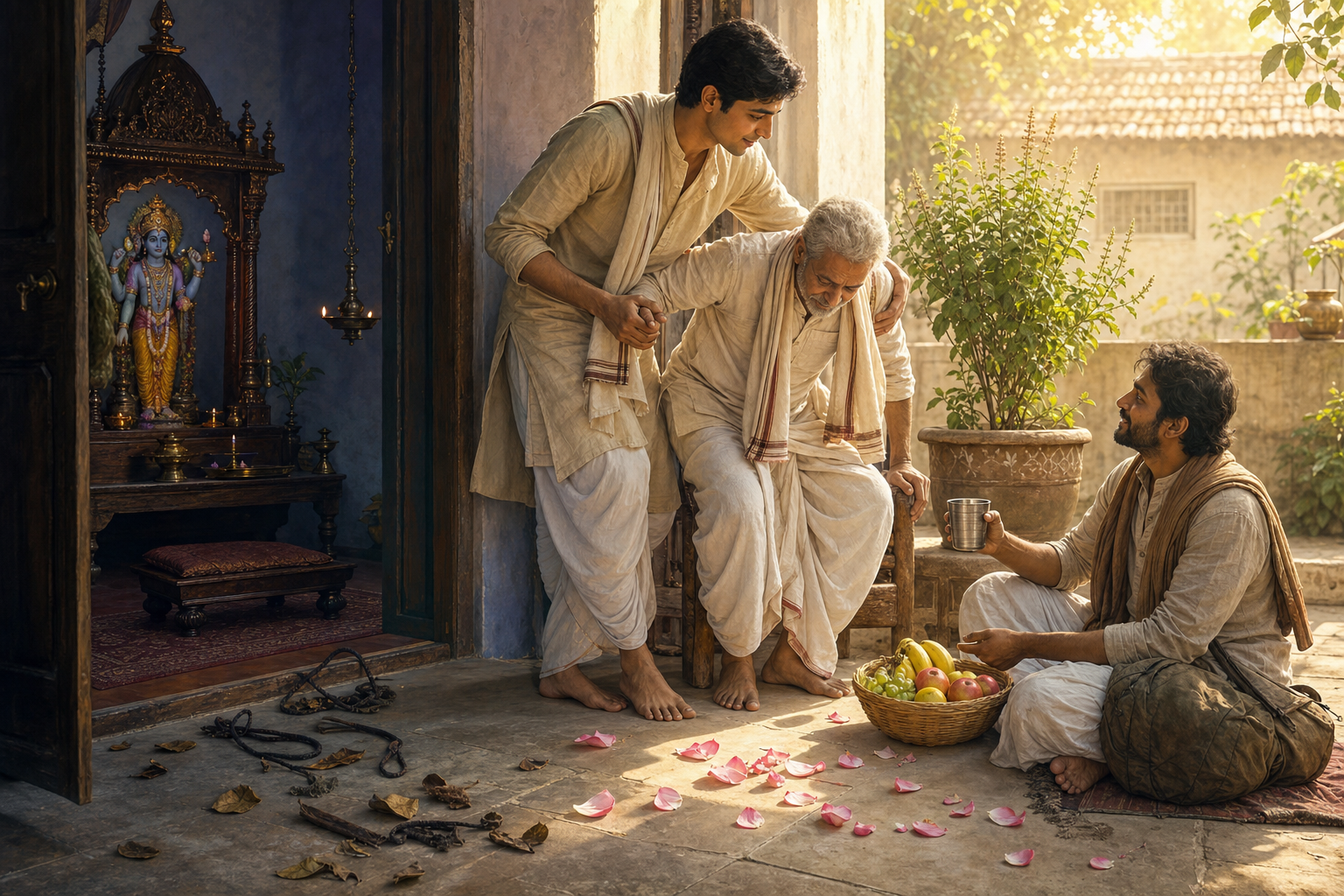
Kamika Ekadashi is praised in striking Vaishnava language, including freedom from sins and attainment of Goloka. These are devotional claims about the fruit of a vrata offered with bhakti. Goloka is understood as the eternal abode of Krishna, while release from sin concerns purification from conduct and tendencies that obstruct one’s relationship with Bhagavan.
The language of glory should deepen sincerity, not encourage spiritual bargaining. Hunger by itself does not cancel deliberate harm, and one sacred day is not permission to repeat the same adharma afterward. Repentance becomes credible when it changes what you do.
Apply the promise of purification in three concrete ways:
- Restraint: Name one recurring impulse you will refuse on Ekadashi, such as angry speech, gossip, dishonesty or compulsive consumption.
- Repair: If your action harmed someone, decide what truthful apology, restitution or correction is required. Ritual observance should not replace that duty.
- Redirection: Give the time, attention or money saved through restraint to worship, study, charity or service.
This is how the vrata’s outer and inner dimensions support each other. The body accepts a limit, the mind returns to the divine name, and conduct begins to align with the prayer for purification.
Key takeaways for your observance
- Use a panchanga or temple calendar prepared for your location and tradition.
- Record both the Kamika Ekadashi fasting date and the local Dvadashi parana window.
- Decide your safe level of fasting before the day begins; do not improvise a severe fast.
- Keep the customary grain and pulse restrictions followed by your community, while checking uncertain ingredients locally.
- Give the day a fixed devotional centre through japa, kirtan, worship, sacred reading or hearing the Kamika Ekadashi katha.
- Treat purification as repentance, repair and changed conduct, not as a mechanical exchange for going hungry.
- Complete the vrata by breaking the fast properly during the prescribed parana period.
Before the observance arrives, make three decisions: which local calendar you will follow, which form of fasting is appropriate, and which devotional practice will anchor the day. Put the parana time beside them. With those choices settled, Kamika Ekadashi can become what the vrata is meant to be: a deliberate return of body, mind and conduct toward Bhagavan.
References
