
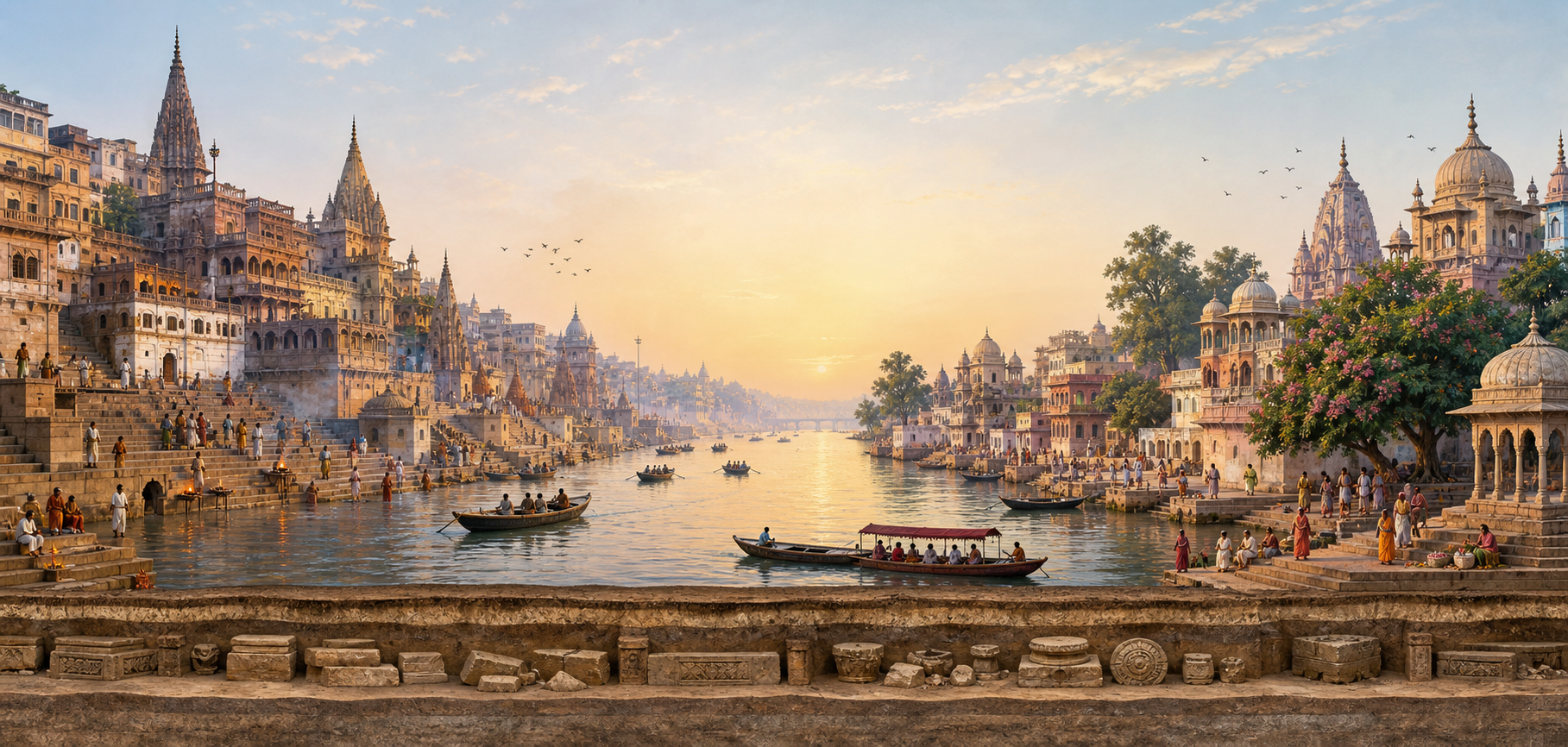
If you care about Kashi and Mathura, the difficult question is not whether their Hindu sacred memory deserves protection. It is how to pursue recognition and redress without letting devotion become a substitute for evidence, lawful process, or care for the places themselves.
A serious pro-Dharma position can hold four commitments together: tell the historical truth as precisely as the record permits, seek durable outcomes through institutions, conserve what cannot be replaced, and protect the dignity of devotees and residents. This is not a retreat from civilizational conviction. It is how conviction acquires public credibility and lasting effect.
Separate the five questions hidden inside every dispute

When a speech, campaign, court development, or viral claim appears, first identify what kind of claim you are being asked to accept. Kashi and Mathura are often discussed as though sacred meaning, history, law, politics, and municipal administration were one question. They are not.
- The sacred question: What does the place mean within a living tradition? Devotional importance does not depend on a political announcement.
- The historical question: What can documentation, material evidence, conservation science, and responsible scholarship establish? A historical proposition should be stated with the degree of certainty its evidence supports.
- The legal question: What issue is actually before a court or public authority, and what remedy can that institution lawfully grant? Religious conviction cannot be presented as though it were already a judicial finding.
- The political question: Is a leader expressing support, announcing a campaign, or creating an enforceable policy? A speech can signal direction without changing any legal or administrative status.
- The civic question: Will pilgrims and residents receive cleaner precincts, safer movement, better access, and more responsible environmental management? These practical outcomes are part of heritage stewardship, not distractions from it.
Before you forward a claim, argue about it, or organize around it, place it in one of these categories. If it crosses categories, ask for the bridge between them. What evidence turns a memory into a historical conclusion? What legal procedure could turn that conclusion into an authorized remedy? What implementation plan could protect the site after a decision? This simple discipline prevents rhetoric from doing work that only evidence and institutions can do.
Kashi and Mathura require different heritage lenses
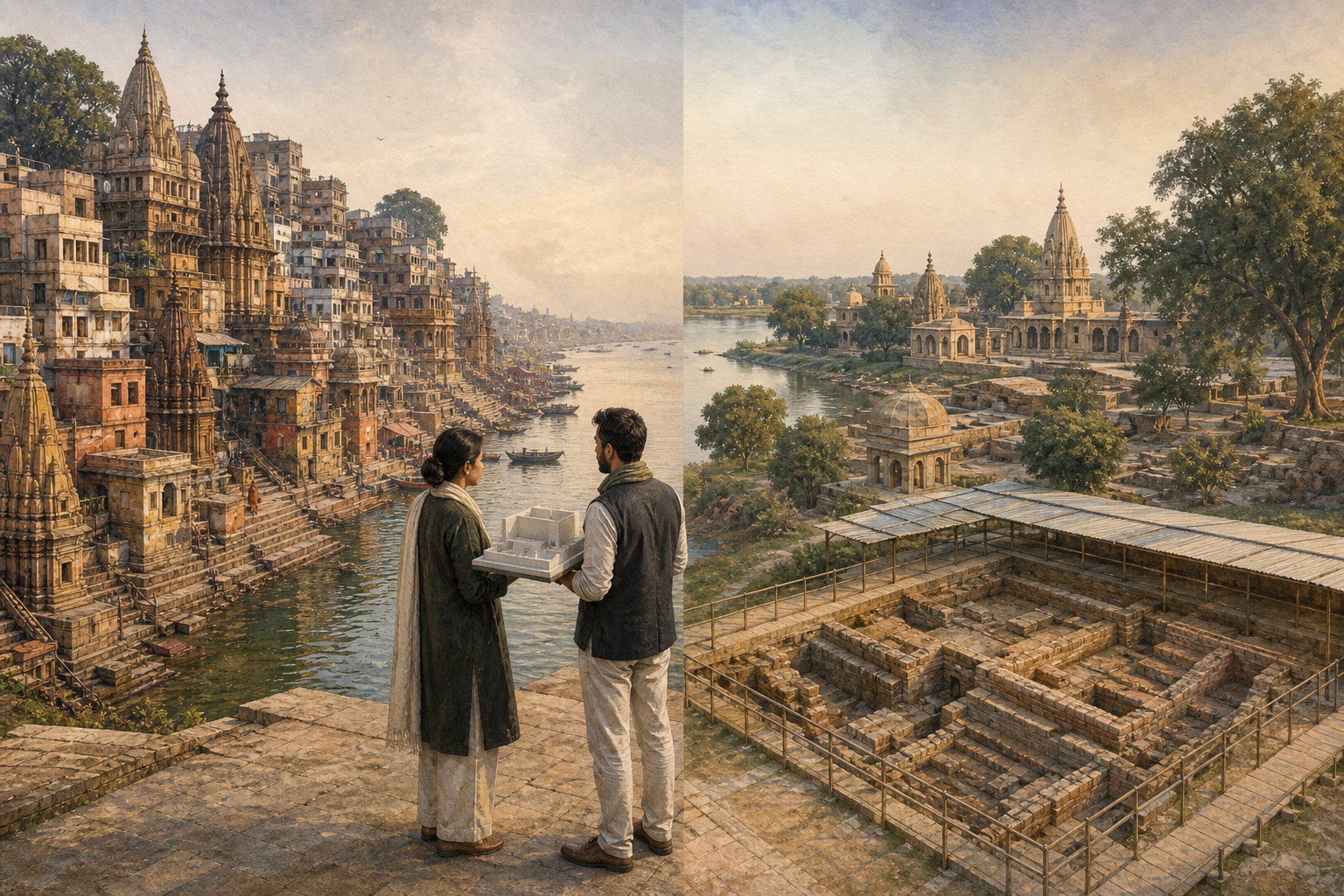
Kashi and Mathura belong within the same civilizational conversation, but they should not be treated as interchangeable cases. Their sacred geographies, public lives, and immediate institutional needs differ. A credible campaign must therefore define each place on its own terms.
Kashi is a sacred landscape, not an isolated monument
Kashi is a central seat of Hindu pilgrimage and learning. Its wider geography also includes proximity to Sarnath, where the Buddha delivered his first sermon, as well as associations with Jain traditions. That breadth does not diminish Kashi’s Hindu centrality. It enlarges the duty of care.
For Kashi, look beyond a single disputed boundary. Ask whether authorities are documenting the surrounding sacred landscape before altering it, coordinating conservation with worship, protecting pedestrian access, managing crowds safely, and treating the ghats and pilgrimage routes as parts of one living system. A plan that renovates a focal structure while degrading its setting is not complete heritage conservation.
Dharmic unity should also be expressed accurately. Hindus, Buddhists, Jains, and Sikhs need not claim identical relationships to every location in order to defend the principle that sacred memory deserves truthful documentation and respectful treatment. Unity is cooperation without invented sameness.
Mathura requires devotional seriousness and legal precision
Mathura is revered as Krishna Janmabhoomi and remains a powerful center of devotional life and cultural memory. At the same time, its contested heritage questions involve continuing legal and administrative considerations. That combination calls for disciplined language: the strength of devotion should not be used to imply that an unresolved institutional question has already been decided.
When a Mathura initiative is announced, ask for its exact scope. Is it seeking a legal remedy, conserving heritage, improving pilgrim facilities, documenting history, or mobilizing public support? Who has authority over that work? What stage has the relevant process reached? A campaign that cannot answer those questions may still express sentiment, but you should not mistake sentiment for a settled plan.
Do not transfer assumptions or evidence from Kashi to Mathura merely because both places appear in the same slogan. Each historical assertion must concern the exact place, period, and question under discussion. Each legal claim must stand within its own proceeding. Treating the cities distinctly makes the civilizational case harder to dismiss, not easier to divide.
What responsible pro-Dharma stewardship demands
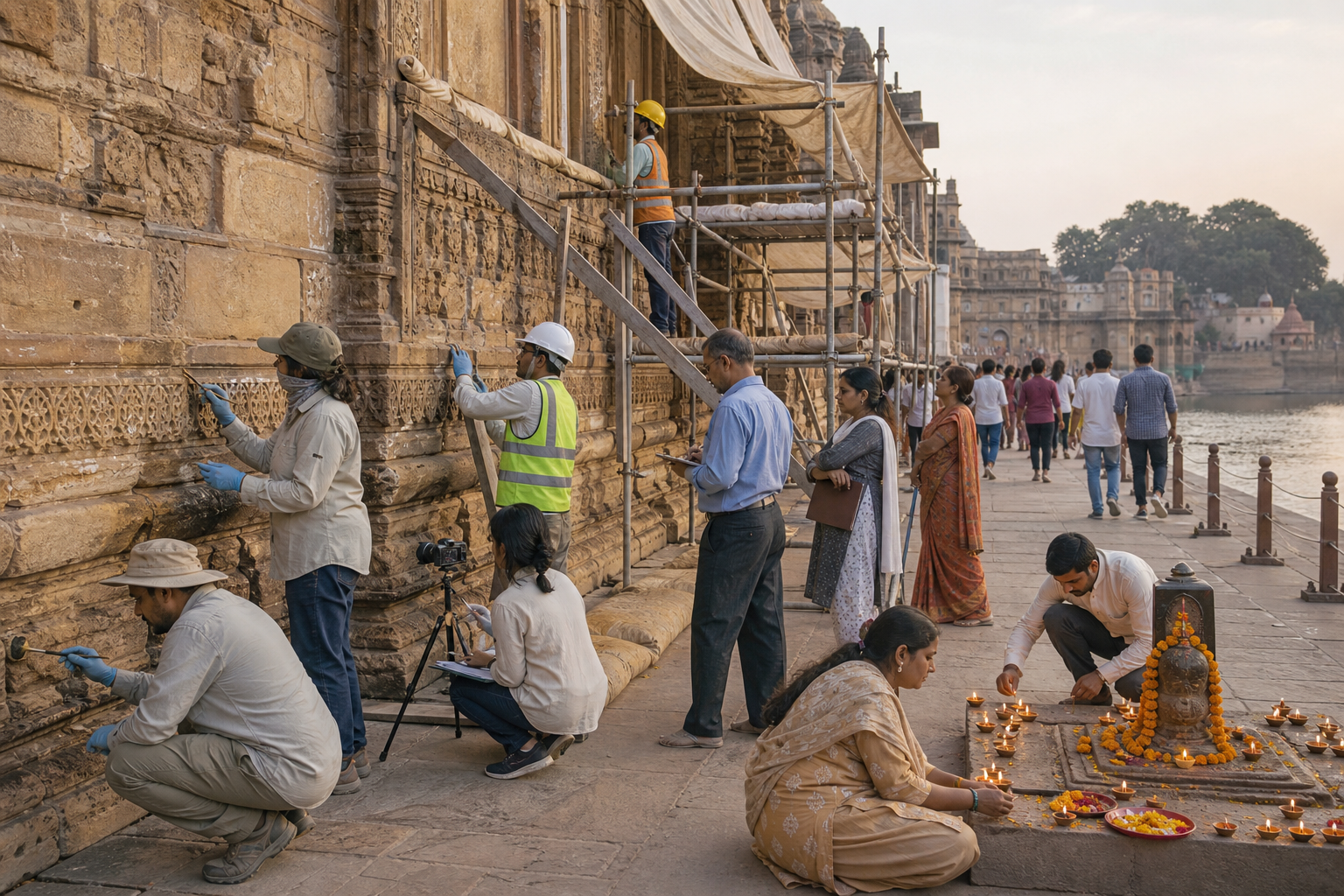
A pro-Hindu position need not choose between silence and confrontation. It can demand a truthful accounting of sacred history while refusing shortcuts that could damage heritage, expose participants to legal consequences, or turn devotees into instruments of political theatre.
- State the claim precisely. Say whether you are making a devotional affirmation, a historical argument, a legal claim, a conservation proposal, or a request for better access. Phrases such as “Hindu memory preserves” and “a court has determined” do not mean the same thing. Use the one the evidence permits.
- Trace evidence before circulating it. For a map, photograph, inscription, quotation, or historical assertion, ask where it came from, whether its date and location can be verified, and whether it concerns the exact disputed place. A cropped image with a forceful caption is not stronger evidence because it has been widely shared.
- Let institutions perform their proper role. Courts assess legal claims; administrators implement authorized decisions; conservation professionals evaluate physical risk; and communities explain how a place is actually used. Public support can sustain a lawful effort, but it cannot confer jurisdiction or replace a decision.
- Protect the physical record. Excavation, demolition, repair, and new construction can irreversibly alter material evidence. No supporter should encourage physical action ahead of the required legal authorization and conservation assessment. If you are directly involved in a proceeding or considering action at a contested site, seek advice from qualified Indian legal counsel rather than relying on campaign messages.
- Consult without erasing disagreement. Devotees, residents, affected communities, historians, conservation professionals, and public administrators may bring different concerns. Consultation does not give every participant a veto, but it exposes practical risks before they become permanent mistakes. Buddhist, Jain, and Sikh participation in wider Dharmic solidarity should be welcomed without assigning any community a position it has not taken.
- Measure stewardship in daily conditions. Cleaner precincts, safer mobility, culturally sensitive design, orderly access, and sound environmental management affect whether a sacred city can carry its traditions into the future. Ask for operating plans, not only visual promises. If a project cannot explain how worshippers and residents will navigate the place after completion, it is unfinished.
This standard is demanding because the stakes are high. A careless claim can discredit sound evidence. Unauthorized physical action can destroy the very record needed to establish history. A poorly designed redevelopment can make a sacred precinct more impressive in photographs while making worship more difficult on the ground. The method must protect the objective.
How to evaluate the next campaign announcement

Public remarks in New Delhi in early December 2025 by Uttar Pradesh Chief Minister Yogi Adityanath appeared to signal possible campaign initiatives concerning Kashi and Mathura. They were not presented as formal policy announcements. That distinction matters: enthusiasm for a signal must not be confused with informed consent to a plan that has not yet been defined.
Use this checklist whenever a new speech, campaign, or proposal appears:
- Status: Is this a political statement, a party initiative, an administrative order, a court development, or an approved conservation project?
- Objective: What exact outcome is being sought: adjudication, documentation, conservation, access, infrastructure, or public mobilization?
- Authority: Which court, department, trust, conservation body, or other institution has the power to act?
- Legal position: Is a proceeding pending, and are there restrictions on what officials, campaigners, or members of the public may do?
- Evidence: What historical documentation supports the stated claim, and is uncertainty acknowledged where the record remains contested?
- Conservation: Has the existing physical condition been documented, and will specialists assess risk before irreversible work begins?
- Consultation: Which devotees, residents, affected communities, and Dharmic institutions have been heard? Is their involvement documented or merely asserted?
- Public benefit: What will improve for a pilgrim or resident: safety, access, cleanliness, environmental conditions, or the continuity of worship?
- Conduct: Does the campaign explicitly reject intimidation, trespass, damage, and other unauthorized action?
If the announcement identifies its authority, legal status, evidence, conservation safeguards, and practical objective, you can evaluate it on its merits. If those elements remain unclear, wait for primary paperwork rather than filling the gaps with assumptions. If anyone calls for intimidation, unauthorized entry, or damage, do not participate; such conduct risks people, heritage, and the legitimacy of the cause.
Political timing is relevant, but it is not by itself proof of either sincerity or bad faith. Judge the initiative by what survives beyond the speech: an identifiable process, accessible documentation, lawful decisions, protected heritage, and measurable improvements in the sacred city.
Key takeaways
- Sacred meaning, historical evidence, legal status, political campaigning, and civic management are connected but distinct.
- Kashi should be approached as a layered sacred landscape with Hindu, Buddhist, and Jain significance; Mathura should be approached through its Krishna-centered devotional importance and its own legal and administrative context.
- Dharmic unity does not require pretending that every tradition has the same theology or the same site-specific claim.
- A durable pro-Hindu effort states claims precisely, verifies evidence, follows institutional processes, and prevents irreversible damage.
- A political signal is not a court decision, administrative authorization, conservation plan, or completed project.
- Cleaner precincts, safer mobility, responsible environmental management, and continuity of worship are tests of heritage success, not secondary benefits.
The next time Kashi or Mathura enters the headlines, do not ask only whether the language sounds assertive. Ask what has been formally proposed, which institution can act, what evidence will be preserved, and how devotees and residents will be served. Back the efforts that can answer those questions plainly. That is how sacred memory becomes a durable civilizational inheritance rather than a passing political signal.
References
