

If you have encountered the claim that Bengal followed a different Hindu inheritance system, the useful question is not simply who inherited. It is why inheritance was thought to pass at all. Jimutavahana’s Dayabhaga placed spiritual responsibility, especially the performance of ancestral rites, near the center of that answer.
That distinction helps you understand Dayabhaga without reducing it to a regional curiosity or a slogan about property rights. It also gives you a reliable way to assess claims about Mitakshara, women’s inheritance, colonial courts, and the place of dharma in legal reasoning.
Start with the duty, not merely the property
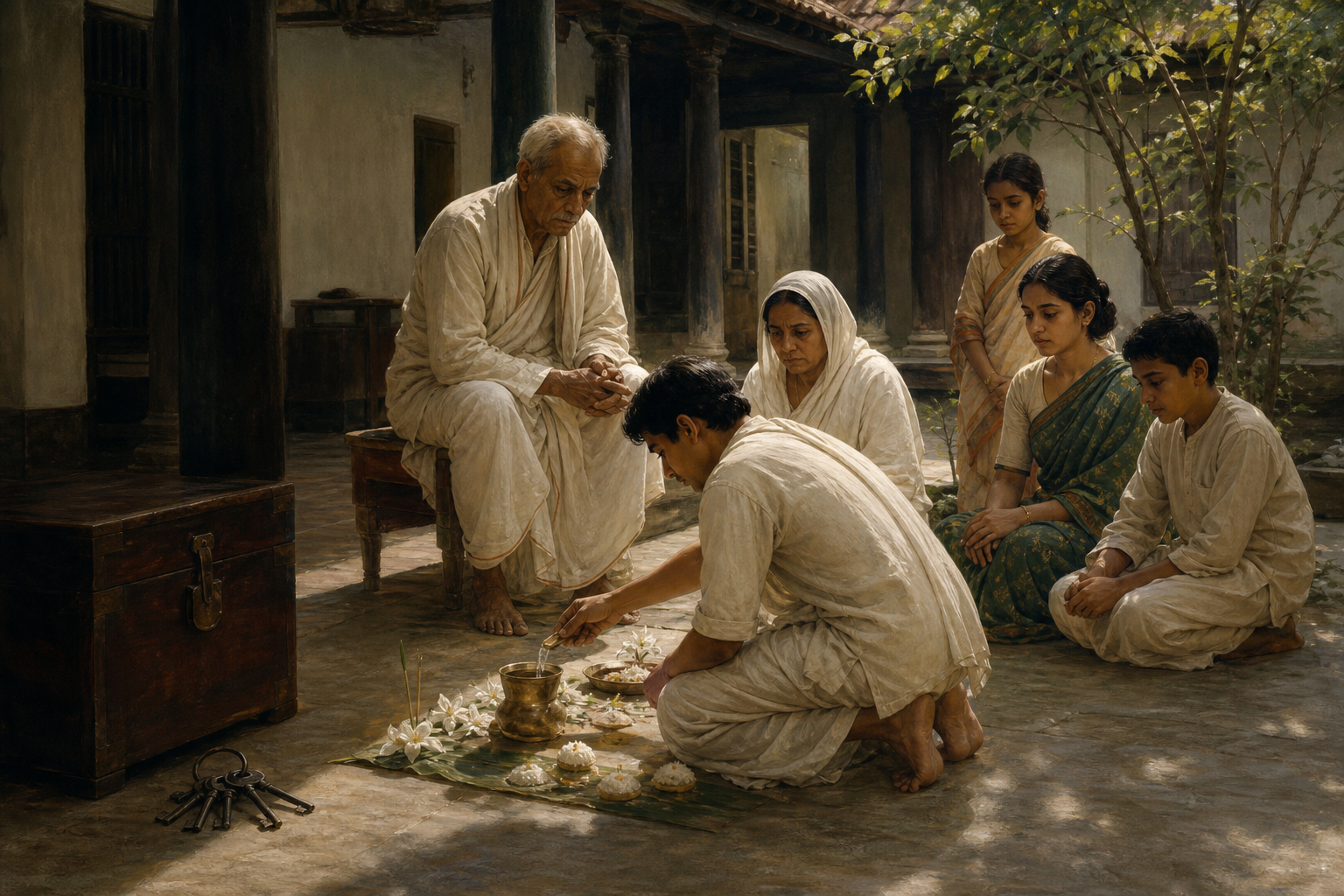
Jimutavahana is often placed in the twelfth-century intellectual world of Gauda-Desha. His enduring importance comes from treating inheritance as more than the division of material assets. In Dayabhaga reasoning, the spiritual rationale for succession and the performance of obligations toward ancestors carry decisive weight.
This does not mean ritual devotion replaced legal analysis. Spiritual responsibility supplied part of the legal logic. Property, kinship, ancestral continuity, and duty were considered together. The right to succeed could therefore be understood alongside the responsibility that succession carried.
When you read a Dayabhaga proposition, ask three questions:
- What ancestral or familial duty gives the proposed succession rule its rationale?
- How does the claimant’s relationship to the deceased connect that person with the relevant responsibility?
- How is the spiritual principle translated into a workable rule for a dispute over inheritance?
These questions bring you closer to Jimutavahana’s method. He worked through shruti, smriti, earlier nibandhas, or legal digests, and vyavahara, the domain of legal procedure. Textual authority mattered, but so did interpretation and practical application. If you are studying a passage, do not stop after locating a scriptural citation. Identify the interpretive move that carries the citation into a rule capable of governing family life.
This is also where a broader Dharmic reading needs precision. Dharma, duty, fairness, and responsible stewardship resonate across Hindu, Buddhist, Jain, and Sikh moral worlds. Dayabhaga itself, however, belongs to the Hindu Dharmashastra corpus. Shared ethical concerns should invite conversation across traditions, not erase the distinct texts, institutions, and legal histories of those traditions.
Dayabhaga and Mitakshara begin from different centers
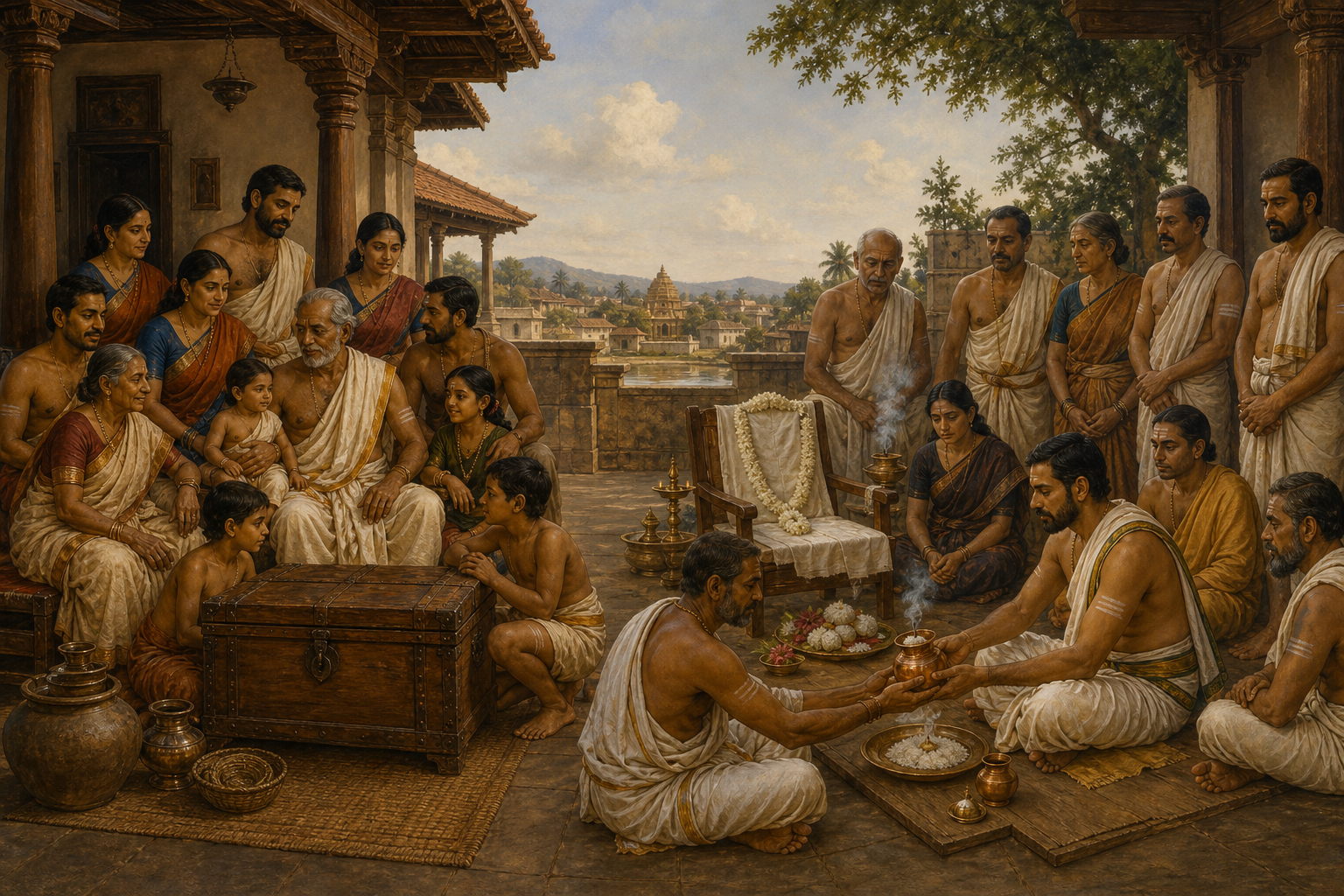
The familiar contrast with Mitakshara is helpful when it is treated as an orientation map rather than a complete statement of either tradition. Mitakshara generally gives greater priority to joint family property and agnatic succession, meaning succession structured through the male line. Dayabhaga gives decisive importance to the spiritual basis of inheritance and ancestral rites.
| Question | Dayabhaga orientation | Mitakshara orientation |
|---|---|---|
| What gives inheritance its principal rationale? | Spiritual responsibility and the performance of ancestral rites carry decisive weight. | The joint-family property framework generally carries greater weight. |
| What structures succession? | Rights are examined in relation to duties toward the deceased and the ancestors. | Agnatic succession, or succession through the male line, is generally prioritized. |
| What should a reader examine first? | The connection between heirship, spiritual benefit, and ancestral obligation. | The claimant’s place within the joint family and agnatic line. |
The distinction is one of legal center of gravity. It should not be converted into crude oppositions such as spiritual versus secular, individual versus family, or compassionate versus harsh. Both traditions belong to Hindu jurisprudence, and both require more than a school label before you can determine a particular outcome.
Suppose you meet a claim that begins, “Under Dayabhaga, the heir must be…” Before accepting it, identify whether the claim concerns eligibility to inherit, the ordering of heirs, management of property, the nature of the property, or the performance of a rite. Those are related questions, but they are not interchangeable. A broad description of Dayabhaga’s rationale cannot by itself settle every technical rule.
The same caution applies in reverse. Mitakshara’s emphasis on joint family property does not permit you to infer every rule affecting every person and every form of property. The useful comparison is the premise each tradition treats as especially important, followed by the precise rule developed from that premise.
Read claims about women’s inheritance without anachronism

Dayabhaga is frequently remembered as more favorable to women than some interpretations associated with Mitakshara. The historically responsible formulation is narrower: developments within the Dayabhaga tradition were, over time, interpreted as more accommodating of women’s claims relative to some Mitakshara interpretations. These developments affected discussions of widows, daughters, property management, and familial responsibility.
Every qualifier matters. “More accommodating” is comparative, not absolute. “Some interpretations” warns you against treating Mitakshara as a single unchanging rule. “Over time” tells you that Jimutavahana’s argument, later regional practice, judicial application, and modern law should not be collapsed into one moment.
Use this five-part check when you encounter a claim about a woman’s rights under Dayabhaga:
- Name the claimant. A statement about a widow does not automatically establish the same rule for a daughter or another female relative.
- Name the entitlement. The right to succeed, the power to manage property, and the power to dispose of it are different legal questions.
- Name the comparison. Ask which Mitakshara interpretation or practice supplies the baseline for the claim that Dayabhaga was more accommodating.
- Name the historical layer. Determine whether the proposition belongs to Sanskrit jurisprudence, regional practice, a colonial court ruling, or later legal reform.
- Separate history from current law. Modern codification changed the legal setting. A historical school cannot by itself answer a present inheritance dispute.
This discipline avoids two opposite errors. A celebratory slogan can make a comparative development sound like complete modern equality. A dismissive slogan can overlook the real ways in which Dayabhaga reasoning created room for different conclusions about widows and daughters. Good legal history requires you to recognize the development without overstating it.
If an actual estate, title, or succession dispute is before you, do not rely on a historical description to decide what to sign, transfer, surrender, or litigate. The downside can be the loss of a legal claim or control over property. Check the current law applicable to the property and parties, and obtain advice from a qualified lawyer in the relevant jurisdiction.
Keep the four historical layers separate

Dayabhaga did not remain confined to a Sanskrit manuscript. Its arguments moved through scholarship, regional legal culture, courts, and eventually a legal order shaped by modern codification. To understand its influence, separate four layers that are often compressed into the phrase “Dayabhaga law.”
- Jimutavahana’s jurisprudence. This is the interpretive argument grounded in authoritative texts, earlier legal learning, ethical reasoning, and attention to vyavahara.
- Bengal’s scholastic tradition. Jimutavahana became one of Bengal’s pivotal Dharmashastra scholars, alongside Shulapani, dated 1365-1445 CE, and Raghunandana, dated 1510-1580 CE. Their placement in a continuing intellectual culture matters because Hindu law developed through commentary, debate, and refinement.
- Early modern and colonial adjudication. Courts in Bengal engaged Dayabhaga principles while deciding disputes. Repeated judicial use helped standardize practice and made Dayabhaga an important part of the region’s legal consciousness.
- Modern legal history. Later codification reformed the setting in which older Hindu legal traditions operated. Dayabhaga remains important for understanding how the modern legal order emerged, even where its historical rules no longer determine present rights.
Whenever someone says, “Dayabhaga held that…”, ask which layer supplies the proposition. A conclusion in Jimutavahana’s reasoning, a later scholastic interpretation, a regional practice, and a rule standardized by a colonial court may be connected without being identical. Failing to identify the layer makes it easy to project a later judicial formulation backward onto the original jurist.
The layers also explain why Dayabhaga matters beyond a catalogue of obsolete rules. It shows a jurisprudential tradition adapting inherited authorities to practical disputes while preserving an ethical account of family responsibility. That is evidence of intellectual development within Dharmashastra, not of a legal culture mechanically repeating a frozen code.
Key takeaways
- Jimutavahana, often dated to the twelfth century and associated with Gauda-Desha, gave Bengal one of its most influential works of Hindu jurisprudence.
- Dayabhaga connects inheritance with spiritual responsibility, especially the performance of ancestral rites.
- Mitakshara generally emphasizes joint family property and agnatic succession more strongly, but that contrast identifies an orientation rather than deciding every case.
- Claims that Dayabhaga was more accommodating to women must specify the claimant, the kind of right, the comparison, and the historical period.
- Jimutavahana’s reasoning, later Bengal scholarship, colonial adjudication, and modern codification are related but distinct historical layers.
The next time you assess a statement about Dayabhaga, write four labels beside it: rationale, claimant, historical layer, and present legal status. If one is missing, the statement is probably incomplete. That small habit will help you see Jimutavahana neither as a relic nor as a modern reformer displaced into the twelfth century, but as a jurist who made duty, interpretation, and workable law answer to one another.
References
