
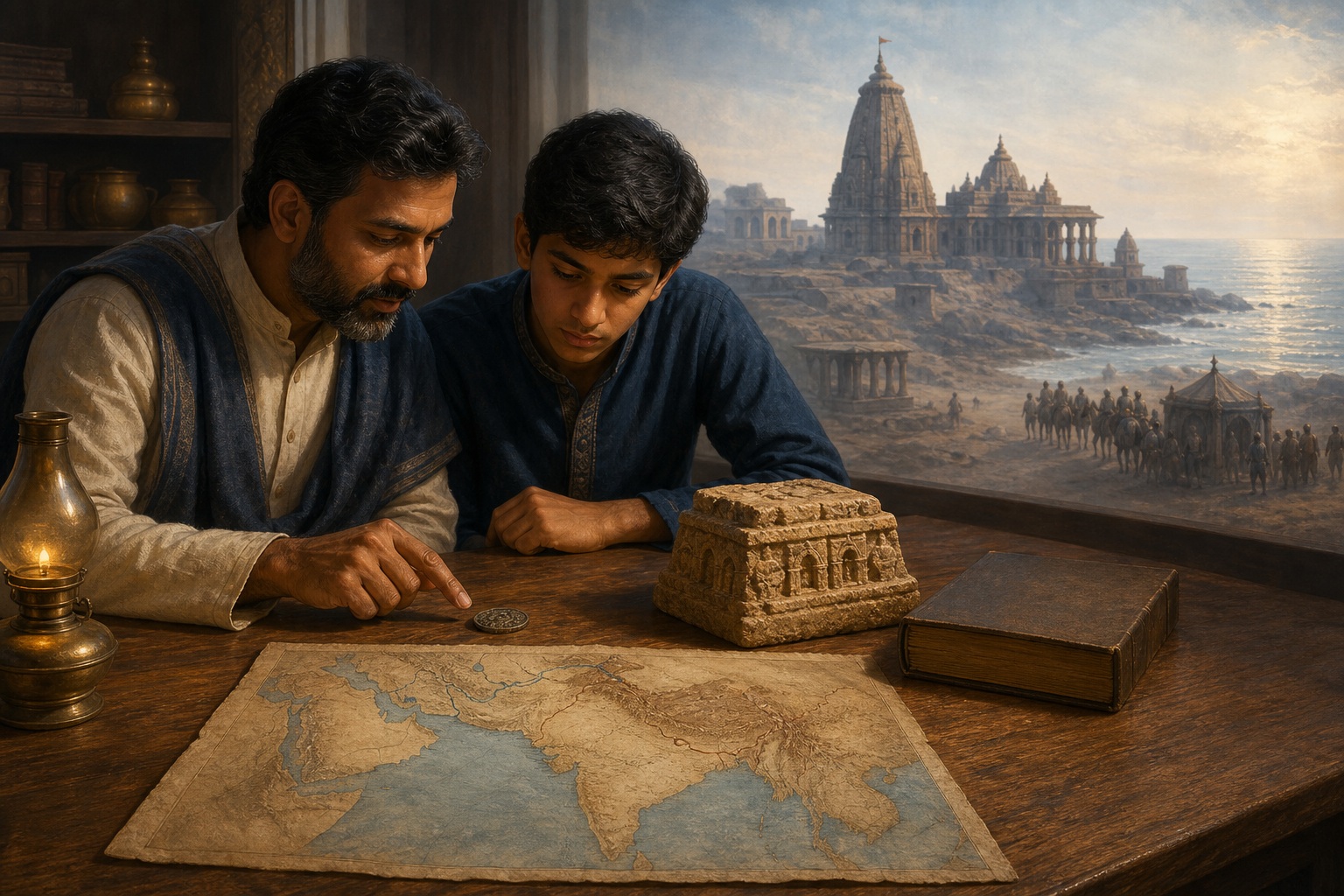
You may be trying to decide whether NCERT’s revised treatment of Mahmud Ghaznavi and Somnath is a genuine correction, a politically convenient retelling, or simply a more detailed version of a familiar lesson. Do not settle that question from a headline, a cropped page, or the emotional force of one paragraph.
Students now encounter a fuller account of Ghaznavi’s campaigns in the Indian subcontinent, including temple destruction and the attack on Somnath, within the political, economic, and cultural setting of the 11th century. That is an important change in scope. Its value, however, depends on whether evidence, motive, violence, and recovery remain visible at the same time.
Key takeaways
- Judge the actual lesson by its class, title, edition, chapter, and page number. “NCERT says” is not a complete citation.
- Keep four questions separate: what happened, why it happened, what evidence supports the account, and what followed.
- Do not let economic or political context erase iconoclasm. Do not let iconoclasm become a substitute for examining political consolidation or resource extraction.
- Persian chronicles, inscriptions, and archaeological indicators are different kinds of evidence. They should be compared, not counted as interchangeable votes.
- Read Somnath through two connected histories: destruction and civilizational renewal. Ending at either one produces a distorted memory.
A sound reading must hold four layers together
The usual argument about Ghaznavi fails because participants rush from an event to a moral conclusion without showing the steps between them. You can avoid that trap by separating four layers and asking whether NCERT connects them honestly.
| Layer | Question to ask | Warning sign |
|---|---|---|
| Event | What happened, where did it happen, and how does it fit into the campaign? | Strong rhetoric appears without a clear timeline or geography. |
| Motive | What evidence supports iconoclasm, political consolidation, or fiscal objectives? | One motive is declared sufficient for every action. |
| Evidence | Which claims rest on Persian chronicles, epigraphic evidence, or archaeological indicators? | Different evidence types are presented as if they have identical strengths and limitations. |
| Aftermath | How did regional communities respond, rebuild, and preserve continuity? | The account stops at destruction or skips over destruction to celebrate resilience. |
Begin with the event layer. Identify the actor, place, action, sequence, and geographical setting. A campaign across the subcontinent, an attack on a temple, and the extraction of wealth are related facts, but they are not interchangeable descriptions. If a passage shifts between them without explanation, mark the shift. Precision matters because vague language can either conceal violence or magnify a claim beyond the evidence offered.
Move next to motive. The revised treatment places iconoclasm alongside political consolidation and fiscal objectives. You should resist the demand to choose one explanation before examining the evidence. A ruler can seek wealth, legitimacy, and symbolic domination through the same action. Multiple motives are not automatically evasive; they become evasive only when context is used to deny an element that the evidence supports.
Then examine the aftermath. A history of Somnath that ends with the attack makes Hindus appear only as victims frozen at the moment of loss. A history that begins with reconstruction, while treating the preceding destruction as an awkward preface, removes the reason that renewal mattered. Keep the wound and the response in the same field of vision.
Test the evidence instead of choosing a preferred narrative
You do not need specialist training to perform a basic source audit. You need the complete page, a pencil or notes app, and the discipline to separate a claim from the evidence used to support it.
- Identify the exact book. Record the class, textbook title, edition, chapter, and page. This prevents quotations from one version being attributed loosely to every NCERT history book.
- Underline factual claims. Mark statements about campaigns, temple destruction, Somnath, political conditions, routes, resources, and regional responses.
- Circle interpretive language. Words that assign purpose, legitimacy, symbolism, or long-term consequence require an argument connecting evidence to conclusion.
- Label the evidence type. Use C for chronicle, E for epigraphy, and A for archaeology. If no basis is identified, add a question mark rather than assuming that the claim is either true or false.
- Check the causal bridge. Ask whether the cited evidence establishes that an event occurred, explains why it occurred, or merely makes one interpretation plausible. Those are different levels of support.
- Read beyond the circulated extract. Examine the preceding and following pages for chronology, qualifications, discussion questions, regional reactions, and reconstruction.
The distinction between evidence types is crucial. A Persian chronicle can preserve a narrative and the outlook of its political world. An inscription can tie a statement to a place, patron, institution, or act of commemoration. Archaeological evidence can indicate material change. None should be forced to answer a question it cannot answer by itself, especially a question about intention.
Students are being introduced to Persian chronicles, epigraphic evidence, and archaeological indicators as distinct lenses. The practical test is whether the classroom preserves those distinctions. Three evidence types do not become three votes for a predetermined conclusion. Each must be assessed for what it can establish, whose perspective it carries, and where interpretation begins.
Use the same discipline when challenging an omission. State the missing claim, identify the evidence relevant to it, and explain how its absence changes the reader’s understanding. “This feels whitewashed” may express a legitimate concern, but it does not yet demonstrate one. A page number, omitted event, neglected source type, or unsupported causal claim does.
Context should explain the attack, not dissolve it
Context is indispensable. Ghaznavi’s campaigns belonged to an 11th-century world of state formation, frontier politics, mercantile routes, contests over legitimacy, and the movement of resources. Without that setting, students receive a morality play rather than history.
Yet context can be misused. If a discussion of wealth, strategy, or medieval warfare leaves the reader unable to say plainly that a temple was attacked, explanation has become erasure. Economic incentives do not make sacred meaning irrelevant. Political calculation does not make iconoclasm impossible. The proper question is not which motive permits us to dismiss the others, but which combination the evidence can sustain.
You can apply two quick tests. First, remove the sentence naming the violence. If the remaining explanation sounds complete, the account may have treated the attack as incidental even though it is central to the subject. Second, remove the political and economic setting. If nothing important is lost, the account may be using religious identity as a complete causal explanation. Either result calls for closer reading.
The same standard guards against presentism. Historical actors must be assessed through documented actions, institutions, aims, and circumstances. Modern people do not inherit personal guilt for the acts of an 11th-century ruler. Refusing collective blame does not require silence about temple destruction, just as naming temple destruction does not authorize prejudice against a living community.
For a teacher or parent, this distinction provides a workable classroom rule: permit disagreement about motive, emphasis, and interpretation, but require every participant to name the evidence and the precise historical actor under discussion. Do not accept a modern community as shorthand for a medieval ruler. Do not accept “harmony” as a reason to omit an evidenced act. Truth and civic restraint are compatible obligations.
Somnath must be read as both loss and renewal
Somnath occupies more than one register. It is a site within the history of Ghaznavi’s campaigns, a sacred place, and a bearer of cultural memory. If you read it only as an episode in military or fiscal history, you miss why the attack remained meaningful. If you read it only as a civilizational symbol, you risk replacing historical inquiry with inherited emotion.
Follow two timelines. On the first, track the campaign, the attack, the damage, the objectives attributed to the aggressor, and the evidence for each claim. On the second, track community response, rebuilding, institutional recovery, and the continuation of sacred identity. The revised framing places devastation beside reconstruction and continuity in cultural heritage; your task is to make sure neither side functions as decoration for the other.
Three questions keep civilizational memory concrete: What was harmed? What did people restore? What practices, institutions, knowledge systems, or social bonds allowed continuity? These questions move the discussion beyond the shallow choice between permanent victimhood and compulsory forgetting.
This is also where a Dharmic approach can make a distinctive contribution. Memory does not have to imitate the logic of conquest. It can honour a sacred place, tell the truth about its desecration, recognise the determination behind renewal, and refuse to turn historical pain into indiscriminate hostility. Restraint should sharpen truth, not weaken it.
The next time a claim about NCERT and Somnath reaches you, ask for the complete page and edition. Then run the four-part test: event, motive, evidence, and aftermath. Support the treatment where it meets that standard. Challenge it with precise omissions or unsupported interpretations where it does not. That is how you turn a charged textbook dispute into responsible historical scrutiny.
References
