
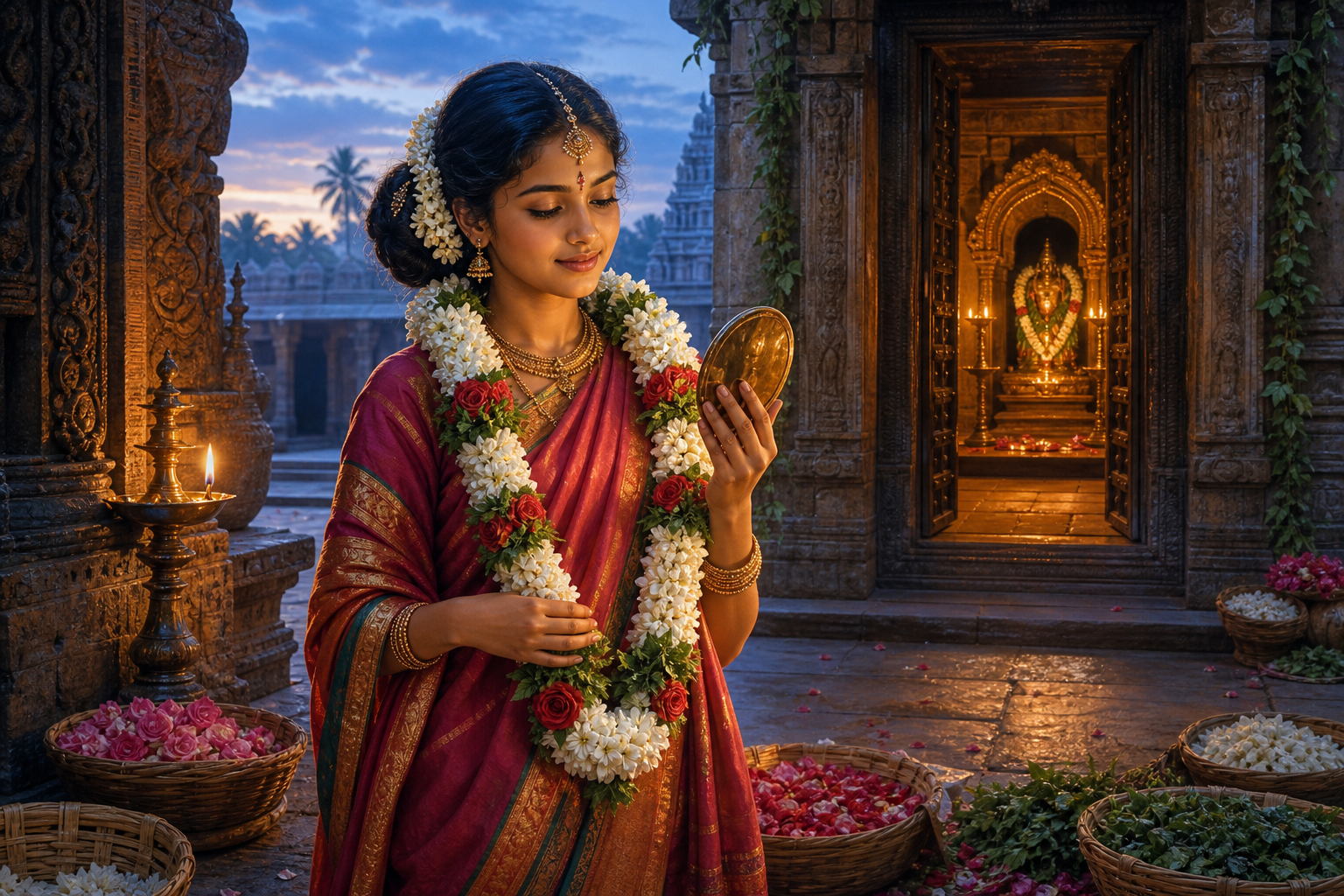
If Andal’s story has ever left you wondering how a garland worn by a human being could become fit for Vishnu, stay with that discomfort. It is the doorway into the story. The easy interpretations – that ritual rules do not matter, or that love excuses whatever a devotee chooses to do – miss the discipline at the heart of her devotion.
The episode asks a more searching question: when you worship, what are you actually offering? Flowers can be placed before the Divine while the person offering them remains guarded, distracted, or untouched. Andal’s garland signifies something more complete. The flowers reach Vishnu carrying the devotee’s attention, longing, and very self.
Why wearing the garland first appeared improper
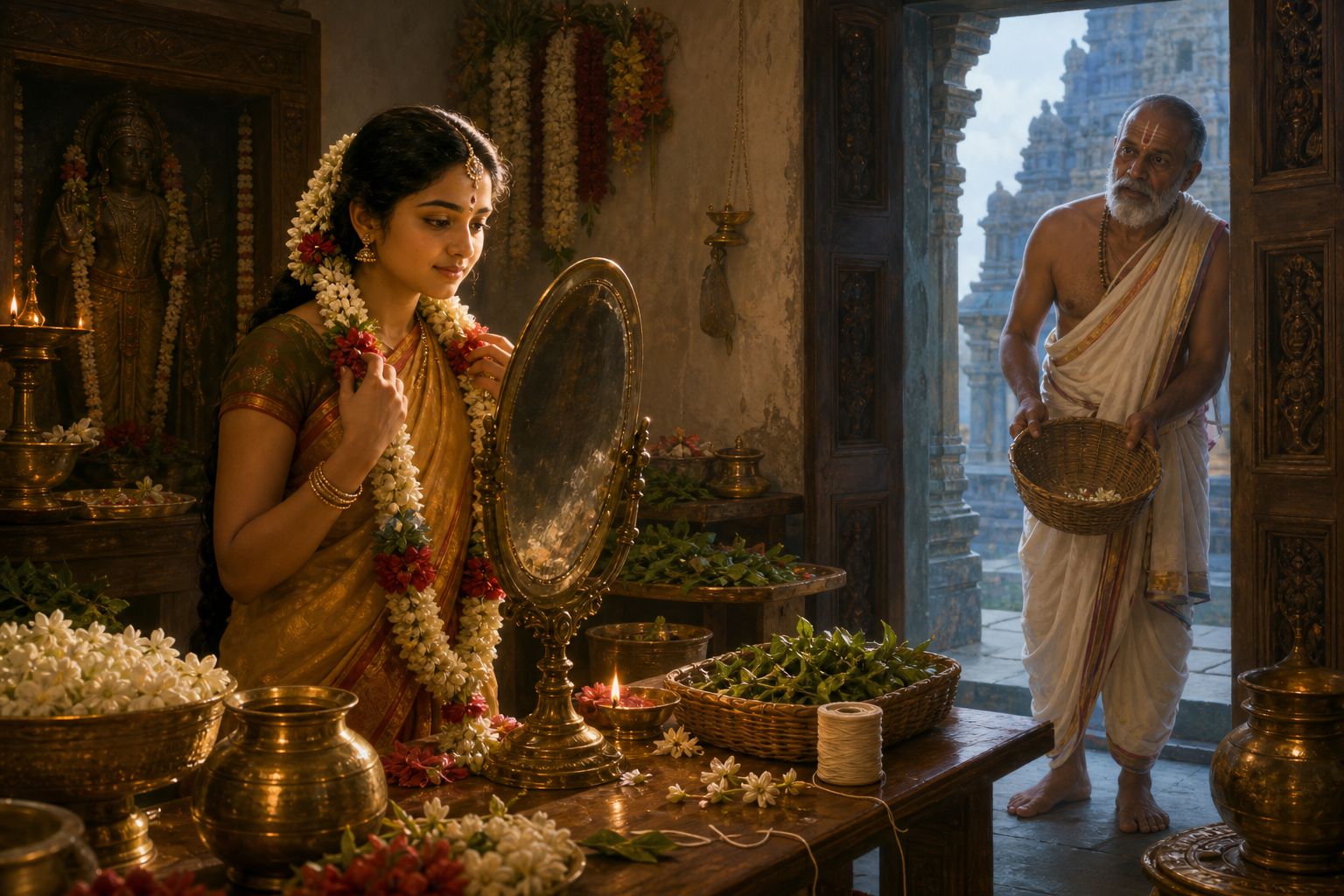
Traditional accounts place Andal, also known as Goda, in eighth-century Srivilliputhur. She is remembered as the only woman among the twelve Azhwars, the Tamil poet-saints devoted to Vishnu. Her adoptive father, Periyalvar, prepared flower garlands each day for the Lord. Before those garlands reached the deity, Andal secretly put them on herself.
Periyalvar’s objection, when he discovered what she had done, was not petty. An object set apart for worship was expected to reach the deity in the prescribed condition. A garland already worn by another person appeared to have been used. From the standpoint of ordinary ritual procedure, it was no longer the untouched offering he believed he had prepared.
The order of events matters. Andal did not publicly declare that her feelings placed her above temple discipline. Periyalvar did not decide on his own that every rule could be suspended in the name of emotion. The hagiographic tradition describes Vishnu revealing through a dream and temple sign that he preferred the garland bearing Andal’s touch. Divine acceptance transformed the apparent breach into a privileged offering.
That sequence gives you the first guardrail for understanding the story. It is neither a manifesto against ritual nor a warning against personal intimacy with God. The customary rule establishes the seriousness of the offering; Vishnu’s response discloses what Andal’s particular act truly contained.
The garland represents the devotee, not just the devotee’s gift
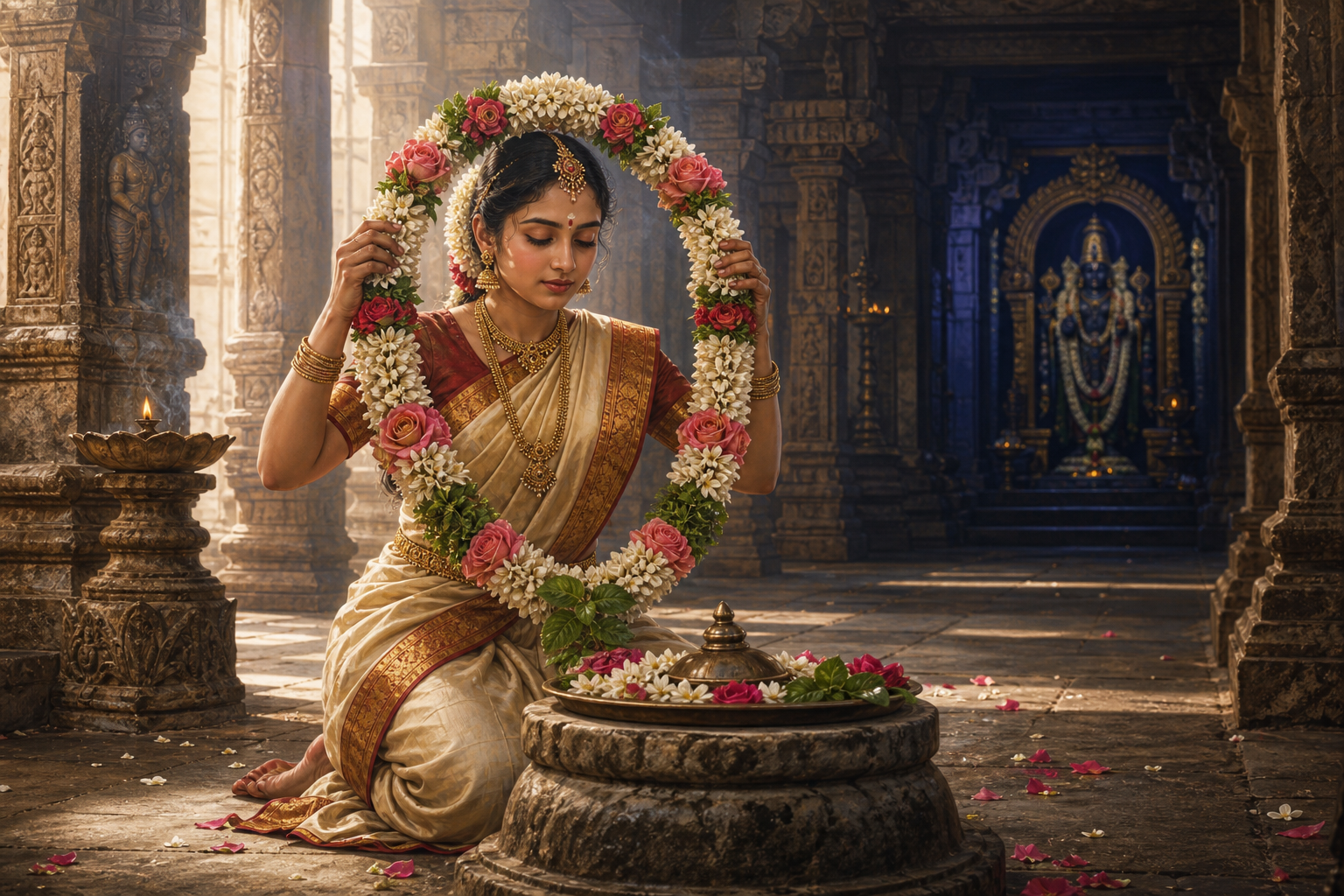
A garland is already a meaningful offering. Separate flowers are gathered, ordered, and joined into one form. Their fragrance is temporary, so the act cannot be hoarded for later. The devotee must prepare the mala and release it. Once it encircles the deity, its beauty no longer belongs to the hands that made it.
Andal intensifies that symbolism. Her garland does not carry flowers alone. It carries contact with the person who longs for Vishnu. In Vaishnava theological language, the act expresses atma-nivedana, the offering of the self. She does not merely send something beautiful toward the Lord; she places herself within the meaning of the gift.
This is why the episode should not be reduced to the claim that intention matters more than material form. Periyalvar’s careful gathering and preparation still matter. The blooms are not neglected, the garland is not carelessly assembled, and devotion is not used to excuse indifference. Love completes the discipline already present in the offering. It does not make discipline unnecessary.
You can test your own offering with four concrete questions:
- Have I given this act enough attention to make it worthy of worship, or am I offering whatever required the least effort?
- Am I using outward correctness to avoid inward honesty?
- What part of myself – time, pride, longing, gratitude, or resistance – accompanies the visible gift?
- Will this practice make me more humble before the Divine, or more interested in being seen as an exceptional devotee?
The questions belong together. Care without surrender can become mechanical. Intensity without discipline can become self-display. Andal’s garland holds care and surrender in one circular form.
Bhakti fulfils ritual order rather than casually discarding it
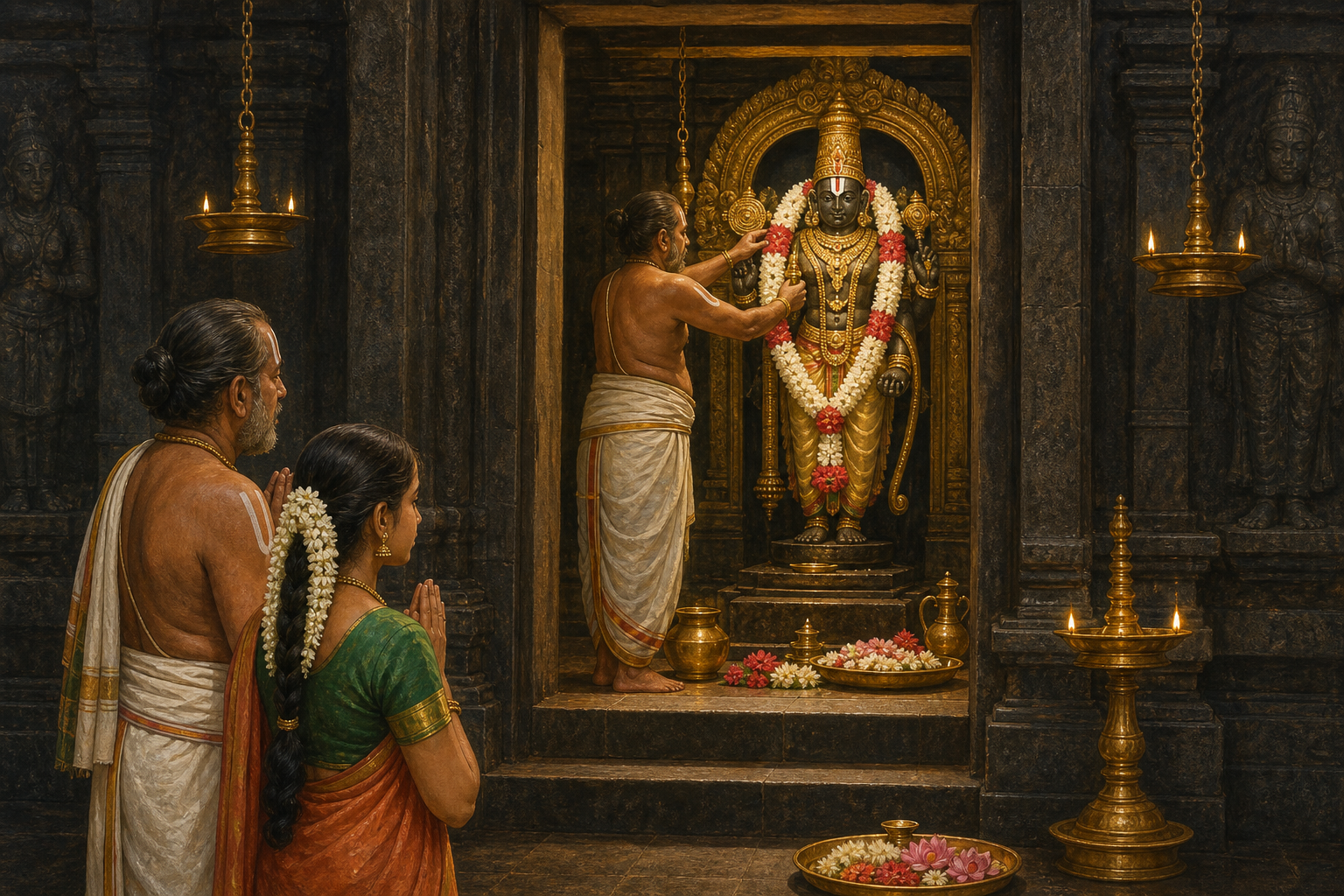
The most useful distinction in this story is between an exception revealed within a sacred relationship and a personal decision to ignore a community’s practice. Andal’s action receives its meaning from Vishnu’s acceptance in the traditional narrative. Copying the physical gesture without that context does not reproduce her devotion.
For that reason, you should not wear a garland intended for a temple deity and then defend the act by invoking Andal. Follow the customs of the temple, household, or sampradaya in which you worship. If you do not know whether a particular offering is appropriate, ask the priest or the person responsible for that worship. The lesson to imitate is total self-offering, not the outward form of an exceptional event.
This also protects the story from two opposite misreadings. A purely rebellious reading turns Andal into someone who proved that rules are meaningless. A purely legalistic reading treats her love as a problem that had to be excused. The deeper reading preserves both truths: ritual boundaries give an offering shape, while the Divine remains the final recipient and interpreter of devotion.
Andal’s place as the female voice among the Azhwars matters here. She is not remembered merely as the object of someone else’s religious teaching. Her embodied act and her poetry communicate theology. The Thiruppavai and Nacciyar Tirumozhi give language to longing, separation, surrender, and union; the garland gives those themes a visible form. When teaching her story, therefore, do not stop at the charming image of a young devotee trying on flowers. Treat her as a spiritual authority whose life and words interpret one another.
Her identity in the Srivilliputhur tradition also resists a simple label. Andal is venerated as an exemplary devotee and as the divine consort of Vishnu in the form of Ranganatha. The movement from lover of God to union with God is not incidental to the garland episode. It is the horizon toward which the gesture points.
How to carry Andal’s garland devotion into your worship
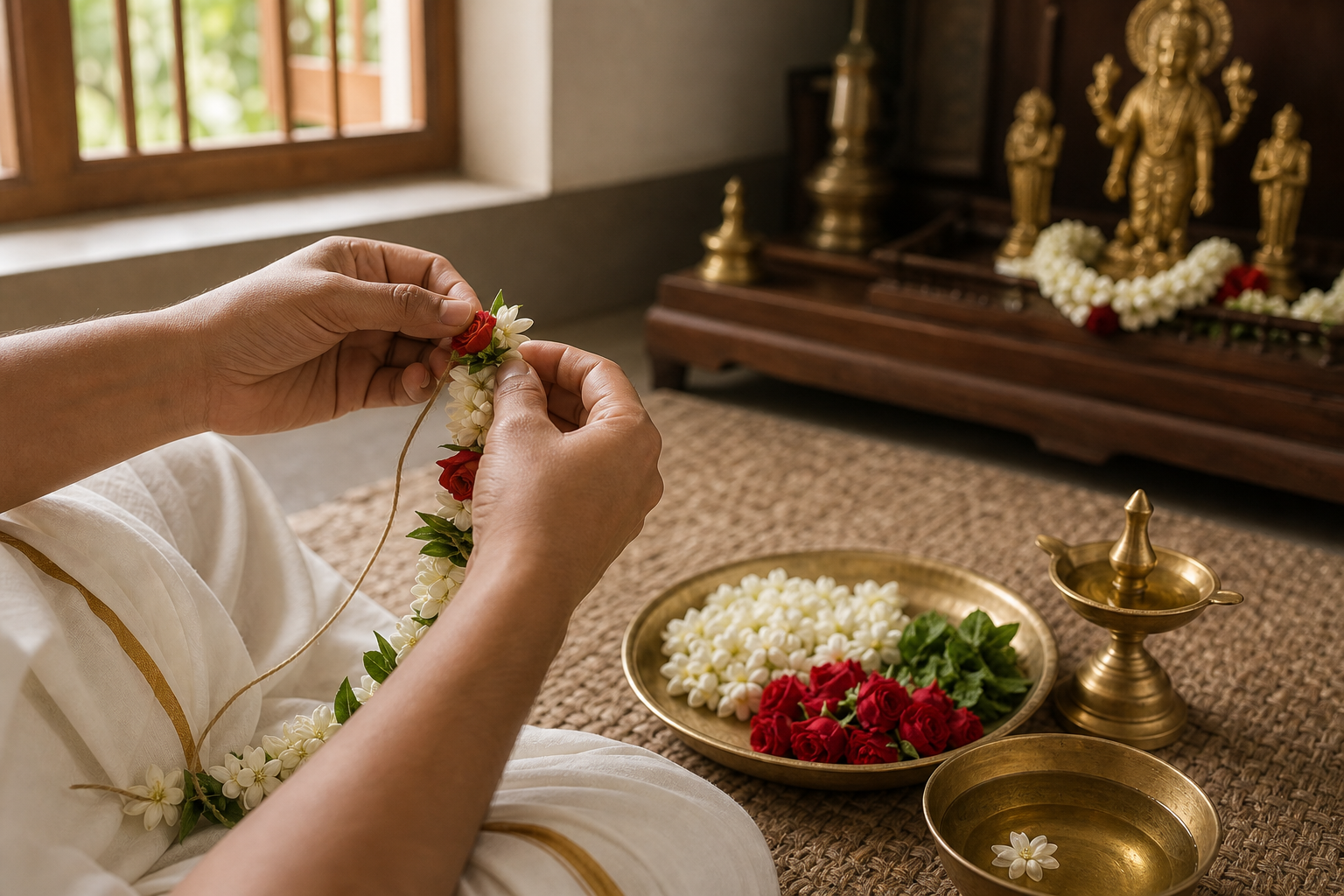
You do not need to reenact Andal’s action to practise its meaning. A better approach is to let the garland become a discipline of alignment: the visible offering, the inward intention, and the conduct that follows worship should belong to the same act.
- Choose one offering you can make attentively. It may be a garland, a few flowers, tulasi where appropriate, or a period of recitation. Choose something small enough that you can prepare it without haste.
- Prepare it as service, not decoration alone. Notice the temptation to hurry, impress, or use extravagance as a substitute for attention. Andal’s meaning lies in the self carried by the offering, not in its price.
- Name the inward offering before you begin. Decide what you are placing before Vishnu with the flowers: a fear you keep defending, gratitude you have not expressed, a duty you have postponed, or pride you are ready to surrender. Keep the intention exact rather than vaguely asking to become more spiritual.
- Let Andal’s poetry supply the devotional language. During Margazhi, when communities recite the Thiruppavai, join that shared rhythm if it is available to you. At other times, read the Thiruppavai or Nacciyar Tirumozhi slowly enough to notice how longing becomes prayer rather than private emotion. If Tamil is not a language you understand, use a trustworthy translation while retaining the names and devotional setting of the poems.
- Complete the offering after worship. Perform one act consistent with the intention you named. If you offered impatience, listen without interrupting. If you offered gratitude, express it directly. If you offered attachment to convenience, complete an unglamorous act of service. This is where inward fragrance becomes conduct.
The last step is essential. Andal’s devotion is relational, not merely emotional. The garland joins maker and recipient, poetry and ritual, private longing and communal memory. If worship repeatedly leaves your treatment of other people untouched, the answer is not necessarily a larger offering. Begin with a smaller promise that you will actually carry beyond the shrine.
You can also use the circular shape of the mala as a simple examination at the end of worship. Ask whether your action has returned you to the Divine with greater truthfulness. If preparation, prayer, and conduct remain disconnected, bring them together on the next occasion. That repeated return is more faithful to Andal’s symbolism than a dramatic imitation of her gesture.
Key takeaways
- Andal’s worn garland becomes sacred through Vishnu’s acceptance in the traditional account; the episode is not general permission to disregard ritual customs.
- The garland embodies atma-nivedana: the devotee offers attention, longing, and self along with the visible gift.
- Inner sincerity does not excuse careless preparation. Andal’s bhakti brings disciplined ritual to fulfilment by filling it with personal surrender.
- Her poetry matters as much as the remembered gesture. The Thiruppavai and Nacciyar Tirumozhi reveal the devotional world to which the garland belongs.
- You can practise the meaning safely by respecting established customs, naming an inward offering, and completing one corresponding act after worship.
The next time you place even a single flower before the Divine, pause before your hand withdraws. Decide what part of you travels with it, then let one action during the day prove that the offering was real. That is where Andal’s garland can begin to encircle your own life.
References
