

If a sacred Swastika at your home, temple, festival, classroom, or workplace is mistaken for Nazi imagery, you need more than a declaration that people are wrong. You need accurate terminology, enough context to establish what the symbol means, and a proportionate way to correct the decision.
Canada’s 2025 clarification associated with Bill C-9 gives that conversation a firmer foundation. It distinguishes an ancient Dharmic symbol of auspiciousness from the Nazi Hakenkreuz without asking Canadians to weaken their rejection of antisemitism, genocide, or political hatred. Here is how to use that distinction carefully and effectively.
Begin with the correct name, history, and purpose

The sacred Swastika belongs to an ancient religious and cultural history. In Hinduism, Buddhism, and Jainism, it is associated with well-being, auspiciousness, good fortune, and the cyclical harmony of life. It appears in worship, festivals, household art, temples, and other settings where its function is affirmative and sacred.
Its relationship to Sikh communities should be described with care. The symbol can appear in broader South Asian artistic, family, or institutional contexts associated with Sikhs, but that does not make it a defining emblem of Sikh doctrine. Precision protects Sikh identity as much as it protects the symbol’s Hindu, Buddhist, and Jain meanings.
The Nazi Hakenkreuz, or hooked cross, is a twentieth-century political emblem appropriated and weaponized by the Third Reich. Its historical identity is inseparable from Nazi ideology, persecution, and genocide. Calling that emblem the Nazi Hakenkreuz names the political movement responsible for turning it into an instrument of hatred.
| Question | Sacred Swastika | Nazi Hakenkreuz |
|---|---|---|
| What is its historical identity? | An ancient religious and cultural symbol | A twentieth-century Nazi political emblem |
| What does it communicate? | Auspiciousness, well-being, good fortune, and harmony | Nazi ideology, persecution, hatred, and genocide |
| Where might you encounter it? | Rituals, festivals, temples, homes, and Dharmic art | Nazi propaganda, ideological displays, intimidation, or glorification of the Third Reich |
| What is the proper response? | Recognize and protect legitimate religious or cultural expression | Apply anti-hate rules with full attention to context, intent, and applicable law |
Do not reduce this inquiry to a quick visual rule about direction, rotation, or one colour. A person making a cultural or disciplinary decision should examine the full setting: who placed the symbol, what purpose they stated, which tradition is involved, what words or images surround it, and how it is being used. Context is not an excuse added after classification. It is part of classification.
What the Canadian clarification changes – and what it does not

The Canadian development matters because a vague category such as “swastika imagery” can capture two radically different uses. The clarification connected with Bill C-9 in 2025 was framed around a more exact division: the sacred Swastika should be recognized as cultural and religious expression, while the Nazi Hakenkreuz remains an emblem of hatred subject to firm opposition and appropriate sanction.
That distinction should change how schools, employers, museums, newsrooms, law-enforcement personnel, and public bodies describe what they see. A temple decoration should not be labelled Nazi imagery merely because the decision-maker lacks Dharmic literacy. Conversely, an extremist display should not acquire protection merely because its owner gives it a sacred name after being challenged.
The practical rule is simple: identify the object by its actual history and use, not by the broadest name someone can attach to its outline.
The development was discussed in connection with Bill C-9 in 2025. Do not convert that fact into a blanket claim that every display is automatically lawful, that the same rules apply in every setting, or that a policy dispute has already been decided in your favour. Religious freedom, workplace conduct, school policy, hate-speech rules, and criminal law can raise different questions.
If you face suspension, dismissal, denial of access, a police complaint, or another formal consequence, ask for the exact rule being applied and confirm the operative legal status of the relevant provision. Preserve the correspondence and obtain advice from qualified Canadian counsel or an appropriate civil-liberties organization. A cultural explanation can correct a misunderstanding, but it is not a substitute for legal advice in an active case.
How to correct a misidentification without escalating it
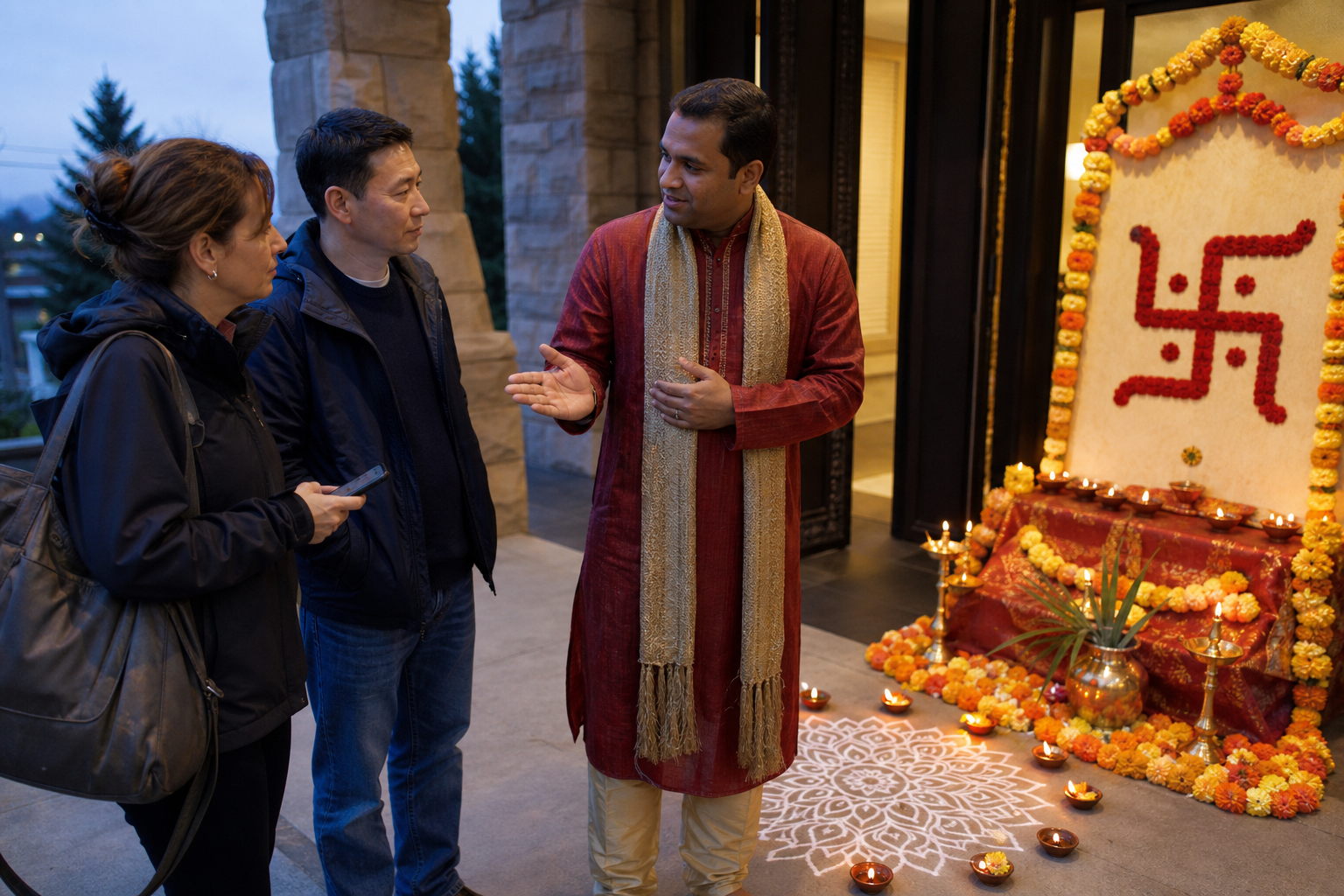
When someone reacts to the symbol, begin by correcting the classification rather than arguing about whether the reaction is emotionally justified. Jewish families and others affected by Nazi persecution have sound historical reasons to be alert to Nazi imagery. Acknowledging that history does not require a Hindu, Buddhist, or Jain family to surrender its own inheritance.
- Name both symbols. Say “sacred Swastika” for the Dharmic symbol and “Nazi Hakenkreuz” for the Third Reich emblem. Avoid using “swastika” as an automatic name for every Nazi display.
- State the immediate context. Identify the temple, ceremony, festival, lesson, household practice, or work of art in which the symbol appears. Do not rely only on a broad claim that it is ancient.
- Explain the intended meaning. Use plain language: auspiciousness, well-being, prosperity, or harmony. Name the relevant tradition rather than speaking vaguely about “Eastern culture.”
- Show the full setting. If a cropped photograph caused the dispute, provide an uncropped image showing the altar, doorway, ritual materials, accompanying text, or event display. The surrounding evidence often answers the classification question more clearly than a debate about geometry.
- Ask for the decision in writing. Request the policy provision, the name used for the symbol, and the reasons the religious context was accepted or rejected. This creates a record and exposes whether the decision was based on evidence or assumption.
- Request a specific remedy. Depending on the situation, ask for a corrected label, restoration of a display, withdrawal of a warning, an accurate classroom explanation, or staff training that distinguishes the two symbols.
A concise first message could read: “This is a sacred Swastika used in a Hindu, Buddhist, or Jain context to signify auspiciousness and well-being. It is not a Nazi Hakenkreuz. Please review the full setting, correct the classification, and identify the policy provision you believe applies.” Replace the list of traditions with the one that actually applies to you.
Keep the first exchange factual. Public accusations and social-media campaigns can harden a correctable misunderstanding before the institution has examined the evidence. If the institution refuses to review the context, imposes a serious penalty, or treats your religious identity as evidence of misconduct, move from informal explanation to a documented complaint and appropriate professional advice.
A fair institutional test separates identity from conduct
Administrators often make the mistake of jumping directly from visual resemblance to punishment. A fair process has two stages. First, classify the symbol in its complete context. Second, assess the conduct surrounding it. Keeping those stages separate protects Dharmic expression without creating a loophole for intimidation.
If you are writing a school rule, workplace policy, museum label, or event guideline, require the decision-maker to answer these questions:
- Is a religious, cultural, educational, or political purpose stated?
- Does the location and surrounding material support that stated purpose?
- Is the symbol part of a Hindu, Buddhist, Jain, or broader South Asian cultural setting?
- Is it being used to praise Nazi ideology, target a person, threaten a community, or glorify the Third Reich?
- Has someone knowledgeable about the relevant Dharmic tradition been consulted before a final classification?
- Could an accurate label or short explanation prevent confusion without suppressing legitimate religious practice?
The resulting policy should name the Nazi Hakenkreuz when Nazi imagery is the intended target. It should also state that the sacred Swastika must be assessed within its religious and cultural context. Broad wording may appear easier to enforce, but it transfers the cost of institutional ignorance to the minority family, student, employee, or temple that is misidentified.
Education works best when neither history is erased. Students can learn that the Swastika existed as a sacred symbol long before the Third Reich, that the Nazis appropriated a related form for a murderous political project, and that contemporary context determines which history a particular display invokes. Museums and newsrooms should apply the same discipline in captions and headlines.
There are also two unhelpful responses to avoid. Telling a Dharmic person to hide the Swastika treats Nazi appropriation as if it permanently confiscated an ancient heritage. Telling a Jewish observer simply to “get over” the resemblance disregards the living memory of genocide. Accurate naming offers a better path because it protects the truth on both sides.
Key takeaways for your next conversation
- Call the sacred symbol the Swastika and the Nazi emblem the Nazi Hakenkreuz.
- Establish meaning through tradition, purpose, setting, surrounding material, and conduct – not through one visual shortcut.
- Explain the sacred Swastika positively as a sign of auspiciousness, well-being, good fortune, and harmony.
- Do not minimize Nazi crimes or antisemitism when defending Dharmic cultural and religious expression.
- When an institution acts against you, request its classification, reasons, and applicable policy in writing.
- For serious legal or employment consequences, preserve evidence and obtain qualified Canadian advice rather than assuming a policy clarification settles the case.
The next time this issue arises, bring three things to the conversation: the correct name, an uncropped view of the context, and a one-paragraph explanation of the symbol’s meaning in the relevant tradition. That small discipline turns a dispute over resemblance into an evidence-based decision. We can defend the sacred Swastika and reject the Nazi Hakenkreuz without qualification; precision is what makes both commitments credible.
References
