

You have probably encountered the claim that scholars in Kerala discovered calculus roughly two centuries before Newton. Before you repeat it in a classroom, family discussion, or public argument, you need to know which part is well supported and which part remains open. The careless version is easy to dismiss. The precise version is much harder to ignore.
The secure core is substantial: Madhava and the mathematical lineage that followed him developed infinite-series results for arctangent, pi, sine, and cosine from the 14th century onward, before related methods became prominent in 17th-century Europe. What has not been established is a documentary chain carrying those methods from Kerala to Newton, Leibniz, or another European mathematician. Historical priority and historical transmission are different questions.
The claim you can defend without exaggeration
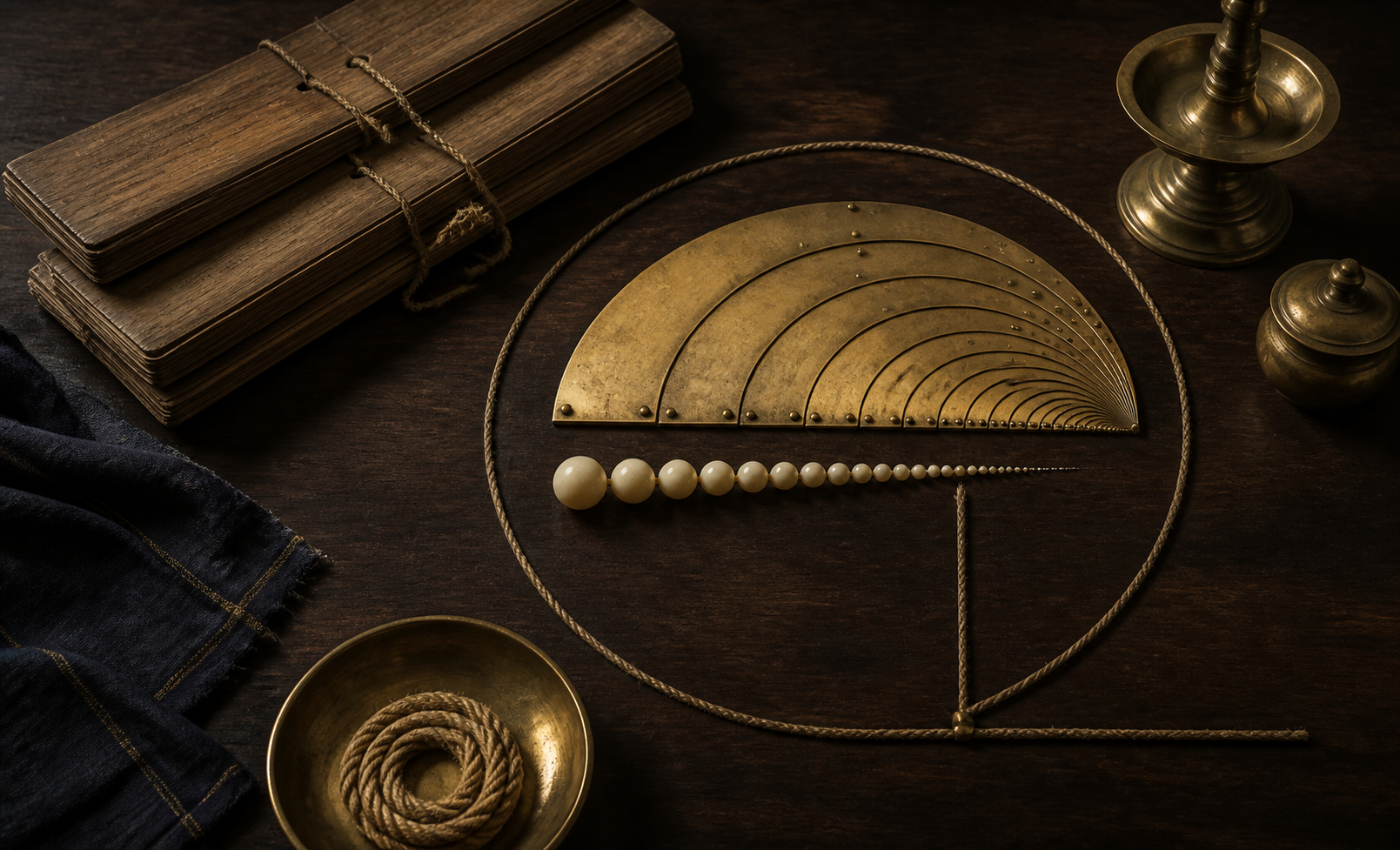
Start by asking what the word calculus is doing in the claim. In a modern textbook, calculus is a broad, organized discipline involving limits, derivatives, integrals, infinite series, and relationships among them. The strongest evidence from Kerala concerns sophisticated infinite-series mathematics, trigonometric functions, numerical computation, and mathematical astronomy. These are central parts of the history of calculus, but calling them the complete modern subject in its present form asks the historical evidence to prove more than it needs to prove.
An infinite series represents a value or function through a continuing sequence of terms. Madhava’s arctangent expansion corresponds to the formula later associated with James Gregory. At a particular input, that expansion produces the alternating series for pi later associated with Leibniz. The Kerala tradition also obtained power-series expansions for sine and cosine that later became associated with Newton. Those European names are useful identifiers for a modern reader, but they should not be mistaken for evidence that the formulas first appeared in Europe.
The most defensible sentence is therefore this: The Kerala School developed sophisticated infinite-series expansions for trigonometric functions and pi between the 14th and 16th centuries, before comparable techniques became prominent in 17th-century Europe. That statement identifies the achievement, gives its period, and avoids turning a set of demonstrable results into a claim about every element of modern calculus.
If you use the shorter phrase “calculus before Newton,” immediately explain what you mean. Say that the priority concerns particular series and computational techniques. Do not retreat into the vague assertion that ancient India already knew everything. Civilizational confidence becomes credible when it can name the result, the period, and the people who transmitted it.
Madhava’s achievement belonged to a living lineage

A priority claim is stronger when a result is not an isolated anecdote. Madhava worked near present-day Irinjalakuda and became the starting point of a sustained guru-shishya lineage. Vattasseri Paramesvara, Nilakantha, Chitrabhanu, Narayana, Jyeshtadeva, and Achyuta continued and extended the tradition. Its later history reached Sankar Varman in the 1840s.
This continuity matters. It shows teachers, students, commentaries, astronomical observations, calculations, derivations, and corrections accumulating across generations. The Kerala School was not a single clever approximation for pi that appeared without context. It was a research tradition with inherited questions and methods.
Its members calculated lunar positions, observed eclipses, worked on spherical astronomy, and refined planetary models. Nilakantha’s Tantrasangraha revised the treatment of the interior planets inherited from Aryabhata. The combination of mathematical derivation and repeated astronomical calculation also challenges a misleading contrast sometimes imposed on Indian science: computation on one side and reasoning on the other. A computational tradition can contain rigorous arguments, especially when its purpose is to produce and check precise results.
You should also resist presenting Madhava as a genius detached from the earlier history of Bharat. Kerala scholars wrote commentaries on authorities such as Aryabhata and Bhaskara while producing their own innovations. Earlier traditions, including the geometry of the Sulvasutras before 500 BCE and the astronomy of Aryabhata in 499 CE, formed part of a much longer intellectual setting. Continuity does not cancel originality. It explains how originality became possible.
When you teach this history, name at least part of the lineage rather than mentioning Madhava alone. A list of successors changes what the listener notices. The subject is no longer an Indian claimant competing with a European celebrity; it is a durable community of inquiry whose work deserves to be studied on its own terms.
Why temples and practical astronomy mattered

Mathematics does not survive for centuries through inspiration alone. It needs teachers, time, material support, manuscripts, students, and recurring problems worth solving. In medieval Kerala, temple-centered communities helped provide that infrastructure. Temples supported priests, scholars, teachers, administrators, and residential students. They also created stable settings in which manuscripts could be copied and knowledge could pass from one generation to the next.
The practical demand was equally important. An agrarian society governed by monsoon rhythms needed dependable calendars. Ritual life and astrology required the calculation of celestial positions and appropriate times. Eclipse prediction, lunar computation, and planetary astronomy were therefore not detached intellectual games. They answered questions that institutions and communities repeatedly asked. Repetition created an incentive to improve the method rather than merely preserve an inherited answer.
One historical explanation for Kerala’s concentration of scholarship also points to the social organization of Namboothiri communities. Only the eldest son typically entered a formal marriage alliance, while younger sons often formed sambandham relationships and could seek standing through learning and institutional service. This was one incentive within a larger social order, not a complete explanation for mathematical creativity.
Calling these temple networks “universities” can help if you mean that they supported teaching, residence, textual transmission, and specialized inquiry. It becomes misleading if you imagine the governance, credentials, departments, and public access of a modern university. Use the comparison to identify functions, not to erase historical differences.
The Dharmic significance also requires precision. The Kerala School’s immediate institutional setting was predominantly Hindu and temple-centered. Across the wider history of Bharat, Hindu, Buddhist, and Jain scholars participated in shared cultures of logic, astronomy, mathematics, debate, and commentary. Sikh commitments to learning and community service resonate with the responsibility to preserve that heritage. This does not mean that every Dharmic tradition jointly authored Madhava’s mathematics. It means the civilizational work of sustaining knowledge has crossed sectarian boundaries and can do so again.
Priority, transmission, and recognition are separate questions

Priority asks what was known, where, and when
The Kerala chronology supports a clear priority claim for particular infinite-series results. That claim rests on the mathematical content attributed to Madhava and developed within a named succession of later scholars. It does not depend on proving that anyone in Europe encountered the work.
This distinction is essential because independent discovery is common in the history of mathematics. If two traditions reach a related result at different times, the earlier tradition deserves recognition even when no contact between them can be shown. Priority tells you that the result existed. Transmission would tell you how it moved.
Transmission asks whether the knowledge reached Europe
A Jesuit route is possible because intellectual exchanges connected India, the Middle East, and Europe, and Jesuits were present in relevant networks. Yet surveys of Jesuit material have not produced conclusive evidence that a particular Kerala derivation reached a particular European mathematician.
Practical diffusion through the Indian Ocean is another possibility. Numerical techniques useful to pilots, navigators, cartographers, or surveyors could circulate without carrying the complete scholarly text that produced them. A recipient might then reconstruct a technique in another language and notation. This is a plausible mechanism, but plausibility is not documentation.
You should therefore reject two opposite mistakes. It is unwarranted to declare that Newton or Leibniz copied Kerala mathematics when no secure transmission chain has been demonstrated. It is equally unwarranted to deny Kerala’s earlier achievement merely because such a chain is missing. The first confuses possibility with proof; the second makes European awareness the condition of Indian accomplishment.
Recognition asks why the achievement remained marginal
European-centered histories often treated Indian science as derivative, stagnant, or chronologically suspect. Some 19th-century arguments even tried to derive Indian numerals from abbreviated Roman forms or to push Indian mathematicians into much later periods. Once such assumptions became embedded in institutions and curricula, evidence from India had to overcome a burden that familiar European narratives did not face.
Bias is only part of the explanation. Kerala mathematics is often preserved in dense metrical Sanskrit and Malayalam. Understanding it can require philology, knowledge of historical notation, familiarity with astronomy, and the ability to reconstruct a mathematical argument. A verse designed for memorization does not resemble a modern journal paper, even when it encodes a sophisticated method. Readers trained to recognize only Euclidean-style exposition can overlook reasoning presented through algorithms, commentary, examples, and computation.
Uncatalogued manuscripts in Kerala and Tamil Nadu create another obstacle. A result cannot enter a global history merely because it may be sitting in a collection. Manuscripts must be located, preserved, dated, edited, translated, mathematically interpreted, and placed in relation to other texts. Historical recognition is therefore a program of work, not a ceremonial correction to a timeline.
When you assess a strong claim online, look for four things in the discussion: a named mathematician, an approximate date, an exact mathematical result, and a distinction between textual evidence and a transmission hypothesis. If a claim jumps directly from a similar formula to an accusation of copying, it has skipped the hardest evidentiary step. If it says only that India had “advanced knowledge,” it has discarded the details that make the case persuasive.
Key takeaways for discussing Kerala calculus
- State the precise achievement: the Kerala School developed infinite-series expansions for arctangent, pi, sine, and cosine from the 14th century onward, before comparable methods became prominent in 17th-century Europe.
- Use later names such as the Gregory, Leibniz, and Newton series as modern identifiers, not as assumptions about who first discovered the formulas.
- Separate priority from transmission. Kerala’s earlier results can be recognized even though a route carrying them to European mathematicians has not been conclusively documented.
- Name the lineage after Madhava. Paramesvara, Nilakantha, Jyeshtadeva, and other successors show that this was a sustained school rather than an isolated insight.
- Explain the institutional setting. Temple support, manuscript transmission, astronomical observation, calendrical needs, and teacher-student succession helped make long-term inquiry possible.
- Frame the Dharmic significance as a responsibility to preserve and teach evidence, not as permission to turn an open historical question into a settled accusation.
If you are preparing a lesson, social-media thread, or public talk, make three additions before publishing it. Put the date range beside the result. Name at least two members of the lineage. Then state plainly that transmission to Europe remains unproved. Those qualifications do not weaken the achievement. They place it on ground firm enough to enter curricula, survive criticism, and become part of public memory.
The next step is practical: replace the slogan in your own notes with the precise claim, and insist on the same standard when you encounter either triumphalist exaggeration or reflexive dismissal. Kerala’s mathematicians do not need a myth built around them. They need their mathematics, institutions, and intellectual continuity to be read.
References
