
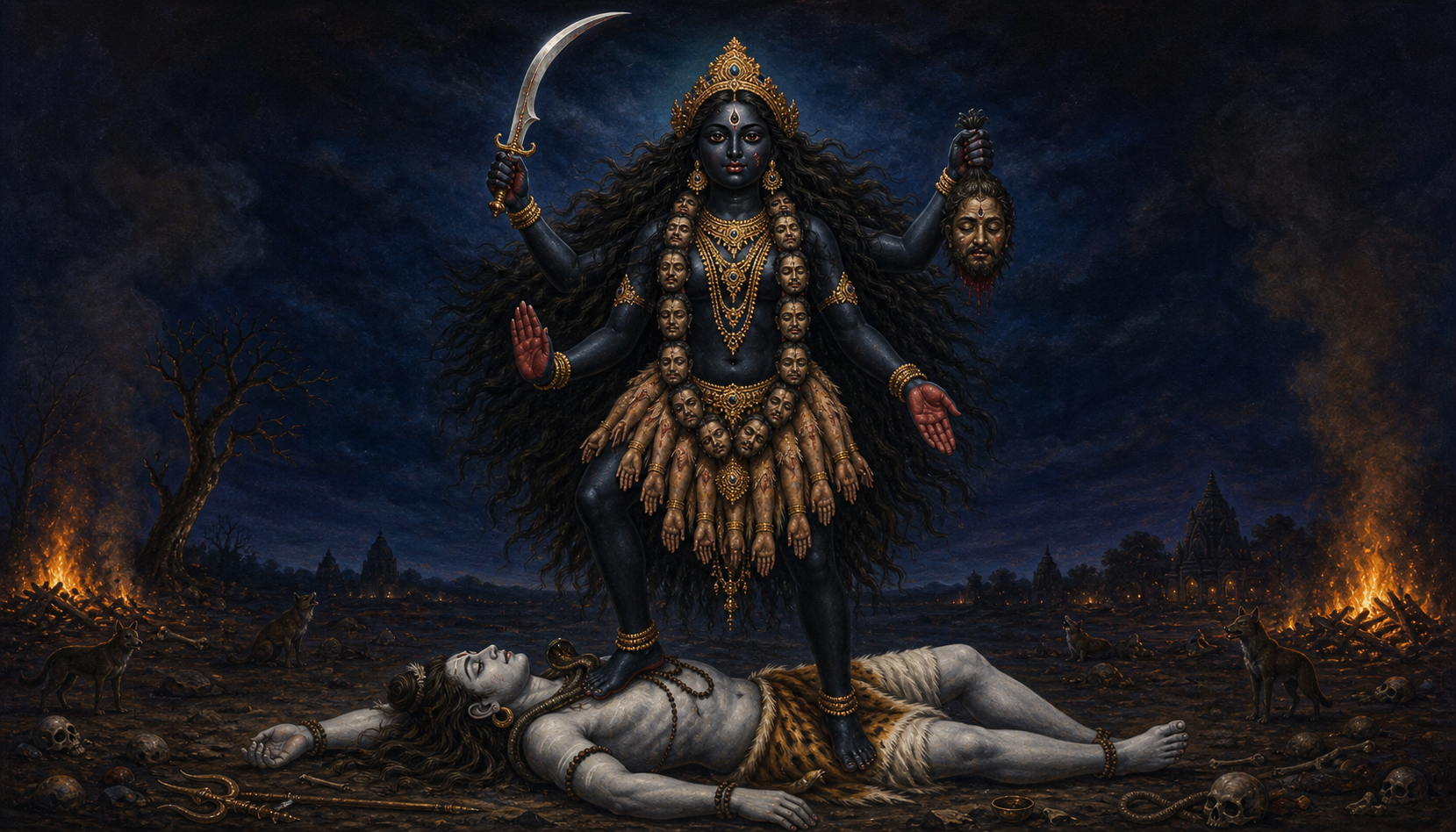
If Kali’s image unsettles you, don’t rush to make her harmless, and don’t stop at the shock. Her black form, streaming hair, skull garland and fierce presence work together as a spiritual diagnosis: much of our suffering begins when we treat passing roles, attachments and fears as the whole of who we are.
Her iconography becomes useful when you read it as a sequence of release. Blackness opens what the mind tries to contain. Unbound hair breaks false constraint. Skulls expose what time will take. Fierceness supplies the courage to act without hiding from those truths. The result isn’t escape from dharma. It is greater freedom to live it without being ruled by ahankara.
Begin with the bondage each symbol confronts
A literal glance asks why the Goddess looks frightening. An iconographic reading asks a more fruitful question: what kind of bondage is this frightening form attacking?
That change of question matters. Kali’s visual language isn’t a celebration of horror, disorder or destruction for its own sake. Each disturbing feature turns your attention toward something the ordinary ego avoids: the limits of identity, the certainty of change, the pressure to conform and the fear that appears when control fails.
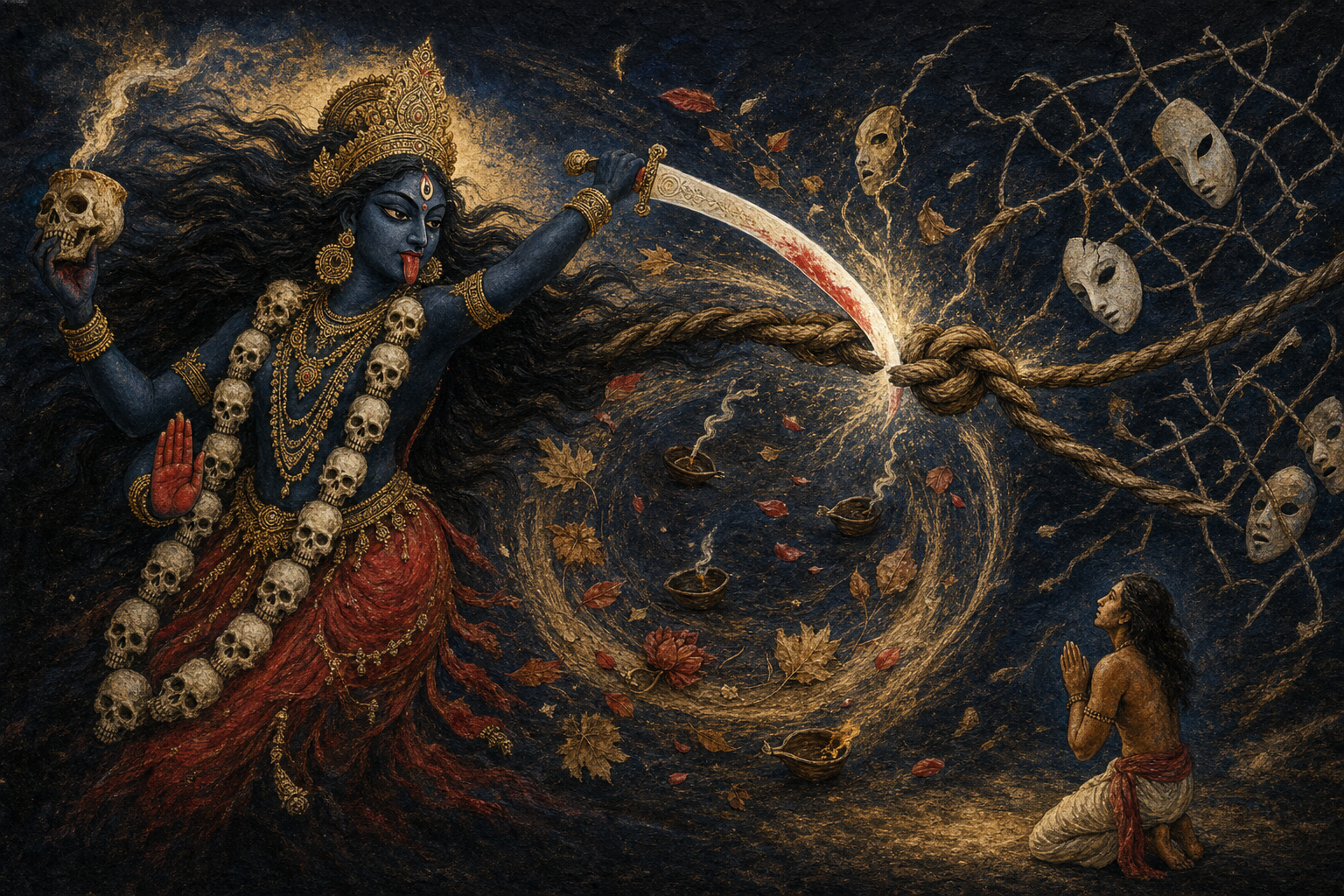
Liberation here doesn’t require you to discard your personality, relationships, vows or responsibilities. It requires you to stop treating any one of them as absolute. A role can be real without defining your entire being. A convention can be useful without becoming a prison. An ending can hurt without making life meaningless.
Key takeaways
- Kali’s blackness points beyond the names and forms by which the mind divides reality.
- Her unbound hair signifies freedom from false constraint, not permission to follow every impulse.
- Her skull garland and association with time expose the impermanence of identities defended by the ego.
- Her fierceness represents courage in the service of protection, transformation and restored balance.
- The image is liberating when contemplation produces clearer dharmic conduct, not fascination alone.
Sacred blackness loosens the rule of name and form
Within Kali’s symbolic grammar, black is understood as containing and absorbing all colors. It therefore signifies completeness rather than deficiency. Kali is not dark because the sacred light is absent. Her blackness points to a reality so unbounded that no single visible quality can contain it.
This symbolism can be read through more than one Hindu lens without pretending that the lenses are identical. In Advaita Vedānta, it evokes Brahman beyond name and form while remaining the ground of every name and form. In a Tantric reading, it evokes Shakti as the power from which manifestation arises and into which it is reabsorbed. One vocabulary emphasizes the unconditioned ground; the other emphasizes dynamic divine power. Kali’s form can hold both contemplative movements.
This corrects a common mistake. Sacred blackness isn’t simply darkness as ignorance. It can signify the unmanifest origin that the senses cannot measure and the conceptual mind cannot divide. Nor is it nihilism. The forms of life aren’t declared worthless; they are placed within a wholeness greater than any particular form.
You can make this insight concrete by noticing how quickly the mind labels what it sees. Beautiful, frightening, familiar, alien and powerful may arise almost at once. Let each label appear, then ask what remains when the label is no longer treated as the thing itself. Apply the same question to one identity you habitually defend: profession, status, success, failure, family position or public reputation. The identity may carry real duties, but it isn’t the full measure of your being.
The practical lesson is not to become vague about who you are. It is to hold identity with enough space that criticism, loss or change doesn’t dictate your conduct. Kali’s blackness trains that space.
Muktakeshi reveals freedom without irresponsibility
Muktakeshi means one with disheveled or unbound hair. Kali’s hair flows beyond the neat boundary expected of an arranged appearance. In Shakta and Tantric interpretation, that visual freedom signifies svātantrya, unconditioned autonomy, and the release of Shakti from constraining forms.
It would be easy to flatten this into a slogan about breaking rules. That misses the dharmic test. Some restraints protect life, fidelity, truth and responsibility. Others survive mainly because we fear disapproval or cling to a conditioned identity. Muktakeshi asks you to distinguish between them.
When a constraint troubles you, ask whether it serves dharma or merely preserves an appearance. Then examine the likely fruit of releasing it. If release makes you more truthful, discerning, compassionate and able to fulfil a real duty, the movement resembles spiritual freedom. If it excuses harm, broken trust or self-inflation, it is impulse wearing sacred language.
Kali’s unbound hair also unsettles the assumption that feminine compassion must always appear quiet, compliant or easily contained. Her power can protect, interrupt and transform. Yet she shouldn’t be reduced to a modern slogan about rebellion. The image reaches further: it affirms spiritual authority that neither depends on social approval nor abandons responsibility toward others. That lesson concerns every devotee, irrespective of gender.
Use Muktakeshi as a mirror when you feel pressure to perform an identity. Name the approval you fear losing. Name the dharmic obligation that would remain even if nobody praised you. The distance between those two answers often reveals whether you are facing discipline or mere conformity.
The skulls and fierce expression teach you how to face time
A skull is difficult to romanticize. It makes mortality visible and strips away the distinctions by which people usually rank themselves. Kali’s garland of skulls joins the dissolution of ego to the impermanence of phenomena. Her association with kāla, time, gives the image its relentless edge: no title, possession, grievance or self-description can bargain its way out of change.
The point isn’t to cultivate morbidity. It is to stop building your inner stability on what time is certain to alter. The skull garland asks which temporary identity you are treating as permanent. Once you see that attachment clearly, you can still honour the role or relationship without demanding that it guarantee your worth.
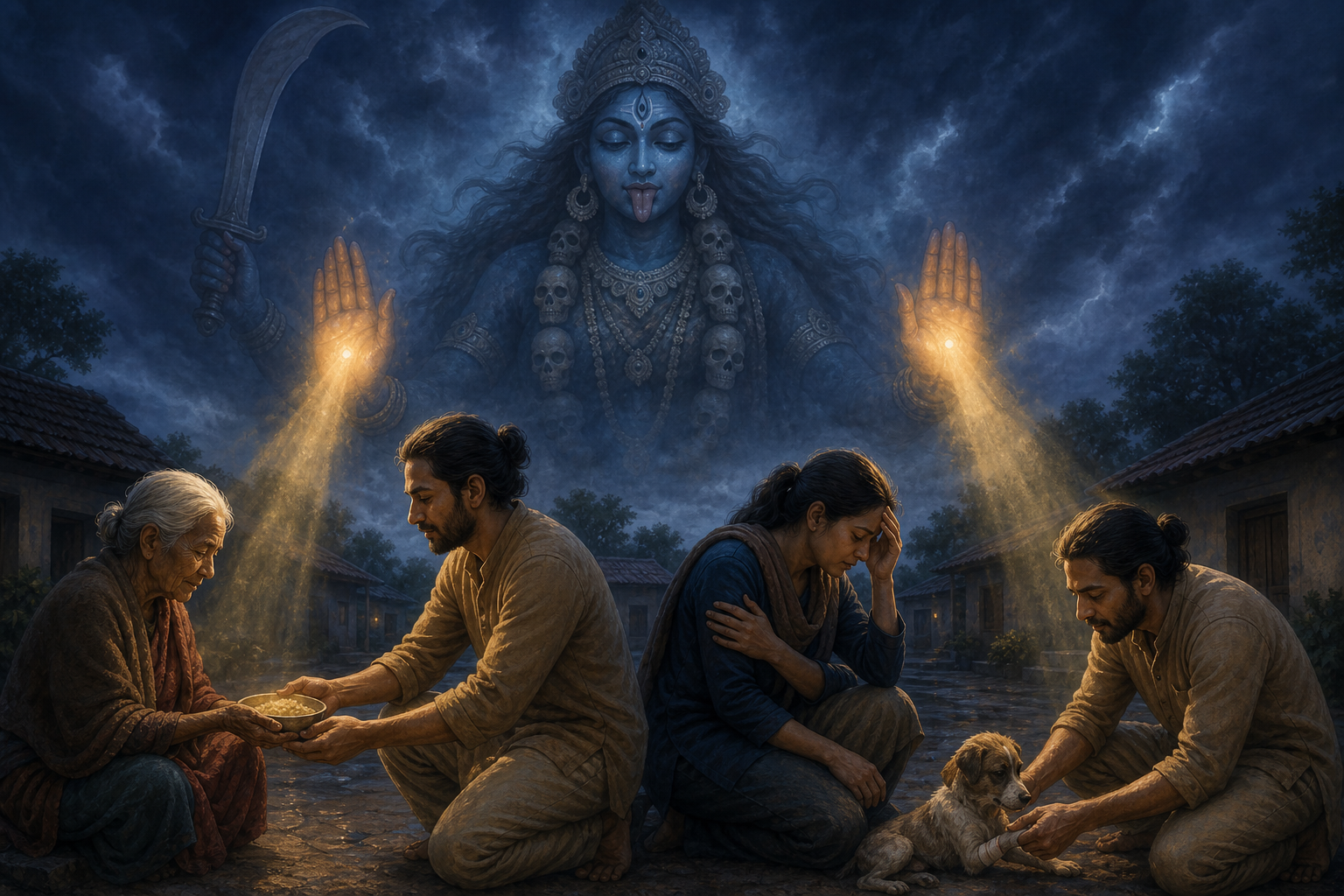
Kali’s fierceness supplies the courage this recognition requires. Compassion in her iconography isn’t reduced to softness. It includes the strength to confront ignorance, fear and attachment, and to destroy what prevents balance from being restored. Destruction is therefore subordinate to transformation; it is not a licence to sanctify rage.
That distinction is especially important when people invoke Kali to justify aggression. A person’s anger doesn’t become divine merely because it feels intense. Test the feeling by its fruit. Does it clarify a duty, reduce vanity and lead to proportionate action that protects what should be protected? Or does it enlarge humiliation, revenge and the need to dominate? Fierceness severed from discernment and compassion is ordinary aggression, not liberation.
When Kali’s severe imagery touches a live fear, ask three questions: What am I afraid will end? Which identity am I defending? What dharmic action would remain if I stopped protecting my image of myself? Don’t force a grand answer. A truthful apology, a necessary boundary, a relinquished resentment or the completion of a neglected duty may be the most serious response.
Turn the image into a disciplined contemplative practice
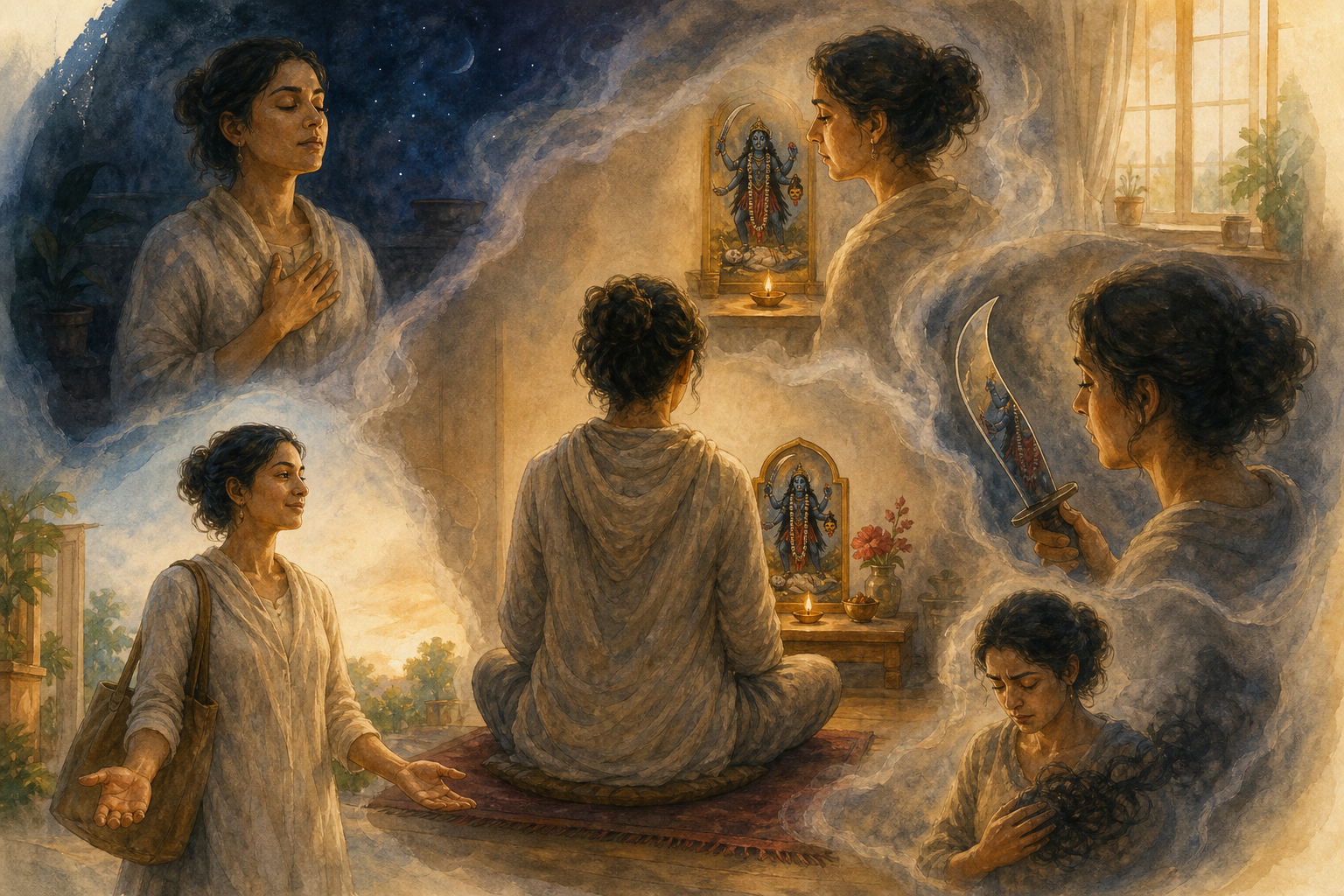
Iconography does its deepest work when it changes attention and conduct. You don’t need to decode every feature at once. A simple sequence keeps the practice grounded:
- State the purpose. Approach the image to see attachment more clearly, not to seek a dramatic mood or confirm a fantasy about power.
- Receive the whole form. Notice attraction, discomfort, resistance or calm before explaining any of it. Your first reaction shows where the image is already working.
- Move through the symbols. Let blackness question rigid identity, unbound hair expose false constraint, the skulls disclose impermanence and fierceness ask what courage dharma now requires.
- Choose one attachment. Keep the inquiry specific. Work with the approval, role, fear or grievance that is actually shaping your next decision.
- Close with conduct. Translate contemplation into one proportionate act of truthfulness, restraint, compassion, protection or relinquishment. Without this step, the encounter can remain an aesthetic experience.
If mantra is already part of your practice, Om Krim Kalikayai Namah is used to gather attention, steady the breath and cultivate resilience. Follow the pronunciation and discipline received from your tradition or teacher. If mantra isn’t part of your practice, silent contemplation, svādhyāya and ethical action are sufficient ways to engage the symbolism. Neither approach should be treated as a magical method for making grief, fear or responsibility disappear.
Keep wider Dharmic parallels precise
Kali remains a distinctly Hindu and Shakta form. Recognizing related Dharmic concerns doesn’t make every tradition interchangeable. Buddhist wrathful forms can express compassionate protection; Jain aparigraha trains release from possession and attachment; Sikh reverence for kesh honours hair as sacred, while remembrance directs the person beyond ahankār. These are parallel movements toward courage, restraint and freedom from limiting identity, not evidence that their doctrines or practices are the same.
That precision lets you appreciate a shared Dharmic civilizational intuition without erasing difference: freedom grows as the narrow self loosens its grip, and genuine freedom becomes visible as responsible, compassionate action.
At your next encounter with Kali, choose one symbol rather than trying to master the entire image. Ask what attachment it exposes, then complete one dharmic action in response. Her iconography becomes liberating when fear may still be present but no longer governs what you do.
References
- DharmaRenaissance Blog — The Sacred Black of Goddess Kali: Profound Symbolism, Unity, and Inner Awakening
- DharmaRenaissance Blog — MuktakeshiKali’s Disheveled Hair: A Fearless Symbol of Liberation, Compassion, and Power
