
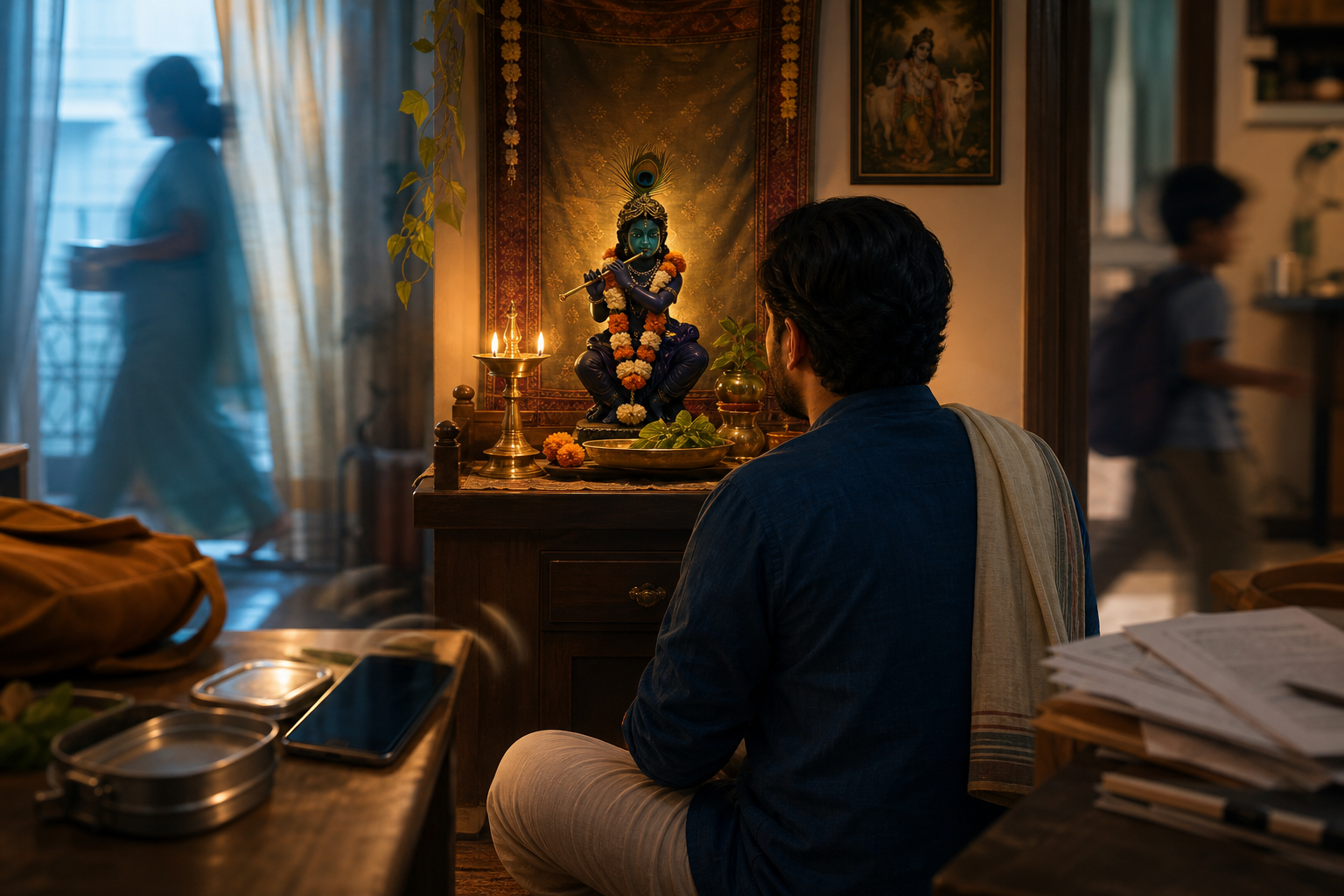
Some days you remember Krishna easily. On other days, you sit for japa and discover that your attention has wandered before you have really heard the Divine Name. You may feel close to Bhagavan in a temple or during parikrama, then lose that thread amid work, family duties, a commute, or an argument.
The name Achyuta offers a precise answer to this instability. Krishna’s constancy does not depend on your ability to maintain a perfect devotional mood. He is unfallen; your discipline is to return. Once you understand that distinction, remembrance stops being a test you either pass or fail. It becomes a dependable way of reorienting attention, judgment, and conduct.
What Achyuta changes about remembrance
Achyuta means the unfallen or imperishable. The Sanskrit prefix a- negates chyuta, fallen, displaced, or deviated. In Vaishnava understanding, the name identifies Vishnu and Sri Krishna as beyond decay, error, and deviation from dharma. When the Supreme appears as an avatar, divine nearness does not amount to a fall from transcendence.
This matters because devotees often reverse the relationship. We imagine that Bhagavan is present when our concentration is strong and absent when it is weak. Achyuta corrects that assumption. Constancy belongs first to Bhagavan. The steadiness of the devotee is a response to that constancy, not the condition that produces it.
Bhagavad Gita 1.21 places the name at a moment of division rather than serenity. Arjuna addresses Krishna as Achyuta while asking Him to position the chariot between the two armies. The conflict does not disappear when the name is spoken. Arjuna is brought to the place from which he must see the conflict clearly. The invocation establishes whom he trusts while confronting a duty he does not yet understand.
You can use the name in the same disciplined way. When you face a divided duty, invoke Achyuta and then identify the fact you would prefer not to examine. Do not use remembrance to escape discernment or rush toward the outcome you already want. Let the name steady you enough to look at the situation without surrendering either principle or compassion.
Achyuta is not a promise that every request will be answered in your preferred form. Nor does it mean that devotion removes every uncertainty. It means that the center toward which you turn is not subject to your changing mood, social pressure, or fear. A useful sentence before japa is simple: your mind may move, but Achyuta does not.
You may encounter both Acyuta and Achyuta in transliteration. They represent the same Sanskrit name. Follow the pronunciation and textual convention taught in your lineage, and listen carefully to the sound you are making. Precision supports attention, but anxiety over English spelling should not become another reason to postpone remembrance.
Continuity is built through return, not forced concentration
An uninterrupted devotional mood is an inspiring ideal, but it is usually an unhelpful daily scorecard. If your only acceptable result is a mind that never wanders, every noticed distraction appears to prove failure. Yet noticing the distraction is precisely the moment when remembrance becomes an intentional act again.
A striking teaching associated with the Srimad-Bhagavatam presses the power of absorption to its limit: even opponents of Krishna, through continuous preoccupation with Him, approached the Supreme Truth sought by disciplined yogic seers. This does not commend hostility as bhakti. It shows how thoroughly repeated attention can organize consciousness around its object.
A devotee should therefore learn from the intensity without imitating the antagonism. Vaishnava remembrance is more than fixation. Its object is Krishna, its proper disposition is reverent and affectionate, and its fruit should appear in dharmic conduct. Attention matters, but the quality of the relationship also matters.
When you notice that your mind has left the mantra, do not conduct a trial inside your head. Name the distraction briefly, return to the next repetition, and hear that repetition as it is spoken. Do not replay the neglected part of the round or wait for the earlier feeling to return. The next audible name is the point of re-entry.
This gives you a more useful way to notice progress. Ask whether you are returning more honestly, whether ordinary transitions are beginning to prompt remembrance, and whether remembrance interrupts an adharmic reaction before it hardens into speech or action. A peaceful sensation can accompany practice, but it is not the only evidence that practice is doing its work.
Build a practice that can survive an ordinary day
A sustainable discipline needs one settled practice and several small points of retrieval. The settled practice gives remembrance depth; the retrieval points prevent it from being confined to a shrine or meditation seat.
- Begin with one intention. Before japa, decide that your task is to hear and return, not to manufacture a particular emotion. This keeps a dry sitting from becoming a dishonest one.
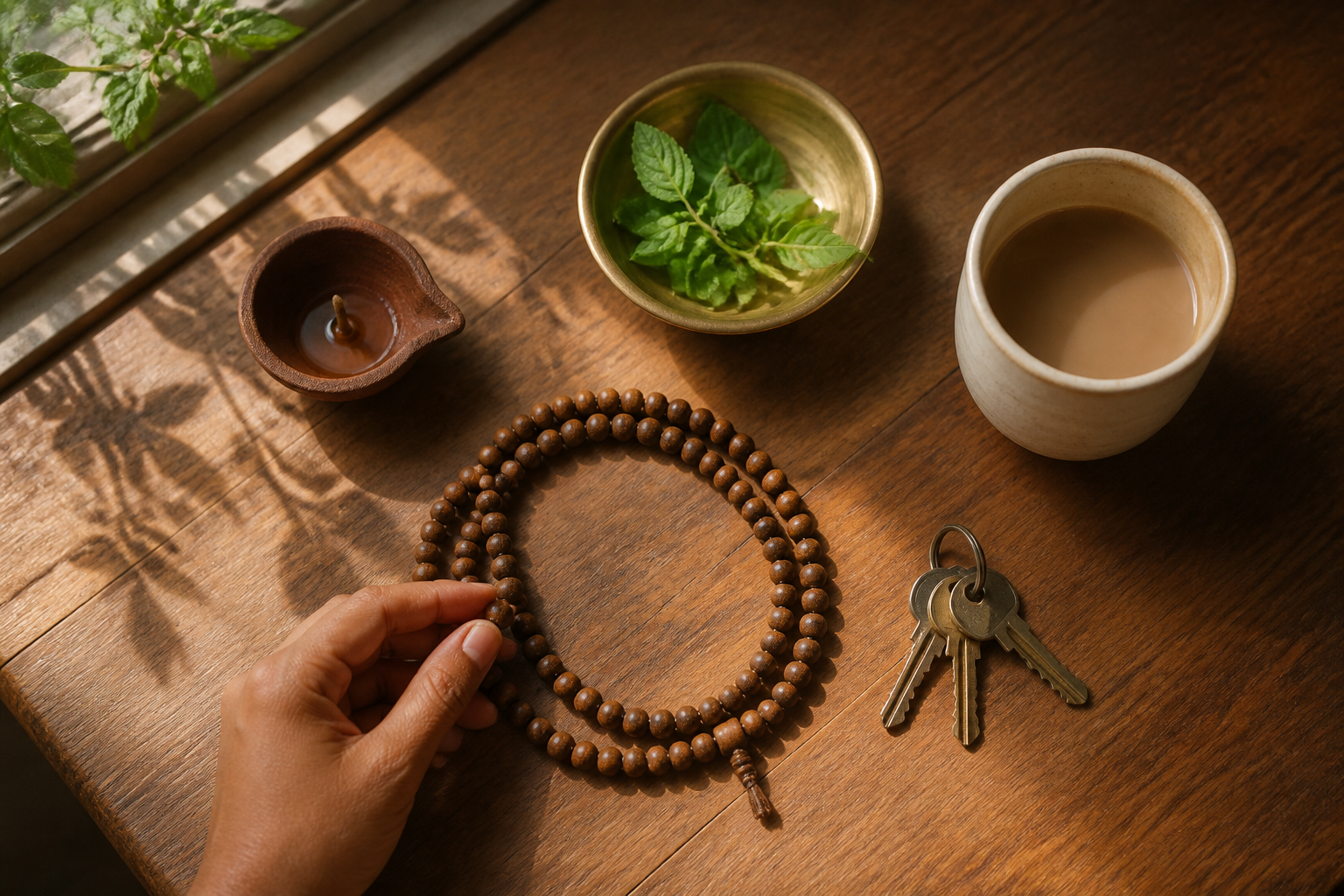
- Give japa a fixed daily anchor. Attach it to a repeatable part of your day, such as after washing and before the day’s demands gather force. If your guru or sampradaya has given you a vow or count, follow that instruction. Otherwise, choose a modest amount you can maintain rather than an impressive amount you abandon.
- Keep the meaning beside the sound. When repeating Achyuta, periodically recall what the name declares: the Lord does not fall, decay, or deviate. Meaning prevents the syllables from becoming empty background noise; sound prevents reflection from drifting into vague abstraction.
- Select three retrieval cues. Use the first moments after waking, the pause before your central duty of the day, and the final transition before sleep. A commute, parikrama, or the opening of scripture study can provide additional cues, but begin with a small set you will actually recognize.
- Collect the breath without making it a performance. Let one natural, unforced breath settle the body before beginning. If pranayama is already part of a practice you have been taught, it can prepare breath, mind, and senses for remembrance. There is no need to improvise breath-retention counts in order to make japa spiritually serious.
- Seal remembrance with one duty. At the end, name one act of honesty, restraint, service, or care that belongs to the day in front of you. Complete it while the intention is still clear. This keeps the Divine Name connected to dharma rather than treating recitation as a private mood.
If you miss the fixed practice
Return at the next available cue instead of declaring the entire day lost. Unless your vow or teacher directs otherwise, do not answer one missed practice with an unsustainable burst that disrupts the following day. Identify the practical failure: Was the cue unclear, was the place unavailable, or did you allow another task to occupy the appointed time? Adjust that one point and preserve the rest of the routine.
If japa feels dry
Do not pretend to feel devotion that is not presently available. Slow down enough to hear the name, recall the meaning of Achyuta, and complete the practice you undertook. Divine constancy is not measured by emotional intensity. A dry but attentive return can be more truthful than an excited practice that depends entirely on atmosphere.
If recitation is calm but conduct is not
Look at the gap directly. Remembrance should make it harder to excuse dishonesty, needless cruelty, neglected duty, or contempt for another person. Choose one recurring reaction and place a retrieval cue immediately before it. If a difficult message usually provokes an impulsive answer, for example, invoke Achyuta before replying and ask what steadiness joined with compassion requires.
Key takeaways
- Achyuta identifies Krishna as unfallen and imperishable; His constancy is not created by the strength of your concentration.
- The practical unit of remembrance is the return. Noticing distraction is an opportunity to resume hearing the Divine Name.
- Daily japa provides depth, while a few stable cues carry remembrance into work, travel, study, and family duty.
- Intensity alone is not the full measure of bhakti. Vaishnava remembrance joins sustained attention with reverence, affection, and dharmic action.
- Judge the practice partly by conduct: whether it helps you see duty clearly and respond with greater steadiness and care.
Recognize Dharmic kinship without erasing difference
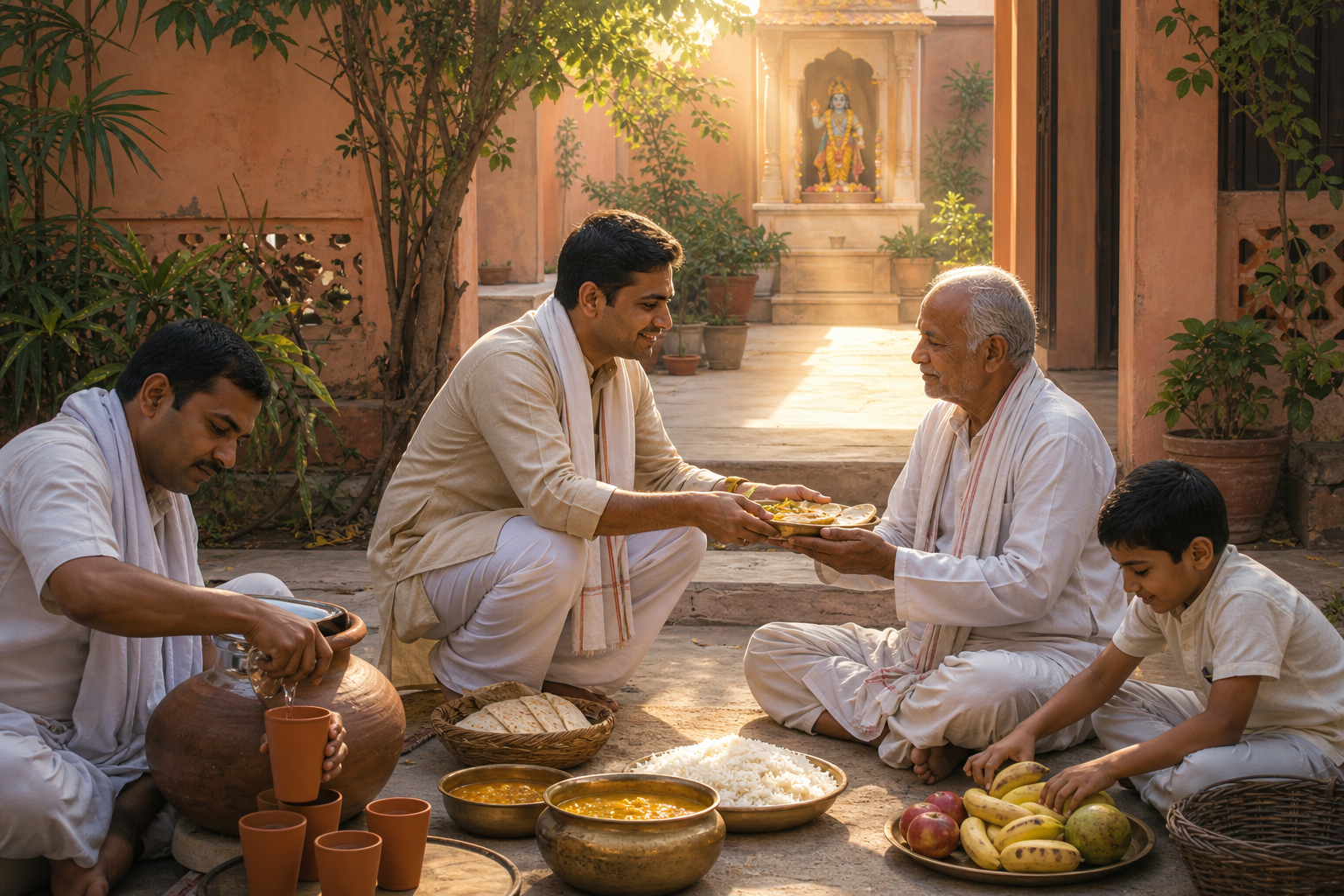
Vaishnava specificity does not require spiritual isolation. Sikh simran also gathers consciousness around the Divine Name, while Akal points toward the Timeless One. Buddhist sati develops continuous awareness, and Buddhist reflection speaks of the unconditioned. Jain samayik and dhyana stabilize attention in the service of ethical purification, while the perfected siddha stands beyond ordinary bondage and delusion.
These are genuine resonances, not permission to treat distinct traditions as interchangeable. Vaishnava smarana is remembrance of the personal Supreme and is shaped by a devotional relationship with Bhagavan. Buddhist, Jain, and Sikh teachings retain their own accounts of self, liberation, perfection, and ultimate reality. Respect grows when we recognize a shared discipline of attention while allowing each tradition to explain its own object and goal.
In a Dharmic conversation, compare practices by asking what they train a person to notice, remember, and do. Use the phrase resonates with when that is what you mean; do not casually replace it with is the same as. That small discipline of language preserves both kinship and truth.
Tomorrow, do not promise yourself unbroken concentration. Choose the name Achyuta, keep one fixed japa anchor, use three retrieval cues, and connect the remembrance to one duty you can actually fulfill. When attention wanders, return without drama. The constancy of Bhagavan is not a prize waiting at the end of perfect practice; it is the ground that makes your next return possible.


References
- DharmaRenaissance Blog — Achyuta Unveiled: Meaning, Symbolism, and the Imperishable Grace of Vishnu
- Dandavats — Vrindavan Wisdom with HG Gopinath Acharya Prabhu: How Remembrance Unlocks Nectar
