
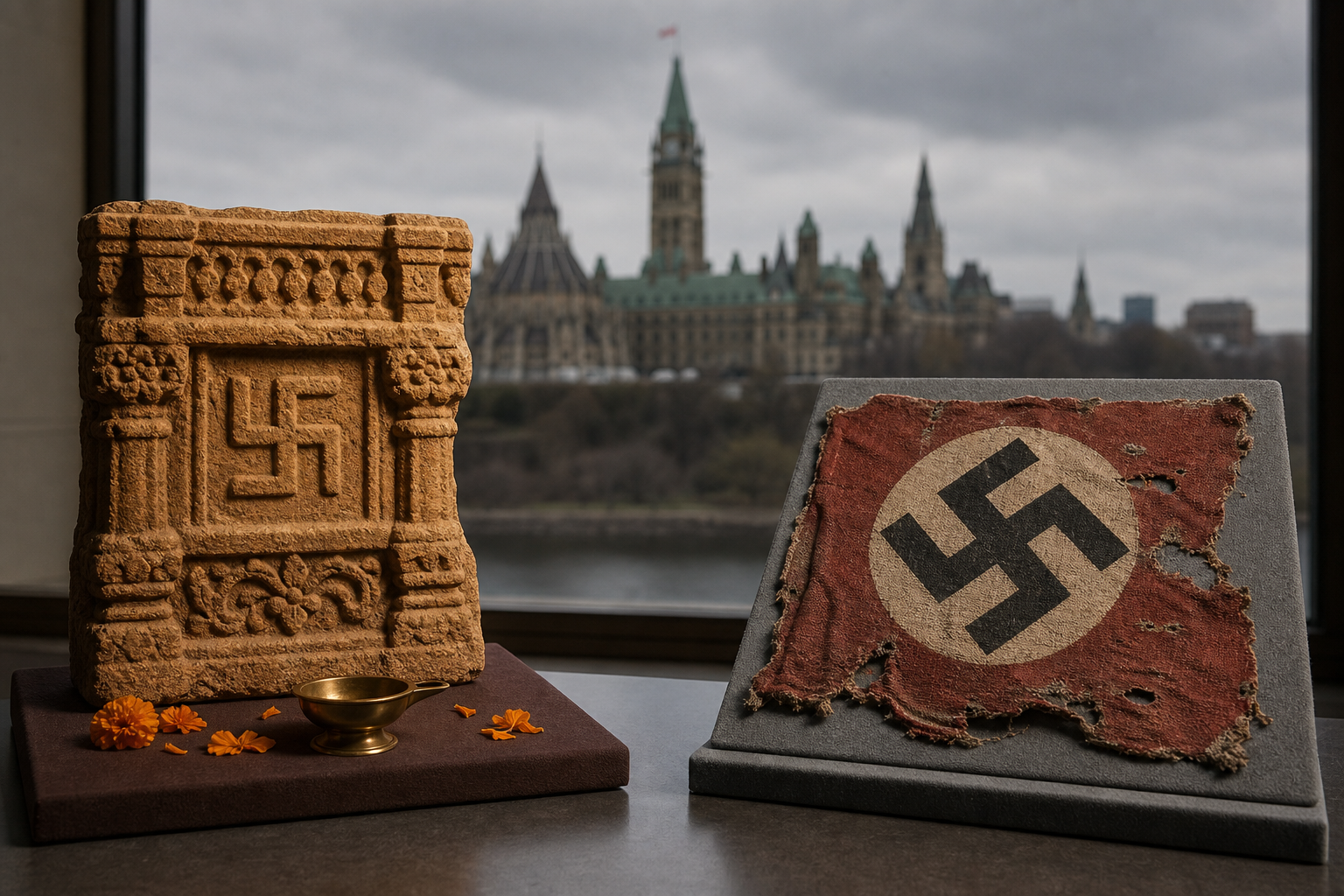
If a teacher, employer, venue manager or neighbour treats the Swastika on a temple carving, ritual object or family heirloom as a prohibited Nazi emblem, you need a more precise answer than saying that the two symbols look different. You also need an answer that takes the menace of Nazi imagery seriously.
Canada’s Parliament removed the term Swastika from the revised draft of Bill C-9 and focused the measure on the Nazi Hakenkreuz. That is a narrow but consequential distinction. It allows opposition to Nazi hate to remain firm without automatically treating a sacred Dharmic symbol as evidence of extremism. If you face a dispute, the practical task is to identify the symbol, establish its context and ask for an exact correction.
Key takeaways
- In the revision described here, Bill C-9 no longer names the Swastika as the prohibited symbol; its wording is directed at the Nazi Hakenkreuz.
- The Swastika signifies auspiciousness and well-being in Hindu, Buddhist and Jain traditions. Many Sikh communities also respect it as part of a shared civilizational heritage.
- Shape alone is not a reliable classification method. Name, provenance, setting, accompanying imagery and communicative purpose all help distinguish sacred use from Nazi use.
- You do not have to minimize Nazi hatred to defend the Swastika. The strongest response protects both historical truth and people targeted by extremist intimidation.
- Bill C-9 is the relevant legislative measure, but an amended bill is not a universal permission slip or an answer to every legal dispute. Check its current official text and status before relying on it in a live case.
The line Bill C-9 draws is between heritage and hate
The central question is not whether two designs share a basic geometric form. It is what each symbol is, what history it carries and what it communicates in the setting where it appears.
| Term | Meaning at issue | Relevant settings | Treatment in the Bill C-9 revision |
|---|---|---|---|
| Swastika | A sacred sign associated with auspiciousness and well-being | Hindu, Buddhist and Jain worship, art and cultural life; also respected by many Sikh communities as shared civilizational heritage | The term was removed from the draft’s targeted hate-symbol wording |
| Hakenkreuz | The Nazi emblem associated with Nazi ideology, hatred and extremism | Nazi propaganda, allegiance, intimidation and extremist communication | The revision focuses the anti-hate measure on this Nazi symbol |
This distinction matters because the Swastika is not a modern variation of a Nazi emblem. Within Dharmic life, it has its own name, meaning, continuity and religious setting. Calling every instance a Nazi symbol reverses that relationship and makes Dharmic Canadians answer for an ideology that is not theirs.
The amendment therefore does two jobs at once: it keeps enforcement directed at symbols tied to historical and contemporary extremism, while reducing the risk that temples, rituals and inherited cultural objects will be mischaracterized. That is not a concession to hate. It is the precision an anti-hate measure needs if it is to protect people without stigmatizing innocent religious practice.
Do not stretch this point beyond what it establishes. The revision identifies which of these two symbols Bill C-9 is intended to target. It does not mean that every act involving a Swastika is automatically beyond every Canadian law, policy or factual inquiry. Conduct, surrounding speech and circumstances can still create separate questions. If removal, discipline, a police complaint or court proceedings are involved, obtain advice from a qualified Canadian lawyer who can examine the current law and the complete facts.
How to identify the symbol without playing a shape game
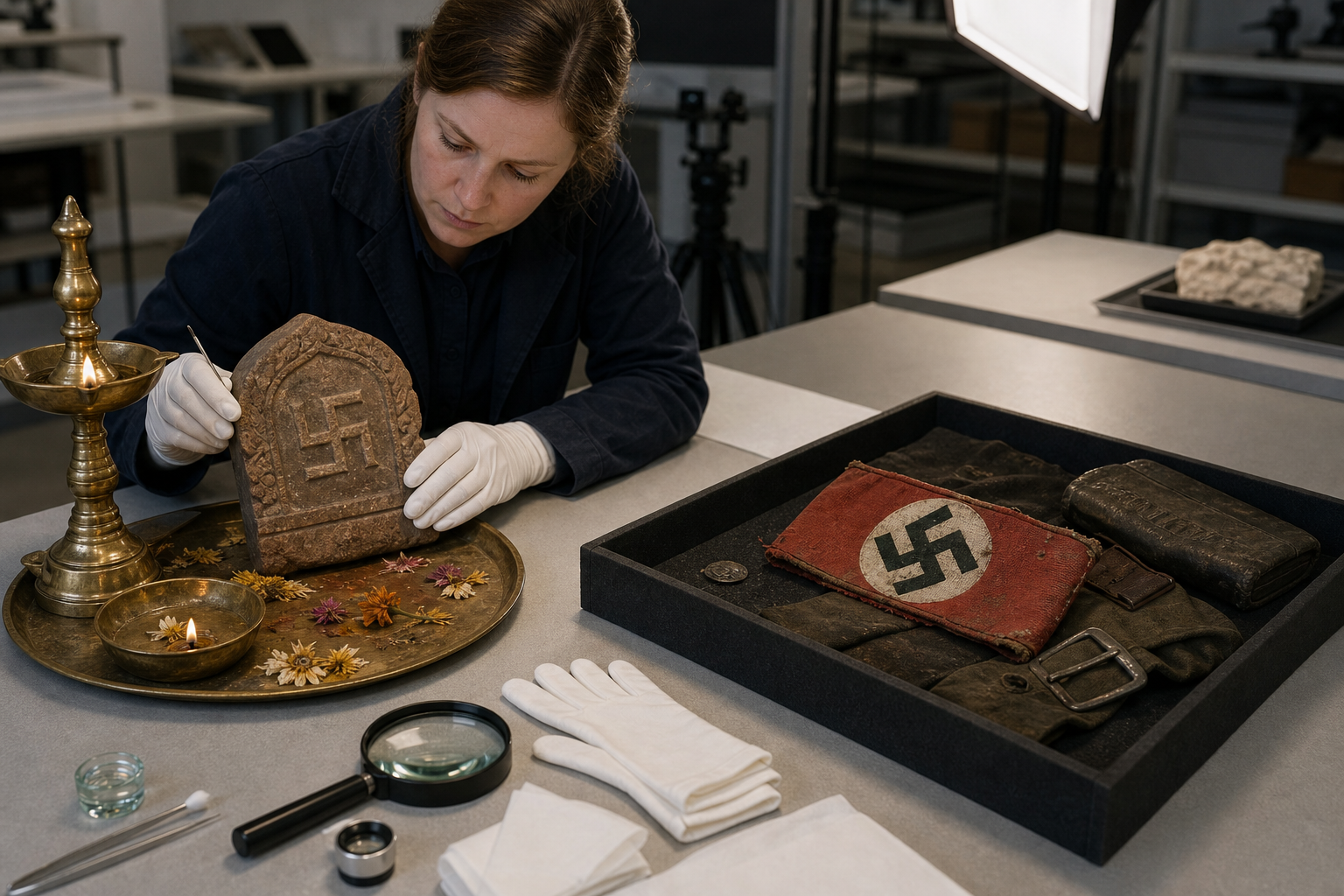
Arguments often collapse into a visual shortcut: someone sees the familiar crossed form and assumes that its angle or direction settles the matter. That approach is fragile. Sacred symbols appear in different artistic conventions, materials and regional styles. Historical reproductions of Nazi imagery can vary too. One visual feature should not carry the entire judgment.
Use the following questions for an initial contextual assessment. They are practical identification questions, not a substitute for the legal test that may apply to a particular incident.
- What is the symbol called in this setting? A temple, family or community may identify it as a Swastika because that is the sacred symbol being used. A Nazi or neo-Nazi display should be identified as a Hakenkreuz rather than being allowed to appropriate the Dharmic name.
- Where does it appear? A shrine, temple surface, ritual arrangement, inherited object or community observance supplies materially different context from extremist propaganda or an intimidating display.
- What surrounds it? Religious iconography, auspicious decoration and a Dharmic ceremonial setting point toward sacred use. Nazi identifiers, ideological slogans or threatening conduct point toward Nazi use.
- What is it communicating? Ask whether the display conveys blessing, well-being, worship or cultural continuity, or whether it communicates Nazi allegiance, hostility or intimidation.
- How is the context documented? A caption, programme, curatorial note, lesson plan or written explanation can prevent an unfamiliar viewer from substituting an assumption for the actual meaning.
Be equally precise when discussing the traditions themselves. The Swastika is revered across Hinduism, Buddhism and Jainism. The narrower statement concerning Sikhism is that many Sikh communities respect it within a shared civilizational inheritance. You do not need to claim that the symbol has an identical doctrinal or ritual role in every Dharmic tradition. Accuracy makes the common heritage more credible, not less.
Context should explain the object rather than conceal it. Asking a Hindu, Buddhist or Jain family to remove a sacred Swastika before anyone has considered its setting places the burden on the wrong party. The first step should be informed identification. Accommodation or policy decisions can then proceed from facts rather than from the mistaken equation Swastika equals Hakenkreuz.
What to do when your sacred Swastika is challenged

A correction is more likely to succeed when you separate identification, policy and remedy. Do not begin with a sweeping debate about civilization if the immediate problem is an incorrect caption or a school administrator’s mistaken reading of a rule. Establish the error in a form the decision-maker can fix.
- Record the exact objection. Ask whether the concern comes from Bill C-9, an institutional policy, a platform rule or an individual complaint. Request the relevant wording in writing. A vague claim that Canada banned the symbol is not enough to evaluate.
- Identify the object and its setting. State where the Swastika appears, who uses it and what it means there. Include a photograph of the full setting when appropriate; a tightly cropped image can erase the very context that resolves the confusion.
- Use the two names. A concise response is usually strongest: This is a sacred Swastika in a Dharmic religious or cultural context, not the Nazi Hakenkreuz targeted by the revised Bill C-9 wording.
- Ask for a concrete remedy. Depending on the incident, request restoration of an image, correction of a caption, withdrawal of a warning, contextual labelling, reconsideration of discipline or revision of an internal style guide. Do not settle for a general expression of regret if the inaccurate label remains public.
- Preserve the record and escalate proportionately. Keep the original notice, screenshots, policy text, dates and your written explanation. If the matter can affect employment, education, immigration status, criminal exposure or another legal right, stop treating it as a public-relations disagreement and seek qualified Canadian legal advice.
Your tone can be firm without becoming dismissive. Acknowledge why Nazi imagery alarms people, then explain that the alarm does not justify transferring Nazi meaning onto a sacred Dharmic symbol. This prevents the conversation from being framed as a choice between religious freedom and opposition to hate.
Also distinguish ignorance from intimidation. Someone asking an honest question may need a short explanation. An institution publishing a false label after receiving clear contextual evidence needs a formal correction. A person deliberately using confusion to harass a Dharmic community may require documentation, a complaint through the appropriate channel and professional advice. The same prepared statement can begin all three responses, but the next step should match the conduct.
Schools, museums and newsrooms should change their vocabulary

Legal clarity becomes culturally useful only when it reaches the places where Canadians encounter symbols. Schools, museums, newsrooms and government agencies can reduce mistakes by treating Swastika and Hakenkreuz as separate entries in curricula, catalogues, captions and style guides. The change is small enough to implement immediately.
Write two definitions, not one definition with an exception
- Swastika: identify it positively as a sacred and auspicious symbol in Hindu, Buddhist and Jain traditions, while noting the respect it receives in many Sikh communities as part of shared heritage.
- Hakenkreuz: identify it directly as the Nazi emblem connected to Nazi ideology and extremist hate.
- Cross-reference carefully: explain that visual resemblance has caused confusion, but do not define the sacred symbol primarily through Nazism. Its Dharmic identity is not a footnote to twentieth-century European history.
This vocabulary improves both religious education and anti-hate education. Students can learn why a Swastika appears in a Dharmic setting without receiving a euphemistic account of the Hakenkreuz. Museum visitors can understand the provenance of an object. Editors can describe extremist imagery without misnaming it. Public officials can address complaints without beginning from a false equivalence.
Require context review before removal or discipline
A moderation rule based only on geometric similarity will predictably catch sacred objects alongside Nazi imagery. Before removing an image or penalizing a person, the reviewer should examine the complete scene, accompanying language, stated purpose and institutional setting. When uncertainty remains, the person or community using the symbol should have a meaningful opportunity to explain it.
A sound internal process should record the reason for a decision and provide a route for correction. That matters because an unexplained removal can be repeated across archives, classroom materials and future events. Correcting the classification without correcting the underlying policy merely postpones the next incident.
Use language that can survive public scrutiny
A contextual label can say: The Swastika shown here is used in its Dharmic sense as a sacred sign of auspiciousness and well-being. It should not be confused with the Nazi Hakenkreuz.
An institutional policy can say: This policy addresses the Nazi Hakenkreuz as extremist imagery. It does not classify a sacred Swastika as a Nazi emblem solely because the symbols share a basic geometric resemblance. Context will be reviewed before a decision is made. Institutions should have legal counsel review final policy language for consistency with the current version and status of Bill C-9 and with any other applicable obligations.
A public correction can say: Our earlier description conflated a sacred Swastika with the Nazi Hakenkreuz. We have corrected the label and are updating our review guidance. This does more than remove an offensive word choice. It identifies the error, repairs the public record and tells affected communities what will change.
The distinction gives you a workable civic position: name Nazi imagery accurately, oppose the hatred it represents and defend the Swastika without apology as a sacred Dharmic symbol. If your school, workplace, museum or local government still uses the two terms interchangeably, begin with one written request: ask it to create separate definitions and a context-review process. That modest correction is where legal precision becomes lived religious freedom.
References
