
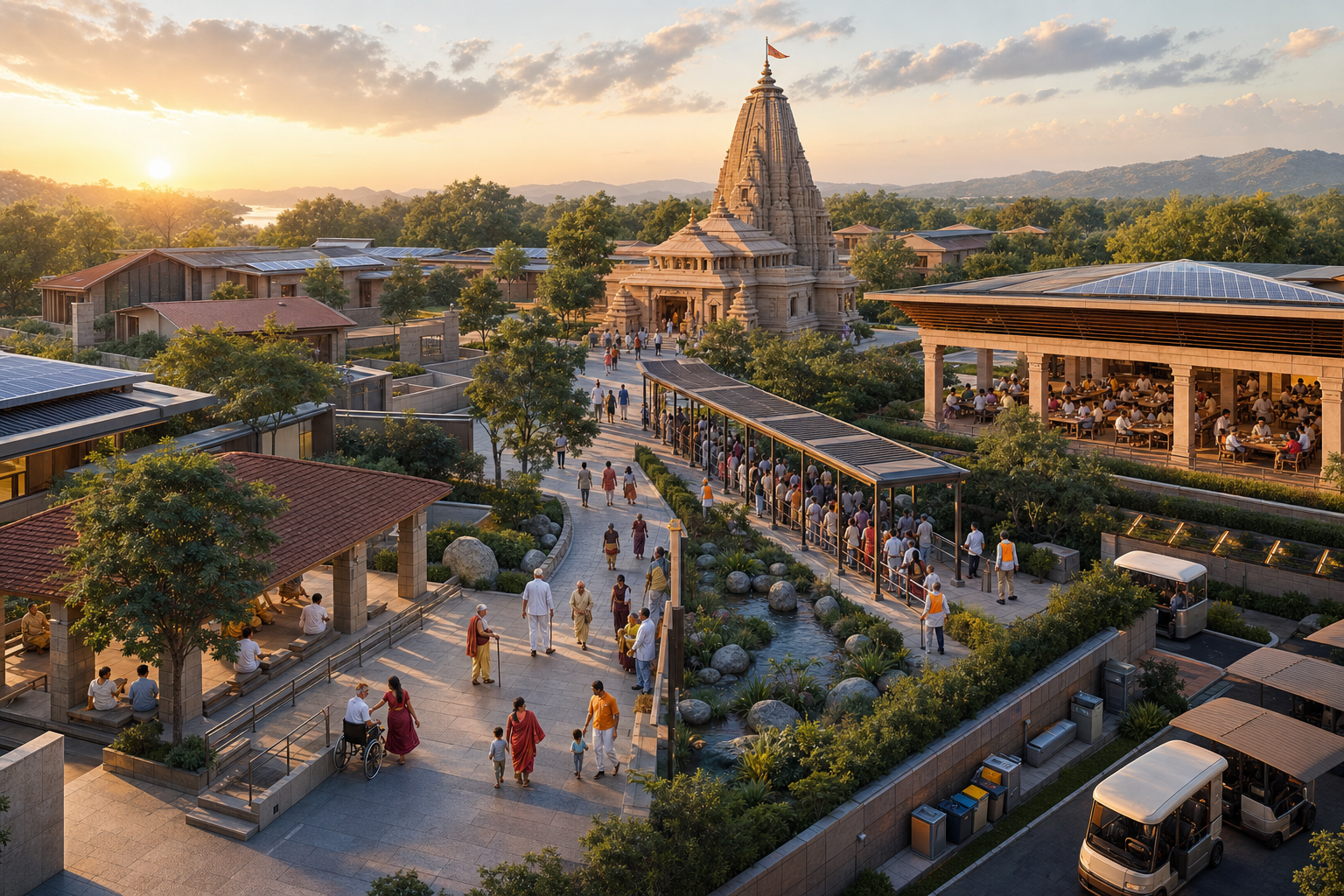
You may be looking at a temple announcement and wondering whether to celebrate the acreage, wait for detailed plans, or ask harder questions. Ask the harder questions now. Land is an opportunity; it is not yet a pilgrim experience, a sacred institution, or a durable public asset.
The useful test is simple: can the project carry a devotee from intention to arrival, darshan, learning, seva, and a safe journey home without weakening the sanctity that brought the devotee there? If you are a trustee, donor, planner, cultural worker, or concerned citizen, that test gives you a practical way to judge what deserves support.
Plan the complete pilgrim journey before celebrating scale
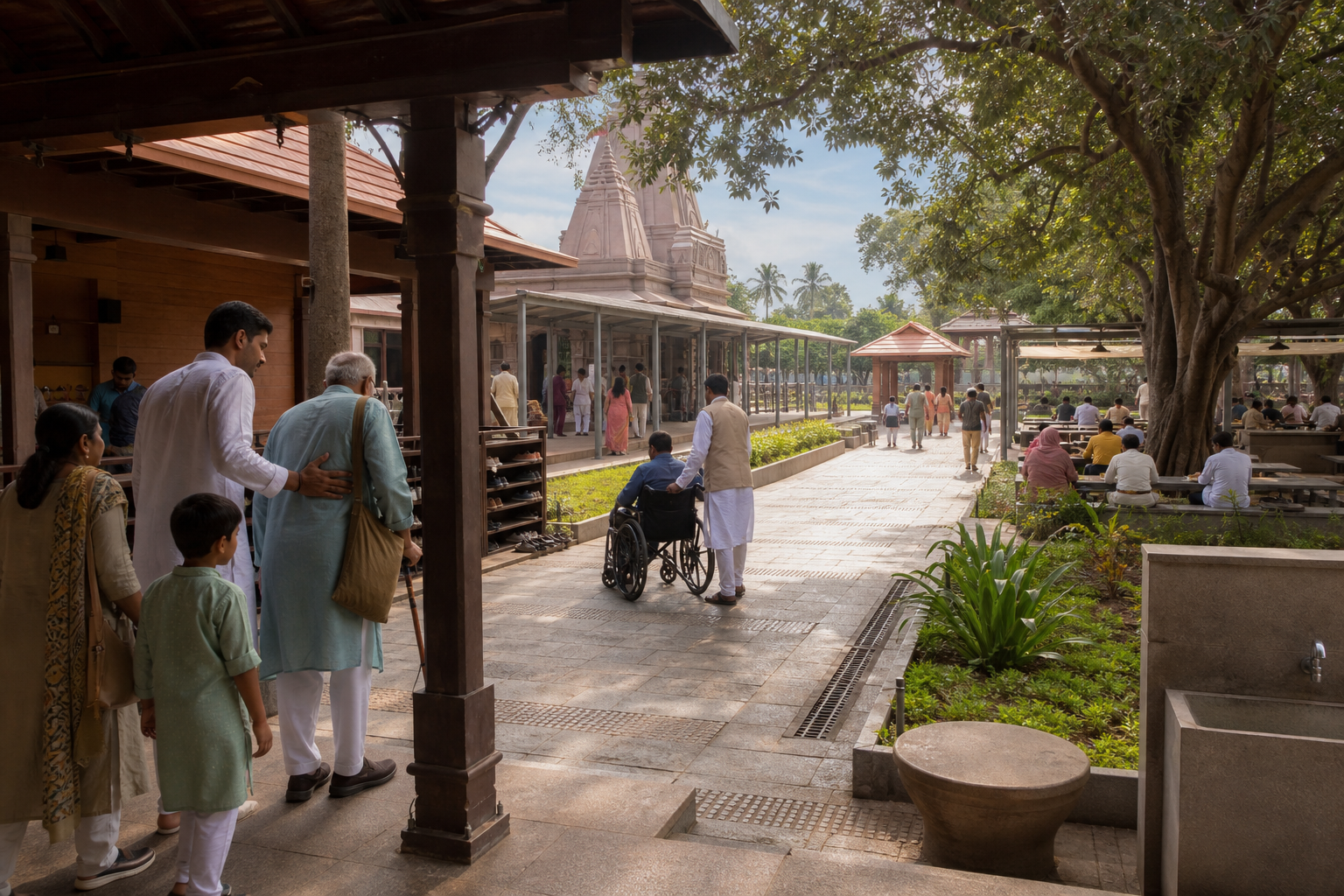
Acreage tells you what might fit. It does not tell you whether the parts will work together. Assam’s allocation of 25 acres in Guwahati for a Tirumala Tirupati Devasthanams temple and the envisioned 300-acre cultural development in Tirupati illustrate the range now being contemplated. Both scales create possibilities, but neither scale guarantees clarity, accessibility, or spiritual coherence.
Before an architect fixes the master plan, the institution should prepare a pilgrim journey brief. That brief should follow a real person through the campus in the order that person will encounter it:
- Before departure: Publish accurate information about opening times, ritual expectations, accessibility, transport, permitted items, accommodation, and services. A first-time visitor should not have to assemble basic instructions from unofficial messages.
- Arrival: Separate buses, private vehicles, service traffic, and pedestrians before they converge. Mark the route from the transport stop or parking area to the entrance, including the accessible route.
- The threshold: Place footwear facilities, washing points, toilets, drinking water, storage, and information where devotees need them, not where they were easiest to fit into a leftover corner.
- The sacred encounter: Design queues, waiting areas, ritual preparation, and darshan as one sequence. Crowd movement must support attention and dignity rather than turn the final approach into a struggle for position.
- After darshan: Give devotees a clear route to prasada, sheltered rest, seva facilities, cultural learning, and assistance. Educational displays should be available without forcing every pilgrim through an exhibition.
- The return: Make the path to public transport, pickup points, accommodation, and local destinations as legible as the entrance path. Departure is part of the pilgrimage infrastructure, not an external problem.
Test this route with at least four perspectives: an older devotee, a parent accompanying children, a wheelchair user, and a visitor who cannot read the campus’s dominant language. Walk each route on the plan. Count stairs, road crossings, changes of direction, unsheltered waits, and points where the person must ask a staff member what to do next. Any essential route that depends on verbal rescue is not yet a reliable route.
Run the same exercise for an ordinary day and a major observance. The purpose is not to predict every crowd. It is to identify which narrow passage, vehicle crossing, service counter, or ritual checkpoint will become the first point of failure. That is where the design needs capacity, shade, staffing, and an alternate route.
Give sacred, cultural, and operational decisions distinct homes
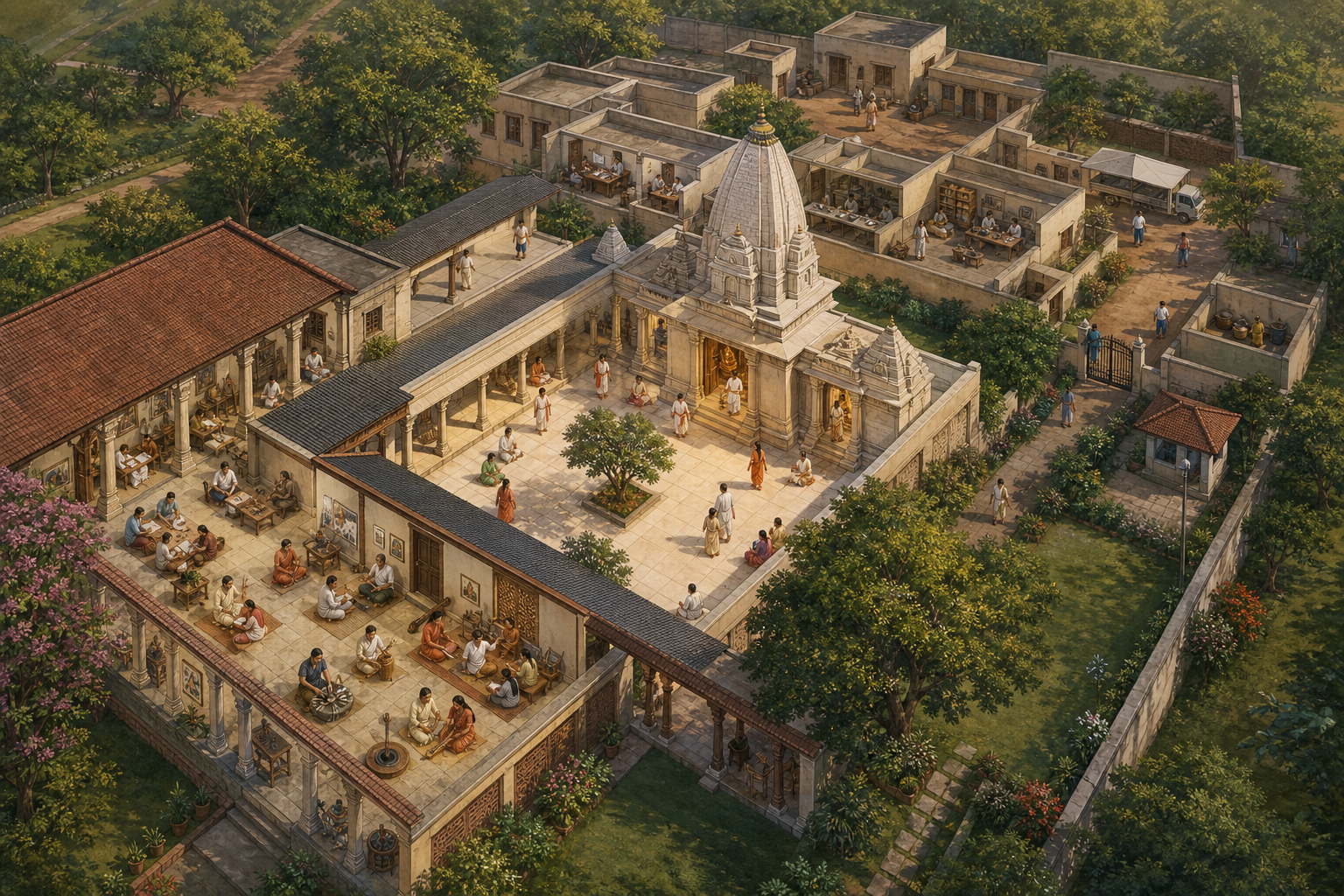
A temple, museum, cultural academy, pilgrim shelter, public plaza, and retail area can share a campus. They should not share an undefined purpose. The envisioned Tirupati development could include curated galleries, learning spaces, seminar halls, and immersive presentations. Those functions can deepen understanding, but they cannot be allowed to redefine the sacred core by accident.
Ritual requirements belong with the relevant temple authorities and lineage. Historical interpretation requires scholars, curators, and living practitioners. Accessibility and crowd flow require operational expertise. Statutory approvals belong with the competent public authorities. Local legitimacy requires structured participation by the surrounding community. One committee can coordinate these domains, but it should not improvise expertise in all of them.
| Domain | Who must shape it | What should exist before detailed design |
|---|---|---|
| Sacred core | Authorized religious and ritual authorities | A ritual brief covering sanctum requirements, processions, preparation, and boundaries |
| Knowledge and interpretation | Scholars, curators, translators, and living practitioners | An interpretive plan naming themes, audiences, review standards, and disputed questions |
| Pilgrim care | Operations, accessibility, crowd-management, and emergency teams | A mapped journey for ordinary days and major observances |
| Civic interface | Local administration and relevant statutory agencies | Access, traffic, utilities, environmental, and emergency-coordination plans |
| Community relationship | Residents, local cultural representatives, artisans, and service partners | A participation plan with named stages at which local input can still change the project |
This separation is especially important when a campus speaks about Hinduism, Buddhism, Jainism, and Sikhism together. Ahimsa, seva, dana, pluralism, and disciplined self-cultivation can provide a meaningful field of conversation. They do not make the traditions interchangeable. A responsible display identifies whose teaching, practice, image, or vocabulary is being presented. It distinguishes a shared ethical resonance from a claim of identical theology.
Use three questions for every inscription, installation, ceremony, and public program: Is this devotional, interpretive, or administrative? Who has the authority to approve it? How will an error or changed understanding be corrected? Put the answers into the institutional charter before commissioning expensive displays. No claim acquires authority merely because it appears on a large screen or a polished wall.
Make pan-Bharatiya connection grow through local belonging
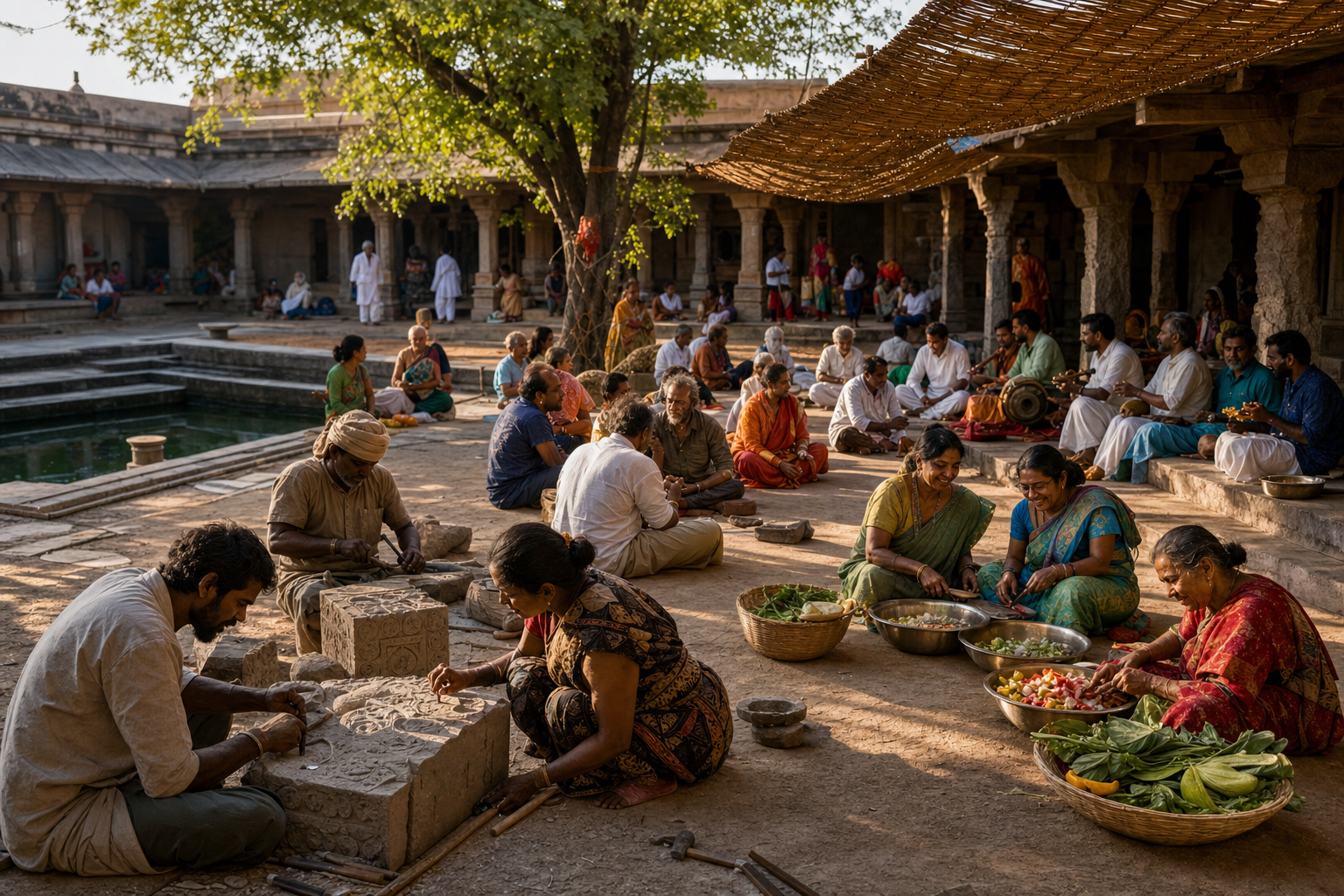
A major dharmic institution entering a new region can strengthen Bharat’s sacred geography. It can also feel imported if its planners treat the host region as an empty site. The strongest practical case for the Guwahati temple is that it could bring Venkateshwara devotion closer to families in Assam and neighboring states who otherwise face a much longer journey. That benefit becomes durable only when the campus also belongs in Assam.
Pan-Bharatiya does not mean visually uniform. A temple can remain faithful to its liturgical tradition while its public realm responds to local climate, movement patterns, artistic knowledge, languages, ecology, and festival calendar. This is not dilution. It is how a sacred institution becomes a respectful neighbor.
- Form a local advisory body before the design is frozen. Include religious representatives, residents, cultural practitioners, artisans, transport specialists, accessibility advocates, and civic services. Consultation held after the final rendering can explain a decision, but it cannot meaningfully shape one.
- Create a language architecture, not a pile of translations. Decide which information must appear in the local language, which additional languages pilgrims are likely to need, and where symbols, transliteration, audio, or staff assistance are more effective than dense text. Liturgical translation should be reviewed by people qualified in the relevant tradition.
- Map the local calendar. Identify when the campus’s observances may coincide with local festivals, school periods, heavy travel, or other major gatherings. Use that map for event scheduling, traffic planning, vendor capacity, and neighborhood communication.
- Write a local livelihood compact. State how artisans, performers, food providers, guides, maintenance workers, and other local participants can qualify for opportunities. Publish selection principles so that cultural inclusion becomes recurring paid work rather than decoration for the opening ceremony.
- Let the landscape answer the place. Water movement, shade, native planting, waste handling, pedestrian comfort, and material durability should respond to the actual site. A recognizable institutional identity does not require copying an entire southern landscape into the Northeast.
Local participation does not require every request to be accepted. It requires a visible process: what was raised, which body considered it, what changed, and why another request could not be adopted. That record turns consultation from ceremony into accountability.
Make seva, governance, maintenance, and learning operational
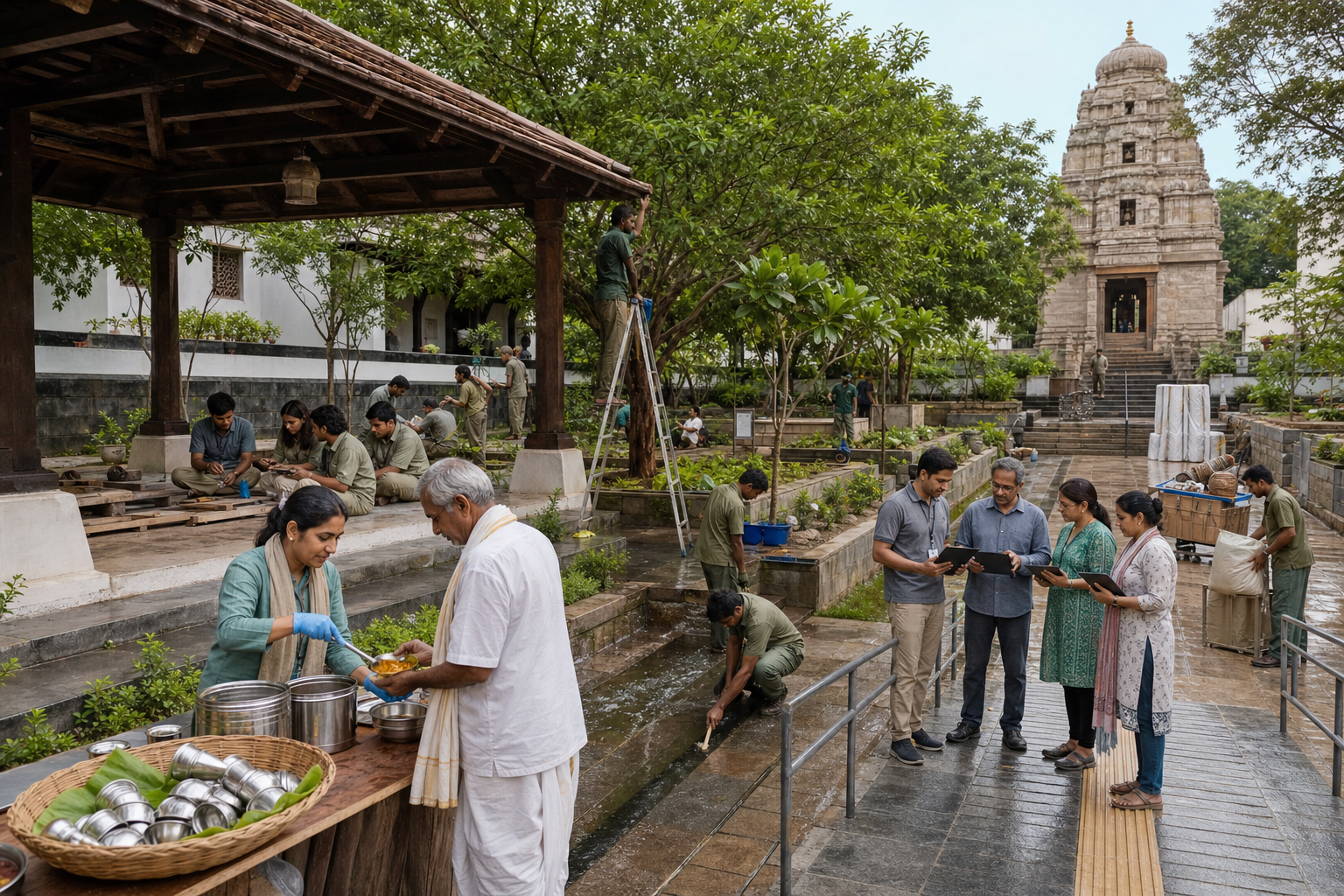
A campus becomes dharmic infrastructure when service is built into its daily operation. Seva cannot survive as a slogan attached to an inauguration. It needs space, staffing, supplies, safeguarding, financial controls, and a responsible institution. The same is true of cultural education. Galleries without curatorial maintenance become dated rooms; pilgrim amenities without maintenance budgets become recurring points of indignity.
Use phase gates that require evidence before the project moves forward:
- Approve the institutional charter. Define the sacred purpose, intended communities, forms of seva, educational role, decision rights, and activities that do not belong on the campus.
- Publish the service baseline. Identify the water, sanitation, sheltered rest, accessibility, information, first-aid coordination, crowd-management, security, and waste systems that must function from the first day. Do not open a celebrated sacred building while essential pilgrim care remains a future phase.
- Complete the site and civic groundwork. Confirm access, utilities, traffic handling, environmental obligations, emergency coordination, and the status of required permissions. A land allocation should never be presented as if it also completed design review or statutory clearance.
- Build in usable phases. Each opened phase should work as a complete experience, with safe entry, worship or learning, essential services, and departure. A half-connected ceremonial opening transfers unfinished planning onto pilgrims and staff.
- Rehearse operations before public opening. Test wayfinding, queues, lost-person procedures, accessible routes, medical escalation, cleaning cycles, transport handoffs, and communication across teams. Record failures and repeat the exercise after corrections.
- Maintain a public milestone ledger. Label each item as proposed, under review, approved, funded, under construction, or operational. Report material changes in scope and sequence in the same place rather than allowing announcements to become the only public record.
This discipline matters in Guwahati because detailed designs, timelines, statutory steps, and environmental milestones still require confirmation. Public enthusiasm can coexist with patience. Support for the temple does not require pretending that an allocation is a completed campus.
The educational function needs its own operating rules. Name who reviews historical claims, how regional traditions will be represented, how translations will be checked, and how visitors will distinguish settled information from a contested interpretation. Plan recurring programs for students and families, but protect quiet and worship from constant event traffic. Living arts should include practitioners through performances, workshops, demonstrations, and commissioned work, not only through objects placed behind glass.
The maintenance plan should be as public-minded as the construction plan. Budget separately for routine cleaning, repairs, water and energy systems, accessibility equipment, landscape care, interpretive updates, staff training, and major-event operations. A donor may naturally be drawn to a visible structure. Project leadership must still protect the less visible systems on which dignity and safety depend.
Finally, connect dana to accountable outcomes. A donation appeal should identify the responsible entity, intended use, whether the need is capital or recurring, and how completion or expenditure will be reported. Devotional trust is not weakened by financial clarity. It is honored by it.
Key takeaways for judging a dharmic campus proposal
- Judge the journey, not the acreage. Ask to see the complete route from travel information to safe departure.
- Protect the sacred core through clear authority. Ritual, scholarship, operations, civic compliance, and community participation require different forms of competence.
- Keep unity honest. Present shared dharmic values without erasing the distinct teachings and practices of Hindu, Buddhist, Jain, or Sikh traditions.
- Require local belonging before design freeze. Language, landscape, livelihoods, arts, traffic, and community concerns must shape the plan while change is still possible.
- Open only complete, usable phases. Essential pilgrim services and safe movement are not optional additions to a sanctum, gallery, or ceremonial plaza.
- Separate announcements from verified milestones. Land, approval, funding, construction, and operation are different stages and should be reported as such.
- Fund the institution after inauguration. Maintenance, staff training, interpretation, seva, and environmental management determine whether the campus matures or merely ages.
When the next temple, expo, or pilgrimage township is announced, ask for three things: the pilgrim journey map, the decision-and-accountability chart, and the phased operating plan. If those documents show sacred clarity, local respect, complete pilgrim care, and honest milestones, the project has moved beyond a grand idea. It has begun the disciplined work of becoming an institution worthy of devotion.
References
- DharmaRenaissance Blog – Assam grants 25 acres in Guwahati to TTD: landmark boost for Venkateshwara devotion and unity
- Hindu Existence – Huge expo on Hinduism & Hindutva in a mega township in Tirupati
