

A thought appears, the body tightens, memory supplies an old story, and suddenly you are speaking from anger before discernment has entered the room. If you have wondered which part of this sequence is the mind, which part is consciousness, and what you can actually do about it, Dharmic philosophy offers a precise place to begin.
The first practical lesson is that mind and awareness are not interchangeable terms. The mind processes, remembers, identifies, prefers and decides. Awareness is that by which those activities become known. Once you can notice the difference, a reaction no longer has to be treated as your whole self.
The useful distinction: mind is known, awareness is the knower
In many Hindu schools, the mind is a subtle instrument rather than the ultimate source of consciousness. It operates through the brain and body, but it is not reduced to either. Consciousness, called Atman in the Vedantic setting, illuminates mental activity without becoming one more mental object.
You can test the usefulness of this distinction without pretending that a private experience proves a metaphysical doctrine. Notice a thought such as, I have been insulted. You know that thought. Notice the heat, tightening or unease accompanying it. You know those sensations too. Notice the impulse to defend yourself. That also becomes known. The contents keep changing, while the fact of their being known remains.
This does not make the brain irrelevant. Contemporary neuroscience can map neural correlates of experience with increasing precision. Work on embodied cognition and the extended mind also treats cognition as something shaped by body, breath, surroundings and relationships. None of that, by itself, settles the philosophical question of whether consciousness is identical to brain activity. A correlation between experience and neural activity is not automatically a complete account of what awareness is.
Keep the distinction modest and usable: a mental event is something you can observe, so you do not have to obey it immediately. Universal consciousness, meanwhile, should not be imagined as an enormous human mind collecting everyone’s thoughts. In Advaita Vedanta, it names the unconditioned reality in which the apparent division between knower, knowing and known is ultimately overcome.
Use the four functions of antahkarana as a diagnostic

The English word mind compresses several different operations into one vague label. The Hindu model of antahkarana, the inner faculty, separates them into four interacting functions:
- Manas receives and organizes sensory impressions, entertains alternatives, and moves through attraction and aversion. Its characteristic movement is: this, or that?
- Buddhi discerns, evaluates and decides. It asks what is true, appropriate and aligned with dharma rather than merely pleasant in the moment.
- Ahamkara forms the sense of I and mine. It converts an event into a claim about identity: this happened to me, threatens me, proves me right or diminishes me.
- Citta carries memory and latent impressions. It supplies the familiar image, association or emotional groove into which a new event can fall.
These are functional distinctions, not four separate organs. They can operate almost simultaneously. Their value lies in helping you interrupt confusion. When you say, my mind is out of control, you have not yet identified the problem. Manas may be overstimulated, citta may be replaying an old impression, ahamkara may be defending an identity, or buddhi may be present but repeatedly ignored.
During a difficult moment, move through four questions before answering:
- What information and immediate preferences is manas presenting?
- What memory, expectation or habitual pattern is citta adding?
- What image of I or mine is ahamkara trying to protect?
- What response would buddhi choose if it did not have to satisfy the first impulse?
This sequence does not require you to suppress emotion. It asks you to stop giving every emotion the authority of buddhi. Anger may alert you to a violated boundary; it does not automatically determine the wisest words. Memory may identify a real pattern; it can also make the present look identical to the past. Ahamkara is required for ordinary functioning, but it becomes unreliable when every disagreement is treated as a referendum on the self.
Do not collapse Advaita, Sankhya, Yoga and the five koshas

Dharmic thought does not offer one uniform theory of mind. The differences matter because each model asks you to notice something different.
Advaita changes your identification
Advaita Vedanta holds that Atman is Brahman. Mental activity appears within consciousness, but consciousness is not confined to a particular thought, mood or personality. The Upanishadic mahavakya Tat Tvam Asi points toward this identity between the innermost Self and ultimate reality.
The practical move is not to repeat I am Brahman while continuing to obey every resentment. It is to examine identification. When a thought changes, did awareness disappear? When a role changes, did the capacity to know experience vanish? Advaitic inquiry loosens the assumption that your passing mental contents define the whole of what you are.
Sankhya separates awareness from nature
Sankhya distinguishes Purusha, pure awareness, from Prakriti, nature. Mind belongs to Prakriti, however subtle, because it changes, acts and presents objects to awareness. This is a distinction between the seer and everything that can be seen, including thoughts about the seer.
Do not silently turn this into the Advaitic identity claim. The two systems give different philosophical accounts. What they share for practice is a refusal to equate pure awareness with every movement occurring in the mental field.
Yoga trains the instrument
Yoga directs practice toward yoga citta-vritti-nirodha, the stilling of the fluctuations of citta. The point is not to destroy the mind. A settled instrument can reflect more clearly than one continually disturbed by impulses, impressions and compulsive commentary.
Use that principle as an operational test. If a practice makes you more capable of observing an impulse, discerning a response and acting without needless harm, the instrument is becoming steadier. If it merely gives ahamkara a new identity as an advanced spiritual person, agitation has changed costume rather than ended.
The five koshas widen the field
The Pancha Kosha model describes experience through five sheaths: annamaya, the physical body; pranamaya, vital energy; manomaya, mental and emotional activity; vijnanamaya, intellect and insight; and anandamaya, the sheath of bliss.
Treat these as lenses for inquiry, not as anatomical layers you should expect to locate under the skin. When you feel mentally overwhelmed, check the whole field. Is the body exhausted or strained? Has the breath become constricted or hurried? Which feeling is dominating manomaya? What does vijnanamaya discern beneath the reaction? Can you stop chasing stimulation long enough for a quieter ease to become noticeable?
This layered check prevents a common mistake: trying to solve every form of disturbance by arguing with thoughts. Sometimes the immediate doorway is the body or breath. Sometimes the problem is not a lack of calm but a failure to let buddhi name an uncomfortable truth. The koshas help you choose the appropriate doorway without declaring any single layer to be the whole person.
Turn the philosophy into a repeatable daily practice
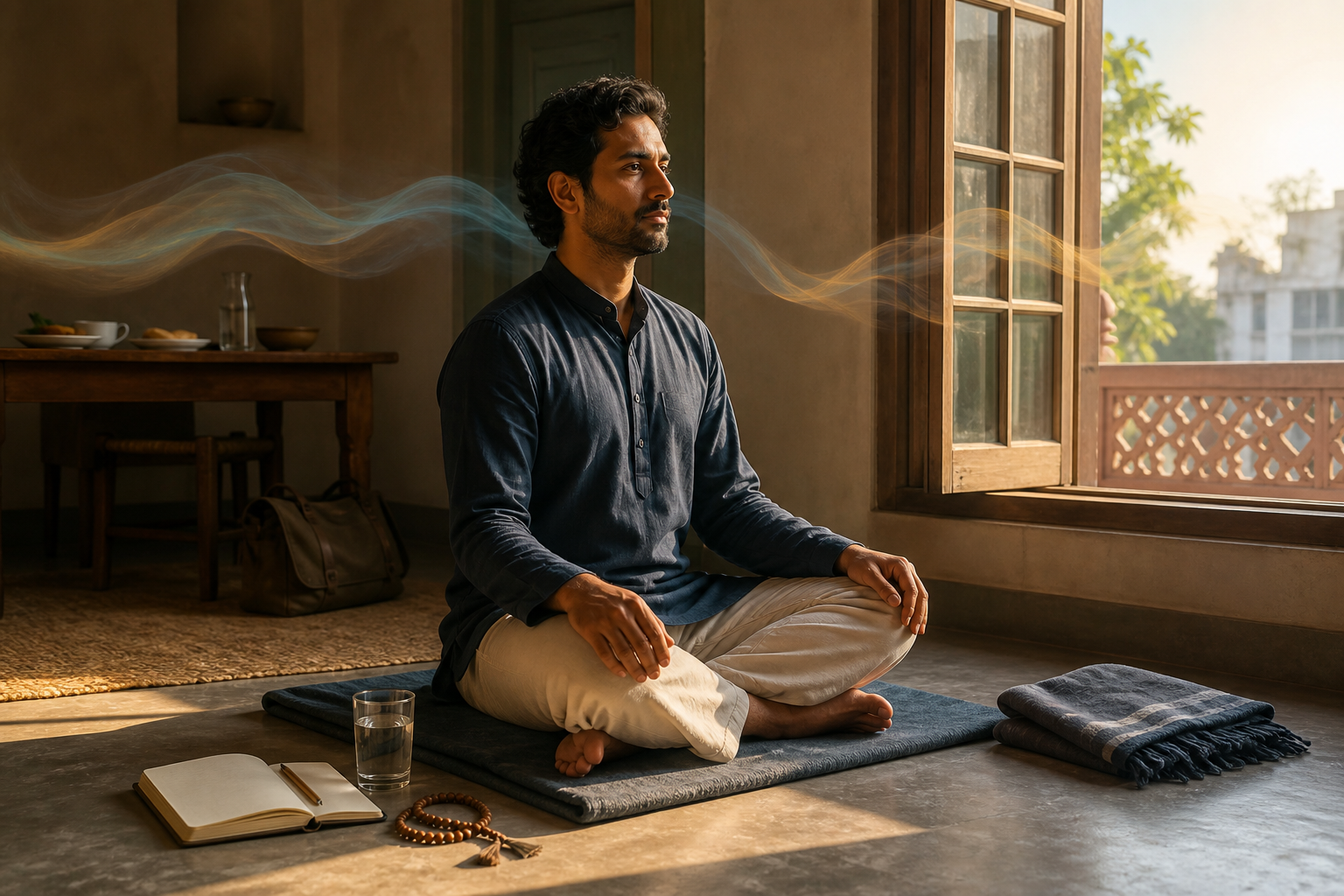
Dharmic practice links attention with ethics. A quiet mind is not automatically a wise mind, and concentration used to protect vanity or manipulate another person is not liberation. Yama and niyama establish the ethical ground; pranayama works with breath and vital energy; dhyana steadies attention; svadhyaya and satsanga refine understanding; compassion and seva carry insight into conduct.
Use the following sequence before a difficult conversation, during rumination, or when an impulse is demanding immediate action:
- Set the ethical boundary. Decide that agitation will not authorize deliberate harm, manipulation or words you know to be false. This gives buddhi a stable reference point.
- Include the body. Feel where the body is supported. Release avoidable effort in the jaw, shoulders or hands without demanding instant relaxation.
- Observe the natural breath. In Yoga and Ayurveda, mind and prana are treated as mutually influential. Let the breath become an object of attention without forcing its depth or holding it.
- Name the active inner function. Identify whether manas is jumping between options, citta is repeating an old pattern, ahamkara is defending an identity, or buddhi is trying to establish a clear course.
- Steady attention. Remain with the breath, a mantra, silent observation or the contemplative discipline native to your tradition. The purpose is enough space for an impulse to be seen before it becomes action.
- Choose the next dharmic act. Speak truthfully without avoidable cruelty, delay the response if discernment is still clouded, or turn attention outward through a concrete act of service.
Judge the practice by what follows it. Are you less compelled to defend every self-image? Can you correct yourself sooner? Does calm make you more available to another person’s suffering? Seva is especially important here because it tests whether inward practice has loosened self-concern or simply made it more sophisticated.
Gentle breath awareness and meditation may support attention and emotional regulation, and concepts such as interoception, vagal tone and neuroplasticity can help explain aspects of that change. They do not prove the metaphysics of Atman or Brahman, and they are not substitutes for medical or mental health care. Do not force breath retention or continue a technique that produces dizziness or escalating distress. Return to ordinary breathing, and seek qualified help when symptoms are persistent, severe or unsafe.
Choose a path without flattening the Dharmic traditions

Hinduism, Buddhism, Jainism and Sikhism share disciplined attention, ethical refinement and liberation from narrow self-concern. They do not make an identical claim about a universal Self. Using universal consciousness as a catch-all phrase can therefore conceal the very distinctions that make each path useful.
- Hindu traditions offer several models. Advaita speaks of Atman and Brahman; Sankhya distinguishes Purusha from Prakriti; Yoga trains the fluctuations of citta.
- Buddhism emphasizes momentariness and anatta. Mindfulness and compassion loosen attachment to reactions without requiring an eternal personal self to stand behind them.
- Jainism speaks of jiva as life endowed with chetana, or consciousness. Ahimsa and aparigraha refine the mind by confronting violence, possessiveness and attachment in conduct.
- Sikh wisdom centers the mind on Ik Onkar, the One, through Naam simran. Remembrance redirects attention from egoic fragmentation toward the divine unity that should become visible in service.
You do not need to turn these teachings into a hybrid vocabulary before using them. If your primary difficulty is automatic identification with thoughts, Buddhist analysis of momentariness and anatta offers a disciplined examination. If harm and possessiveness dominate, Jain vows expose the ethical roots of mental disturbance. If attention is fragmented by self-concern, Naam simran and seva provide a Sikh orientation toward the One. If you need to distinguish sensation, memory, identity and judgment, antahkarana gives you a Hindu diagnostic map.
Choose one coherent discipline as your foundation, learn its terms in their own setting, and let respectful comparison deepen rather than erase it. The shared Dharmic concern with truth, nonviolence, remembrance, attention and service becomes most credible when it changes how you meet another being.
Key takeaways
- In Hindu models, mind is an instrument known through consciousness; it is not automatically identical with the knowing awareness.
- Manas processes and prefers, buddhi discerns, ahamkara identifies, and citta carries memory and latent impressions.
- Advaita, Sankhya and Yoga should not be flattened into one metaphysical position, even when their practices produce related forms of self-observation.
- The five koshas remind you to examine body, breath, emotion, discernment and quiet ease rather than trying to solve every disturbance through thought alone.
- Buddhist anatta, Jain jiva, Sikh Ik Onkar and Hindu Atman-Brahman language are distinct teachings, not interchangeable names for one doctrine.
- The soundest test of contemplative insight is ethical conduct: less reactivity, clearer discernment, reduced harm, greater compassion and service.
At the next moment of mental turbulence, do not begin with the largest metaphysical claim. Identify the function that is active, include the body, steady the natural breath, and let buddhi choose the least harmful truthful response available. The nature of consciousness remains a vast inquiry. Your next action can still be clear.
References
