
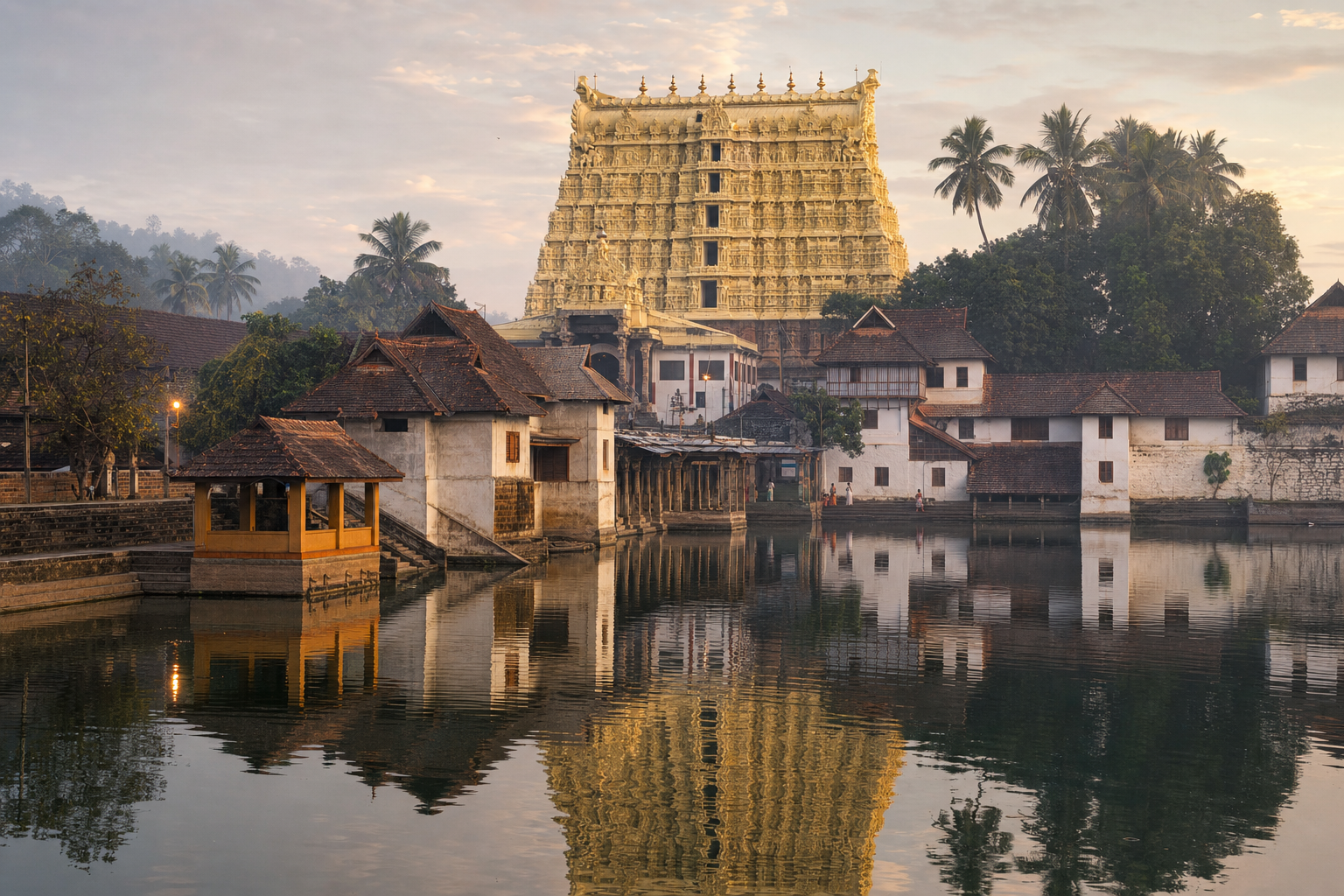
If you came looking for a single founding date and a one-line translation of Padmanabhaswamy Temple’s reclining Vishnu, the temple asks for a more careful reading. Its historical chronology, sacred memory, and living worship belong together, but they don’t answer the same questions.
You can understand the temple without confusing devotion with archaeology or reducing Ananta Shayana to decorative mythology. The key is to ask what each layer establishes: what the historical record can support, what the sacred image communicates, and what you should carry from darshan into daily dharma.
The temple’s history runs on three different clocks
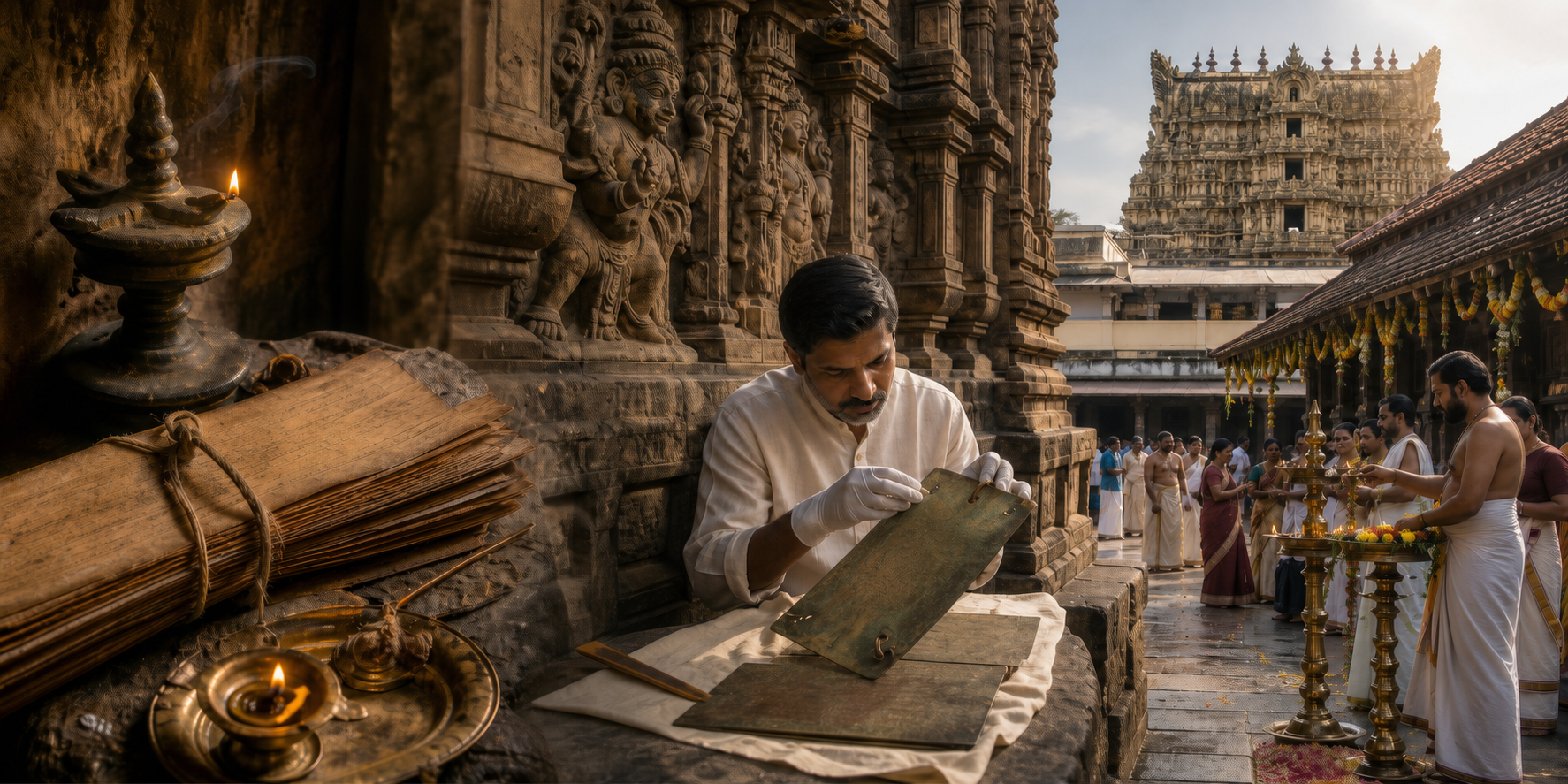
Padmanabhaswamy Temple stands in Thiruvananthapuram, Kerala’s capital. The relationship between deity and place is embedded in the city’s identity: Thiruvananthapuram literally means the city of Ananta. The name doesn’t merely tell you where the temple is. It shows how thoroughly the sacred presence has shaped the way the place understands itself.
To read that history accurately, keep three kinds of continuity separate:
- Sacred continuity concerns the enduring identity of the site as a kshetra, a place ordered around divine presence, pilgrimage, and worship.
- Textual continuity concerns the preservation of the temple’s sacred geography, theological meaning, local memory, and ritual framework through the kshetra-mahatmya tradition.
- Lived continuity concerns the community that sustains worship through daily practice, seasonal observances, festival cycles, custodianship, and the transmission of knowledge.
The pre-fourteenth-century provenance associated with the Ananta Shayana Kshetra Mahatmya gives us an important but limited historical conclusion. The careful inference is that the temple’s sacred identity was already established strongly enough to be preserved within a developed sacred-site tradition by that period. It does not, by itself, supply an exact construction date for every part of the present temple or prove that buildings and practices remained physically unchanged.
This distinction protects both history and faith. A tradition can remain recognizably continuous while its material setting, custodial arrangements, artistic forms, and urban surroundings develop. Continuity means that a community keeps transmitting an identity and its obligations; it doesn’t require history to stand still.
When you encounter a claim that the temple is “ancient,” therefore, ask what is actually being dated. Is it the sanctity of the site, the circulation of a sacred narrative, an inscriptional memory, a ritual lineage, or a particular structure? Until that question is answered, a dramatic date tells you less than it appears to.
Ananta Shayana is a complete theological composition
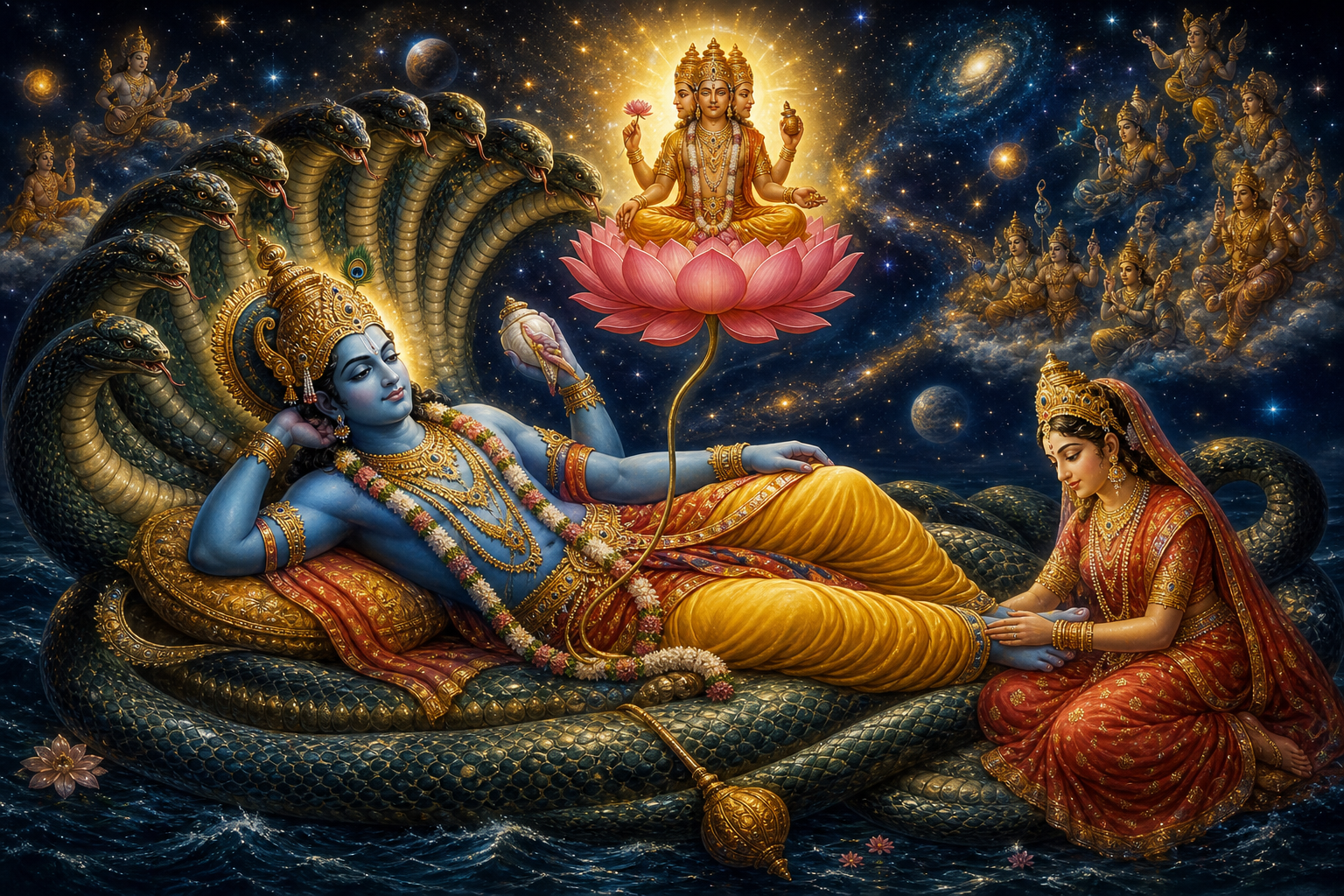
The central form presents Vishnu reclining upon Ananta, the cosmic serpent also known in Vaishnava usage as Adi Sesha. Read the entire composition before isolating any one element. Vishnu, the serpent support, the reclining posture, yoga-nidra, and the name Padmanabha work together.
- Ananta means the unending or boundless. The serpent places the divine repose against a horizon larger than ordinary human time.
- Shayana means reclining. Here reclining is not collapse, defeat, or neglect; it is an ordered posture of repose.
- Yoga-nidra is not ordinary sleep caused by exhaustion. Within this iconography, it signifies poised inwardness while cosmic order remains sustained.
- Padmanabha, “lotus-naveled,” brings generative possibility into the identity of the reclining deity. Creation is not separated from stillness; it is held within it.
- Vishnu supplies the governing meaning of preservation. The image centers the power that maintains order rather than celebrating agitation for its own sake.
One common misreading begins with the serpent. In many modern visual habits, a serpent is automatically treated as a sign of evil, danger, or an enemy awaiting conquest. That framework fails here. Ananta bears the reclining Vishnu. The serpent is support, not adversary, and its endlessness expands the image from an episode of conflict into a vision of cosmic duration.
A second misreading treats repose as inactivity. The rhythm of creation, repose, sustenance, and renewed manifestation is central to Ananta Shayana. Rest and action are not enemies in this vision. Proper action emerges from an order deeper than restless motion.
This is why the form can feel calm without being empty. The deity doesn’t need to display strain in order to sustain the cosmos. The icon turns equilibrium into power: stillness holds potential, preservation makes future action possible, and repose prevents activity from becoming disorder.
You can apply that distinction without pretending that a personal reflection is an official temple ritual. Before an important duty, ask whether you are gathering yourself or merely postponing action. Repose aligned with dharma clarifies the next obligation. Avoidance leaves the obligation untouched. Ananta Shayana points toward the first kind of stillness.
Sacred memory and historical evidence answer different questions
A kshetra mahatmya preserves the greatness and sacred character of a place by joining foundational narrative, sacred geography, theology, ritual responsibility, and local memory. Its purpose is wider than supplying a modern chronology. It tells worshippers why a place matters, how it should be approached, and what kind of relationship joins deity, land, ritual, and community.
Questions of meaning are answered through sacred narrative; precise questions of chronology require inscriptional, manuscript, architectural, and other historical evidence appropriate to the claim. Neither inquiry needs to threaten the other. Confusion begins only when one type of evidence is forced to do a job for which it was not designed.
Use this three-question test whenever you assess a historical claim about Padmanabhaswamy Temple:
- What exactly is being claimed? Distinguish the age of the sacred site from the date of a surviving structure, inscription, manuscript, or present ritual form.
- What kind of evidence supports it? Sacred narrative establishes theological and communal meaning; it should not be silently converted into an exact architectural date.
- How strong is the conclusion? A record from before the fourteenth century can establish recognition by that period without identifying the first moment at which worship began.
This method also helps you avoid the opposite error: dismissing sacred memory because it doesn’t behave like a construction ledger. Kerala’s temples developed within a layered world of worship, artistic lineages, trade routes, scholastic communities, and collective memory. A living kshetra carries relationships that a date alone cannot record.
Manuscript transmission and ritual participation are therefore forms of custodianship. They preserve not only information about the past but also responsibilities in the present. The relevant heritage question is not simply, “How old is this?” It is also, “What must a community continue doing so that this sacred identity remains intelligible?”
How to approach the image during darshan or study
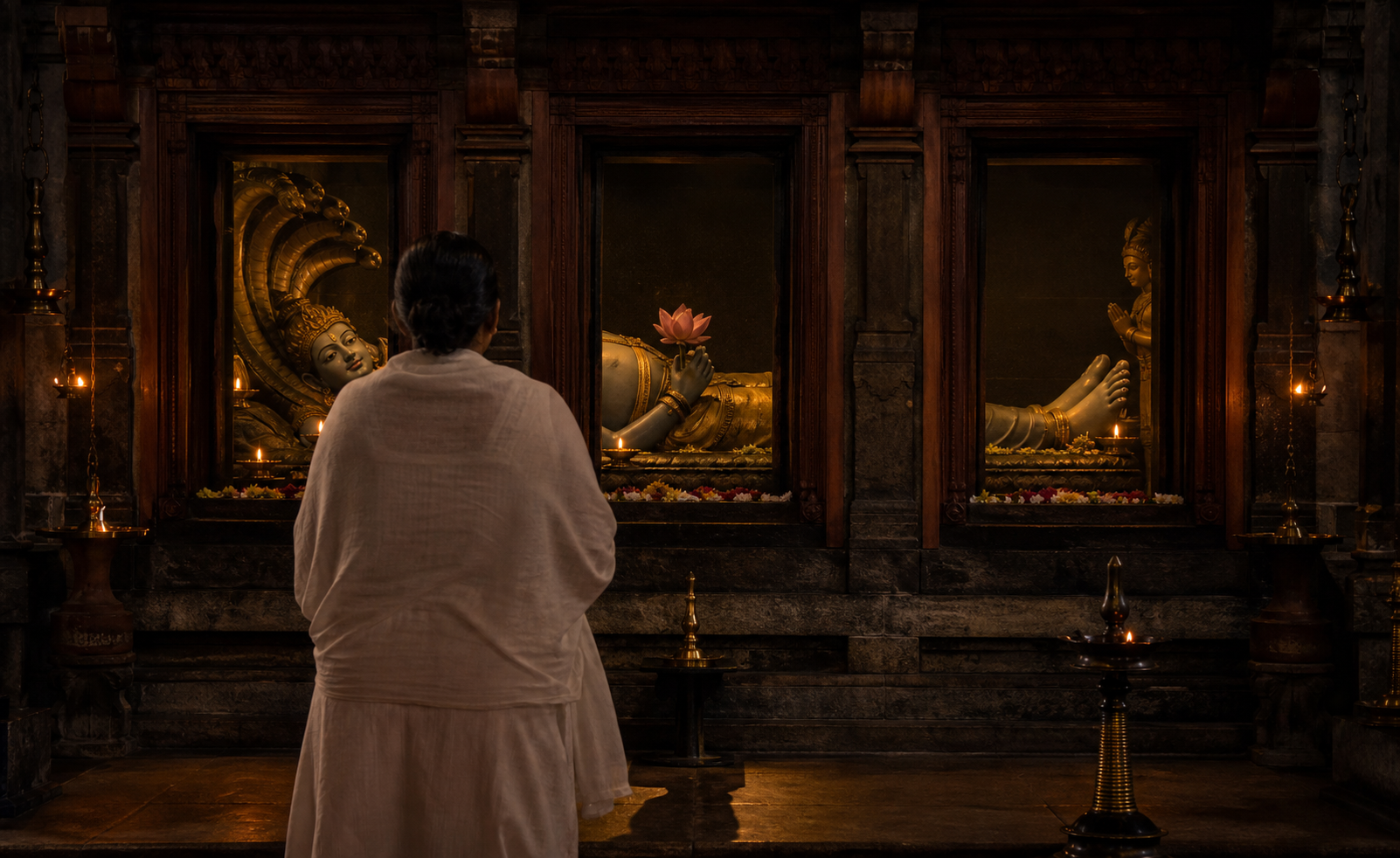
You don’t need to master every historical debate before approaching Ananta Padmanabha. You do need a disciplined way of looking. The following sequence works whether you visit the kshetra or encounter the image through serious study:
- Begin with the names. Remember that Ananta directs attention toward the boundless, Shayana toward repose, Padmanabha toward generative potential, and Vishnu toward sustenance.
- See relationships rather than separate objects. Notice how Ananta supports, Vishnu reclines, stillness contains possibility, and the entire composition expresses order.
- Resist importing an alien serpent-versus-deity conflict. In this form the serpent is the ground of repose, so interpreting it as a defeated enemy reverses the visual grammar.
- Let the pace of worship correct the pace of your mind. Daily worship, seasonal observances, and festivals belong to an ordered cycle; they are not disconnected spectacles.
- Keep historical and devotional questions side by side. You may ask how a tradition developed while also receiving what its sacred form is meant to disclose.
- Leave with one duty clarified. Ask which responsibility in your life needs steadiness rather than agitation, then take the next concrete step instead of turning contemplation into indefinite delay.
This approach also makes room for readers from other Dharmic traditions without flattening their differences. Disciplined contemplation, ahimsa, seva, ethical living, and the cultivation of wisdom resonate across Hindu, Buddhist, Jain, and Sikh paths. Those resonances can support mutual understanding, but they don’t make the traditions interchangeable. Respectful comparison notices shared ethical disciplines while allowing each theology and practice to retain its own voice.
For a Hindu pilgrim, the final movement is especially practical. Vishnu’s repose isn’t permission to withdraw from dharma. It reveals the inward order from which dharmic action can proceed without panic. If your stillness makes you more capable of protection, service, restraint, and truthful duty, it has begun to resemble the lesson of the image.
Key takeaways
- Padmanabhaswamy Temple should be understood through historical chronology, sacred memory, and living worship; no single layer replaces the others.
- The temple’s place in a text believed to predate the fourteenth century supports an early established sacred identity, not an exact date for every present structure.
- Ananta is Vishnu’s support, not an enemy. Reading the serpent as evil distorts this particular iconography.
- Yoga-nidra expresses poised cosmic repose rather than exhaustion, negligence, or lifeless inactivity.
- The practical lesson is disciplined stillness that strengthens dharmic action, not contemplation used to avoid responsibility.
On your next visit or period of study, don’t chase one dramatic fact. Hold one precise question instead: what is being sustained here? Follow it from Ananta’s support to Vishnu’s repose, and then into the duty waiting for you beyond the temple.
References
