

You can understand that everything changes and still find yourself gripping a relationship, a plan, or a familiar identity as if your vigilance could keep it unchanged. The mind quietly adds a condition to love: this person must remain as they are, this effort must produce the result we expect, or this season of life must not end.
Dharmic non-attachment helps you remove that condition without removing love. It gives you a practical way to care fully, fulfil your responsibilities, and meet change without making your peace dependent on controlling what happens next.
First separate impermanence, samsara, and non-attachment
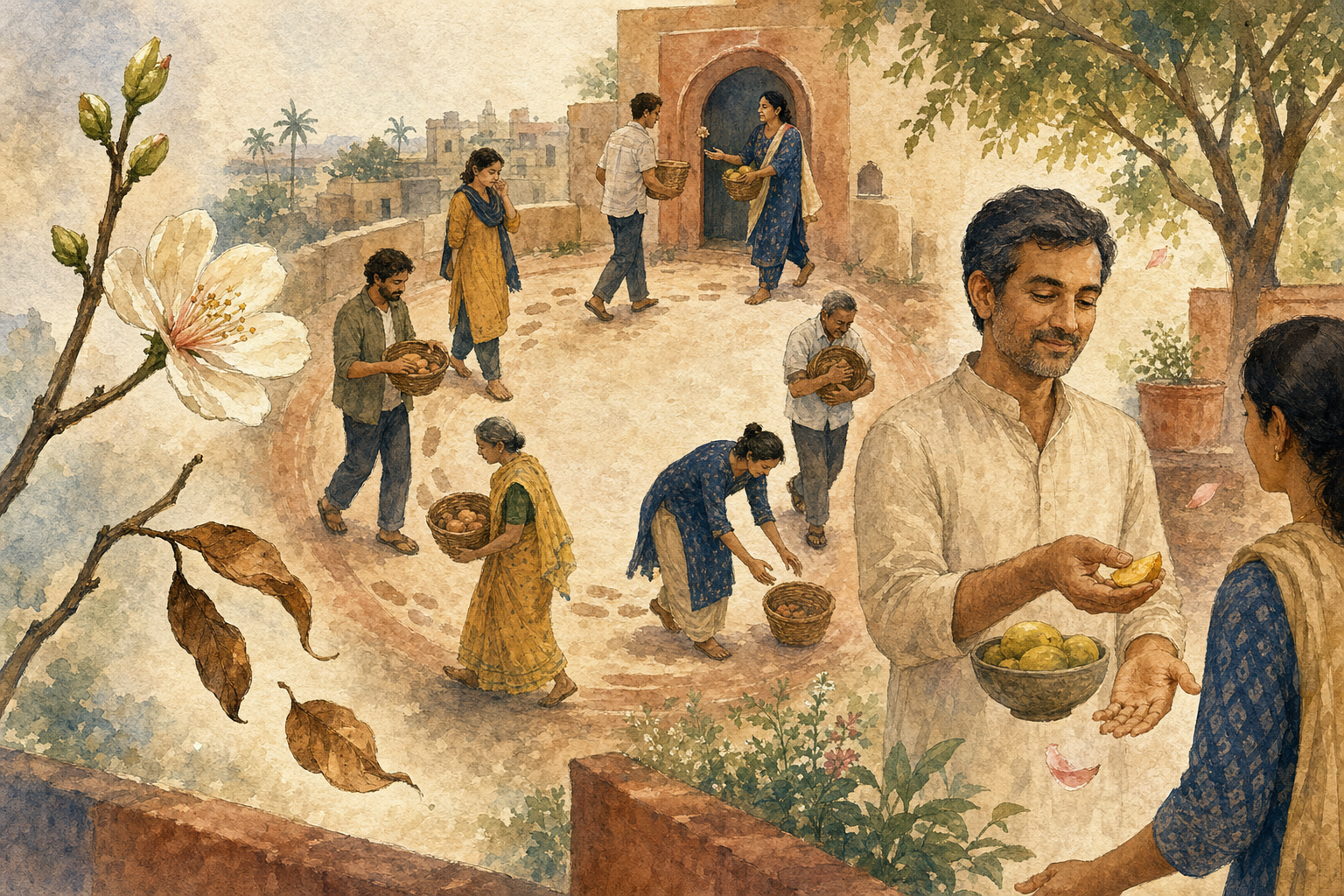
These ideas belong together, but they do not mean the same thing. Confusing them can turn a demanding spiritual discipline into a vague instruction to accept whatever happens.
Impermanence is the fact you must notice
Your body changes. Children become independent. Parents age. Success loses its shine. Roles that once defined you eventually pass to someone else. Even a welcome experience cannot be held in one form indefinitely. Embodied existence follows a rhythm of birth, growth, fruition, decline, and transformation.
Impermanence does not tell you that nothing matters. It tells you that importance and permanence are different qualities. A conversation can matter precisely because the opportunity to have it will not remain forever. A responsibility can be sacred even though the role is temporary.
Samsara is the larger condition of entanglement
In Hindu thought, samsara is not simply the observation that circumstances change. It is the cycle of birth, death, and rebirth in which action has consequences, desire repeatedly seeks satisfaction, and ignorance obscures the nature of the self. Karma makes conduct consequential; dharma gives conduct an ethical direction; moksha is freedom from compulsory participation in that cycle.
This makes samsara intensely practical. Whenever you expect a temporary thing to provide permanent security, you reproduce its logic in the present. The object may be a body, reputation, relationship, possession, opinion, or social role. The pattern is the same: you ask something conditioned by change to guarantee that change will not disturb you.
Non-attachment is the discipline you can practise
Non-attachment means giving up possessiveness toward an action, person, identity, or result. It does not mean giving up discernment, responsibility, affection, or effort. In the Bhagavad Gita’s practical synthesis, you are called to act according to duty while refusing to make the fruits of action the foundation of your identity and inner balance.
Within a Hindu account, avidya includes mistaking the enduring self for the temporary body. That confusion can spread from the body to everything associated with it: my family, my achievement, my status, my future. Affection then becomes mixed with anxiety because care is burdened by the impossible demand to control birth, ageing, separation, and death.
You can detect that burden by asking one sharp question: What is mine to do, and what am I trying to guarantee? The first part reveals your duty. The second exposes attachment. You may be responsible for making a careful decision, keeping a promise, protecting a child, apologising, or seeking help. You are not responsible for forcing every person and circumstance to produce your preferred outcome.
Use a repeatable practice when the mind starts clinging

Non-attachment becomes real at the moment an outcome feels threatened. That is when philosophy must become a sequence of actions rather than an admired idea.
- Name the change without adding a prophecy. Say what has actually happened: a plan was refused, a relationship is changing, a child made a choice, or a role is ending. Do not immediately add that everything is ruined, no one respects you, or nothing will be secure again. The event may be painful; the prophecy is an additional construction.
- Notice the demand hidden inside the distress. Complete this sentence privately: I can be at peace only if… The ending often reveals the object of attachment. It may be another person’s agreement, a particular public image, a guaranteed return on effort, or the preservation of a familiar identity.
- Name your present dharma. Ask what honesty, compassion, courage, restraint, or service requires from you now. Make the answer behavioural. Speak clearly. Listen without interrupting. Keep the appointment. Prepare the meal. Set the necessary boundary. Correct the mistake. A general intention to be spiritual is too vague to guide conduct.
- Separate action from fruit. Put your energy into the quality of the action you can perform. Leave the response, timing, recognition, and final result outside your claim of ownership. Releasing the fruit does not mean ignoring it. Results still provide information, and harmful consequences still require correction. You simply stop treating one desired result as something reality owes you.
- Offer and release. Use japa, prayer, silent remembrance, meditation, or a deliberate inward offering to loosen the mind’s claim over the result. A useful formulation is: This outcome matters, but it does not belong to me. My conduct is mine to purify.
End the day with a brief review. Identify where you served well, where fear became control, and which unfinished duty still belongs to you. Then distinguish that duty from mental replay. If another action is required, decide what it is. If no action remains, repetition is not responsibility; it is the mind trying to obtain certainty by rehearsing the problem.
This practice avoids two opposite errors. One is attachment disguised as commitment: over-monitoring, coercion, resentment, or refusal to accept another person’s agency. The other is avoidance disguised as detachment: withholding care, abandoning obligations, or claiming that consequences do not matter. Dharmic steadiness lies between them. You act wholeheartedly and surrender ownership, not accountability.
Turn family attachment into responsible affection

Family life exposes attachment quickly because love, fear, identity, and duty meet in the same place. The solution is not emotional distance. It is a movement from possession to stewardship: this person is entrusted to your care, but is not an extension of your will.
- With a child: provide protection, instruction, boundaries, and a stable example. Do not confuse good parenting with arranging every consequence or preventing every age-appropriate struggle. Guidance should gradually strengthen the child’s capacity to choose well.
- With a partner: practise truthful speech, reliability, listening, and repair. Do not demand sameness as proof of love. A relationship can remain faithful while both people continue to change.
- With an ageing relative: offer presence, practical assistance, patience, and dignity. Do not measure the depth of your love by your ability to stop decline. Some changes call for better care, not denial that change is occurring.
- During conflict: ask whether you are protecting dharma or protecting your preferred image of the family. A calm boundary may express less attachment than forced harmony, because it does not make appearances more important than truthful conduct.
- During grief: do not treat sorrow as proof that your practice has failed. Non-attachment does not require emotional numbness or a performance of serenity. It asks you not to turn grief into a claim that the impermanent should have become permanent for your sake.
Before intervening in another person’s life, test the impulse. Is this genuinely part of your role? Is protection or practical help needed? Will the action strengthen the other person’s capacity, or mainly quiet your own anxiety? The answers will vary with age, vulnerability, and responsibility. The point is not to avoid intervention; it is to distinguish service from control.
Seva helps make that distinction visible. Service asks, What can I offer? Possessiveness asks, How can I make this person secure my preferred future? The outward actions can look similar, but their inner effects differ. Service can remain warm when its advice is declined. Possessiveness often turns help into resentment when obedience does not follow.
Do not use non-attachment to silence another person’s pain, excuse indifference, or remain passive in a harmful situation. Telling someone to let go can become a way of avoiding the care, protection, apology, or justice that dharma requires. Apply the teaching first to your own grasping. Offer others compassion and room to work through change honestly.
Learn across Dharmic paths without flattening their differences

Hinduism, Buddhism, Jainism, and Sikhism all offer disciplines for living amid change, but they should not be reduced to one interchangeable doctrine. Their metaphysical accounts and vocabularies differ. Their practical convergence appears in ethical conduct, inward discipline, compassion, and freedom from grasping.
- Hindu paths: vairagya, or dispassion toward possessive desire, belongs beside seva, devotion, self-knowledge, and dharmic action. The Bhagavad Gita joins vigorous participation in life with freedom from ownership of the fruits. The aim is not to make action insignificant, but to purify why and how you act.
- Buddhist paths: anicca draws attention to the impermanence of conditioned experience, while dependent origination clarifies that phenomena arise through conditions rather than stand alone. Clinging intensifies suffering; compassion does not require clinging. In practice, observe a feeling, desire, or fear arise and pass before treating it as a permanent command.
- Jain paths: aparigraha, or non-possessiveness, works with ahimsa, self-restraint, and right knowledge. Possession is not only a question of how much you own; it is also the hold that objects and desires acquire over consciousness. Practise by identifying what you cannot share, lose, or see changed without hostility.
- Sikh paths: hukam directs attention to divine order, while remembrance of the Divine Name and seva shape life within the world. The householder setting matters: responsibility and spiritual freedom are not opposites. You can work, provide, love, and serve without making egoic control the centre of those activities.
This shared practical horizon is why compassion, service, remembrance, and non-possessiveness can deepen family love rather than weaken it. It is also why accepting samsara as a description of conditioned life is not the same as resigning yourself to bondage. Ethical action and inward discipline turn change into an occasion for insight, while liberation remains the horizon beyond compulsive grasping.
Choose the practice that addresses the form your attachment is taking. If possessions or status dominate the mind, use aparigraha to examine what you are protecting. If a feeling seems permanent and absolute, observe its arising and passing through the lens of anicca. If anxiety about success is corrupting your effort, return to the Gita’s distinction between duty and fruit. If household obligations feel spiritually inferior, let seva and remembrance transform the way you inhabit them.
Key takeaways
- Impermanence is the changing nature of conditioned life; samsara is the larger cycle of bondage; non-attachment is a disciplined response to both.
- Non-attachment removes possessiveness from love. It does not remove affection, duty, boundaries, grief, or accountability.
- Ask what is yours to do and what you are trying to guarantee. Perform the duty; release the demand for certainty.
- Judge detachment by conduct. If it produces neglect, coldness, or avoidance, it has become an excuse rather than a spiritual discipline.
- Dhyana, japa, remembrance, scripture study, gratitude, and seva train the mind to release ownership while remaining fully engaged.
- Dharmic traditions offer related practices but distinct teachings. Learn from their convergence without pretending their doctrines are identical.
The next time change unsettles you, do not begin by ordering yourself to feel detached. Name the fact, find the demand hidden inside your fear, and perform the next duty cleanly. Then release what was never yours to command. Repeated in ordinary decisions, that movement turns samsara from a force that drives the mind into a field of practice through which the mind can become free.
References
- DharmaRenaissance Blog — Breaking the Illusion of Attachment: A Dharmic Perspective on Samsara and Family Love
- DharmaRenaissance Blog — Embracing Samsara: The Unavoidable Cycle of Life and Transformation in Hindu Thought
