
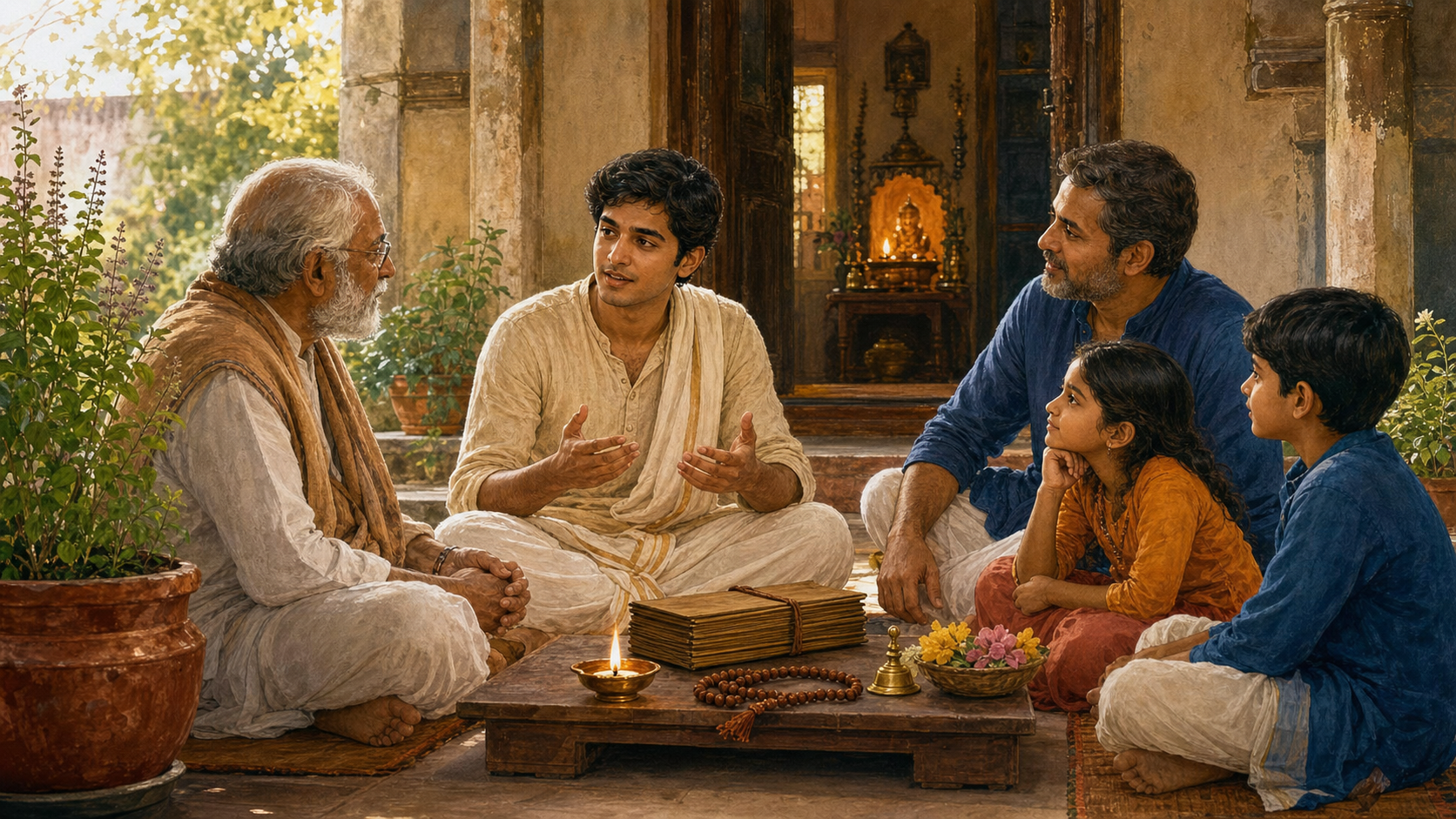
You may know the discomfort: Hindu knowledge is praised in public, yet the version offered to you often arrives as a list of ancient achievements, wellness techniques, or patriotic proofs. It can make you proud for an afternoon without helping you answer what a human being is, what knowledge is for, or how you should live.
If you want reclamation that lasts, you have to hold two tasks together. Hindu knowledge must be restored within living lineages, practices, debates, and sacred purposes. Hindu identity must also become something a person can affirm, inherit, or return to with dignity. The first task without the second produces an archive. The second without the first produces a badge.
Reclaim the purpose of knowledge, not just its label
Knowledge reclamation and identity reclamation overlap, but they are not interchangeable. Knowledge reclamation asks who defines valid inquiry, which authorities deserve attention, what kind of human being education should form, and what ends learning should serve. Identity reclamation asks whether a Hindu can name that belonging without apology, participate in its institutions, and pass it to the next generation.
The tempting shortcut is to replace Western material with Indian material while leaving the structure of education untouched. That scratch-and-replace model of decolonization can change the names in a syllabus without changing its governing assumptions. A course may celebrate Sanskrit, yoga, the epics, or ancient sciences and still treat them as inert information delivered for examinations, employability, national prestige, or cultural display.
Those worldly benefits are not illegitimate. The problem begins when they become the only benefits we know how to defend. If Sanskrit matters only because it might help technology, if the Gita matters only because it might improve management, or if a ritual matters only because it can be translated into a measurable modern outcome, the inherited tradition remains answerable to an external court. Its vocabulary has returned, but its authority has not.
Before you support a curriculum, reading group, temple class, or cultural project, ask five questions:
- What is the stated end of learning: employment, cultural confidence, ethical formation, liberation, devotion, or some clearly explained combination?
- Who is allowed to interpret the material: only a modern presenter, or also the acharyas and communities that preserved it?
- Does the learner encounter a living practice, or only information about practices?
- Are Sanskrit and other inherited terms allowed to carry meanings that do not fit neatly into English categories?
- Does the program disclose disagreements among Hindu traditions, or manufacture a single convenient version of Hinduism?
Thin answers reveal a heritage-display project. Substantial answers reveal the beginning of a knowledge tradition. This test also prevents a common overcorrection: declaring anything Indian to be true merely because it is Indian. Reclamation is not reversal of prejudice. It is recovery of the ability to investigate from within Bharatiya categories while remaining intellectually accountable.
Put texts back inside lineage, practice, and Bhagavan
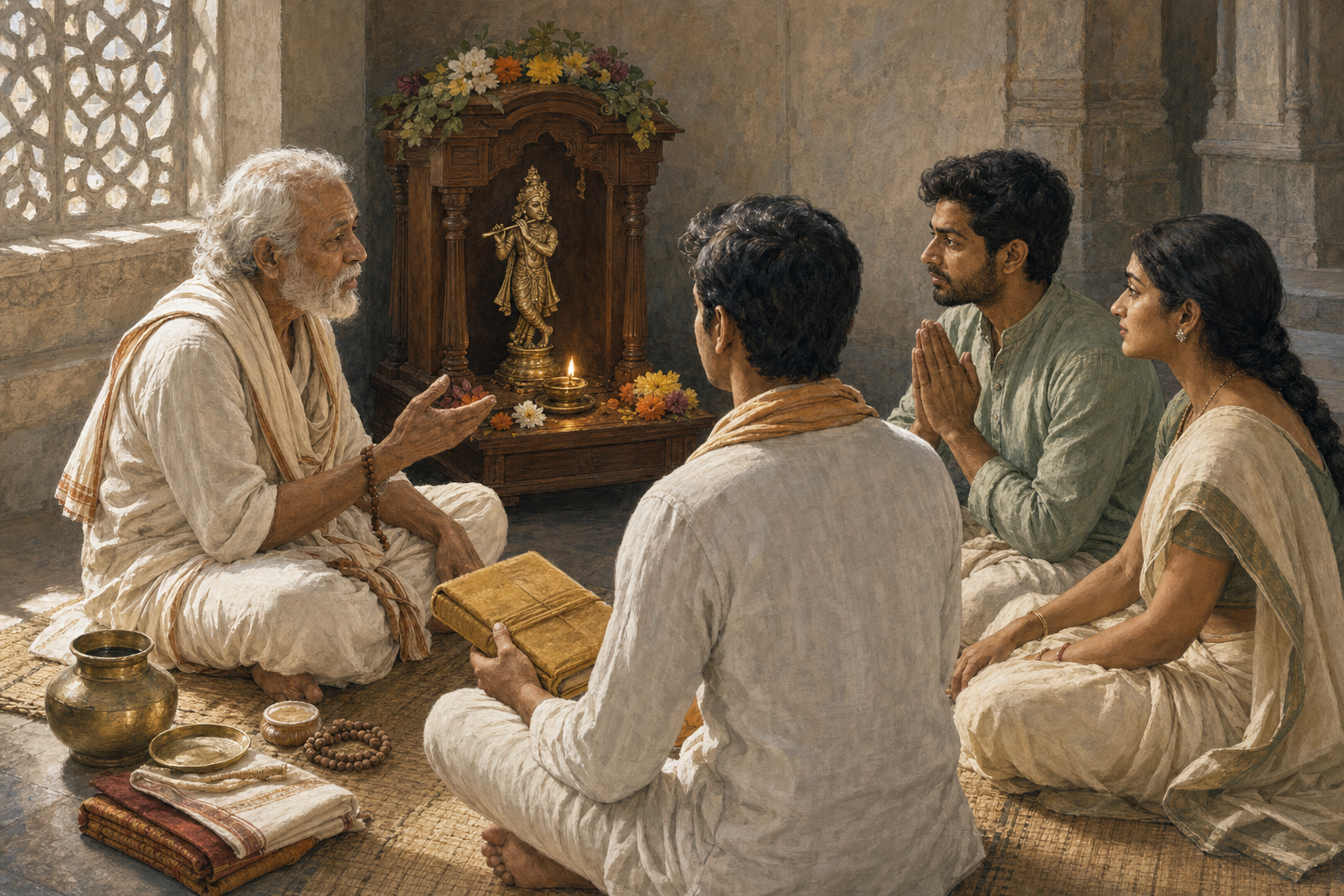
A sacred text is not reclaimed merely when it appears on a reading list. You also need to recover the relationships around it: the question being asked, the teacher and student, the vocabulary, the commentarial lineage, the discipline expected of the learner, and the transformation toward which the teaching points.
For large domains of Hindu learning, the ultimate concern was not only the prosperity of Bharat, bodily health, or intellectual achievement. It was also knowledge oriented toward Bhagavan, liberation, right action, and the proper relation between the human being and reality. Remove that orientation and you may retain impressive content while losing the reason the tradition considered the content worth preserving.
This gives you a demanding but useful test. Would Adi Shankara, Madhvacharya, or Sri Raghavendra Swami recognize the questions, methods, and purposes of what is now presented as Indian Knowledge Systems? They would not have agreed on every answer. That is precisely the point. A serious reclamation restores principled disagreement among sampradayas instead of flattening every acharya into a spokesperson for generic spirituality.
Use the following reading discipline whenever you study a Hindu text:
- Name the standpoint. Identify the sampradaya, commentator, translation, or modern interpretive frame you are using. Do not present one interpretation as though Hindu traditions have never disputed it.
- Preserve key vocabulary. Learn what an important term does within the text before replacing it with an English word. A translation can help you enter a teaching, but it can also quietly decide the teaching for you.
- Restore context. Ask who is speaking, to whom, under what conditions, and for what immediate purpose. A detachable quotation is easier to circulate, but easier to misuse.
- Connect study to discipline. Where the tradition calls for recitation, worship, contemplation, ethical observance, or guidance from a qualified teacher, do not treat those as decorative additions to the intellectual content.
- State the end. After studying, write one sentence explaining what the teaching asks you to know, one explaining what it asks you to become, and one explaining what it asks you to do.
A management lesson drawn from the Gita may be a legitimate application. It becomes a distortion when the Gita is reduced to corporate grooming and its theological, ethical, and liberative claims are treated as embarrassing packaging. Application should follow understanding; it should not replace it.
The same rule applies to the Ramayana and Mahabharata. Their civilizational and historical importance can be discussed without hiding their sacred character. National memory and devotion do not have to be enemies, but neither should the nation quietly take the place of the divine.
Give the next generation questions worth inheriting
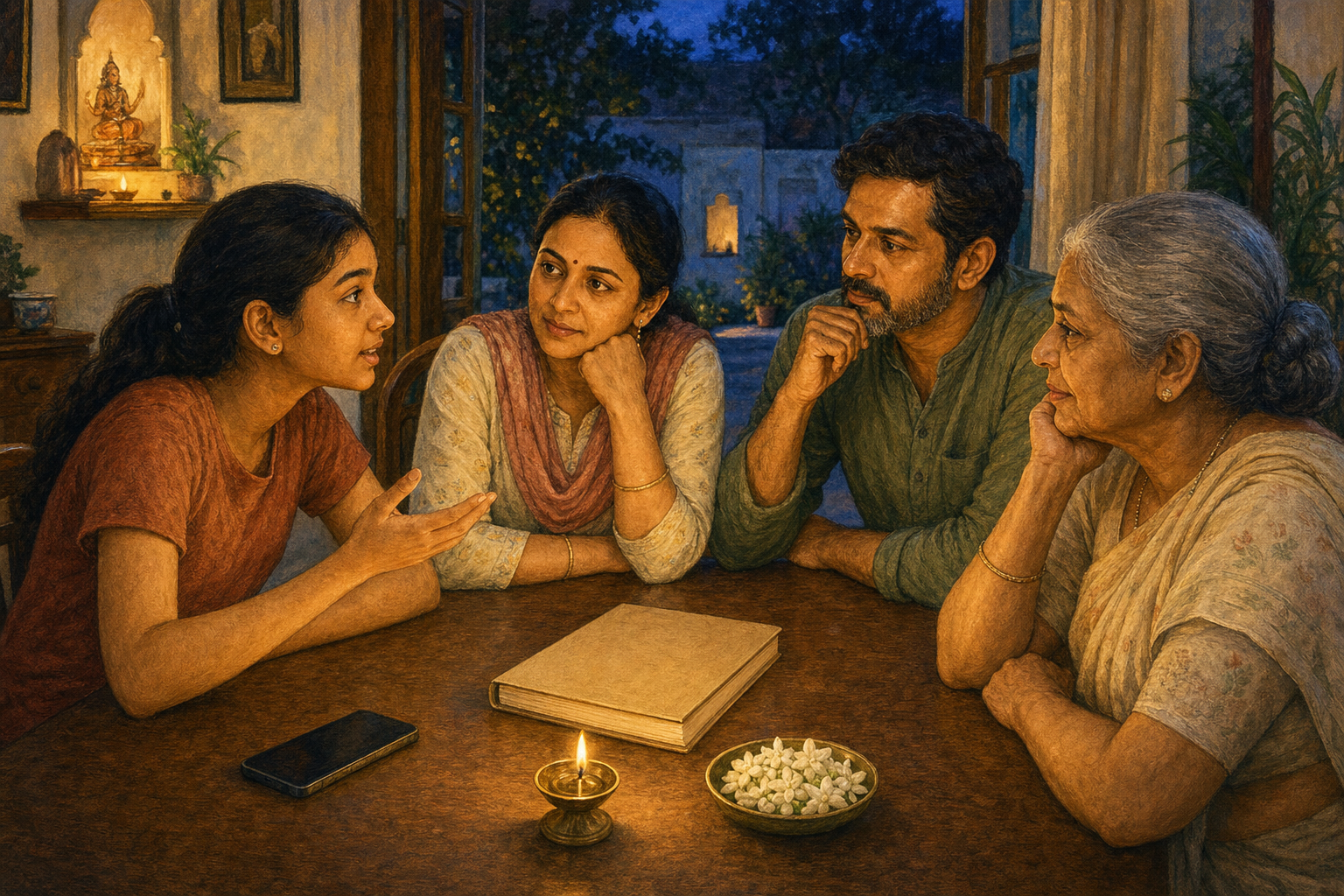
A younger person may hear the word decolonization very differently from a parent or grandparent. One generation may picture Gandhi and political independence. Another may associate the term with contemporary protest movements, campus ideologies, economic anxiety, artificial intelligence, or a future that appears ecologically and professionally unstable. Assuming that the phrase Indian Knowledge Systems will carry the same meaning for both generations is a reliable way to lose the younger one.
Begin by asking what the student thinks has gone wrong. Do not begin with a correction or a catalogue of achievements. If the concern is academic pressure, alienation, purpose, injustice, or the fear of becoming economically disposable, show how a Hindu tradition frames the human being before asking the student to admire its antiquity. A living curriculum must be able to engage the questions Who am I? How did I get here? What is my purpose?
A useful learning unit can be built around five movements:
- Start with a real question, such as what knowledge is for, what makes an action right, or whether freedom means having no obligations.
- Read a selected passage in a reliable translation while retaining the central Sanskrit or regional-language terms.
- Introduce at least one traditional commentary and, where relevant, a competing interpretation. Let the student see that inherited thought contains argument, not only instruction.
- Connect the teaching to an embodied setting: a temple, a home practice, a festival, recitation, service, or conversation with a competent practitioner.
- Ask the student to formulate the teaching, the strongest objection to it, and the practical consequence of accepting it.
This approach does more than produce agreement. It produces competence. A student who can repeat that ancient India was great may still be unable to recognize a mistranslation, distinguish two schools, or explain why a practice exists. A student who can define a key term, locate an interpretation within a lineage, identify a disagreement, and connect teaching to conduct has begun to inherit knowledge.
Measure your educational work accordingly. Do not count only attendance, certificates, social-media reach, or facts memorized. Ask whether learners can read more carefully, question imported assumptions, locate authority, and undertake a practice with understanding. Pride may attract attention. Capability keeps a civilization alive.
Make Hindu return an act of agency, not spectacle
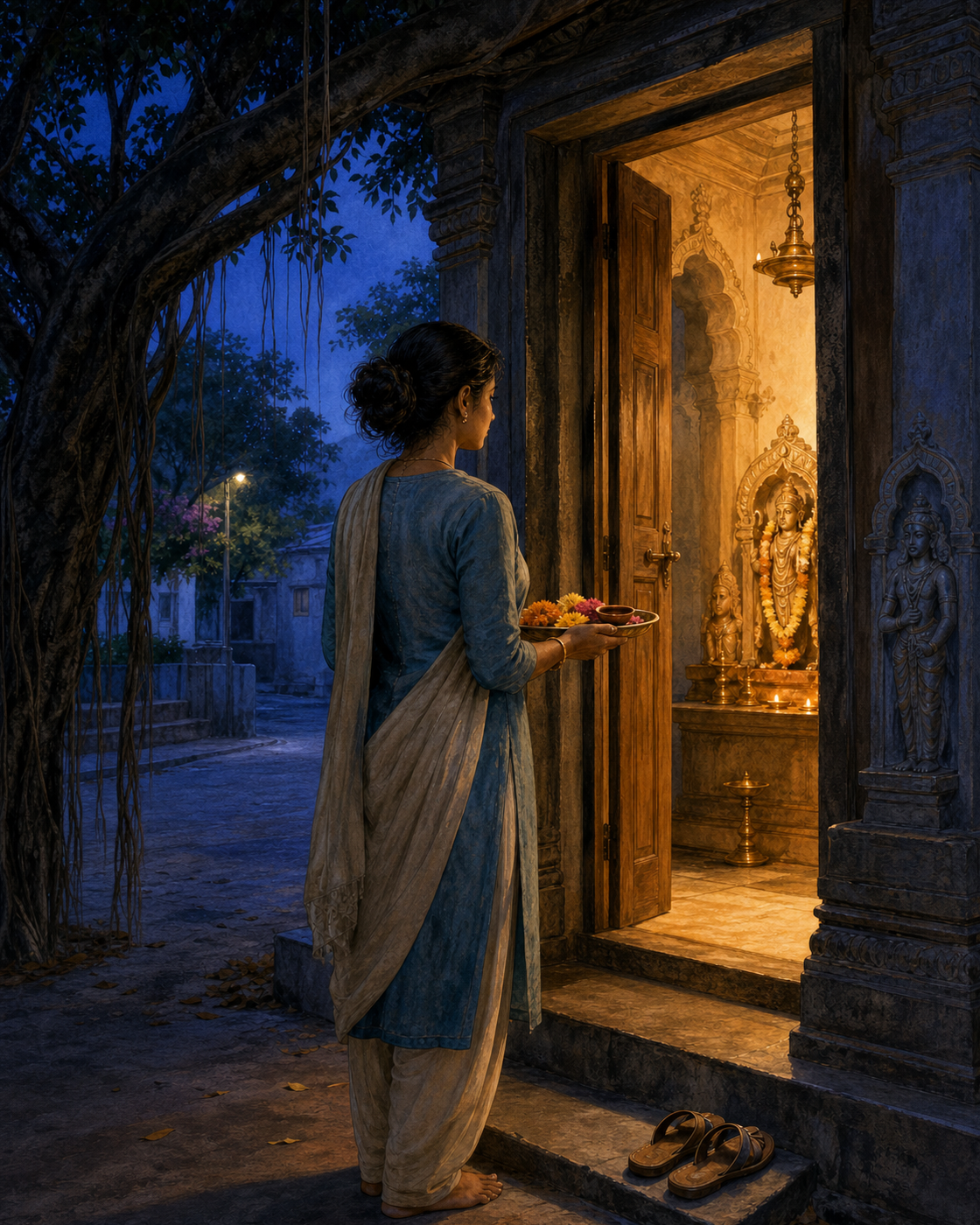
Civilizational reclamation also concerns people who wish to return to Hindu Dharma. Hindu society possesses public memories of return, not only stories of departure. At a Solapur observance marking the 350th anniversary of Netaji Palkar’s reconversion under Chhatrapati Shivaji Maharaj, organizers said that five individuals formally returned to the Hindu fold.
A public ceremony can keep that civilizational memory visible. It cannot, by itself, tell you whether a return will become durable belonging. A person needs more than a moment on a stage. The real work begins in the temple, household, study circle, festival calendar, and network of relationships that follow.
If you help organize a return, use a person-first discipline:
- Establish voluntary intent privately. The person should understand the rite and be free to pause or withdraw without public embarrassment.
- Let the returnee control the personal story. Do not demand a dramatic testimony, denunciation of others, photograph, or published name as the price of acceptance.
- Seek tradition-specific guidance. A qualified acharya, priest, or community authority should explain the relevant rite instead of treating every Hindu lineage as procedurally identical.
- Prepare a place to land. Introduce the person to a dependable local family, teacher, temple, or satsanga that can answer ordinary questions after the ceremony.
- Teach the first practices clearly. Explain worship, festivals, food customs, basic vocabulary, and community expectations without assuming prior knowledge or using ignorance as a test of sincerity.
- Do not impose a political loyalty test. Religious belonging should not depend on performing the preferences of an organization, party, or public campaign.
- Follow up after the attention has moved elsewhere. Ask what remains confusing, whether the person has encountered exclusion, and what kind of learning or pastoral support is still needed.
The language of shuddhi also requires care. A traditional rite can carry a specific inherited meaning, while the same word can sound like a judgment that the returning person is inherently impure. Explain what the rite means within the relevant tradition. Never use its language to humiliate the person it is meant to welcome.
This is where knowledge reclamation and identity reclamation meet. A community that remembers a ceremony but cannot teach its own theology offers belonging without depth. A scholar who can explain every doctrine but treats returnees as an embarrassment offers knowledge without civilizational confidence. Hindu renewal needs both intellectual seriousness and a hospitable social body.
Key takeaways: test any reclamation effort
- Changing the content is not enough. Genuine reclamation also changes the questions, authorities, methods, practices, and ends of learning.
- Worldly usefulness may support Hindu knowledge, but it should not become the sole court before which Dharma must justify itself.
- A sacred text remains thin when separated from vocabulary, context, commentary, sampradaya, discipline, and its orientation toward the divine.
- Young people need arguments and existentially serious questions, not only a heritage inventory or instructions to feel proud.
- Differences among Hindu schools are intellectual assets. Naming them honestly is more faithful than manufacturing a generic consensus.
- Religious return must rest on consent, dignity, tradition-specific guidance, community integration, and continuing support.
Choose one project already within your reach: a family reading practice, temple class, campus group, curriculum, or return ceremony. Write down who authorizes it, what human end it serves, which practice sustains it, how it handles disagreement, and what happens after the public event or final class. If those answers are thin, repair them before expanding the program.
Civilizational reclamation becomes real when a person can enter a tradition, understand its language, encounter its disagreements, undertake its disciplines, and transmit it without stripping away Bhagavan. Build that complete path for one learner or one returning family. Scale can wait until the path is sound.
References
- Pragyata — Decolonizing IKS (Indian Knowledge Systems)
- Hindu Jagruti Samiti — Rashtriya Shuddhikaran Din observed in Solapur; Five re-enter Hindu Dharma
