

You check one calendar and it marks Ekadashi on Tuesday. A family message names Monday. The temple bulletin appears to favor Tuesday but gives a different starting time. The confusion usually begins when a lunar observance is treated as though it were a fixed midnight-to-midnight date.
You do not need to memorize a universal list. You need a calendar that records the tithi rule, your location, the authority you follow, and the practice you intend to keep. Once those pieces are visible, most apparent contradictions become questions you can resolve rather than dates you have to guess.
The civil date is an output, not the vrata rule

A civil date changes at midnight. A tithi does not have to begin or end at midnight, so one civil date may contain portions of two tithis. That is why a bare calendar entry such as “Ekadashi – Tuesday” may be useful as a reminder but insufficient for deciding how the vrata was assigned.
Consider a concrete transition. In most regions on Tuesday, December 30, 2025, Shukla Paksha Dashami continued until 3:27 AM, followed by Shukla Paksha Ekadashi. Writing only “December 30” hides the transition that explains the entry.
Location is part of the calculation, not a decorative setting. Time zone and local sunrise affect how tithi timings appear in a regional Panchang. Nakshatra, Rashi, and muhurta can also vary by locality. A time copied from an Indian calendar into a North American calendar without checking the stated city and time zone is therefore not reliable merely because the tithi name is correct.
Separate three layers whenever you record an observance:
- Tithi layer: the paksha, tithi, beginning time, ending time, locality, and time zone.
- Observance layer: the civil date selected by your sampradaya, family practice, temple, or regional Panchang.
- Practice layer: the fast, puja, recitation, temple visit, seva, or other discipline you will actually undertake.
Do not assume that seeing a tithi on part of a date is enough to determine the vrata date yourself. Sunrise matters in many calendar decisions, but individual observances may be governed by more specific traditional rules. Use a calendar that explicitly labels the observance date, then retain its start and end times so you can understand the label.
Define the recurring tithi before collecting dates
The most common calendar mistake happens before any date is entered: the devotee begins with a festival name but never writes down its lunar anchor. A recurring civil-date reminder cannot find a tithi for you. The anchor must name both the tithi and, where relevant, the paksha.
Three familiar observances show why that precision matters:
- Ekadashi: Ekadashi is the eleventh tithi and has particular importance in Vaishnava vrata practice. Record whether your intended observance is associated with Shukla Paksha, Krishna Paksha, or the full Ekadashi cycle followed by your tradition.
- Sashti: Sashti is the sixth tithi following either Purnima or Amavasya. Devotees therefore encounter a Shukla Paksha Sashti and a Krishna Paksha Sashti in most lunar months. Monthly Sashti observance and the especially prominent Aippasi Skanda Sashti should not be reduced to one undifferentiated annual reminder.
- Masik Durgashtami: The stable anchor is Shukla Paksha Ashtami in every Hindu month. Regional calendars may use Amanta or Purnimanta month naming, so the displayed month name can vary even while the vrata remains anchored to Shukla Ashtami.
Before searching for dates, write a one-line rule in this form: observance – paksha and tithi – home city – calendar authority. For example: “Masik Durgashtami – Shukla Paksha Ashtami – Toronto – family temple calendar checked against local Panchang.” That line prevents a copied date from losing the conditions that made it useful.
Then settle the questions that genuinely affect your calendar:
- Which form of the observance does your family or sampradaya keep?
- Are you tracking one paksha or both pakshas?
- Which city and time zone will be your normal reference?
- Which regional Panchang will be your baseline?
- Which temple calendar will govern communal worship or a planned temple visit?
- What fasting form is appropriate for your health and responsibilities?
If you cannot answer the first question, ask your family elder, acharya, or temple before building a year of reminders. Technical accuracy cannot decide which lineage-specific practice you intended to follow.
Build a calendar you can verify month by month

A dependable fasting calendar is an audit trail, not merely a colorful list of festival names. You should be able to look at an entry several months later and see why it was placed there.
- Set the home locality first. Record the city and time zone at the top of the calendar. Do not leave the location implicit, especially if relatives in Bharat and the diaspora share the same file.
- Choose a hierarchy of calendar authorities. Use one reliable regional Panchang as the timing baseline. Use your temple calendar for the community’s actual gathering date. Keep your family or sampradaya rule visible when it differs from a general festival listing.
- Create complete entries. Each row or event should contain the observance name, paksha and tithi, civil date, local start and end times, locality, calendar authority checked, intended practice, and any temple commitment.
- Verify each month rather than using a civil-date recurrence. A phone calendar’s ordinary monthly-repeat function repeats a numbered civil date; it does not calculate the next Shukla Ashtami, Sashti, or Ekadashi.
- Add a preparation reminder. Place a separate reminder before the observance to obtain puja materials, choose an appropriate meal plan, confirm temple timings, and protect time for prayer. The observance entry itself should remain uncluttered and devotional.
- Recheck when you travel. If you will observe from another city or time zone, consult that locality’s Panchang. Do not mechanically carry your home city’s start and end times across the journey.
A practical event note can use this compact template: Vrata; paksha/tithi; selected date; tithi begins; tithi ends; city/time zone; calendar checked; fasting form; puja or recitation; temple plan. Leaving an unknown field blank is better than filling it from memory. A blank invites verification; an unmarked guess looks authoritative later.
When two calendars disagree
Do not average their dates or choose whichever is more convenient. Compare the assumptions in order:
- Confirm that both calendars are set to the same city and time zone.
- Confirm that both name the same paksha and tithi.
- Check whether the displayed times have already been converted to your local zone.
- Check whether one listing is a general Panchang date while the other is a sampradaya-specific vrata date.
- Check whether a temple announcement gives the congregational program time rather than the full tithi span.
- If the difference remains, follow the authority that governs your actual practice and note the decision in the event. For a family vrata, that may be the inherited family convention; for communal worship, it will normally be the temple whose worship you will join.
This method does not erase legitimate regional variation. It makes the variation legible. The goal is not to force every Hindu household into one date but to stop a date from circulating without its locality and traditional context.
Let the calendar support the vrata, not replace it
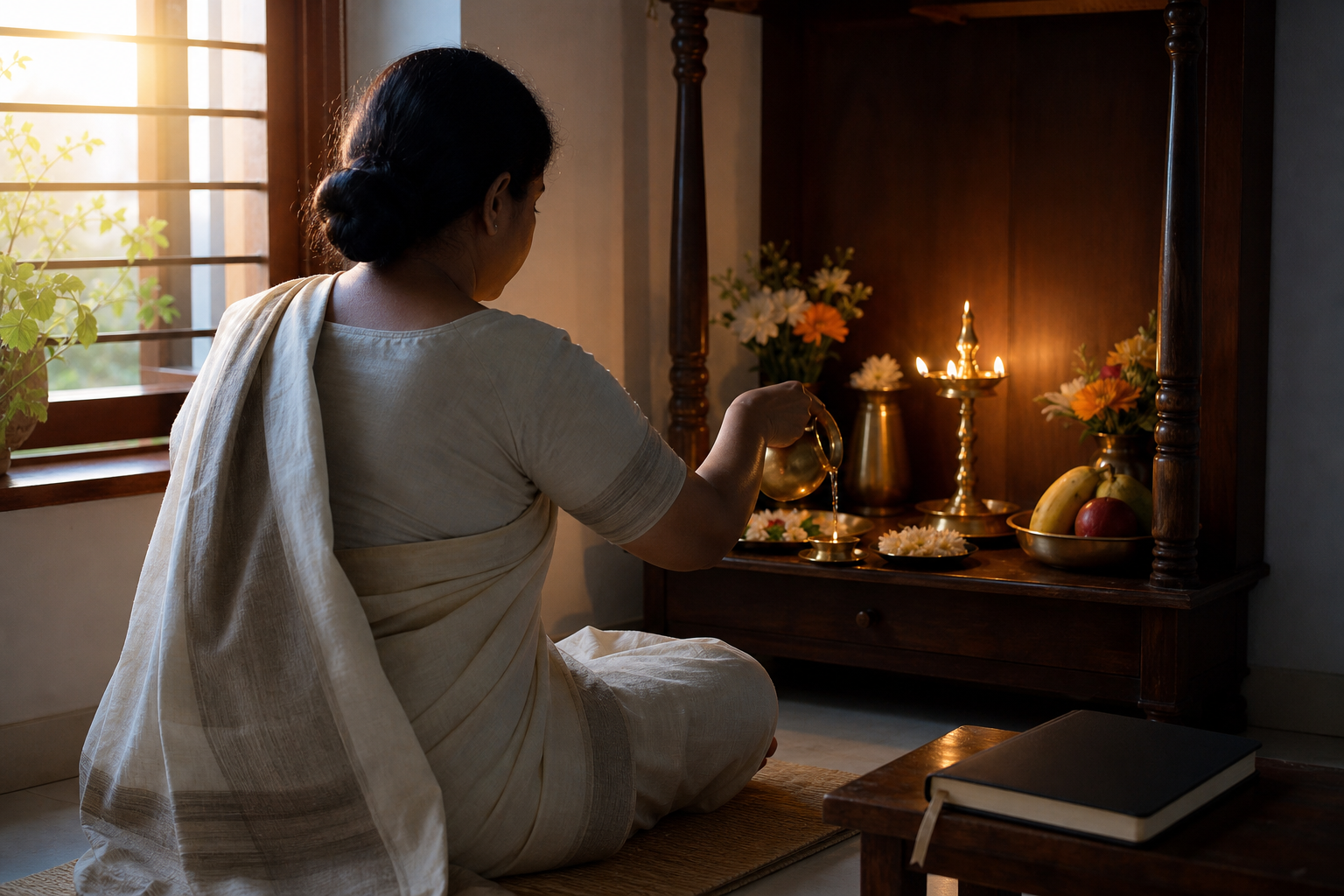
A perfectly timed notification has little spiritual value if it produces only anxiety about food. Put the devotional center of the observance into the calendar entry so that the day directs attention toward Bhagavan, ethical restraint, and inward steadiness.
| Observance | Tithi anchor | Devotional center | Practices to place in your plan |
|---|---|---|---|
| Ekadashi | Ekadashi in the relevant paksha | Vaishnava devotion, restraint, and clarity | Japa, dhyana, scriptural reading, sattvic food or upavasa, mindful conduct, and seva |
| Sashti | Shukla or Krishna Paksha Sashti; Aippasi Skanda Sashti receives special attention | Lord Subramanya or Murugan, courage, and the overcoming of inner obstacles | Abhishekam, archana, Skanda Shashti Kavacham, pradakshina, temple worship, and charitable offerings |
| Masik Durgashtami | Shukla Paksha Ashtami | Durga as compassionate and resolute Shakti | Durga mantra, Devi Mahatmyam, kumkum, red flowers, deepa, satsang, and prayer for universal well-being |
Choose a fasting form deliberately. Hindu vrata practice includes nirjala upavasa, phalahara, and a single sattvic meal, but these are not rungs on a ladder of spiritual worth. Age, health, family duties, and the demands of the day matter. If restricting water or food could affect your health or medical treatment, do not improvise a severe fast. Choose a gentler observance and consult an appropriate medical professional when needed. A religious calendar is not a substitute for individual medical advice.
When fasting is not appropriate, retain the vrata’s center: eat simply, reduce distraction, keep japa or dhyana, read a relevant text, perform seva, or participate in puja. Children can be included through simple chants, flowers, lamps, and offerings without making an adult austerity the measure of their devotion.
You can also make each calendar entry carry one devotional commitment and one ethical commitment. A Sashti entry might pair Skanda Shashti Kavacham with charity. A Durgashtami entry might pair a deepa and Durga mantra with an act of protection or service. An Ekadashi entry might pair japa with deliberate restraint from distraction. This turns the tithi from a dietary rule into a recurring discipline of attention and conduct.
These observances remain distinctly Hindu in deity, mantra, and ritual form. Their disciplines of restraint, compassion, meditation, and seva nevertheless offer points of kinship with Buddhist, Jain, and Sikh ethical life. In a wider Dharmic household or community, you can honor that kinship without pretending that different traditions have identical doctrines or rites.
Key takeaways for your next calendar entry
- A tithi-based observance cannot be safely reduced to a bare civil date.
- Record the paksha and tithi, city and time zone, local start and end times, calendar authority, and intended practice.
- Use a locality-specific Panchang and preserve the convention of your family, sampradaya, or temple.
- Do not use an ordinary monthly civil-date recurrence to predict a lunar observance.
- When calendars conflict, compare location, time zone, tithi, tradition, and purpose before choosing a date.
- Adapt the fasting form to health and duty while preserving prayer, restraint, seva, and devotion.
Open next month’s calendar now and create one complete entry for the vrata you actually keep. Include its tithi anchor, locality, timing, authority, and one practice you will protect. That single traceable entry is a better beginning than an entire year of unexplained dates.
References
- DharmaRenaissance Blog – December 30, 2025 Panchang: Shukla Paksha Ekadashi Tithi, Timing, and Dharmic Guidance
- DharmaRenaissance Blog – Sashti 2026: Skanda Sashti Viratham Dates Explained, Fasting Rites, and Devotional Insights
- DharmaRenaissance Blog – Masik Durgashtami 2026 Guide: Monthly Durga Ashtami Vrat Cycle, Meaning, and Blessings
