
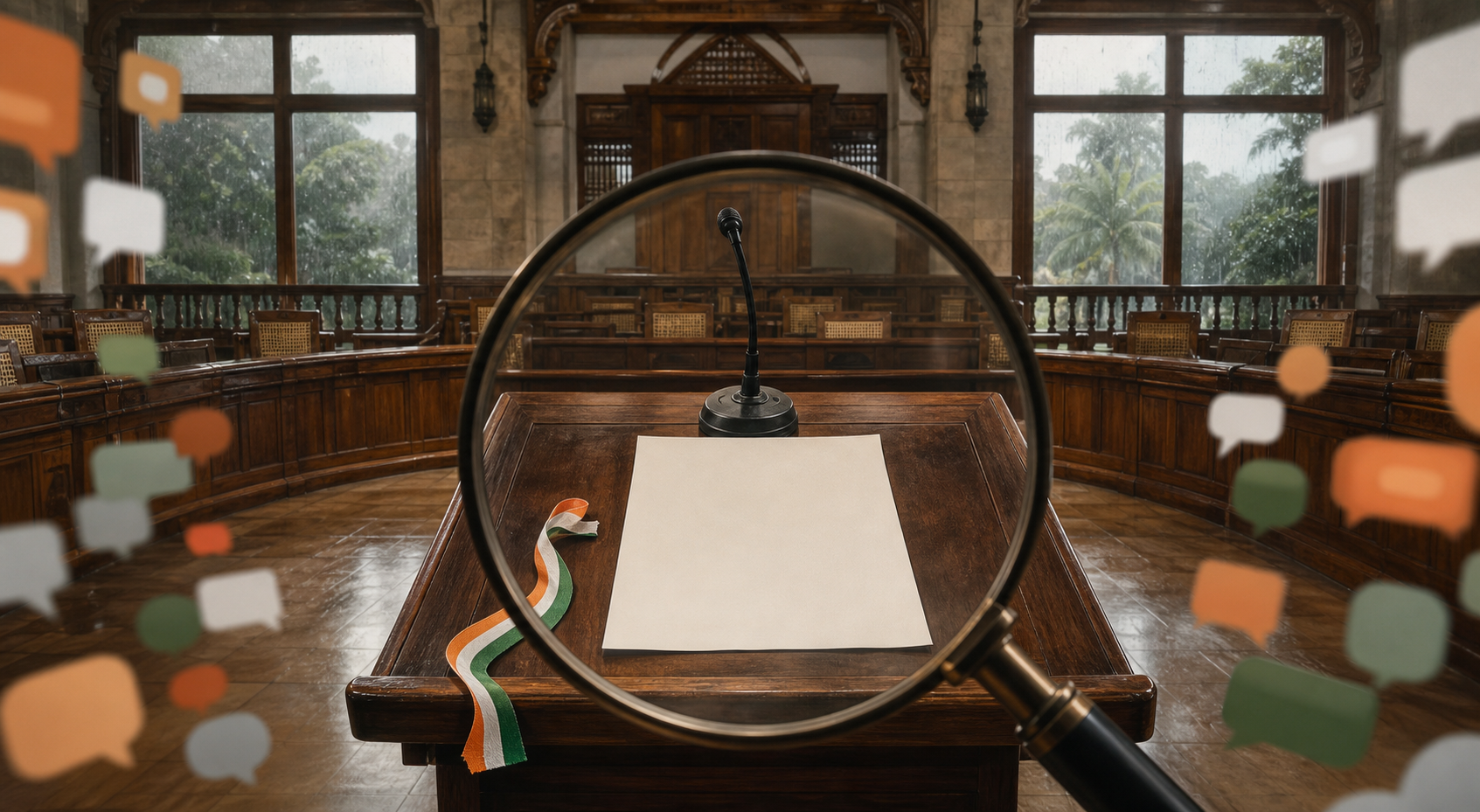
If you saw the Kerala oath controversy and wondered whether an elected councillor was pressured to apologise for expressing patriotism, don’t let the loudest interpretation settle the question for you. The apology deserves scrutiny. It does not, by itself, prove every allegation now attached to it.
You can defend “Jai Hind” without circulating a conclusion that the known facts don’t yet establish. Focus on three things: what happened, what rule supposedly applied, and whether anyone compelled the apology. Those distinctions reveal whether this was a routine procedural correction, selective political discipline, or something in between.
Start with the narrow fact that is actually established
Following Kerala’s local body elections, an LDF councillor in Thiruvananthapuram said “Jai Hind” during an oath-taking ceremony and subsequently apologised. The BJP publicly criticised the incident, interpreting the apology as evidence of ideological pressure within the CPI(M)-led LDF.
Those are two different kinds of information. The councillor’s words and apology form the observable sequence. The allegation of ideological pressure is a political interpretation of that sequence. It may prove justified, but it should not be silently promoted from allegation to established motive.
Several decisive details remain unestablished:
- Whether the councillor added “Jai Hind” inside the prescribed oath or spoke it immediately before or after the formal words.
- Whether the councillor apologised voluntarily or after an instruction from a party official, presiding officer, or another authority.
- Whether a written rule barred all additions to the oath-taking procedure.
- Whether comparable additions by other councillors were treated in the same way.
- Whether refusal to apologise would have brought any political or procedural consequence.
These aren’t minor gaps. They are the facts that determine what kind of controversy this is. If you share or discuss the incident, state the confirmed sequence first and label the allegation as an allegation. That protects the case for “Jai Hind” from being weakened by an avoidable overstatement.
Separate the oath, the ceremony and party discipline

Public debate often collapses three separate questions into one. Keeping them apart makes the issue much easier to judge.
- The formal oath: Was an exact form required, and did the councillor alter that form?
- Ceremonial procedure: Were brief remarks permitted before or after the oath, and was the same rule applied to everyone?
- Political discipline: Did the councillor’s party object to the patriotic salutation itself or demand a public retraction?
A phrase can be honourable while still falling outside a tightly prescribed ceremony. If every unscripted addition was disallowed, a request to repeat or regularise the oath would not necessarily express hostility to the phrase. It would be a procedural decision, although officials should explain it clearly enough to prevent suspicion.
The conclusion changes if other additions were tolerated but “Jai Hind” was singled out. It changes more sharply if a party authority required an apology because the salutation was considered politically unacceptable. Selective enforcement would turn a neutral-procedure defence into a much weaker one; documented coercion would give substantive support to the BJP’s criticism.
Before deciding which explanation fits, ask for four concrete items: the prescribed oath, the ceremony’s rule on additional words, the full recording rather than a clipped segment, and a direct explanation of why the apology was offered. Without them, categorical claims of either proven coercion or harmless procedure run ahead of the facts.
Keep “Jai Hind” outside every party’s private territory
“Jai Hind” is widely understood as an inclusive national salutation rather than the property of one party. It affirms attachment to India without prescribing a religion, sect, language, region, or party programme. That is precisely why an apology following its use can unsettle citizens even before the reason for the apology is known.
The right response is not to surrender the phrase to party competition. A Left organisation should not treat an ordinary national salutation as suspicious merely because its opponents use it. A nationalist party should not turn the same salutation into a compulsory password by which every citizen’s loyalty is judged. Both moves shrink a shared civic expression into a partisan instrument.
For a Dharmic reader, the deeper standard is the relationship between words and duty. Saying “Jai Hind” is meaningful, but it cannot substitute for honest public service, equal treatment of citizens, or fidelity to one’s oath. At the same time, suppressing a benign expression of national belonging would impoverish the common language through which citizens recognise one another as members of the same polity.
Pluralism does not require public life to be emptied of affection for Bharat. Hindus, Buddhists, Jains, Sikhs and citizens of other traditions need not hold identical beliefs to share a civic vocabulary. “Jai Hind” can serve that shared space precisely because it does not demand theological uniformity. The relevant test is whether it expresses common national belonging without denying anyone else’s dignity.
This also explains why criticism should remain proportionate. If evidence eventually shows pressure against the phrase, oppose that pressure directly. Do not inflate an institutional dispute into guilt by association against every LDF voter, Left worker or Keralite. Dharma is not served by replacing one suspected intolerance with another.
Use a five-step test before sharing the controversy

Political controversies travel faster when a short sequence appears to confirm what each side already believes. You can interrupt that pattern without becoming neutral about patriotism.
- Watch for the missing moment. A clip showing the salutation and later apology may omit the instruction, discussion, or procedural objection between them. Look for the complete sequence before assigning motive.
- Separate action from interpretation. “The councillor said ‘Jai Hind’ and later apologised” is a factual description. “The party forced an apology because it opposes patriotism” is a causal claim requiring additional evidence.
- Ask for the rule. A vague appeal to protocol is inadequate. Identify the exact procedural requirement and determine whether it prohibited every addition or only this one.
- Check consistency. Compare the treatment of other ceremonial additions, slogans or salutations. Consistent enforcement supports a procedural explanation; selective enforcement supports concern about viewpoint discrimination.
- Look for evidence of pressure. A direction to apologise, a threatened consequence, an internal communication, a direct statement from the councillor, or a repeated organisational pattern would materially strengthen the coercion claim. Political suspicion alone does not perform that work.
If the missing details cannot be obtained, use a formulation that preserves both concern and accuracy: “An LDF councillor apologised after saying ‘Jai Hind’ during the oath-taking ceremony. The BJP alleged ideological pressure, but the reason for the apology and any instruction behind it have not been established here.” That sentence gives your reader the controversy without pretending the disputed part has already been proved.
The same method helps you notice when the evidence changes. A neutral written rule, applied uniformly, would substantially reduce the force of the ideological allegation. Proof that “Jai Hind” alone triggered party discipline would make the controversy far more serious. You don’t need to decide in advance which evidence is allowed to matter.
Key takeaways
- The councillor’s use of “Jai Hind” and subsequent apology are established; the motive for the apology is not.
- The BJP’s ideological-pressure argument is a political claim that requires evidence of an instruction, consequence, selective rule, or wider pattern.
- A strict oath procedure could explain a correction only if the rule existed and was applied consistently to all additional words.
- “Jai Hind” should remain an inclusive civic salutation, not the private property of a party and not a compulsory test of personal loyalty.
- You can defend national dignity most effectively by stating confirmed facts, identifying disputed claims, and asking for the missing evidence.
The responsible next move is concrete: seek the full recording, the applicable ceremonial rule and an explanation from the councillor or presiding authority. If they reveal neutral and consistent procedure, acknowledge it. If they reveal selective pressure against “Jai Hind,” oppose it plainly. Bharat is strengthened neither by enforced silence nor by exaggerated certainty.
References
