
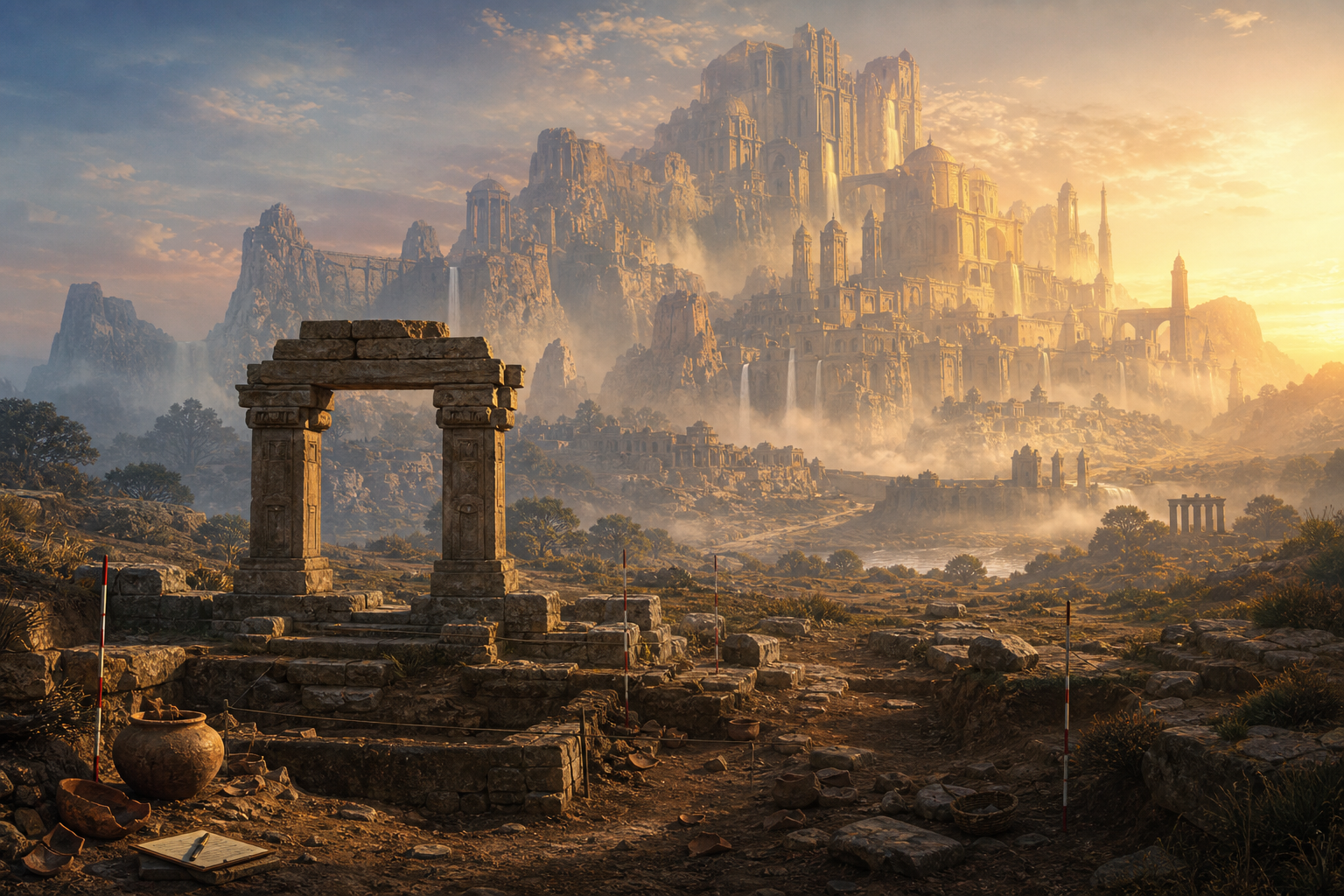
Perhaps you want to know whether Baahubali can be treated as a picture of ancient Bharat, or whether its kingdoms are entirely invented. The clean answer lies between those options: it is an original mythic fantasy built from genuine place-names, regional memories and Dharmic aesthetics, not a reconstruction of one historical kingdom or century.
If you keep three questions separate—what is historically attested, what is plausible within the imagined world and what is civilizationally resonant—you can appreciate the films without carrying fiction into history. That distinction also gives you a fairer way to judge future historical fantasies rooted in Bharat.
The right verdict is mythic fantasy, not reconstructed history
Baahubali does not identify a reign, dynasty or securely bounded era whose details can be checked scene by scene. Its time and place are deliberately indeterminate. A historical name may appear beside a practice, costume or military formation associated with a very different region or period.
Calling the result historically accurate would therefore be misleading. Calling it culturally empty would be just as mistaken. Three different standards are at work:
| Test | What you are asking | How Baahubali fares |
|---|---|---|
| Historical correspondence | Does the representation belong to an identifiable polity, place and period supported by the record? | Limited. Real names are used, but the narrated kingdom is fictional. |
| Period coherence | Could the architecture, clothing, weapons, institutions and named groups plausibly coexist in one era? | Uneven. The visual world and explicit time-markers do not settle into one period. |
| Civilizational authenticity | Do the moral conflicts, symbols, languages, customs and aesthetic forms grow from Bharatiya memory? | Often persuasive, though some traditions are integrated more deeply than others. |
This distinction matters because accuracy and authenticity are not synonyms. Accuracy asks whether a depiction corresponds to evidence. Verisimilitude asks whether the invented world is internally consistent. Civilizational authenticity asks whether the story understands the culture whose forms it borrows. A fantasy can be weak on the first test, uneven on the second and still achieve something substantial on the third.
The fairest description is therefore Bharatiya epic fantasy. That label neither demotes the films nor turns spectacle into evidence. It tells you what kind of truth to look for: not a recoverable royal chronicle, but a modern imaginative world assembled from many layers of Dharmic civilization.
Mahishmati and Kuntala are historical names in invented geography
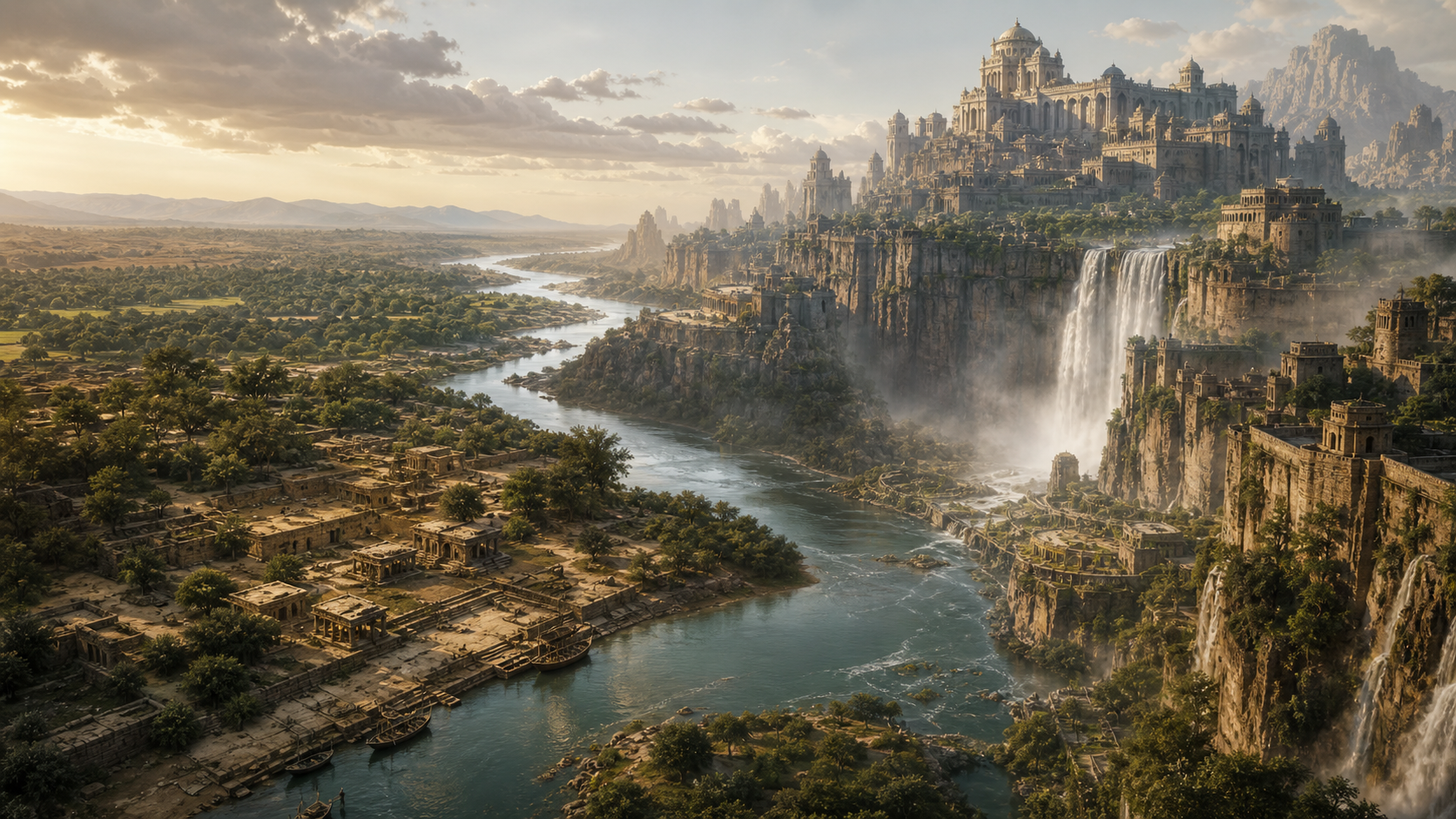
The existence of a historical Mahishmati is not in doubt within the material available here. It stood on the Narmada, south of Ujjaini and north of Pratishthana, or Paithan, in present-day Madhya Pradesh. It was an important urban centre of Avanti. Its memory appears in the Ramayana, Mahabharata, Raghuvamsha, Digha Nikaya and Sutta Nipata, while a 13th-century inscription of Paramara king Devapala provides later epigraphic attestation.
The cinematic Mahishmati is not a reconstruction of that city. It functions as a monumental, pan-Indian imperial capital whose terrain, palace, social order and political story serve the needs of the saga. The shared name creates historical resonance; it does not establish historical identity.
Kuntala presents the same issue more visibly. On screen, it is a lush mountain realm that can evoke the Himalayan foothills. Historical Kuntala belonged to the Deccan. Its name occurs in inscriptions and copperplates connected with the Nagas, Yadavas, Vakatakas, Chalukyas and Rashtrakutas. The landscape is therefore not a harmless clue to the historical location; it actively points the viewer elsewhere.
Geography is not a minor technicality. Terrain shapes crops, building materials, roads, military movement and relations between neighbouring polities. Once a film uses the name of an attested region, viewers reasonably expect at least some connection between that region and the world on screen. Moving the name while discarding the geography may produce a beautiful setting, but it weakens historical memory.
The precise formulation to use with a child, student or fellow viewer is simple: historical Mahishmati and Kuntala existed, but the kingdoms bearing those names in Baahubali are fictional reimaginings. Do not say that Mahishmati was invented. Do not say that the film shows what Mahishmati looked like. Both claims confuse a borrowed name with a represented place.
The timeline clues cannot support a single historical period
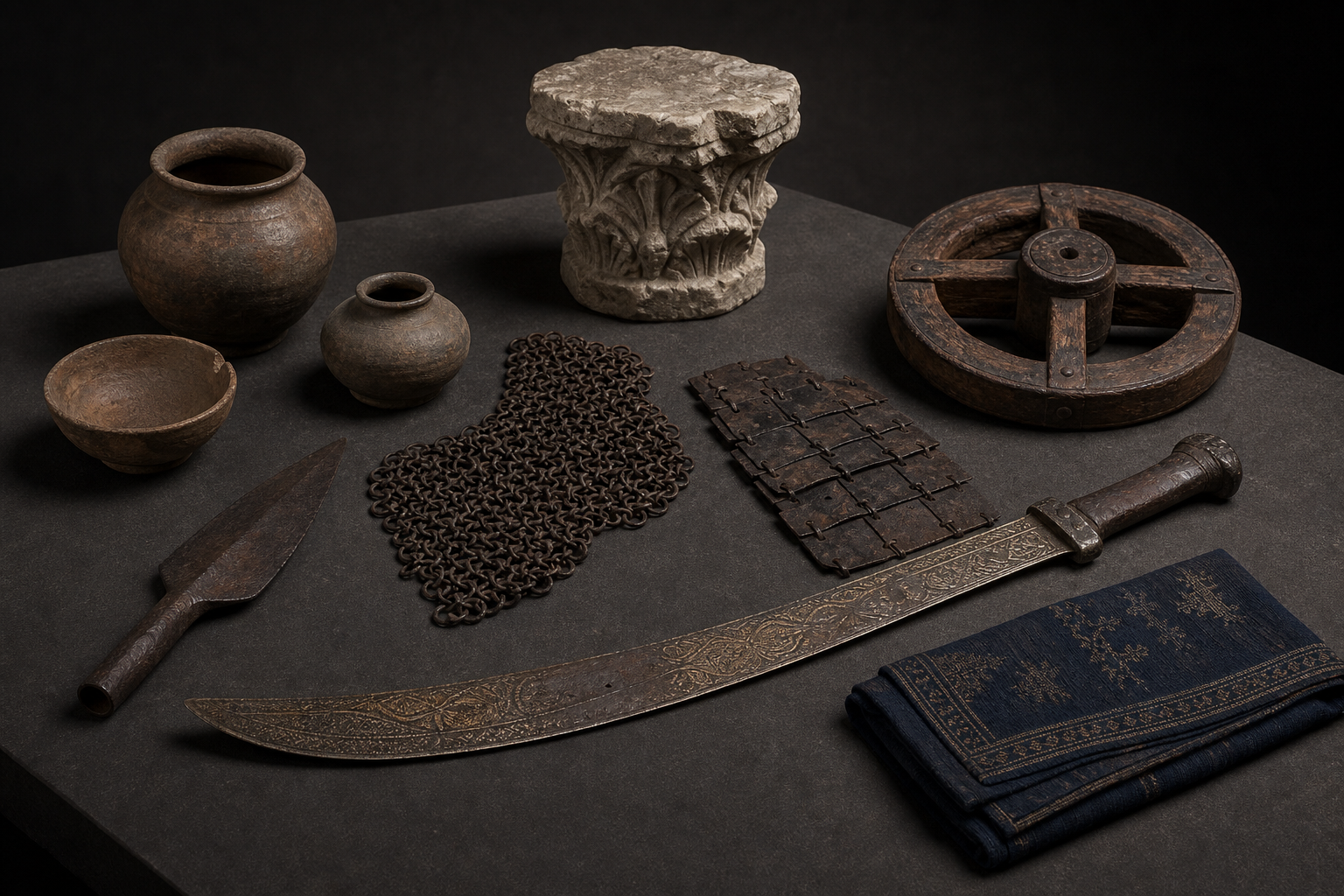
A palace can be designed to feel ancient without telling you which century it belongs to. Named communities and social roles are more useful clues, although even these must be handled carefully in fantasy.
Aslam Khan, presented as a Persian arms dealer, signals a post-early-medieval horizon. That is a clue rather than a date-stamp: the character is part of the fiction, and a name alone cannot assign a year to the story. It nevertheless places a later historical association inside a visual world whose architecture and costumes do not consistently reflect one corresponding era.
The second film supplies a sharper association through the Pindaris. Historically, these irregular bands were active in the 18th-century Malwa region. Using that name pulls the viewer toward a much later horizon than the generalized antiquity evoked by much of Mahishmati’s visual language.
No single date can be responsibly inferred from this combination. You would have to treat some elements as literal historical indicators, others as deliberate anachronisms and still others as pure inventions. The films offer no rule for deciding which is which. Their chronology is cumulative rather than reconstructive: anything that intensifies an epic Bharatiya atmosphere can enter the frame.
This gives you a practical rule for evaluating any period fantasy. Begin with the hardest marker available—a named historical formation, an inscription, a datable institution or a clearly located polity—and then test the surrounding world against it. Do not begin with the mood of the costumes and work backward to a century. A generalized ancient appearance is an aesthetic effect, not a chronology.
If you use a Baahubali image in teaching, commentary or social media, label it as fantasy artwork rather than an illustration of a particular historical era. The image may communicate kingship, sacrifice or grandeur. It cannot establish what an attested court, army or city actually looked like.
Names carry Dharmic memory without identifying one dynasty
The characters’ names reveal how deliberately the films range across regions. Sivagami is typically Tamil. Bijjaladeva and Ballaladeva recall Kannada royal lineages. Kattappa can be heard within Kannada, Tamil or Telugu linguistic settings. Avantika and Devasena are Sanskritized names with a wider pan-Indic reach. This is not the naming pattern of one documented court; it is a civilizational collage.
The most significant example is Baahubali itself. The name evokes the celebrated Jain monk whose monumental form is represented by the Gomateshwara statue at Shravanabelagola. The cinematic warrior is plainly not a biography of that monk. The title draws on the authority and familiarity of a revered Jain name while assigning it a new role inside a different story.
That borrowing should neither be mistaken for historical depiction nor dismissed as meaningless. It can operate as a bridge between Dharmic traditions, reminding viewers that the cultural vocabulary of Bharat has never belonged to a single modern compartment. The responsibility lies in recognising the transformation: a name may preserve a memory even when the new character does not preserve the original life.
The Kalakeyas work in a similar fashion. Their fearsome portrayal resonates with Puranic and Buddhist memories of the Kalakanjakas as terrifying asuras. A related mythic field includes Agastya drinking the ocean so that hidden enemies could be exposed to the Devatas. These echoes deepen the atmosphere, but they do not turn the cinematic army into a historically documented ethnic group or establish the saga’s date.
When you encounter a culturally familiar name in fantasy, read it in three passes. First, locate its linguistic, regional or textual associations. Second, identify what emotional or moral weight those associations bring. Third, examine what the new story has changed. Skipping the third step is how resonance gets misreported as history; skipping the first two is how meaningful civilizational memory gets reduced to decorative exoticism.
Rasa is the stronger test of authenticity—and the result is uneven
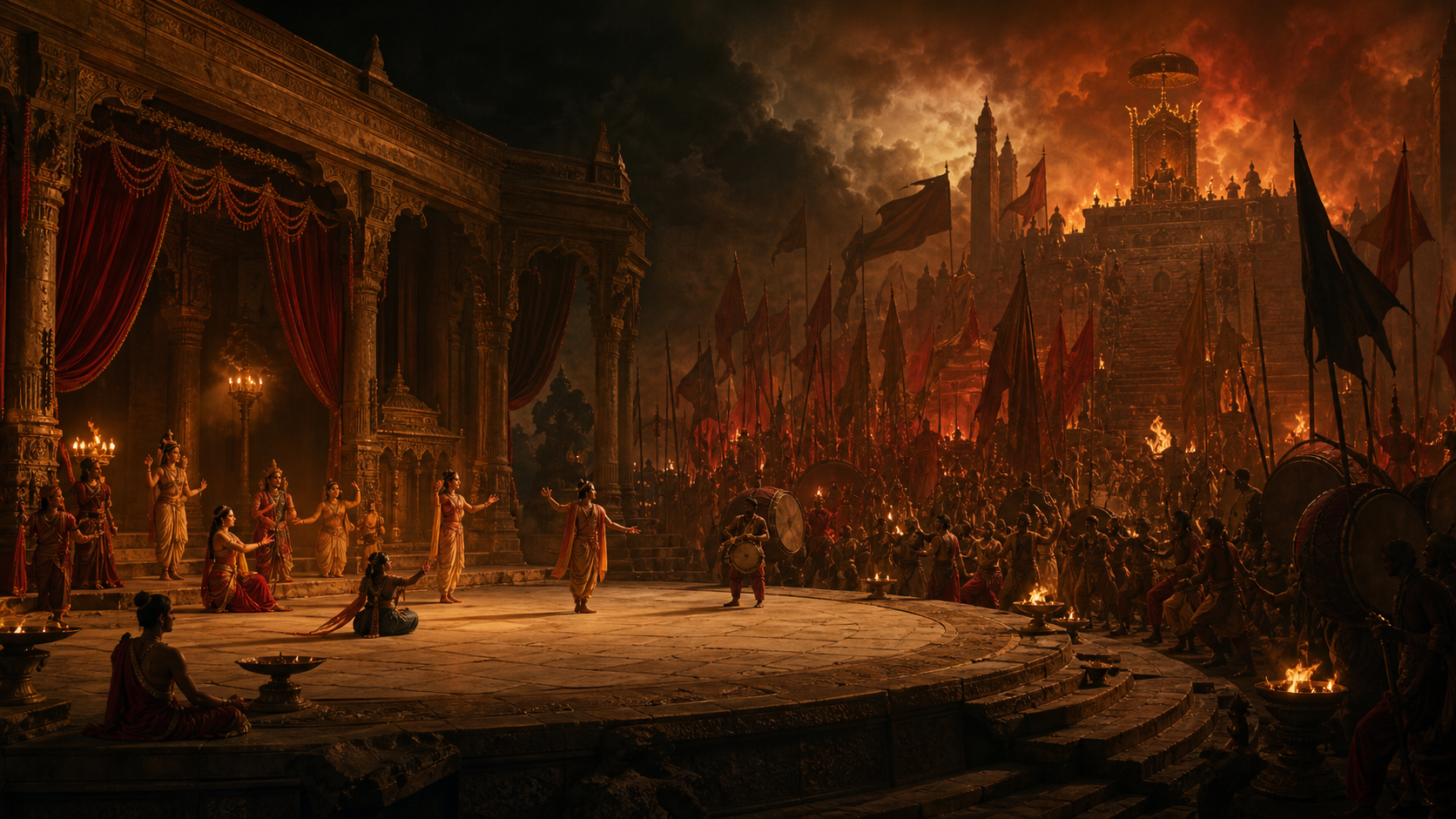
Once literal historical accuracy is set aside, the harder question remains: does the imagined world possess the inner grammar of the civilization it invokes? That grammar is carried not only by objects and names but by rasa, bhava, speech, gesture and the moral weight of action.
In a courtly epic, dialogue does more than transfer information. Diction, vocal control and bodily bearing tell you how a ruler understands authority, how a warrior receives an order and how a moral breach disturbs the kingdom. The classic Telugu mythological tradition associated with figures such as Samudrala Raghavacharya, K. Kameshwara Rao and K. V. Reddy cultivated that integration with unusual precision. Baahubali often achieves physical grandeur, but its elevated speech and performance do not sustain the same classical register in every decisive scene.
Compression is a revealing benchmark. Jaya Krishna Mukunda Murare can carry Krishna’s childhood through a composition of about seven minutes, while the Kannada Ramana Avatara can distil the Ramayana in about six. The achievement is not speed for its own sake. Music, gesture, poetic language and narrative move as one, allowing density without draining away bhava.
K. Viswanath’s Sutradharulu and Swati Muthyam offer another useful standard. Gangireddu, Haridasa and Rama Katha traditions participate in character and moral consequence. They are not merely displayed to certify that a scene is Indian. If one of these forms were removed, the human meaning and dramatic movement would change.
That removal test exposes a weakness in the use of Jallikattu and Kambala in Baahubali. The sequences display real regional traditions, but they operate largely as spectacular set-pieces rather than as narrative sinew. Whenever you see a ritual, festival, sport or folk form in a film, ask one concrete question: if it disappeared, would a character’s decision, relationship or moral understanding change? If the answer is no, you are probably looking at cultural decoration rather than cultural integration.
The moral test is equally important. A genuinely Dharmic epic need not resemble a museum display or belong to one sect. It should allow values such as karuna, tyaga and satya to shape choices and consequences. Those values travel across Hindu, Buddhist, Jain and Sikh traditions even where their philosophical formulations differ. Shared aesthetics do not erase those differences; they give artists a civilizational field within which difference can remain intelligible.
This is where Baahubali deserves substantial credit. It returned a native epic imagination to the centre of mass spectacle, trusted culturally recognisable motifs and showed that a large audience could enter a mythological-fantasy world without having it filtered through a foreign medieval template. Its historical looseness does not cancel that achievement. Its achievement does not excuse the looseness.
Key takeaways
- Classify Baahubali as Bharatiya epic fantasy, not as a historical reconstruction of ancient India.
- Distinguish an attested name from an accurate depiction: Mahishmati and Kuntala were real, but their cinematic forms are invented.
- Do not assign the saga a century from its visual mood. Aslam Khan suggests a later horizon, while the Pindari name carries an 18th-century Malwa association.
- Read names such as Baahubali and Kalakeya as cultural resonances, not proof that their cinematic characters represent the Jain or textual figures they evoke.
- Judge cultural authenticity by narrative function: a tradition is deeply integrated when it changes character, conflict or moral consequence.
- Use the film as a gateway to historical and Dharmic inquiry, never as the evidence that settles it.
The next time someone asks whether Baahubali is true history, give them the precise answer: it uses real Bharatiya names and memories to build an invented epic. Then direct their curiosity toward the historical Mahishmati, Deccan Kuntala, Jain Baahubali and the classical arts that gave those resonances their power. That response preserves both the pleasure of imagination and the integrity of history.
References
