

You may chant, study the Bhagavad Gita, visit the temple, and feel genuine love for the Divine. Yet irritation may still command your speech, distraction may still consume your attention, and duties may still be postponed. The next step is not necessarily more devotional material. It is learning to carry devotion into the moments that test who governs your life.
A workable sequence is simple: remember what is sacred, protect that remembrance through self-mastery, and spend the resulting strength in seva. This gives you a practical way to examine spiritual progress without mistaking strong emotion, severe restraint, or visible activity for transformation.
Bhakti, self-mastery, and seva must correct one another
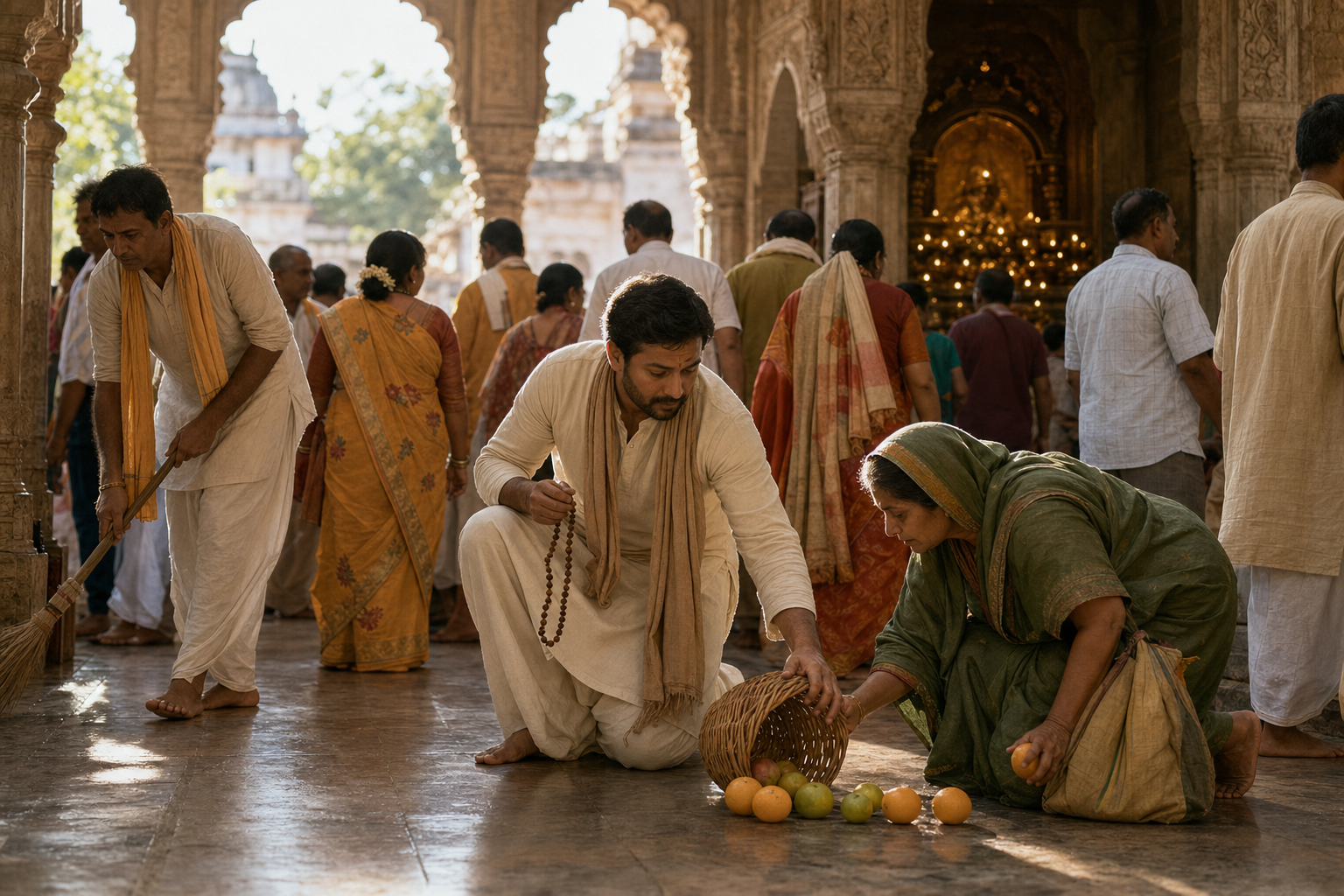
Bhakti gives your life an orientation. Self-mastery prevents every passing impulse from changing that orientation. Seva turns the orientation into conduct that benefits someone beyond yourself. Each element answers a different question:
- Bhakti asks: What is worthy of my deepest love and loyalty?
- Self-mastery asks: What must I govern so that this loyalty survives temptation, anger, fatigue, and praise?
- Seva asks: Who becomes safer, stronger, less burdened, or better served because of my practice?
If your devotional feeling is sincere but you remain chronically unreliable, the missing link is disciplined follow-through. If your restraint makes you contemptuous of people with different capacities, discipline has separated from devotion. If you perform extensive service but become possessive about the task or resentful when nobody notices, seva has drifted away from offering.
This is why bhakti needs philosophical clarity as well as willing participation of the heart. Bhagavad Gita 10.08 identifies Krishna as the source of everything, while 10.41 places the attractiveness and excellence encountered in the world within his splendor. For a Krishna devotee, this changes restraint from a war against everything pleasant into a return from reflected attraction to its source. Understanding sets the direction; remembrance, japa, kirtan, and service train the heart to travel in that direction.
When you face a difficult choice, pause over three questions: What do I claim to love? Which impulse is attempting to rule me now? What action would serve dharma rather than merely protect my comfort or image? The answers may not remove the difficulty, but they expose whether devotion is governing the decision.
Make a vow that belongs to your actual dharma

Hanuman is often invoked whenever self-mastery is discussed, and rightly so. But copying the outer form of his brahmacharya is not the same as understanding it. The Valmiki Ramayana does not announce a formal lifelong vow; it reveals Hanuman through unwavering attention, discernment, courage, and service to Rama’s mission. Later devotional memory explicitly venerates him as a naishthika brahmachari whose strength is governed by undivided devotion.
Some South Indian traditions also preserve the Suvarchala narrative, in which Hanuman is ritually united with the daughter of Surya. Devotees within those traditions can interpret the union yogically, as the joining of disciplined prana and solar wisdom, while maintaining Hanuman’s essential brahmacharya. That variation is a useful warning against reducing a rich sacred memory to a slogan or using it to police every seeker’s life.
In the broader dharmic vocabulary, brahmacharya includes mastery of the senses, clarity of intention, and the conservation of energy for dharma. Celibacy is its formal expression in particular paths and stations of life, not a universal instruction to abandon household responsibility. Buddhist and Jain monastic disciplines give celibacy an explicit place; Sikh thought places strong emphasis on self-control, fidelity, and integrity within household life. The forms differ, but restraint is expected to strengthen compassion, purpose, and responsible service.
Your vow should therefore protect your dharma, not imitate someone else’s vocation. Build it in this order:
- Name the sacred relationship at the center of the practice: Rama, Krishna, the Guru, the path to awakening, ahiṃsa, or another commitment received within your tradition.
- Name a duty already entrusted to you. It may belong to family life, work, temple service, study, or care for the community.
- Identify the recurring impulse that interferes with that duty: scattered attention, anger, gossip, appetite, sexual conduct that violates a commitment, hunger for recognition, or avoidance of inconvenient work.
- Set a boundary that can be observed. Instead of promising to be less distracted, keep the phone outside the place of japa. Instead of promising to be humble, complete an unglamorous task without announcing it.
- State what the boundary protects. A useful sankalpa sounds like this: I am keeping this attention available for Rama’s name and the duty that follows it.
Do not make the vow impressive. Make it truthful. A severe undertaking that you hide, repeatedly break, or use to judge others trains duplicity rather than mastery. A modest boundary faithfully connected to devotion and duty is spiritually more serious.
If you live under formal vows, their interpretation belongs within your lineage and guidance. If you are a householder, do not use spiritual restraint as permission to neglect fidelity, care, honest livelihood, or promises already made. A practice that damages the dharma it claims to serve has been badly framed.
Use Hanuman’s standard: strength must become trustworthy

Hanuman’s greatness is not merely that he possesses extraordinary bala. His power can be trusted. In Lanka he must cross danger, remain focused in hostile surroundings, approach Sita without increasing her fear, offer credible reassurance, gather what Rama needs, and return with a useful report. Courage alone would not accomplish that mission. It also requires buddhi, tact, humility, and obedience to purpose.
The sequence provides a demanding test for your own restraint: does it make the right kind of strength available at the right moment? Hanuman’s disciplined energy becomes fearless yet lucid service, not uncontrolled force.
- When provoked, can you preserve the actual purpose instead of winning the exchange?
- When you have more power than another person, can you use gentleness without becoming weak or evasive?
- Can you finish an assigned duty after its novelty and visibility have disappeared?
- Can you hear correction without turning the discussion into a defense of your spiritual identity?
- Can you change tactics when circumstances change while remaining loyal to the dharmic aim?
Traditional language describes brahmacharya as conserving ojas and directing prana. The practical point is not to make grand claims about hidden power. It is to stop spending attention and desire as though they have no purpose. For Hanuman as Vayuputra, the symbolism is especially clear: immense movement is gathered under a vow and made useful.
You can recognize distorted restraint by its fruit. Suppression produces preoccupation while pretending the desire has vanished. Perfectionism treats a lapse as proof that the entire path has failed. Display turns austerity into a social rank. Harshness makes personal discipline an excuse to humiliate people whose duties or stage of life differ from yours.
The repair is concrete. Name the lapse without embellishment. Make the boundary more precise if it was vague. Resume at the next relevant act rather than staging either self-condemnation or self-justification. Then perform a useful duty. Returning discipline to service prevents the ego from making even failure the center of attention.
Build seva around real needs, good company, and review

Seva is where your private spiritual story meets public reality. The question is not how much sacrifice will make you look devoted. It is what actually needs doing, what responsibility is properly yours, and whether another person can depend on you to complete it.
A sound seva commitment passes several tests:
- It is needed. Someone benefits from the work itself, not merely from witnessing your enthusiasm.
- It is defined. You know what completion means, who owns the decision, and when responsibility returns to someone else.
- It respects existing dharma. Temple activity does not become an excuse to abandon agreed household or professional duties.
- It is sustainable. You can serve steadily without repeatedly creating emergencies that others must repair.
- It is accountable. A responsible person can correct the work, and you can receive that correction without claiming devotional immunity.
- It does not depend on recognition. Gratitude may come, but the task remains worth doing when it does not.
If you do not know where to begin, ask a responsible person in your family, temple, sangha, or community which recurring task is being neglected. Take a clearly bounded part of it, agree on what done means, complete it, and report back. This is often a better beginning than inventing a grand project around your preferred talents.
Sadhu-sanga matters because self-assessment is limited. The character of a mature devotee can reveal what humility, steadiness, compassion, and equipoise look like under ordinary pressure. Satsang, disciplined practice, and service reinforce one another: good company refines your standard, practice stabilizes attention, and seva tests whether the lesson has entered conduct.
Do not use satsang merely to collect inspiring speech. Notice who arrives prepared, who listens before acting, who treats invisible workers with respect, who remains steady under praise and blame, and who finishes what was promised. Then imitate the observable virtue rather than the person’s mannerisms.
This pattern appears across dharmic traditions without making their theologies interchangeable. Vaishnava bhakti honors service to the Divine and to devotees. The Bodhisattva ideal directs compassion toward the liberation of beings. Jain discipline joins self-restraint with ahiṃsa and purification of conduct. Sikh practice gives seva, sangat, Naam simran, and integrity in household life a central place. Their aims and vocabularies retain their own meanings, while disciplined concern for others creates a shared ethical meeting ground.
A simple rhythm can keep the three elements connected:
- At the beginning of your practice, remember the Divine through japa, prayer, contemplative reading, kirtan, or the discipline given by your tradition.
- Before rising, name the duty that will carry this remembrance into the day.
- When the predictable distraction appears, keep the boundary chosen to protect that duty.
- During seva, attend to the recipient and the task rather than narrating your virtue to yourself.
- At the close of the day, ask where remembrance changed an action, where impulse took control, and what must be repaired.
- During regular satsang, let a mature practitioner question both your discipline and your usefulness.
If service produces recurring resentment, inspect it instead of immediately abandoning it. You may have accepted an undefined role, expected unspoken recognition, ignored a prior duty, or attempted to control work that belongs to someone else. Clarifying scope can be an act of humility. So can stepping back responsibly after arranging a clean handoff.
Key takeaways
- Use bhakti to choose your orientation, self-mastery to protect it, and seva to make it visible in conduct.
- Do not imitate Hanuman’s outer austerity without understanding its purpose: undivided devotion and ethically reliable strength.
- Choose a specific boundary around the impulse that most often disrupts a duty already entrusted to you.
- Judge restraint by its fruit. It should make you more dependable, discerning, tactful, and useful, not proud or severe.
- Choose seva according to real need, clear responsibility, and accountability rather than visibility.
- Use satsang as a mirror for character, not merely as a source of devotional emotion.
At your next period of japa, prayer, or contemplation, name the duty that will receive its energy. Choose the boundary that will protect that duty, and complete the service before looking for a larger vow. That is how bhakti leaves the prayer space without leaving the heart.
References
- DharmaRenaissance Blog — Why Hanuman Embraced Eternal Brahmacharya: Devotion, Dharma, and the Strength of Service
- Dandavats — Magnanimous Devotion: How Exemplary Bhakti Inspires and Unites Dharmic Traditions
- Dandavats — Bhakti Beyond Reason: When the Bhagavad-gita Unites Head and Heart in Devotion to Krishna
