
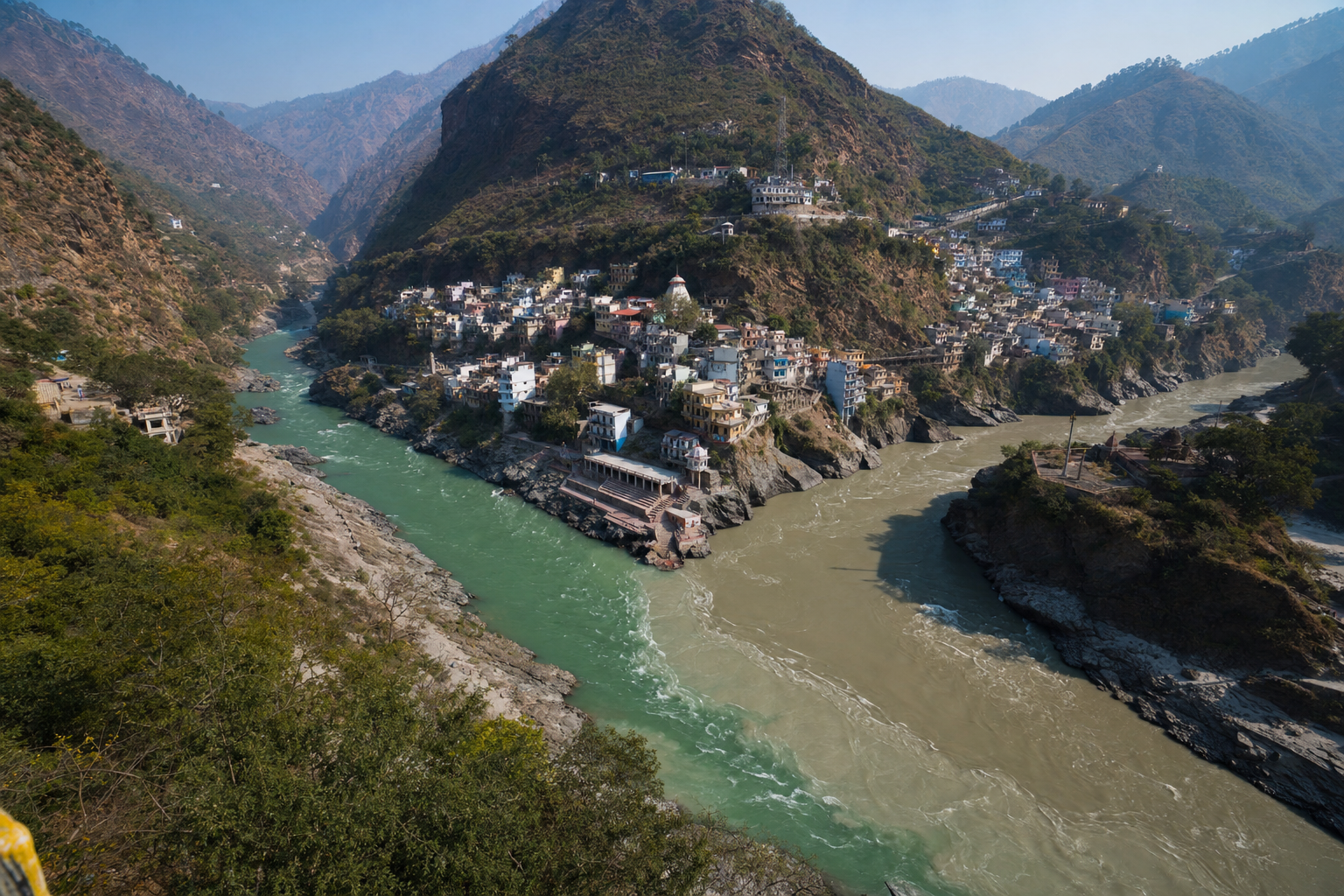
You may arrive at Devprayag knowing only that two rivers meet there. The more useful question is what changes at the meeting, and how that should change the way you stand before it.
At this sangam, the Alaknanda and Bhagirathi do not simply enter a common channel. Their united flow is revered as Maa Ganga. Give the confluence time before you reach for a camera or begin a ritual, and you can watch geography become sacred meaning in front of you.
Why Ganga’s name begins at Devprayag
The two currents arrive with different Himalayan journeys behind them. The Bhagirathi descends from Gaumukh near Gangotri, while the Alaknanda passes Badrinath and the high Himalayan valleys. From their meeting at Devprayag, the joined river is known and worshipped as Ganga.
This distinction matters. Devprayag is not sacred because water appears there without a past. It is sacred because two already meaningful journeys acquire a new identity through union. The tributaries retain their histories, yet neither proceeds alone. That is why the confluence can be understood at once as a geographical event, a place of worship and a lesson about transformation.
Devprayag is also regarded as the culminating confluence of the Panch Prayag. The word tirtha carries the sense of a crossing. At a river confluence, that meaning is tangible: land meets water, one current meets another, and a pilgrim is invited to cross from ordinary attention into deliberate awareness.
So do not reduce Devprayag to a question of which stream is larger, clearer or more visually dramatic. The defining fact is the relationship. Ganga emerges through confluence. If you keep that in mind, your darshana begins before any formal act of worship.
Read the confluence before you perform a ritual
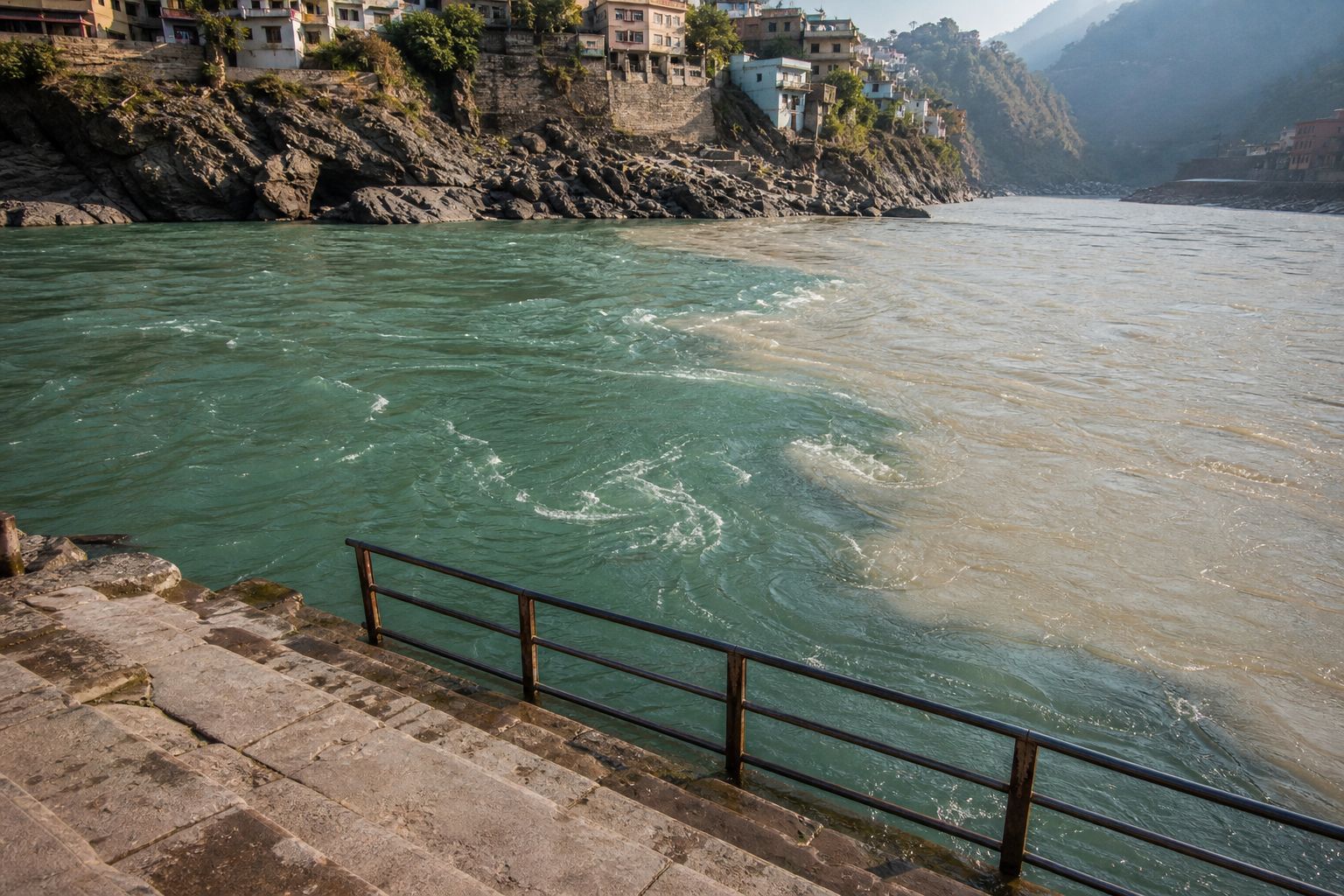
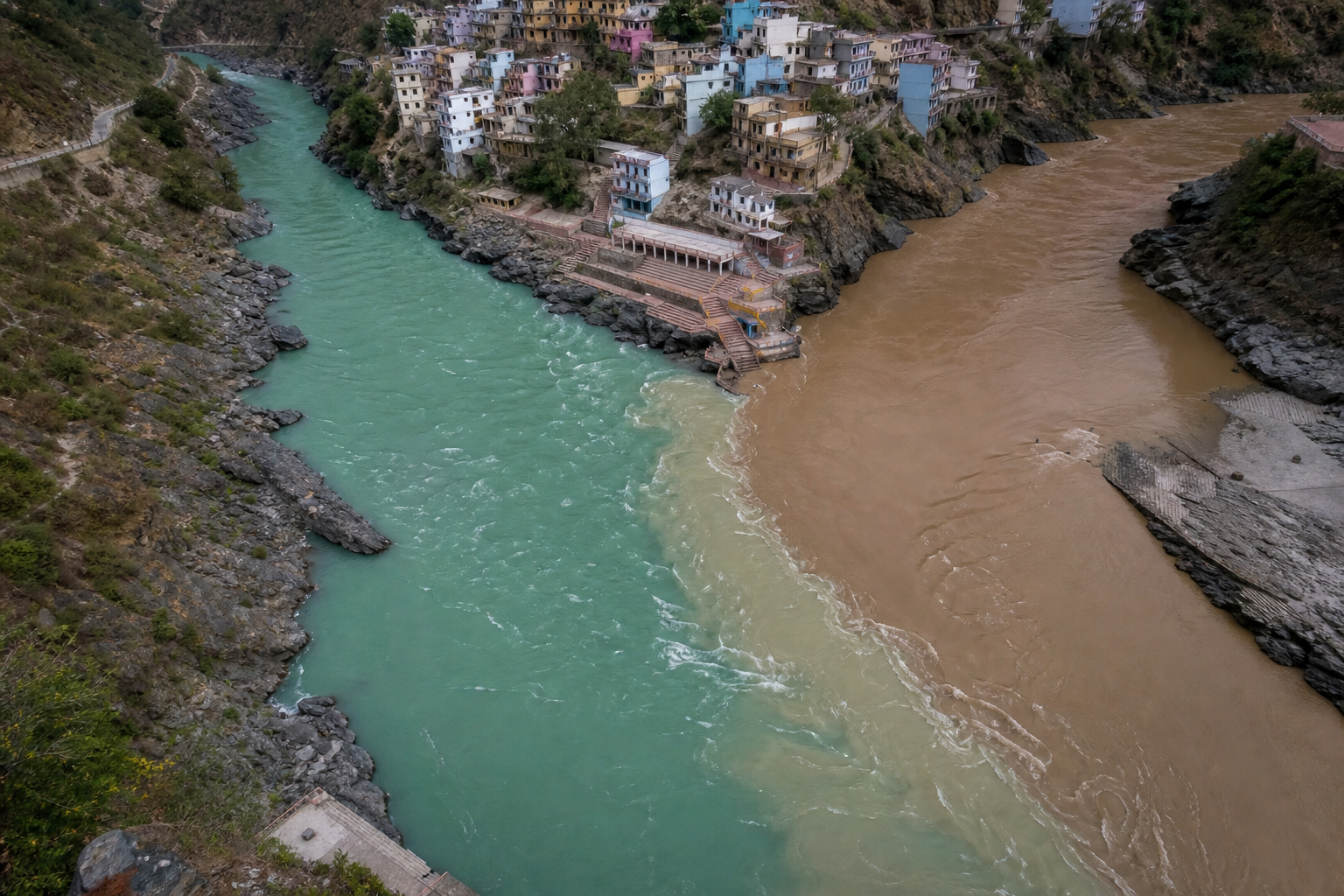
Begin from a secure viewpoint above the ghats. The currents often show contrasting hues or textures as they approach each other. Notice where they remain distinguishable, where the boundary begins to soften and how the united flow moves away from the sangam. Visibility changes with light and river conditions, so muted colours do not make the darshana incomplete.
Then listen. The force of the water can be considerable, yet the setting often produces an unexpected inward quiet. You do not need to manufacture a mystical feeling. Attend to the sound long enough for your own mental noise to become obvious. That recognition is already useful.
The Raghunathji Temple, dedicated to Shri Rama, rises above the confluence. River and temple should not be treated as unrelated attractions. At the sangam you encounter movement, merger and continuity; before Shri Rama you encounter the demand to bring action under dharma. One gives you an image of unity, while the other asks what disciplined conduct that unity requires from you.
A useful sequence is therefore to see the whole confluence from above, approach the ghat with care, and include the temple in your pilgrimage. This movement from broad view to close attention and then to worship prevents the visit from becoming a quick photograph followed by departure.
A pilgrimage sequence that honours both worship and river
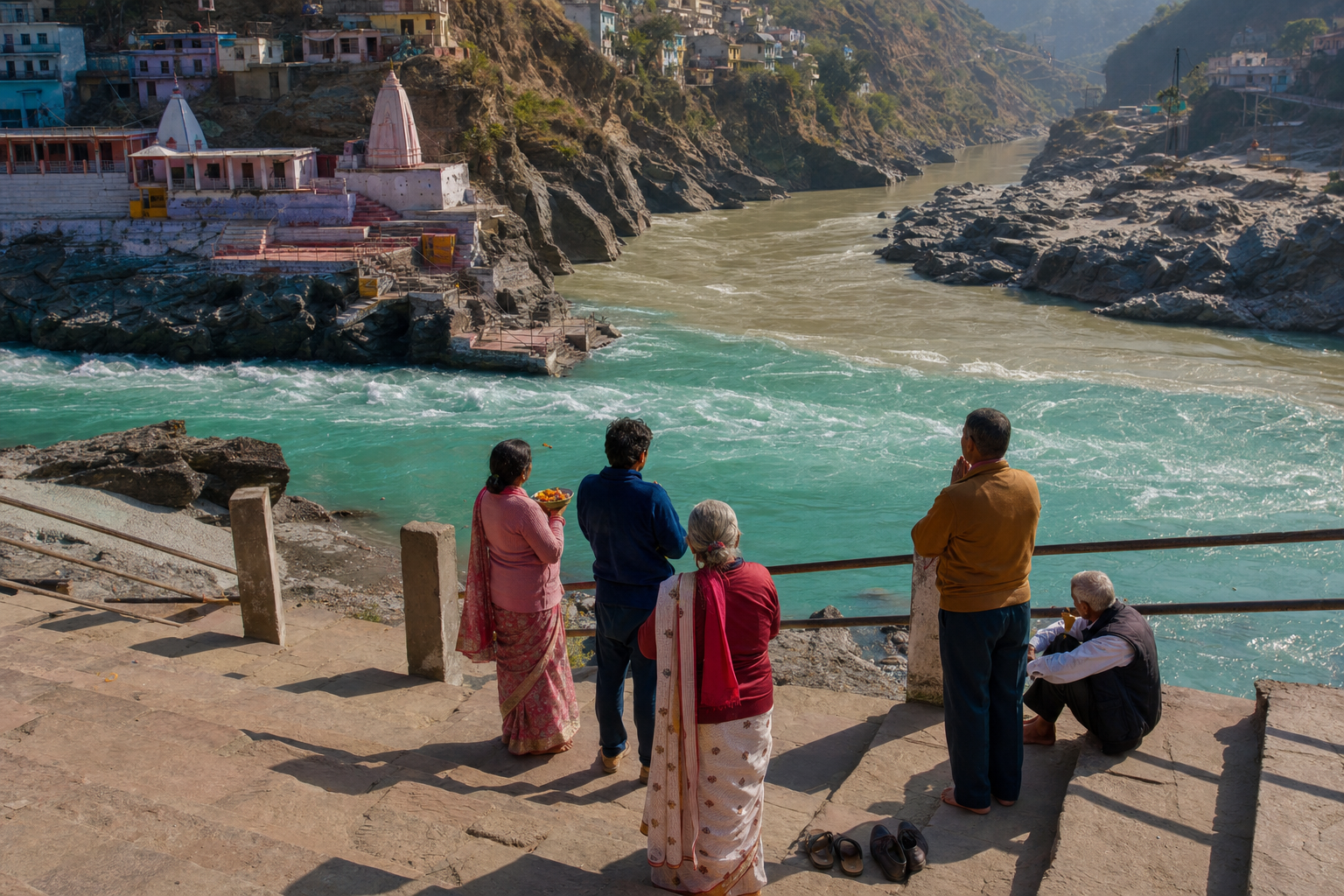
You do not need an elaborate programme to approach Devprayag properly. A simple sequence can keep the visit attentive, safe and rooted in dharma.
- Choose visibility over haste. Clear mornings in spring and after the monsoon generally offer better views of the river currents and surrounding ridgelines. If seeing the meeting clearly matters to you, make the sangam your first purpose rather than squeezing it between other stops.
- Pause above the ghats. Spend a few quiet minutes identifying the approaching rivers and the downstream Ganga. This establishes what you are seeing before ritual emotion or activity takes over.
- Let present conditions govern access to the water. Use designated areas, obey barriers and follow local instructions. Never judge the safety of a Himalayan current by surface appearance alone. If conditions do not permit entry, remain on secure ground. Snana is a sacred practice, not a test of courage or faith.
- Keep the ritual focused. Where bathing is safely permitted, snana may be accompanied by japa and prayer. If immersion is not appropriate, you can still undertake japa and darshana from a secure place. The spiritual centre of the act is reverence, not the depth to which you enter the river.
- Offer darshana at Raghunathji Temple. Approach the shrine with the same restraint you would expect at any living place of worship. Follow local customs instead of treating the temple as scenery above the river.
- Leave no burden behind. Carry back bottles, wrappers and anything else you brought to the ghat. Do not assume that an object becomes harmless to the river merely because it was used devotionally. Use local services respectfully and pay fairly so that pilgrimage supports, rather than merely passes through, the host community.
This sequence also corrects a common mistake: trying to collect every possible experience in the shortest possible time. At a tirtha, attention is not dead time between activities. It is part of the pilgrimage.
Unity here does not erase dharmic differences
Devprayag’s particular sacred vocabulary is Hindu: Maa Ganga, snana, japa, darshana and the worship of Shri Rama at Raghunathji Temple. Respecting that specificity is important. Unity among dharmic traditions does not require us to pretend that Hinduism, Buddhism, Jainism and Sikhism assign identical ritual meanings to every river or pilgrimage place.
The confluence can nevertheless illuminate values that cross sectarian boundaries. Disciplined conduct, gratitude toward the natural world, humility, compassion and responsibility are intelligible across these traditions, even when their doctrines and practices differ. The most honest form of shared dharmic reflection begins with that distinction: resonance is not sameness.
You can make this reflection practical by carrying three questions to the water. What separate journey brought you here? What responsibility must you accept when your life joins the lives of others? What will flow downstream from your conduct? These are not questions the river answers for you. The sangam gives them a form you cannot easily dismiss.
This is also why the visible meeting of the rivers is more than a convenient metaphor. The currents do not demonstrate unity by becoming identical before they meet. They arrive from different landscapes and then move forward together. Devprayag lets you contemplate unity without demanding the erasure of origin, memory or discipline.
Key takeaways
- Devprayag is the confluence where the Alaknanda and Bhagirathi unite and the joined flow is revered as Maa Ganga.
- Its sanctity lies in both continuity and transformation: two Himalayan journeys become one river without losing their histories.
- Begin with an elevated view, then approach the ghat and Raghunathji Temple with deliberate attention.
- Enter the water only where current conditions and local instructions make it safe; japa and darshana do not depend on immersion.
- Keep waste out of the river, respect living worship and let your spending support the local community.
- Use the confluence to examine what your own conduct contributes to the shared current of family, society and civilisation.
Before you leave Devprayag, make one river-facing sankalpa that can be tested by your next journey: carry every item away from the ghat, support a local livelihood fairly, or give future tirthas more time than your camera. Let the next sacred place you visit receive the benefit of what this confluence taught you.
References
