
If you want to understand Sikh leadership in wartime, look beyond battlefield command. The harder test may come after weapons, rank and freedom have been taken away. In captivity, leadership means keeping frightened people fair, truthful and responsible when scarcity gives everyone an excuse to become otherwise.
The Sikh answer is not a technique for controlling prisoners. It is a discipline of character shaped by sant-sipahi, seva, simran, hukam and Sarbat da Bhala. These principles show you how spiritual steadiness can become practical care – and how loyalty can remain strong without becoming blind.
Leadership begins with the ordinary conditions of dignity

Captivity creates large dangers through small uncertainties. Who receives food first? Who gets enough rest? Who performs the hardest chores? Who settles a dispute before it becomes a factional conflict? When no answer is trusted, fear fills the gap.
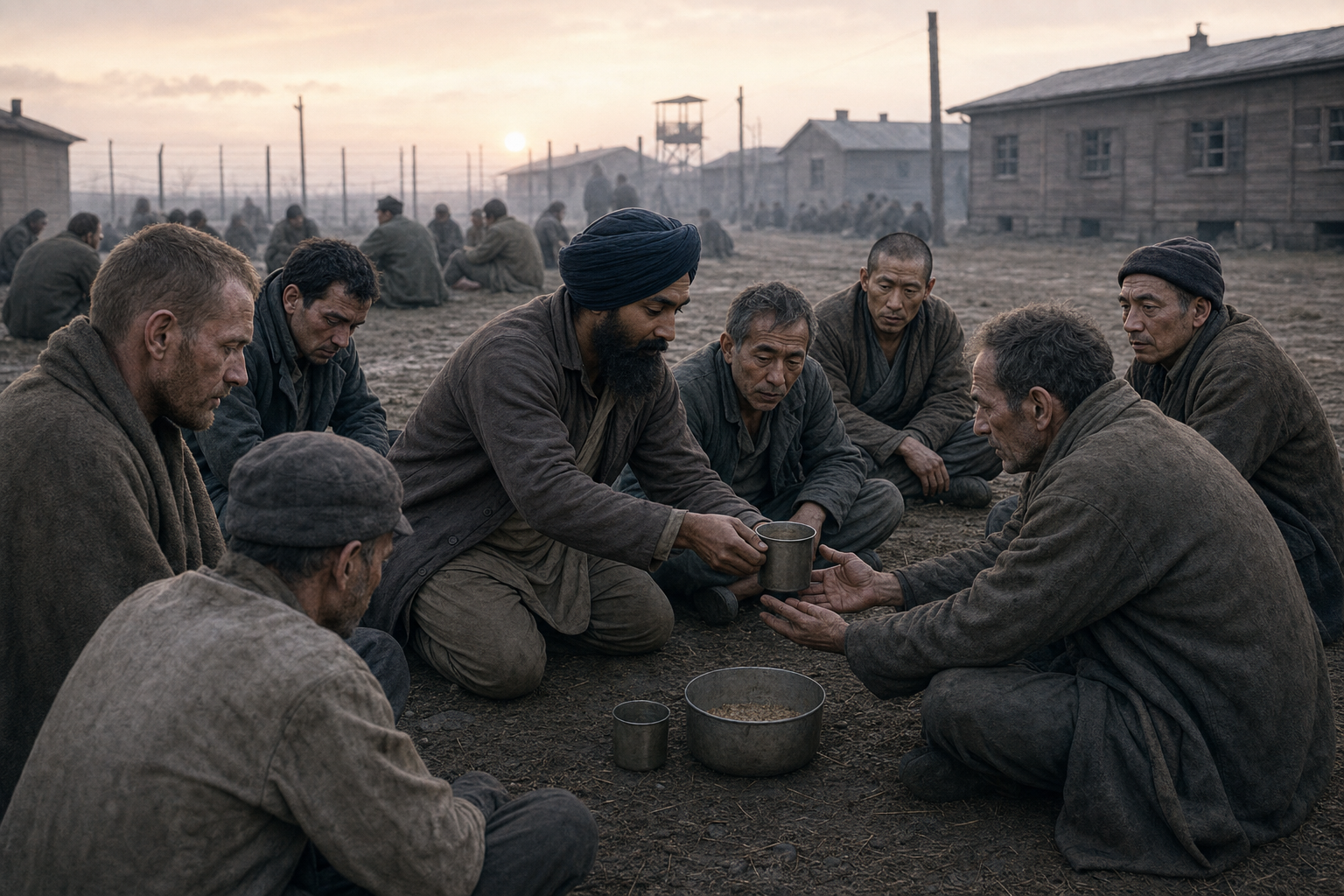
This is why the first work of a captive leader is often unremarkable from the outside. Shared rations, regular duties, quiet prayer and deliberate protection of vulnerable prisoners create a dependable rhythm inside an environment built around uncertainty. The routine is not valuable because order is automatically virtuous. It is valuable because fair order prevents the strong, the loud and the well-connected from quietly taking control of scarce necessities.
You can recognize this form of leadership by what it makes predictable:
- Food and other necessities are distributed by an understood rule rather than personal preference.
- Chores rotate so that service does not become punishment for the weakest.
- Rest is protected through mutual watchfulness rather than left to private bargaining.
- Disputes are heard before resentment hardens into retaliation.
- Prayer, simran or shared silence has a regular place, especially when fear is driving impulsive decisions.
An improvised langar illustrates the whole ethic. It is not merely a meal assembled under deprivation. The shared preparation, equal distribution and collective responsibility make a public statement: hunger will not be allowed to decide whose dignity matters. The person organizing it leads by accepting the same rule as everyone else.
Rank can help coordinate this work, but rank alone cannot make it legitimate. Captives learn quickly whether a leader takes the safest place, secures a private ration or exempts close companions from unpleasant duties. Authority survives only when sacrifice and fairness are visible together.
Loyalty is bounded by dharma, not by obedience
Wartime language often treats loyalty as compliance: obey your superior, protect your group and refuse the enemy. Sikh ethical leadership demands a harder form of fidelity. A person must remain loyal to truth, duty and compassion even when a captor offers relief in exchange for betrayal or when fellow prisoners demand revenge.
Hukam gives this fidelity an inner foundation. Acceptance of hukam is not an instruction to become passive. It distinguishes the conditions you cannot presently change from the duties you still possess. A prisoner may be unable to leave, fight or restore the wider order. The prisoner can still refuse deceit, share a ration, calm a quarrel and protect someone being targeted.
Sarbat da Bhala widens the moral field further. The welfare of all cannot mean only the welfare of one’s own companions. Kindness could extend to other prisoners and, where circumstances permitted, even to guards. That did not require trust, surrender or approval of captivity. It meant refusing to let another person’s conduct dictate the limits of one’s own humanity.
When loyalty is being tested, use these questions in order:
- Does the proposed act require a lie, betrayal or coerced collaboration?
- Who becomes more exposed if we accept this privilege or make this refusal?
- Are we protecting a vulnerable person, or merely defending the pride of our group?
- Will this response stop harm, or begin a cycle of reprisal against people with less power?
- Would we defend the same rule if it benefited someone outside our own community?
The order matters. A dramatic refusal can look courageous while transferring the consequences to sick, isolated or unprotected prisoners. An attractive concession can appear harmless while allowing a captor to divide the group. Principled leadership examines both the moral character of the act and the burden it places on others.
This history supplies an ethical test, not a universal tactic for every detention. Circumstances differ, information is incomplete and captors may punish collective solidarity. The durable principle is narrower: do not purchase personal safety with another person’s degradation, and do not confuse retaliation with courage.
Sant-sipahi keeps courage and restraint together

The saint-soldier ideal is sometimes misread as two alternating identities: gentle during peace, fierce during conflict. In captivity, sant and sipahi have to operate at the same moment. The saint disciplines anger, ego and vengeance. The soldier prevents patience from becoming surrender to injustice.
Each side corrects a predictable failure in the other:
- Courage without spiritual restraint can turn humiliation into cruelty toward a weaker target.
- Restraint without moral courage can become an excuse for silence when someone needs protection.
- Faith without seva can remain private consolation while the barracks descends into disorder.
- Service without inner practice can become frantic, partial and vulnerable to despair.
Simran is therefore not an escape from the material emergency. Repeated remembrance steadies attention so that fear does not make the decision before conscience can enter it. Soft kirtan, whispered shabads and quiet prayer are remembered alongside ration sharing and collective chores because the inward and outward disciplines supported each other.
The same union clarifies ahimsa. Non-harm in intention does not require indifference to aggression. It requires resistance without hatred becoming the governing motive. Under a dharma-yuddha ethic, force belongs only to a just struggle; when force is no longer available, truth and duty do not disappear. The field of action shifts to endurance, testimony, protection and self-command.
This is also why refusing reprisals matters. A captive group may be tempted to restore its wounded pride by punishing an isolated prisoner, suspected collaborator or socially marginal person. Sant-sipahi leadership interrupts that displacement. It asks the group to direct courage toward the actual injustice while keeping innocent and vulnerable people outside the circle of vengeance.
Dharmic solidarity does not require erasing differences
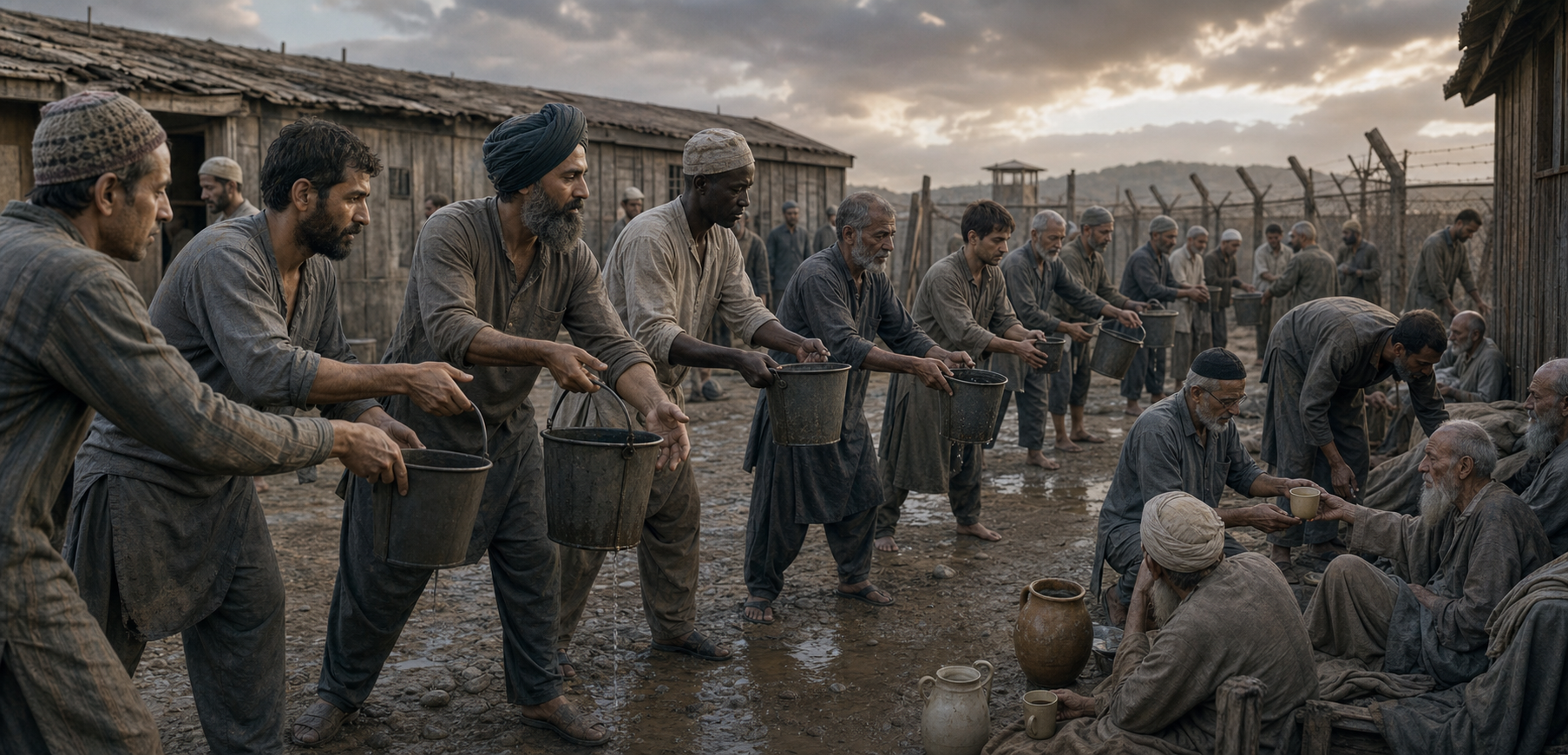
Captivity can intensify communal division because fear makes familiar identities feel like the last secure possession. It can also reveal a deeper kinship. Sikh seva, Hindu discipline, Buddhist equanimity and Jain concern for non-harm offer distinct languages for controlling fear, limiting injury and caring for a neighbor.
The useful goal is not to pretend that these traditions are interchangeable. Unity built on blurred identities is fragile. A stronger solidarity lets each person draw from a real practice while agreeing on shared conduct: necessities will be distributed fairly, the vulnerable will not become bargaining chips, prayer will be respected, and revenge will not be inflicted on a convenient substitute.
Prayer, silence and mutual care gave prisoners of different Dharmic backgrounds practical common ground. Notice the sequence. Cooperation did not begin with a debate about whether their doctrines were identical. It began with work that everyone could recognize as necessary and honorable.
If you are responsible for a religiously mixed group under pressure, build solidarity in the same order:
- Name the shared ethical floor: truthfulness, fair burdens, protection of the vulnerable and restraint toward opponents.
- Give people room to practice from within their own tradition rather than imposing a blended ritual.
- Organize a concrete act of service in which status offers no exemption.
- Use a trusted mediator when religious or social differences become attached to a practical dispute.
- Judge unity by coordinated care, not by uniform vocabulary.
This approach protects two things at once. It preserves the Sikh identity that generates seva and simran, and it turns that identity outward for the welfare of others. A confident tradition does not need to diminish a neighbor’s discipline in order to demonstrate its own strength.
Key takeaways for leadership under severe pressure
- Stabilize ordinary life first. Fair rations, rotating duties, protected rest and a known way to settle conflict give people enough order to exercise judgment.
- Test loyalty against dharma. Obedience that requires betrayal, cruelty or secret privilege is not principled loyalty.
- Join contemplation to service. Simran should improve the next decision, the next distribution and the treatment of the next vulnerable person.
- Refuse displaced revenge. Humiliation does not justify punishing someone weaker or more accessible than the actual aggressor.
- Make solidarity practical. Shared work and fair treatment can unite Dharmic communities without pretending their teachings are identical.
- Treat privilege as a moral warning. If a benefit cannot be shared, ask who will pay for it and what obligation it creates.
You do not need to equate an organizational crisis with wartime captivity to apply this code. The situations are not morally comparable. What carries across is the architecture of trustworthy conduct: steady the mind, make burdens visible, protect the person with the least leverage, reject benefits purchased through betrayal, and explain decisions by a rule that also binds the leader.
At your next difficult decision, do not begin by asking who has the highest rank or which action looks strongest. Identify who is most exposed, decide which principle cannot be traded away, and make the burden of your choice visible to the group. That is where principled leadership stops being an admired memory and becomes a present duty.
References
