
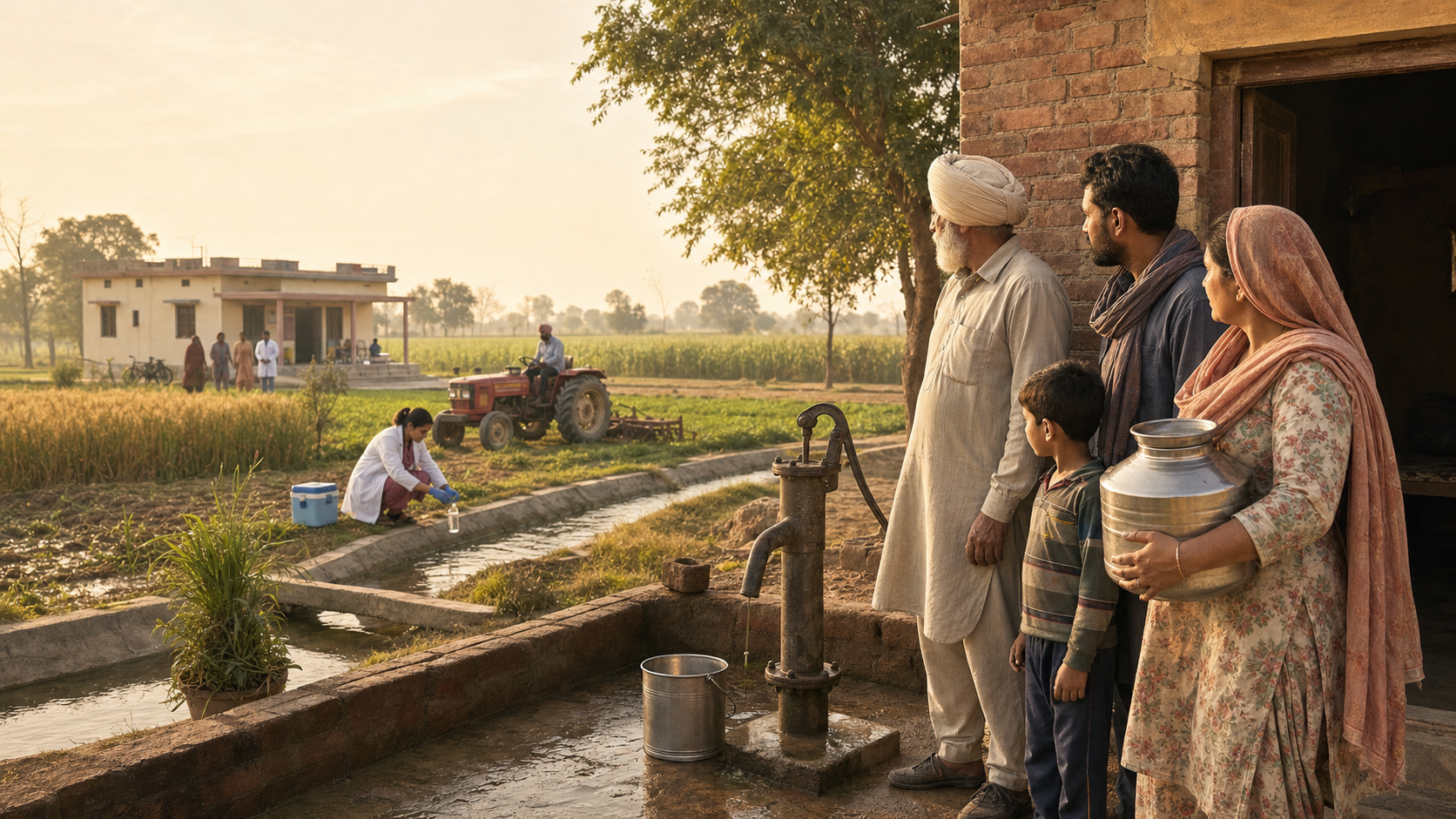
If cancer has touched your family or village in Punjab, the hardest question is often the most practical one: what can you do now, when no single explanation accounts for every case? You do not have to choose between panic and passivity. Protect your household from avoidable exposures, seek appropriate medical care early, and press local institutions to measure and reduce the hazards that individuals cannot control.
This is especially urgent in the Malwa belt, where cases have been reported across districts including Bathinda, Mansa, Faridkot, Muktsar, and Sangrur. The journeys associated with the so-called cancer train to Bikaner reveal the burden of distant treatment. They do not, by themselves, identify what caused an individual’s illness. Punjab needs immediate risk reduction and better evidence at the same time.
Do not wait for one culprit before reducing risk
Cancer is not one disease with one cause. Nor does a cluster of illness prove that every person was harmed by the same exposure. In Punjab, the useful working model is a stack of risks: intensive agrochemical use, contaminated groundwater in some locations, industrial effluent, open burning, tobacco and alcohol use, and delayed screening can all contribute to an unhealthy environment. Their relative importance may differ between villages, occupations, households, and types of cancer.
Two common reactions lead nowhere. The first is to treat pesticides or water as the complete explanation before exposure has been measured. The second is to use uncertainty as a reason to do nothing. A serious response avoids both errors. It asks what can be verified, what can be reduced safely, and who has the authority to act.
- Name the possible exposure. Is the concern drinking water, pesticide handling, smoke, an effluent discharge, tobacco, alcohol, or delayed access to care? A vague fear cannot be investigated.
- Ask what evidence exists locally. For water, that means a dated laboratory result tied to a named sampling point. For a suspected discharge or burning site, it means a recorded location, recurring pattern, and complaint trail. For cancer burden, it means a properly maintained registry rather than recollection alone.
- Choose an action that remains sensible under uncertainty. Safer chemical handling, verified drinking water, stopping tobacco use, curbing open burning, and obtaining appropriate screening do not require a final verdict about the origin of every case.
The distinction matters personally. Environmental investigation can guide prevention for a community, but it cannot diagnose you or determine the cause of your cancer. That requires qualified medical care, and even then a single cause may not be identifiable.
Build a household plan around water, exposure, and early care
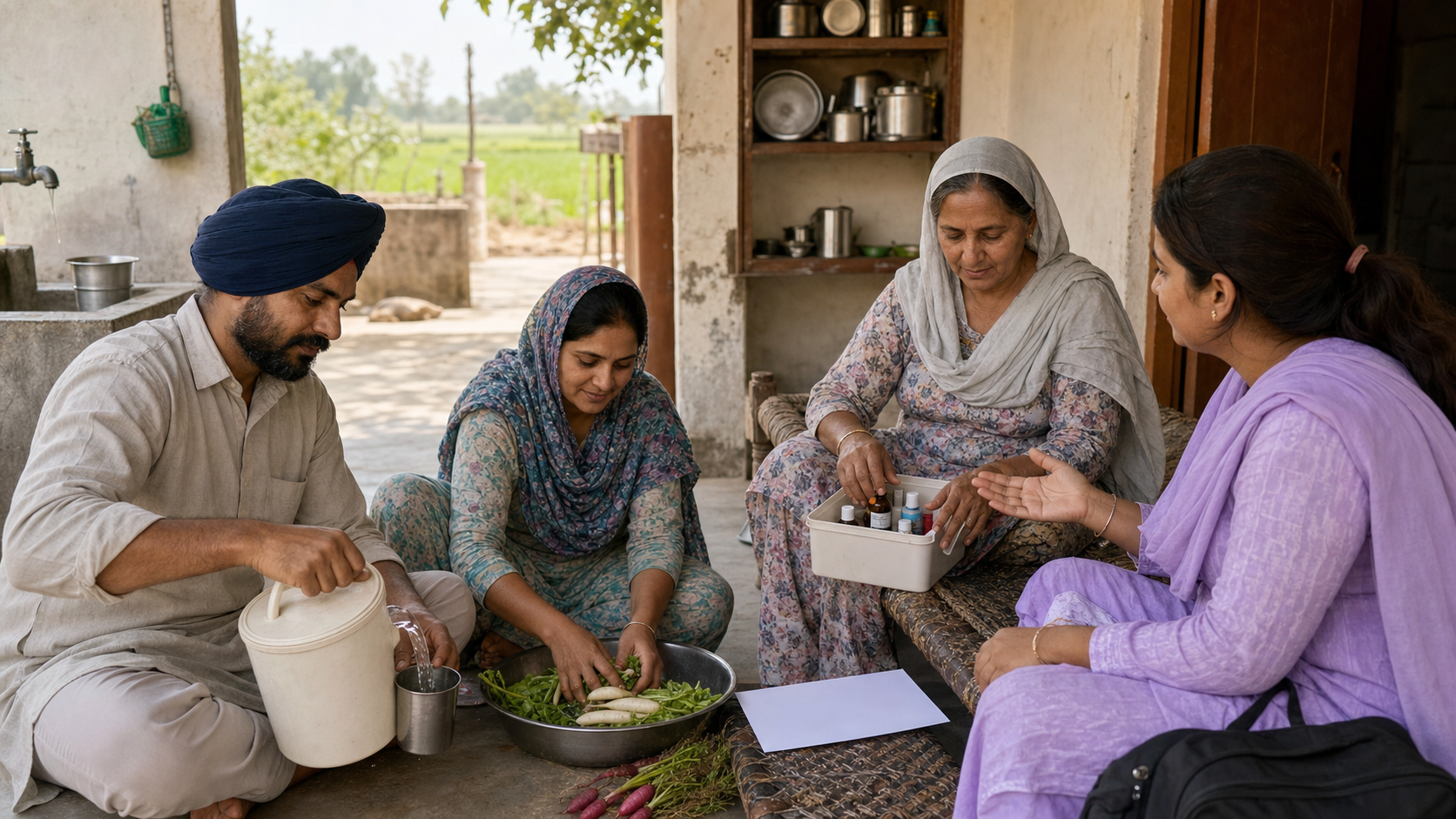
A family cannot remediate a polluted channel or regulate an industrial unit. It can, however, make a small number of decisions that reduce avoidable risk while collective remedies are pursued.
Verify your water instead of judging it by appearance
Clear water is not proof of safe water, and an unusual taste is not a contaminant analysis. Ask your panchayat or responsible water authority for the latest laboratory report connected to your actual supply. Check the sampling location, sampling date, substances tested, results, and any corrective action. If no relevant result exists, the proper demand is testing and public disclosure, not reassurance by word of mouth.
If testing identifies a problem, seek contaminant-specific advice from the responsible public-health or water authority. Do not assume that boiling or a generic household purifier removes a chemical contaminant. A treatment method has to match what was found. Where contamination affects a shared supply, verified central treatment and transparent monitoring are more dependable than unverified household fixes. Until authorities provide an effective remedy, ask them to identify a tested alternative source rather than improvising from advertising claims.
Treat screening and symptoms as different situations
Screening is intended to look for disease before symptoms appear. A screening camp can be a useful entry point for oral, breast, or cervical cancer prevention, but it is not a diagnosis and it is not treatment. Ask who will review the result, where an abnormal finding will be assessed, how quickly referral can occur, and whether the receiving facility is prepared to accept patients from the camp.
If you already have a persistent or concerning change in your health, do not wait for the next camp or try to match yourself to a checklist online. Contact a qualified clinician who can examine you and decide what evaluation is appropriate. Screening schedules and decisions about HPV vaccination depend on individual factors and current medical guidance, so discuss them with a clinician rather than copying another person’s plan.
Remove risks that do not need an environmental investigation
- Avoid tobacco and seek cessation support if stopping is difficult. Do not wait for a cancer scare to make the attempt.
- Avoid excessive alcohol. If alcohol use has become difficult to control, use a qualified de-addiction service rather than relying only on willpower or family pressure.
- Prefer fresh, minimally processed food as an ordinary health measure. No food, supplement, ritual, or detoxification claim should replace cancer evaluation or treatment.
- Keep agricultural chemicals out of living, cooking, food-storage, and drinking-water areas. Store them in their original, clearly identified containers and follow the product’s safety directions.
- If someone in the household handles pesticides, make protective equipment and trained handling part of the work plan, not an optional precaution after symptoms occur.
If you or a family member is already receiving cancer treatment, changes to water, diet, farming practice, prayer, or community support can sit alongside medical care. They must not be presented as substitutes for oncology, pain relief, or palliative care.
Reduce farm exposure without making farmers carry the whole burden
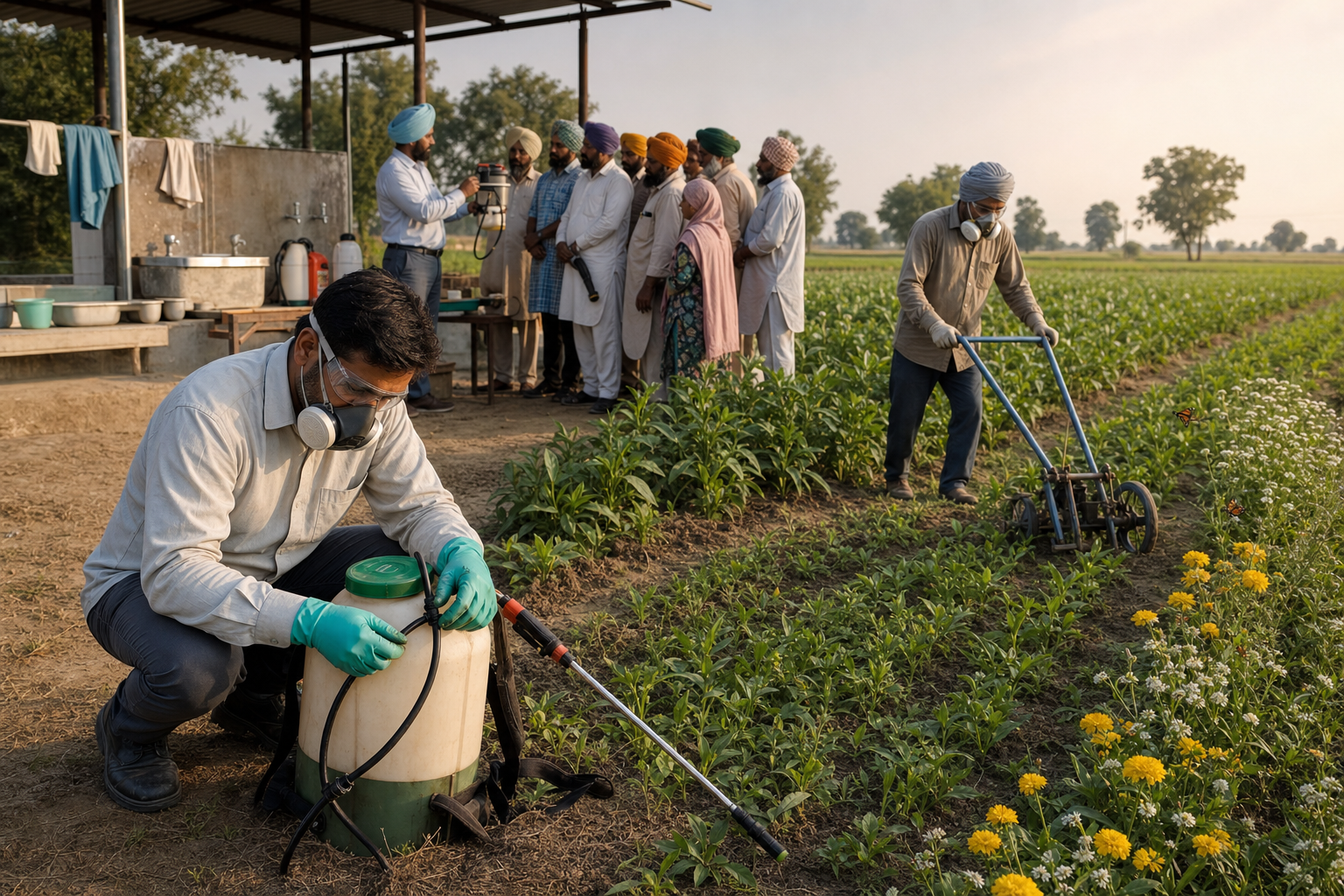
Punjab cannot protect public health by telling individual farmers to be more careful while the incentive system continues to reward the same high-input pattern. Farmers need workable transitions, reliable training, appropriate equipment, and markets for alternative crops. Health protection and livelihood protection belong in the same policy.
At field level, integrated pest management offers a practical direction. It means monitoring the crop and pest problem, using preventive and non-chemical controls where suitable, and applying a targeted chemical intervention only when it is needed. It is not a slogan for abandoning a farmer with lower yields or an unidentified infestation. Proper extension support must connect the principle to the crop, pest, product, and local conditions.
- Ask for product-specific training. The necessary gloves, respiratory protection, clothing, mixing precautions, and re-entry rules can vary. A generic cloth covering should not automatically be treated as adequate equipment.
- Make safe storage routine. A pesticide should not be decanted into a food or drink container, left where children can reach it, or stored beside household food and water.
- Record what is used. Keeping the product name, application date, field, and task gives a farmer, clinician, or investigator more useful information than a general statement that chemicals were sprayed.
- Use collective purchasing and training. A cooperative or panchayat can make appropriate protective equipment and instruction more accessible than leaving each worker to improvise.
- Support a gradual agronomic transition. Crop diversification, including millets and pulses, soil-health restoration, and integrated pest management can reduce dependence on intensive chemical use, but farmers also need procurement, extension, and income support for the transition to last.
Protective equipment is a last line of defence, not permission for indiscriminate chemical use. Regulation must remove or restrict unacceptable hazards, training must reach the worker who actually mixes and sprays, and agricultural policy must make safer choices economically possible.
Give each local institution a job that can be checked
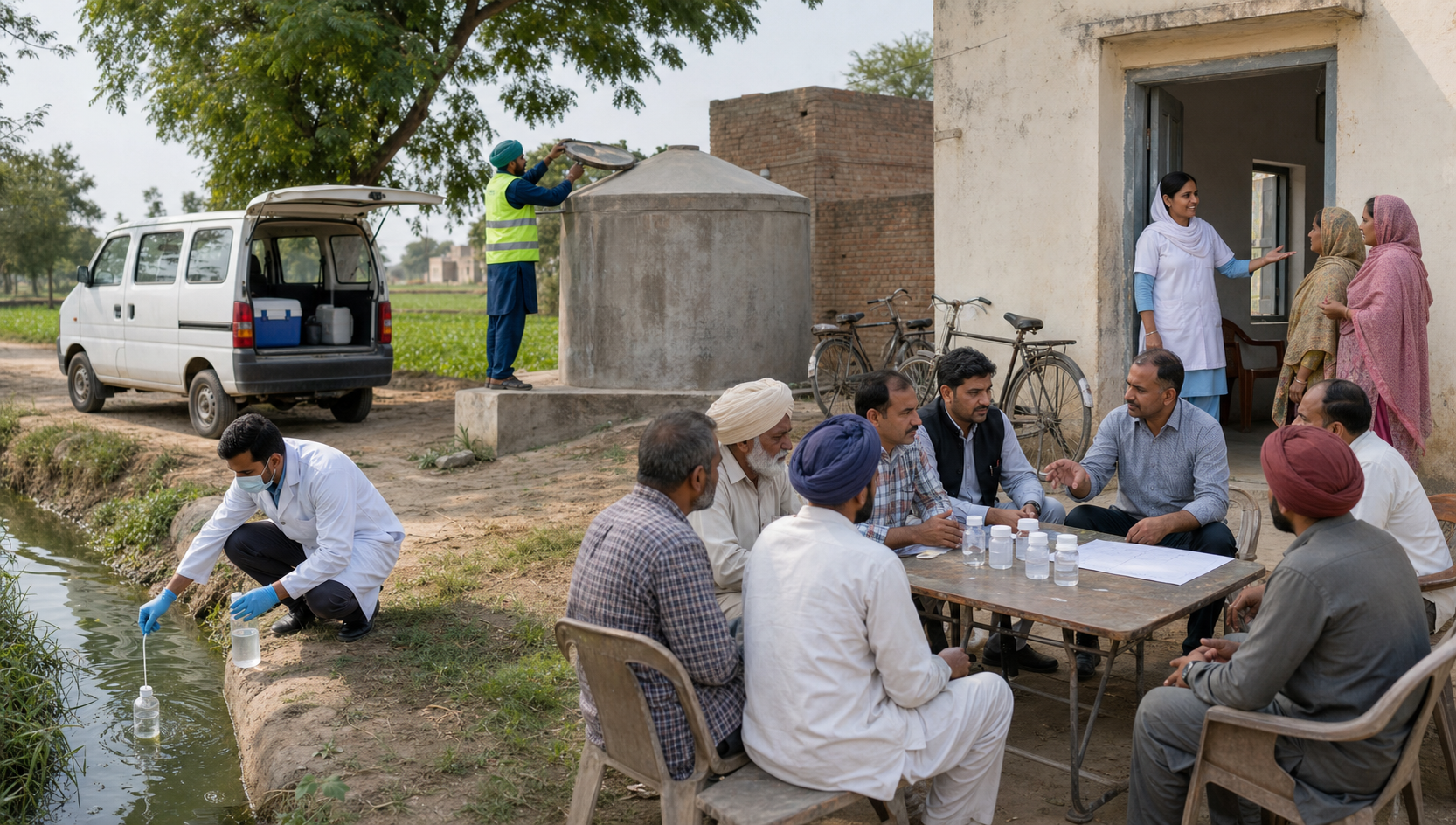
A call for awareness is too vague unless someone owns the next action. Punjab’s response becomes credible when each institution publishes what it tested, what it found, what it changed, and where a resident goes next.
Panchayats: make environmental conditions visible
- Publish water-sampling locations, dates, laboratory findings, corrective actions, and the status of any alternative supply.
- Map suspected contamination instead of allowing every household to work from rumour.
- Provide a named channel for reporting open burning, waste dumping, and possible effluent discharge, then retain a public record of action taken.
- Improve solid-waste collection so that residents are not pushed toward burning waste as the default disposal method.
- Request technical intervention from district or state authorities where treatment, channel remediation, or industrial enforcement exceeds local powers.
One water sample should not be advertised as proof that an entire district is safe or unsafe. The result belongs to its location, date, sampling method, and tested contaminants. Transparent mapping helps authorities target treatment while preventing a frightening finding from being stretched beyond what it establishes.
Health administrators: connect detection to treatment
A mobile screening van has limited value if an abnormal result disappears into a referral gap. Every camp should have a documented pathway to diagnostic assessment and treatment. Frontline workers need training to recognise when referral is required, while tele-oncology can help connect district services with specialist expertise.
District cancer registries are equally important. They allow authorities to examine patterns by place and time, plan services, and identify questions that require investigation. They should protect patient privacy while producing useful public information. Without reliable registration, dramatic stories can reveal suffering but cannot show the shape of the burden.
The care pathway must also include affordable pain management, palliative care, and psychosocial support. These services are not admissions of defeat. They reduce suffering for patients and caregivers during treatment, advanced illness, and difficult transitions. The need for registries, mobile screening, referral capacity, tele-oncology, palliative care, and psychosocial support should be treated as one connected system rather than a collection of occasional camps.
Dharmic institutions: turn trust into a reliable care pathway
Gurdwaras, temples, Jain trusts, and Buddhist centres already bring people together through service. Their strength is trust, but trust should be paired with clinical and environmental competence. A religious institution should host qualified providers and verified services, not give a platform to untested cures.
- Host oral, breast, and cervical cancer awareness or screening sessions with a named medical partner and a confirmed referral route.
- Run tobacco-cessation and de-addiction programmes that protect dignity and connect participants with qualified help.
- Use langar and community meals to make fresh, minimally processed food accessible without claiming that a menu can prevent or cure an individual’s cancer.
- Help patients navigate appointments, transport, treatment paperwork, pain services, and caregiver support.
- Convene farmers, health workers, panchayat representatives, and water officials around a short public action list with named owners and follow-up dates.
This is dharma expressed through disciplined seva: care for the sick, protection of workers, honesty about evidence, and stewardship of land and water. It leaves no room for blaming patients for their illness or demanding that farmers absorb the cost of a public-health transition alone.
Key takeaways
- Punjab’s cancer burden should be treated as a layered health and environmental problem, not reduced to one unproven universal cause.
- A cancer cluster warrants investigation, but it cannot determine what caused an individual person’s illness.
- Ask for a dated, location-specific water report. Do not rely on appearance, taste, boiling, or an unverified purifier for a suspected chemical contaminant.
- Use appropriate pesticide controls, product-specific training, careful storage, and protective equipment while supporting integrated pest management and crop diversification.
- Do not delay medical evaluation for a concerning health change. Screening camps need a real pathway to diagnosis and treatment.
- Make panchayats, administrators, and community institutions publish measurable actions rather than stopping at awareness.
Your next move can be small and concrete. Ask your panchayat for the latest report on your drinking-water source. If you farm, identify who can provide product-specific safety and integrated pest-management training. If screening or a medical concern has been postponed, contact a qualified health service. Then ask one trusted local institution to bring those three pathways — water, farm safety, and early care — into the same public meeting.
Punjab does not have to choose between feeding the country, protecting livelihoods, and protecting health. The credible path is to measure honestly, reduce exposure steadily, treat people promptly, and make public institutions answerable for the risks no family can solve alone.
References
